"Any reader who has ever felt doubt, anxiety, or a tinge of obsession will relate to Astrid, which is to say, all of us." —Jessica Francis Kane, bestselling author of Fonseca and Rules for Visiting
"A fun, clever, witty novel." —Annie Hartnett, bestselling author of The Road to Tender Hearts
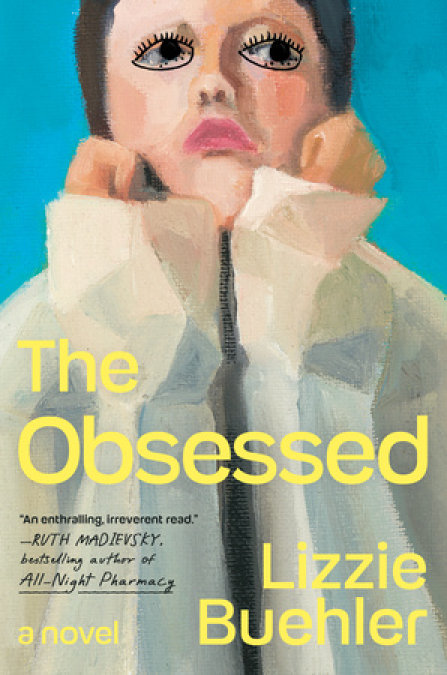
A wildly endearing coming-of-age story and "offbeat tale of obsession" (Caitlin Barasch), following one young woman who reenacts the love plot of her favorite novel only to find herself flailing when she enters a relationship with a fellow literary obsessive.
Astrid is obsessed with Russian American novelist Sofiya Sova, whose life trajectory serendipitously parallels Astrid’s own and whose writing seems to encompass every anxious thought Astrid has ever had. Desperate to find the purpose she’s always craved, Astrid begins her PhD program hoping to fully embody the ethos of Sofiya Sova's novel.
But when Astrid’s long-term boyfriend, Charlie, breaks up with her after moving to Japan, and a spontaneous Hinge date connects her with a fellow Sofiya Sova obsessive named Elijah, Astrid quickly finds herself transcribing the love plot of her favorite Sofiya Sova novel onto her own life . . . until one day, Elijah begins to pull away and Astrid is left flailing in a life scaffolded by obsession.
A bighearted portrait of the anxieties of desire, The Obsessed explores the trials of modern dating, the strange ennui of academia, and the question of how to create a world for yourself within and without the confines of your influences. What we’re left with is a striking portrayal of how a willing reader can bring a text to life, and similarly the animating power of a good novel.
Release date:
July 28, 2026
Publisher:
G.P. Putnam's Sons
Print pages:
304
* BingeBooks earns revenue from qualifying purchases as an Amazon Associate as well as from other retail partners.
CAUTION: This email originated from outside of Penguin Random House. Please be extra cautious when opening file attachments or clicking on links.
1.
Charlie accidentally backed our rental van into a chain-link fence, marking our arrival at my new Cambridge apartment with the screech of metal on metal. Not the most auspicious beginning to my new life, but I was too excited-and too eager to stretch my legs after the long drive-to care. I got out of the vehicle and walked around to inspect the damage. There were two long black scratches in the paint. I couldn't blame him. I didn't even have a driver's license, so Charlie had had to haul me and all my stuff from Iowa to Massachusetts in the cheapest and smallest van we could get from Hertz. I was grateful for the gesture, considering the journey had taken eighteen hours over two days. As far as I knew, Charlie had never taken so much time away from his work to help any of his exes move, not even Sofiya.
"The scratches are really big," I told Charlie through the driver's window, already wary of how he'd respond.
He groaned with a pained expression and hit his head flat against the headrest. "We're going to get fined!"
He was gripping the steering wheel more tightly than before. Charlie didn't really curse or sweat, but with how he looked right now, if he were the kind of person who did, he would be yelling expletives and wiping his brow.
"It's okay," I said, attempting to calm him. He'd be stressed out for the next couple of hours and then swiftly forget about it. "I'll pay for it. Let's just get my stuff out so we can return the van by five."
Charlie reluctantly turned the van off and stepped onto the cracked sidewalk. The sunlight was starting to turn golden and evening-like, creating spindly shadows that trailed behind us as we hauled the first of my bags up the stairs to my second-floor unit. The dusty openness of the empty, freshly cleaned apartment ushered us in. Lola wouldn't get to Cambridge until the next day, so we had the place to ourselves as I got settled. I stopped for a moment, taking in the smell of floor polish, but Charlie was already pacing around the various rooms, appraising where he'd place my possessions.
"Here, let me move the furniture," Charlie said when he returned to the entryway, taking a disorganized bag of pillows and bike tools from my hand. "You go find a hardware store and buy a paint marker."
This was the way of our relationship. Charlie was a lot more nervous about the minutiae of the everyday, afraid to get in trouble, disturbed by any alteration to the rigidity of his self-imposed structure. As a result, he was always figuring out solutions to problems I didn't think were that big of a deal. But I would still go along with it. Modulating my plans according to his anxious whims did get slightly annoying, but this was the equilibrium we'd found over the past three years of dating. It worked well for us.
Fortunately, there was a hardware store two blocks away. I ended up finding a marker that wasn't quite the right shade of gray but wasn't egregiously different and half-heartedly scribbled over the scratches. Then I helped Charlie move my easy chair upstairs and sat in the passenger seat as we ran a red light trying to return the van in time. We dropped the keys off at 4:58. The whole time, I scoured the streets, looking for any hints of Sofiya. Sofiya lived in Cambridge, too. Of course, I didn't signal my anticipation about this to Charlie.
"That was terrible," Charlie said as we left the grimy rental office, making our way back to the apartment. We had approximately fifteen more hours together before Charlie would be on a flight to Japan. Then I'd be spending my first day alone in Cambridge. I would be a PhD student-living with Lola, my best friend, embracing my youth, doing what I was supposed to be doing. And Charlie would, for the next year, live in the city of Tsukuba, doing research for a dissertation on the history of computers. (There was a connection between this city near Tokyo and the development of computer speech-something to do with an archive at the elegantly named National Institute of Advanced Industrial Science and Technology-but I always forgot the details beyond that.) I didn't really mind that Charlie and I would be in an international long-distance relationship for the foreseeable future. Honestly, I was excited about my impending independence. This was the beginning of the life I'd yearned for. I couldn't waste it worrying about fines.
• • •
In a way, it was too bad Charlie wasn’t the one moving to Cambridge. Since I’d enrolled in my PhD program, people had been telling me that Cambridge was full of uptight people who loved rules. This hadn’t dissuaded me from coming to Harvard. After all, Charlie’s need for order had been helpful over the last few years-it was the reason I’d gotten into a PhD program. Uptight rule-following meant that everything was orderly, clean, and worked the way it was supposed to. It meant the opposite of New York, which was chaotic, dirty, and full of yelling-and where I lived for one broke, anxious year after graduating from college.
When I'd moved to New York, my college friend Isa-who'd concertedly chosen a job in Seattle to get away from all our classmates-had warned me about the environment I would soon face.
"You know how there are those weird dark streaks on the sidewalks in New York?" she'd said. "They're from the bellies of sewer rats. The streets there are so unforgiving that the rats have evolved a layer of protective grease to survive." I still didn't know if this was true, but since that conversation the image had never left me.
In fact, Isa's warning had been a sort of premonition. It turned out I did need a protective layer like the rats to continue in New York, and I quickly realized I didn't have it. I had managed to cobble together a living fraudulently working a series of part-time positions as an SAT tutor, a French tutor (despite my knowledge of the language being tenuous at best), and a teacher's assistant at a Jewish after-school program (despite not being Jewish). But unlike my friends in graduate school at Columbia or NYU, or those striving to climb the ladder of raises and bonuses in finance and consulting, I had no vision for my future. I couldn't teach students about languages and religions I didn't know-or standardized tests I did know-forever, and I didn't particularly want to be doing it then, either.
My housing situation had been less than ideal, too. I'd decided to live with two friends from Brown, but in my haste to establish some sense of stability in my postgraduate future, I agreed in April to sign the lease, sight unseen, for an apartment that one of them had found on Craigslist. Unsurprisingly to anyone older than twenty-two, the place was as dirty and architecturally dysfunctional as one could expect from a mystery internet listing. What's worse was that I'd agreed beforehand to take the bedroom that not only didn't have a main door (the vacuous opening into the room was right next to the apartment's bathroom) but also had French doors as a wall, which opened onto the living room. After four years of sleeping peacefully in single dorm rooms, my slumber interrupted only by the occasional hallway conversation, I was no match for the din of New York City. Sure, I was in Park Slope, but still. I was weak. I couldn't do it.
After a few months there, I started to feel so sleep deprived that I would intermittently hear noises during the day. Sometimes it would be clapping, or someone shouting my name. I was sure I had schizophrenia. My grandfather had had it apparently, and I'd read that early to mid-twenties was when people started to show symptoms. WebMD reassured me that it was normal to hear things when you hadn't gotten enough sleep, but I still worried my mind was moving somewhere beyond my control.
I wasn't only worried about my mind-I also became convinced that my body was deteriorating. Specifically, I was certain I had pancreatic cancer. Sure, the average age of diagnosis was seventy years old, and yes, the primary risk factors were obesity and being a man-I knew this because I'd read all about how to do self-checks for the disease-but my back hurt! And that was one of the symptoms! I read a Daily Mail article about a woman in England who'd died of pancreatic cancer in her twenties. By the end, she had so many tumors in her brain that her skull had become bumpy. I looked into my future and saw the same thing happening to me. It had happened once already, so why not a second time? As illogical as I knew it was to blame cancer for the pain in my twenty-two-year-old body, I had no choice. I was compelled to by some internal force: There was no other way to put it. Whenever I tried to push away the thoughts about cancer-the thoughts about dying in general, the worry that I wasn't doing enough to prevent premature death from the most common diseases (diabetes, heart disease, and cancer)-they always came back with a greater force. They floated in the corner of my mind, distracting me from whatever else I'd be trying to think about.
To ease my worries about mortality, I googled how to optimize your lifespan. I spent far too much time on blogs run by Silicon Valley biohackers, on Ray Kurzweil's Wikipedia page, and I plotted to get a prescription for the diabetes medication metformin, which people who were In The Know said would extend your life by slowing your metabolism, because each time you digested something your body got a little closer to death. I looked at over-the-counter supplements that the biohackers swore by and told myself that I'd buy them as soon as I had enough money, that a few months without them wouldn't make a difference. Deep down, though, I knew that a few months without these life-extending pills would make a difference, and that I wasn't doing everything I could to live as long as possible.
I wrote down the top five ways to live longer. 1. Get adequate sleep. 2. Eat as little sugar as possible. 3. Intermittent fasting. 4. Exercise. 5. Supplements. Even after I'd written it down, I chanted the list to myself, committing it to memory. I didn't necessarily want to do this, but what if I was in the middle of a conversation, or waiting for the subway, and suddenly recalled that I was supposed to be optimizing my lifespan but COULDN'T REMEMBER everything on the list? Just having these rules recorded on paper wasn't enough. They needed to be inscribed in the folds of my brain, and the only way to do that was to repeat the contents of the list to myself throughout the day.
"Why do you keep repeating these rules to yourself if you're not going to follow them?" Charlie had asked in frustration one night at his house in Crown Heights. I had just finished an enormous bowl of soup from his Crock-Pot after haven eaten nothing the entire day.
"I don't know," I said in response. Tears welled up on my bottom eyelids and threatened to spill onto my cheek. "I just can't stop."
The more powerful part of my brain had tricked me into thinking that as long as I kept the list close, on my mind at all times, I would be protected.
• • •
Another feature of my unhappy present was nonstop rumination about what I should be doing with my life. I had always thought I’d done college right-get into an Ivy League school, and then relax. While many of my peers had toiled over their graduate-level seminar papers and secretly worried when they got an A minus on a chemistry test, I just took language and art classes and wrote my papers in five hours, submitting them without revision and consistently getting B pluses. Lola had written a senior thesis that was almost two hundred pages long, while I’d applied to do a translation thesis through the creative writing department specifically so I could avoid having to write another academic paper.
Clearly I wasn't the natural choice for a PhD in the humanities, and going into college I hadn't thought that I would want to go to graduate school. But I loved being on campus, being a student, being in a community that felt like a Disneyland of ideas and smart people, so much so that by the time my last year of undergrad came around, I was terrified. What would I do once I had to leave the best place I'd ever lived? I had hurriedly scraped together applications, only to spend the spring of my senior year watching friends get into PhD program after PhD program, earning fellowship after fellowship; meanwhile, I was rejected from every PhD I'd applied to and didn't receive any funding for the master's degrees that did accept me. I'd felt overcome with envy, as if every cell in my body was harboring a grudge against my friends for their success.
In New York, the sentiment had only intensified. Everyone there had something you wanted: an in-unit washing machine, a job at The New Republic, parents with a Brooklyn apartment that they could return to if they ran out of money. I eventually realized that I wasn't going to get any of these things by mere proximity, so I pulled myself away from the ratling race and turned my jealousy into the motivation needed to reapply to grad school, which was how I'd ended up at the University of Iowa for an MFA in literary translation, and now at Harvard for my PhD.
• • •
“Can you turn the stove on to three-fifty?” Charlie asked from the counter. He’d pulled out a baking pan-a kitchen item he had almost certainly purchased for us in Iowa-from one of my cardboard moving boxes and was now concocting some sort of Midwestern pot pie with Campbell’s soup mix and Bisquick. Whenever he made us dinner, I lamented the lack of vegetables and heavy emphasis on cream, but if not for Charlie, I’d probably be living off Clif Bars and fruit, so I couldn’t really complain. I ate the food, anyway.
"I can run out and get us some beers," I offered after preheating the oven. There was a liquor store across the street, and I figured that a can of Miller High Life, Charlie's favorite beer, would calm his nervous energy. Plus, I'd get another chance to keep a lookout for Sofiya.
We hope you are enjoying the book so far. To continue reading...

 Please log in to recommend or discuss...
