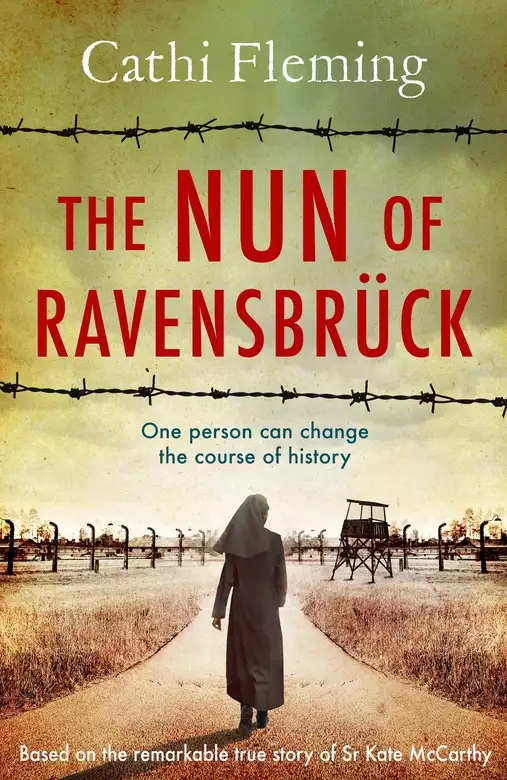
In the cold winter of 1944, Sr Kate McCarthy - Irish nun and French Resistance leader - arrives at the gates of Ravensbrück Concentration Camp for women. She has endured four years of horrendous suffering in various prisons, still having the courage to resist the Nazi regime, a journey that began at the outbreak of World War II when she joined the resistance movement.
Her actions have saved hundreds of lives and brought her to the edge of existence. Together with her friends Sylvette and Angèle, they have survived against the odds. But nothing can prepare her for what awaits beyond the Ravensbrück gates. And soon, Kate will face her biggest test yet...
The Nun of Ravensbrück is the gripping account of a remarkable woman whose deep faith and untold courage would shine a light in the darkest of places. It is a tale of horrendous tragedies and small mercies, of the bonds of women in a world of war, and of how one nun's courage changed the course of history.
Release date:
June 18, 2026
Publisher:
Hachette Books Ireland
Print pages:
320
* BingeBooks earns revenue from qualifying purchases as an Amazon Associate as well as from other retail partners.
Kate stood on the platform at Béthune railway station, a shabby brown suitcase by her feet. Her brown habit reeked of smoke, from fellow passengers and the steam engine. Black smuts streaked her face and wimple.
Her tiring journey from Louisiana had included an eight-day Atlantic crossing on rough April seas, followed by long hours on a local train from Paris, stopping at every halt. Yet, as she looked around the familiar station, exhaustion gave way to elation.
The platform was nearly empty, apart from a few passengers disembarking in the fading afternoon light. The air bit through her wool garments – so different from Louisiana’s heavy warmth. Her eyes settled on the two military policemen at the station gate, rifles slung over shoulders. They glanced at the tall nun before lighting cigarettes and resuming their expressions of bored indifference. The sight unsettled her. It echoed her first day in France, twenty-seven years earlier.
The previous day, at Le Havre, she’d felt invigorated as she struggled down the gangplank of the transatlantic liner with her suitcase. Clean, crisp air had filled her lungs, and she’d smiled. She was back on French soil – a country where she felt destined to live. The oppressive humidity of Louisiana was already a fading memory, and she remembered her eighteen-year-old self arriving at the same spot all those years back, where her life as one of the Franciscan Sisters of Calais had begun.
Now, even the seagulls, wheeling and shrieking, seemed to welcome her return. Kate, you’re back! At last! Dock workers yelled and hauled rope nets from the ship’s belly as passengers milled around, dragging trunks and greeting loved ones. Her heart had sunk when she’d seen the checkpoints and sandbags piled high on the quay walls and suddenly become aware of the military presence surrounding everyone. France was yet again preparing for war.
Seeing the military personnel at Béthune railway station was another reminder. She touched the worn rosary beads at her waist, seeking calm. It’s only a precaution, she told herself. The Nazis may never come. France might be spared.
She waited patiently. Mother Angelica had promised that someone would meet every train until she arrived. Would anyone still recognise her? At the thought of St Jean’s Hospital, memories of laughter and kindness came flooding back. It had been two decades, but Kate didn’t feel much different from that young woman who had left France in 1919, called, along with five other sisters, to America, to nurse at a new hospital set up in the South. Although the intolerable Louisiana heat had taken a toll on her physically, her drive and spirit shone with the same intensity as they had in her youth.
‘Sister Marie-Laurence! Marie-Laurence!’
A voice rang out in a familiar Scouse lilt, calling her by a name she had not heard in some time – that which she had taken at her final vows. Kate turned to see Sister Marie-Ursule dashing through the gate, waving. Kate laughed, seeing her friend’s bright smile, unchanged.
They embraced. A grey curl had escaped Marie-Ursule’s wimple, the only sign of passing time.
‘Look at you – hardly aged a day in twenty years!’ Kate said, framing her friend’s face with her palms. Sometimes it surprised Kate when she caught her own reflection in a mirror, but if Marie-Ursule noticed the lines on her face, she didn’t say.
They hauled Kate’s battered case to a waiting horse-drawn cart. The middle-aged driver, his cap pulled low against the chill, puffed his pipe, paying little heed to the sisters. Kate noticed his left sleeve was pinned at the elbow – another casualty of the last war.
‘Sister Marie-Laurence, welcome home!’ said Marie-Ursule as they sat on the wooden bench.
‘It’s been too long,’ Kate replied. ‘But I never expected to return, to tell the truth.’
Only weeks earlier, doctors had warned that Louisiana’s heat was harming her heart and circulation. Mother Bethanie had reluctantly sent her back to the milder climate of northern France, so she could continue her nursing career.
She looked down at her swollen ankles and sighed. At forty-four, life had upended her again. She was grateful she could still nurse – it was her vocation. But leaving all she loved behind had felt like a blow. She reminded herself that she’d been happy in Béthune before the Great War. Yet the signs of conflict she’d seen on arrival had shaken her. It felt like waiting for a storm.
She nodded at an army truck rumbling towards them. ‘Is this really happening again?’
She didn’t miss the shadow that crossed Marie-Ursule’s face.
‘You probably haven’t heard – Germany’s invaded Denmark and Norway. Everyone thinks they won’t stop there.’
Kate shook her head. Hadn’t France endured enough? Its innocent citizens had been thrust into the blazing centre of what they had all believed was ‘the war to end all wars’. No – Kate stubbornly refused to believe it. Fate would not inflict such devastation twice in a people’s lifetime.
‘God will protect us,’ she said firmly. ‘France will be spared this time.’
The cart rolled through the steep-roofed streets of Béthune, and Kate drank in the view. When she’d left in 1919, much of it had lain in rubble. Now, orderly streets stretched before her again, as if time had wound back to her first arrival in 1913. The centuries-old belfry stood proud once more in the Grand-Place, its restored pinnacle gleaming.
Ahead stood the stone buildings of the Franciscan convent and hospital. Damaged but still standing, St Jean’s stirred something deep within her. She hadn’t cried on leaving Louisiana – but now tears pricked her eyes. As they passed through the gates, Kate looked up at the stone cross above the entrance – the cross of Lorraine, which St Joan of Arc had carried into battle. Kate turned to the horizon where, just over two decades ago, artillery flashes had lit the night sky. For now, all was quiet. But for how long?
She looked around with familiar fondness. St Jean’s had been built in a square around a leafy courtyard. Three sides housed the hospital, the fourth the convent of the Franciscan Sisters of Calais, whose residents formed the majority of the hospital’s nursing staff. The fourth wall of the building also contained the entrance gates, the porter’s lodge between them.
‘I thought I’d never see this place again,’ Kate said, eyes on the red-brick walls. ‘I believed Louisiana would be my eternal resting place.’
Sister Marie-Ursule took her hand. ‘Maybe God has brought you back when we need you most.’
The flicker of joy Kate had felt faded. She hoped her friend was wrong.
Warm morning light filtered through the linden trees as Kate stepped into the courtyard garden the next morning. Marie-Ursule, who was waiting for her on the stone bench, glanced up, but her usual smile was absent.
‘Sorry, Marie-Laurence, I’ve had bad news about a friend.’ Marie-Ursule’s fingers twisted in her lap. ‘Edith – a doctor from Berlin. She worked with us here in the hospital.’
‘A German doctor, working here?’
Marie-Ursule sighed. ‘Yes. After the Nazis stopped Jewish doctors practising in Germany five years ago, Edith moved in with relatives in the town – the Levins, who run the fabric shop – and she worked here instead.’
The morning breeze stirred the leaves above them as Kate waited.
‘I’ve just heard that she’s gone.’ Marie-Ursule stood abruptly and began pacing the narrow path between the rose beds. ‘Edith and the entire family have vanished.’
Kate’s chest tightened. ‘Lantial told me last night that Jewish families have been disappearing in some local towns,’ she said.
‘The doorman hears everything,’ said Marie-Ursule, slumping down on the bench beside her friend. ‘German Jews are regarded as “enemy aliens” now, and the government has a detention camp for them here in France.’
‘Surely not—’
‘Yes, thousands are being interned near the Pyrenees.’
Marie-Ursule turned, her face pale in the dappled sunlight, and Kate reached for her hand. ‘They’re smart people. They left Germany – maybe they decided it was time to flee France too.’
Marie-Ursule shook her head. ‘Edith would never have left the hospital without a word. She would never have abandoned her patients. The Levins closed their shop as usual one evening last week, and they haven’t been seen since. I think they’ve been taken.’
Kate’s words of comfort died on her lips as the convent bell tolled the hour.
Marie-Ursule escorted Kate on a brief tour of St Jean’s before they began work that morning. Kate’s footsteps only slowed as they approached the open doors of St Clare’s ward. She hesitated on the threshold. The familiar smell hit her first – a blend of disinfectant, beeswax polish and dampness. The north-facing windows cast the same thin light across empty beds. The new colour on the walls – cream, not the grey she remembered – couldn’t disguise the memories transporting her back through the years.
Two faces from the past surfaced in the cool light, both young Irish men, only seventeen years old. She remembered them clearly – Clement O’Reilly, freckles stark against his pallor, and John Lynch, his dark hair matted with sweat.
Her pen had scratched across paper in this room – Dear Mrs O’Reilly, your son wants you to know – while Clement’s breathing caught between words. Mustard gas. She recalled guiding John’s feverish hand to form letters that his mother would treasure – Tell Da I was brave. Their hands had gripped hers, small hands that reminded her of her younger brothers at home. She had given whispered assurances to young Lynch, smoothing the damp hair from his forehead even as his breathing faded. These were the only lies that came easily to her. John’s lips had moved in silent prayer. She had opened her Bible, her voice steady as his breath grew shallower. ‘Do not fear, for I am with you – do not be dismayed, for I am your God. I will strengthen you and help you.’
Her gentle words had felt hollow in the face of the raw fear that stared back at her.
The ward stretched before her now, beds in neat rows. But Kate could still feel those young hands in hers, hear the rustle of turning pages, and see the frightened eyes of boys who should have lived to be men. She vowed to visit their graves in Béthune’s cemetery, far from the homes they should have returned to.
But it wasn’t only memories that troubled her now – it was what lay ahead. She could almost hear the danger rumbling like distant thunder before a storm.
The mood was solemn when the sisters sat around the refectory table for supper that night. News of the war filled the conversations, and one of the younger sisters grew tearful and upset.
‘Enough war talk now,’ said Mother Angelica, her sharp knuckles striking the wooden table. ‘Soeur Marie-Laurence, you have travelled to places we have never seen. Regale us all with one of your great adventures in Louisiana!’
Kate was one of a long line of storytellers in Cork, and she responded with an easy smile to the Reverend Mother’s request.
‘Picture this,’ she began. ‘A place filled with dark marshes and swamps, home to crawfish and slinking alligators hunting for their next meal.’
The younger sisters exchanged glances, and Marie-Ursule raised an eyebrow. ‘And in this wilderness they built a hospital?’
‘Mother Marie de Bethanie Crowley from Cork brought me to Louisiana in 1919. I was very happy to go – she was an inspir-ation to me when I was growing up, and one of the reasons I decided to take the veil. By then, she and a handful of almost exclusively Irish sisters had built a hospital among the dark bayous – a place called Monroe,’ explained Kate. ‘With the hospital came all the troubles of that area. The wards were divided – white patients only in some, coloured patients confined to the others. Sister Mary Reginald Slattery ran the coloured ward.’
‘Another Irish sister,’ Marie-Ursule said, pointing a warning finger at the French novices. ‘Soeur Marie-Laurence told me they were everywhere in Monroe. We can’t escape them and thank God for that!’
Laughter rippled around the table before Kate continued, her voice lowering. ‘One August night, when the air hung thick as molasses and cricket song filled the darkness, lit torches appeared outside the St Francis Sanatorium.’
The dining table fell silent.
‘Sister Reginald was tending to patients when she first heard the shouting. Through the window, she saw them – maybe thirty men, their faces anonymous in the flickering light. A lynch mob had come to hang one of her patients.’
A young sister pressed her hand to her chest. ‘What did she do?’
‘She went running for her coloured assistant, a man called John Allen,’ said Kate. ‘He kept a hunting rifle, for possums.’
Kate held the room in the palm of her hand.
‘Sister Reginald planted her feet at the front door of the hospital. Picture her – barely five feet tall, in her white nursing habit.’ Kate mimed the motion of lifting a rifle. ‘She aimed that rifle and stared down thirty men. Sweat ran down her face. Her hands shook. But she did not budge.’
The sisters held their breath as Kate continued.
‘The mob had expected panicking nurses, perhaps a male doctor to reason with. They had not expected … a nun with a gun!’
Kate looked around the room, her audience rapt.
‘They yelled at her to get out of their way, but Sister Reginald refused to move an inch. She was frozen in this stand-off with a mob. It continued for one minute, maybe two. It seemed forever to her. Voices muttered in the darkness. Some shouts and arguments. Then, one by one, the torches lowered and the men melted back into the bayou. No one wanted to take on the nun with the gun.’
‘But what if they had kept coming?’ asked one sister. ‘Would she have fired?’
Kate laughed out loud, breaking the tension. ‘The gun wasn’t even loaded, and she had never held one in her life before. John had only seconds to coach her on how to go out brandishing it like a professional.’ She shook her head at the memory. ‘The men were rattled, meeting a wolf in sheep’s clothing. They saw a woman of God ready to die for her patient. They didn’t dare fight her.’
Kate settled back into her chair.
‘For weeks afterwards, John Allen would whistle “Davy Crockett” whenever Sister Reginald made her rounds. The patients would cheer, knowing they slept under the protection of their very own frontier nun.’
The dining hall erupted in applause, all thoughts of the looming war forgotten. Mother Angelica beamed with amused pride. ‘What a story, Kate! She sounds like a singular woman.’
‘She was, Mother. She died two years ago and left a lesson for us all,’ said Kate. ‘She showed the courage that’s hidden in quiet service, and the great bravery it can require to stand by our beliefs.’
Mother Angelica invited Kate to join her for tea in her parlour that evening. The Reverend Mother sat by the fire in her overstuffed armchair, her tiny feet hardly touching the ground from her chair, her hands tucked away in her habit’s wide brown sleeves. One of the novices laid a silver tea tray on the table before her.
‘Welcome back to St Jean’s, Soeur Marie-Laurence,’ Angelica said, waving Kate towards the armchair opposite her. ‘I have heard much about your time in America – all good, I might add.’
The older nun poured tea with practised grace, her movements unhurried. Her eyes, when they met Kate’s, held both compassion and steel. Even though war loomed, she explained that the Order was determined to continue running St Jean’s. A few of the youngest novices would be sent away, but most of the staff would remain, whatever happened. As she spoke, Kate’s heart became heavier. The Mother Superior believed that the invasion of France was imminent.
‘We must be ready, Soeur Marie-Laurence, to honour our vow.’
It was a much younger Kate who had made her vows in 1913, but she held that pledge sacred and had sworn always to uphold it. ‘We promise to take in and care for every poor stranger passing,’ Kate answered firmly.
‘And that, my dear child, is precisely what we will do, no matter what or who tries to stand in our way.’
A thunderous pounding ripped Kate from sleep. Blinking rapidly in the semi-darkness, she took a few seconds to realise it wasn’t a dream – someone was banging on her door. Switching on her old bedside lamp, she squinted at her watch and struggled out of bed. It was shortly after dawn, and she had been in France only a few weeks. What in all of heaven was happening?
She heard Marie-Ursule’s voice as she tugged on her moth-eaten dressing gown and slippers and opened the door. Tears had carved tracks down her friend’s face, and, in the dim light behind her, other sisters hurried past like shadows.
‘It’s happened, Kate. War has come to France,’ said Marie-Ursule.
As if to confirm her words, there was the sound of low-flying planes and both nuns looked up in fearful unison. Kate knew, in that instant – Friday, 10 May – that she was listening to the sound of the world she knew being shattered forever.
She shook her head, hardly believing the world had come to this again.
Everyone gathered in the chapel, cloaked in the flickering warmth of wax candles, an island of calm in the outside chaos. Mother Angelica stood at the foot of the altar, the statue of St Francis gazing down. Her male nurse and orderly, André Bar, towered at her left elbow. On her right stood the hospital chaplain, Canon Bouchind’homme. The three were the picture of composure, waiting patiently for the sisters to assemble.
Dull thuds echoed, and lights flashed through the chapel windows. Panicked exclamations from younger nurses broke the quiet. The Mother Superior clapped her hands sharply.
‘Calm now, Sisters, I implore you,’ she said, casting a disapproving glare towards the pew of novices. ‘We knew this day might come. We must be ready to receive those who will need us. Pray now, for a few moments. Ask God for His guidance and strength, then proceed to your stations. We will have much to do.’
Kate tried to banish the doubts churning in her mind. Perhaps Marie-Ursule was right – perhaps it was God’s will that she had returned to France for this. She was no longer the frightened young nun of the last war. This time, she was the one meant to lead and shepherd the young sisters. Others led me, she thought – now it is my turn. With His help, I can do this.
But, deep in her heart, guilt stirred. She wanted to be anywhere but war-torn France again.
All morning, the sisters heard the drone of what were almost certainly squadrons of German Junkers flying overhead. Kate tensed at each one, bracing for the whistle of falling bombs that never came. Instead, news arrived that La Bassée, just fifteen kilometres east, was under heavy attack. The injured began arriving within hours, exhausted and in shock. Kate tended to one bleeding veteran accompanied by two small grandchildren.
‘I never thought I’d see such carnage again after the last war,’ he said grimly. ‘Nothing prepared us for this savagery.’
Kate checked that the two solemn-eyed children, sipping the milk she’d given them, were out of earshot. ‘What happened in La Bassée today?’
‘The Germans started bombing at first light. It was a stampede from town, a rout of frightened old and young. Everyone was pushing and rushing like great currents down winding roads. We had no idea where we were going – just south, away from the Boche and the horrors they were bringing.’
She hadn’t heard the term Boche, short for German ‘cabbage head’, since the Great War. Silent tears slid down the man’s lined face as he continued.
‘We fled like everyone else, but later we heard the planes coming after us on the country roads. It’s terrifying, Sister. You hear them before you see them, those Stukas. They were over us so quickly. Then they dived, sirens screaming, that high-pitched howl getting louder and louder as they closed in.’
He shook his head, reliving the horror.
‘Machine gunfire tore the air apart. We just threw ourselves into a ditch. I had my granddaughter Lily tied to my wrist with a piece of twine so I wouldn’t lose her. I held her underneath me to protect her. Look at her out there, Sister – her poor face, all nettle stings. I saw children sitting on the roadside, crying, lost in the chaos. But what could I do?’
He hesitated, then continued.
‘My wife had young Tommy under her,’ he said, nodding towards the child in the ha. . .
We hope you are enjoying the book so far. To continue reading...

 Please log in to recommend or discuss...
