
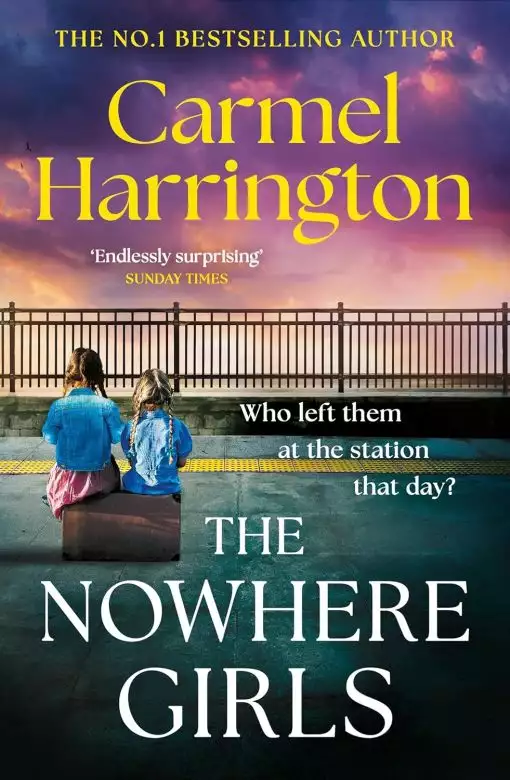
The Nowhere Girls
- eBook
- Paperback
- Audiobook
- Hardcover
- Book info
- Sample
- Media
- Author updates
- Lists
Synopsis
From the bestselling author of The Stolen Child and The Lighthouse Secret comes a gripping new novel about two abandoned sisters, a missing mother and a shocking twenty-five year old mystery.
On a cold afternoon in December 1995, two small girls are found abandoned on a platform at Pearse Station in Dublin, Ireland.
Twenty-five years later, investigative journalist Vega is determined to find out what happened to the so-called 'Nowhere Girls'. Where did their mother go? Why did no one come forward to claim them? And where are they now?
Little does Vega know that her investigation will reveal much more than she bargained for . . .
Praise for Carmel Harrington:
'This complex novel requires faultless plotting, and Harrington pulls it off with consummate ease' SUNDAY TIMES
'One of the greatest twists I've ever read' CATHERINE RYAN HOWARD
'An addictive, immersive, incredibly poignant page-turner' ANDREA MARA
'Clever, compelling and compulsive, a read-until-the-early-hours rollercoaster' AMANDA GEARD
'A compelling, extremely tender page-turner' ADELE PARKS
Release date: February 19, 2026
Publisher: Headline
Print pages: 400
* BingeBooks earns revenue from qualifying purchases as an Amazon Associate as well as from other retail partners.
Reader buzz
 Please log in to recommend or discuss...
Author updates
The Nowhere Girls
Carmel Harrington
Vega’s thoughts drifted back to her own childhood, recalling a day when a social worker suggested that she change her unusual name to something a bit more ‘normal’. She had immediately dismissed the idea. She appreciated the fact that Luka, like her, held onto his past, refusing to let circumstances force him to forget.
She looked away from the wolf tattoo, feeling a shiver of unease as its eyes followed her. It felt as though it was judging her for what she was about to do. Shaking off her guilt, she gently moved Luka’s arm and placed it on the bed. He stirred, murmuring in his sleep.
‘Luka?’ she whispered, stiffening as she waited for him to respond.
But there was only silence as he relaxed back into his dreams once more.
Vega slid out of bed, her naked body shivering in the cold night air. Spotting one of Luka’s T-shirts draped over a chair, she grabbed it and slipped it over her head as she left the bedroom. She walked gingerly along the dark hallway until she reached the open-plan living area of Luka’s flat on Monck Street in Wexford, then switched on the light and made her way to the kitchenette to pour a glass of water.
She gulped half the glass in one thirsty motion, sensing a tightening in her temples. They had shared a bottle of wine earlier with dinner, and its effects were now taking their toll. As she surveyed the living area, she smiled as she spotted her dress and Luka’s jeans in a tangled embrace on the hardwood floor. Somehow they consistently ended up there. Their mutual attraction was as strong today as it had been the first time they met.
Luka’s laptop lay on the wooden coffee table. She flicked it open, frowning as the screen prompted her for a password. She glanced behind her, towards the dark hallway, and sighed. She was on the verge of crossing a line – something she had done before to secure a story. But never with someone she . . . She frowned as she paused to determine what label to assign to their relationship.
She and Luka had been seeing each other regularly since New Year’s Eve, which had also been his thirty-third birthday – he was a year younger than her. They had both been vying for the barman’s attention at Wexford’s Crown Bar. Vega won. On a whim, she bought a consolatory drink for Luka, who pretended to protest. An hour of outrageous flirtatious banter ensued, and as the countdown to midnight was announced, he leaned in to kiss her.
Over the past few months, he had made it clear that he was keen to elevate their relationship from casual to official. However, Vega had been equally clear with him that she had no desire to be anyone’s girlfriend. While her university friends dreamed of future proposals from their boyfriends, she envisioned a life free from complicated entanglements.
A peal of laughter floated into the room from the street below. It was late, and the pubs were closing, with revellers making their way happily home. She glanced towards the hallway once more, concerned that the sounds might disturb Luka. However, all remained quiet in the apartment.
She turned her attention back to the laptop and typed Luka Wilczek into the small box. Incorrect. She wasn’t particularly surprised; Luka was not that obvious. Nonetheless, he did possess a sense of humour, which made her recall an article she had once written for an online newspaper outlining the most common passwords used globally. He might just find it funny to do exactly what all the experts said you mustn’t. Considering it worth a shot, she entered the word Password, followed by 1234567890, and then Admin123. Each entry was incorrect.
She drummed her fingers along the arm of the sofa as she surveyed the living room for a clue. Her eyes landed on a book lying upside-down on a chair – Klopp: The Liverpool FC Celebration. Luka was a diehard LFC fan. She typed in Liverpool FC and nearly whooped with joy when she gained access to the laptop.
‘What are you doing?’ Luka asked from behind her, causing Vega to jump in her seat. She closed the lid of the laptop and turned to face him.
‘What am I doing?’ She paused, scrambling for a legitimate answer. ‘I couldn’t sleep, so I thought I’d do some mindless scrolling.’
Luka frowned, and then nodded towards her mobile, which lay on the coffee table where she had left it earlier. ‘Isn’t that what phones are for?’
‘I’m almost out of charge,’ she said, smiling as she stood up and walked towards him. She moved into his embrace, but his arms were stiff around her.
‘That’s a work computer, Vega. There are confidential items on it.’ He extricated himself, retrieved the laptop and slid it into its case. The sound of the zipper closing sliced through the tension in the air.
‘I’m sorry. I didn’t think.’ A flush stained Vega’s face, and she was certain her blatant lie was obvious to him. She switched tactics and jokingly added, ‘Who knew social workers had so many secrets?’
Luka’s expression relaxed, and he grinned as he spoke in his best spy voice. ‘If I revealed my secrets, I’d have to kill you.’
Vega moved closer to him and effortlessly slipped off the T-shirt in one smooth motion, saying seductively, ‘Oh, but I have ways of making you talk . . .’
He scooped her up in his arms and carried her back towards the bedroom. As they left the living room, she cast one last glance at the laptop.
It could wait, because she was one step further than she had been.
She knew Luka’s password now.
Vega walked into the plush entrance lobby of HLD Media, located on Haddington Road in Dublin. Five years ago, she had joined their team as a journalist for the weekly national newspaper Ireland Today. She had a couple of regular features each week: a quick-fire round of questions with Irish celebrities and well-known personalities published in every Friday edition, and a weekly in-depth interview with a person of interest, where she gave her take on a current cultural issue. Earlier today, she’d had a two-hour interview with Padraig Nolan, a clean-cut children’s TV presenter whose affair with a colleague had been exposed, ruining not only his marriage but also his career. She itched to write that piece, because Padraig had opened a vein in the interview, sharing a vulnerability that Vega knew would make great copy.
Overall, she did not regret her decision to join HLD Media. The regular salary compensated for the loss of the freedom that her freelance work had afforded her up to that point. And she had saved diligently, so that three years ago she’d been able to purchase her first home – a small cottage in the Ballagh, a rural village between Wexford and Enniscorthy.
Having her own home was a significant milestone for Vega. It provided her with an anchor and a sense of belonging. She had felt outside of life for as long as she could remember. However, when she kicked off her trainers and closed the front door of her cottage, she experienced the peace that often eluded her.
She hadn’t invited Luka to her home yet, and she wasn’t sure if she ever would. He’d hinted multiple times about coming to visit her, and there had been occasions when she wished he were there with her. Like last week, when there had been a full moon that was so large and round it seemed she could reach up and pluck it from the sky like a ripe apple. The dark sky was dotted with stars, shining brighter in her rural haven than they ever had when she lived in the bustling city. She’d known that Luka was alone in his small apartment and regretted that he couldn’t experience the majesty of the sky with her. More than that, she realised it wasn’t just him missing out on the starry sky that irked her; she missed him.
At moments like that, she wished she didn’t have so many rules for her relationships.
She frowned as she recalled him kissing her farewell the previous morning.
‘Have breakfast with me,’ he had urged.
‘Can’t. Deadline looming! I have a meeting with my editor in Dublin tomorrow, and Kieran wants an update on the piece I’m writing. I need to get to my desk.’
This wasn’t a lie, but she could have lingered longer. Years ago, she’d established a firm rule against sharing breakfast with any of her romantic flings. There was something excessively intimate about that first meal of the day, with echoes of the previous night still resonating. It could weaken your resolve, and before you knew it, you’d gone from casual to all-in.
Tomás, the HLD Media security guard, called from behind his desk, ‘Morning, Vega,’ bringing her back from her reverie. ‘The sun is shining, thank God.’
‘It surely is, Tomás. And aren’t we all pleased to see it?’ she replied with a bright smile. Tomás spoke exclusively about the weather whenever she arrived at the office, but there was something comforting about that. You always knew where you stood with him.
Balancing a cardboard tray holding two takeaway coffees, she held her work ID up to the security barrier until the red laser detected the barcode, then made her way to the eighth floor in the lift.
The open-plan office buzzed with activity today. Vega never knew what to expect, as, like her, most of the staff worked from home these days and only came into the office for meetings. But at least a dozen of her colleagues were seated at desks, some on their phones while others bent low over their laptops. She called out a greeting to them and made her way to the editor’s office.
Kieran Spain’s door was closed. She tapped on it to signal her arrival, then pushed it open. Noticing he was on the phone, she mouthed, ‘Shall I wait outside?’ Kieran waved her in, and she sat opposite him as he finished his call.
She noticed that he looked tired, with dark circles under his eyes. His beard, which was typically neatly trimmed, appeared unruly and somewhat wild. Vega wasn’t entirely sure how old her boss was; she’d estimate him to be in his late fifties. But it seemed he had aged a decade since their last meeting. She tutted softly as he stirred two sugars into his coffee. He disregarded her reproach. His doctor’s warnings regarding diet and exercise were still being brushed aside.
Vega had never had a father figure, and she was self-aware enough to recognise that Kieran had taken on that role for her over the past couple of years. From the moment he’d interviewed her to join the staff, she had been drawn to his no-nonsense approach to life. He spoke plainly, a trait that she valued. They were close, but their friendship remained defined by their roles as colleagues. She could only hope that his wife and teenage children nagged him about his lifestyle at home and had better luck keeping him on track.
He took a deep gulp of his coffee. ‘Thanks. I needed this.’
‘All okay?’
‘Just had a mouthful from Senan Delaney. Rising paper and printing costs are killing our industry, blah, blah, blah. None of which I can control. But Delaney believes I’m somehow responsible for the global paper shortage, making life impossible for the publishing industry!’ He muttered an expletive under his breath as his face flushed with annoyance.
‘But you’ve made significant changes over the past few years, transitioning Ireland Today to a digital platform as well. Surely he recognises that?’
‘According to Delaney, it’s a rapidly evolving era. I’m not sure. Perhaps he’s right, and I’m too old for this game now.’
Vega’s jaw tightened as she leaned forward, outraged on Kieran’s behalf. ‘What on earth does Senan Delaney know? I mean, you’re sixty at the most, right? That’s not old. Not these days.’
Kieran rolled his eyes and groaned dramatically, ‘Ouch, that hurt. I’m fifty-five.’
‘See, you’ve got years ahead of you. Experience trumps age, regardless of what Delaney says.’
Kieran made a face. ‘From the whispers I’ve been hearing, the Delaneys are having a bad week, so he’s likely just taking out his mood on me.’ When Vega raised an eyebrow in question, he added, ‘Something and nothing, just gossip. Ignore me.’
Vega knew better than to push her boss, so let it go. ‘This place would collapse without you, Kieran. And if you went, I’d leave too. The only reason I stick around is because you make it tolerable.’
Kieran smiled appreciatively. ‘Thanks, Vega. That means a great deal. And don’t worry, there’ll be no Jerry Maguire antics from me yet.’
‘That’s fortunate, because I don’t own a fishbowl,’ Vega replied, joining in good-naturedly. Kieran loved to reference iconic moments from his favourite films. Vega tried to play along, and she recognised this one, as she particularly enjoyed a good romcom.
She handed him her finished feature, and they shared their coffee in comfortable silence as Kieran read. Vega’s body stiffened as she awaited his verdict. If he didn’t like it, he would tell her, regardless of how well they got on. She had worked hard on this piece, about a newborn baby girl found at a fire station in Wicklow Town the previous month. The Gardaí had launched a nationwide appeal for her mother to come forward, and less than forty-eight hours later, a twenty-five-year-old woman named Annette had contacted them and admitted the baby was hers. Along with every national broadsheet, Ireland Today had sought an exclusive interview with the young mother, and once they succeeded, Vega was given the story.
While the media had been fair in their coverage, Annette had been put on trial on social media and found guilty on all counts. This did not sit well with Vega, who was determined to bring some nuance and balance to the discussion surrounding a parent abandoning their child. She had spent days talking to the young single mother, who had been reunited with her baby and was now under the care and supervision of a social worker. Annette had been out of work and homeless for several months, lacking family support, and felt that her baby was better off without her. Vega’s heart ached for the woman and the impossible situation she found herself in.
‘It’s one of the best pieces you’ve written,’ Kieran said, flicking through the pages in search of a particular paragraph. He cleared his throat and read aloud, ‘“I know many people have expressed their shock that a mother could abandon her newborn child. I, too, have asked myself how Annette could do this. But let’s discuss something more important – how brave she has been. First to walk away from her daughter, who she carried in her womb, her love growing deeper with every kick and turn, because she believed it was in Lucy’s best interest. Driven by desperation and fear, knowing she was leaving herself open to judgement and abuse from us all. And second to come forward and admit she made a mistake and could not live without her child. I’ve spent hours in Annette’s company, and as I watched her rock her little girl in her arms, her eyes never leaving her baby and hungrily taking in every detail of her perfect features, I saw only devotion. I trembled with the realisation that if she had not found her courage that second time, Lucy would never have felt her mother’s love. Wouldn’t that be the greater travesty?”’
He dropped the pages onto his desk and shook his head, his eyes glistening. ‘Feck, Vega. You’ve got me. Unlike some other journalists, you have a real knack for getting to the heart of an issue. Truly brilliant work.’
To her surprise, Vega felt herself flush at the praise, and a lump formed in her throat. She wasn’t one to cry. The last time she’d shed a tear was when she somehow managed to stab her pinky finger with a fork in a dishwasher-loading accident. Now that was painful.
‘Thanks.’ Her voice was strained and somewhat gruff. She picked up her lukewarm coffee and finished it off while she regained control of her emotions.
‘When you care about what you write, your work transforms from good to great. Did you know that?’ Kieran asked, waving a finger in her direction.
Vega shrugged. She was aware of that, but she was disconcerted that Kieran knew her so well.
‘Find stories that you believe in,’ he commanded. ‘Then there will be no stopping you. I have a photographer going to Annette’s later today, and we’ll run the feature in Saturday’s edition. It’s gonna be a four-pager. Well done, kiddo.’
Vega took a deep breath to steady her emotions. Saturday had the most extensive readership; she’d hoped the story would be featured in that edition. It wasn’t always a given. ‘That means a lot to me, Kieran. I value your opinion more than anyone else’s. As it happens, there’s another story I want to run by you. It’s one I’ve been considering for a couple of months and it ties in with this.’
‘Go on,’ Kieran said, watching her with interest.
‘I want to write a story about children who were abandoned but never reclaimed. How did that impact their choices, and what became of their adult lives?’
Kieran took out his A4 jotter pad and started making notes. ‘Have you anybody in particular in mind?’
Vega swallowed. ‘Do you remember those children found at Pearse station the day the Clintons came to town?’
‘As it happens, I do recall that story, as I was at College Green covering the presidential visit. I had a press pass and could get close to both of them. Hillary was a beauty; I never understood why Bill ever strayed.’
‘A mystery,’ Vega replied, rolling her eyes. ‘But before we tumble down that rabbit hole, can we return to my story?’
Kieran grinned and nodded.
‘I’d like to find out what happened to those girls. Discover where they are now.’
‘What do you know so far?’ Kieran asked.
‘They were never claimed, despite a nationwide appeal. Not a single relative came forward. Isn’t that strange? After all, they weren’t newborns like little Lucy – two girls aged four and three. Someone must have known them. The younger one was adopted, while the elder grew up in foster care, and their names have never been released. There’s a story there if I can find them or their family. I can feel it.’ She thumped her chest lightly to emphasise her words.
Kieran glanced out of his office window for a moment. Vega remained silent, understanding there was no point in rushing her boss as he contemplated her pitch. ‘When those girls mentioned that they lived in the woods in the middle of nowhere, Charlie Keane from the Herald labelled them the Nowhere Girls. Clever. And since we couldn’t use their names or photographs when we covered the story, just general descriptions, that moniker stuck.’ He frowned. ‘That’s where I believe you’ll encounter a problem, Vega. Without their names, you don’t have a story. You’ll need first-hand testimonials for this to make it work.’
‘I interviewed the social worker who was assigned to the girls. But she wouldn’t share their details with me.’
Kieran gave her an I-told-you-so look.
‘Look, you can take it that I’m working on obtaining their names,’ Vega insisted. ‘In fact, I’ve found a source to assist me in cutting through the red tape and discovering where the girls are now.’
While this wasn’t strictly true, she permitted herself the little white lie. After all, if Luka had slept through the previous night, who knows what she might have uncovered on his laptop.
Kieran glanced down at his notes for a moment. ‘Okay, I tend to agree with you. You’ve got something here. I’ll give you two weeks to locate the girls or the family for an interview. But you need to find a few more cases to pursue. Enhance the story a bit more. Plus, I need the Padraig Nolan piece this week.’
‘Two weeks!’ Vega exclaimed. ‘I’m going to need a month! You know I’ve got a week’s holiday booked for the week after next. I’m heading to the States.’
‘Well for some. Look, Vega, you were the one who said you have a source. Utilise it. You’ve got two weeks.’
‘Ah, Kieran. Be fair.’
‘Ah, Vega,’ he mimicked. Then his expression softened. ‘I’ll tell you what: because you’ve managed to make this old cynic tear up today, something I rarely do, I’ll give you a month. But that’s all. Now off you go; I’ve work to do.’
‘Living legend, that’s what you are,’ Vega said, a grin lighting up her face. ‘Same time next week for a catch-up?’
Kieran grinned. ‘Highlight of my week, kiddo.’
Extract from an interview with Susan Bailey
Vega: I’m recording our interview for my notes, Susan. Can you please confirm your name and profession for me?
Susan: I’m Susan Bailey, a retired social worker, with forty-nine years of service.
Vega: That’s an impressive career, Susan. A true vocation.
Susan: My childhood best friend was in care and had a dreadful time, being moved from pillar to post. I resolved to become a social worker to try and make a difference.
Vega: That’s admirable. As I explained earlier, I’d like to chat about the Nowhere Girls case from 1995.
Susan: An unforgettable one. It was the only case of its kind that I handled. Over the years I’ve dealt with hundreds of challenging and emotionally taxing cases, but that one has remained in my mind.
Vega: What can you tell me about the girls when you first met them?
Susan: They were scared. The younger one didn’t speak for weeks, but she was barely three. The elder was like a lioness protecting her cub. It wasn’t right. She was only just four herself.
Vega: From what I understand, the girls knew very little about where they had been living or any details that might help identify them.
Susan: It was odd. Yes, they were young, but most little ones are taught basic identifying details: their full name, where they live, and their parents’ names.
Vega: And developmentally?
Susan: Both could count to ten and knew their alphabet. I remember showing them picture books, and the elder girl could read. Of course, neither of them had been to school yet.
Vega: How did you determine their ages?
Susan: The elder girl informed us. She didn’t know the exact dates of their birthdays but she had recently celebrated her own. And she knew she was a year older than her sister.
Vega: Is it fair to say that they were well looked after?
Susan: Very fair. They’d obviously been taken care of and were beautifully dressed, albeit in a slightly old-fashioned way. They mentioned that their mother made their dresses and brushed their hair every night before bed. I remember thinking that it shone so much it resembled glass. I said as much to my husband.
Vega: So in your opinion, they were loved by their mother?
Susan: No doubt. They spoke fondly of her. She taught them to read. She sang to them and danced with them.
Vega: And did they talk about their father?
Susan: Very little. They confirmed they had a dad who lived with them, and if I remember correctly, they mentioned that there were other adults there too but couldn’t provide any details about them other than their first names.
Vega: I’ve read the newspaper articles about the girls. It’s so strange that no one came forward.
Susan: It was pretty bizarre. They were abandoned and left to fend for themselves. Anyone could have taken them. They could have fallen onto the tracks. I shudder when I think of that.
Vega: Can you tell me where they were placed?
Susan: You know perfectly well that I can’t share that with you. However, I can confirm that the younger girl was adopted a few months later, while the elder one remained in foster care. She was assigned to another social worker, so I lost track of what happened to her. I hope she was eventually adopted too. But I wouldn’t put money on it.
Vega: Why is that?
Susan: She didn’t want to be adopted and made it abundantly clear to all that she felt this way. She was convinced her mother would return and wished to be available when she did. One of the most heartbreaking aspects of this case was witnessing that young girl becoming lost.
Vega: In the system?
Susan: Partly. But also lost within herself. She believed she was worthless and undeserving of love. And no child should ever feel that way.
Vega’s phone pinged with a message from Luka as she parked in McCauley’s car park in Wexford Town.
Don’t come to the apartment. I’m in T. Morris.
She frowned as her stomach growled to punctuate her thoughts about hunger. She longed for a stack of pancakes from The Pantry. Luka’s suggestion to meet at the pub surprised her slightly; neither of them was the type to enjoy a pint at lunchtime.
I need food, she replied.
You’ll be fed. Promise.
The clouds parted, and the sun’s rays glinted off the puddles on the ground from the earlier rain shower. She smiled as she walked purposefully towards the pub. She wondered if she would have a chance to see Luka’s laptop today. She could suggest having coffee at his flat after lunch, then find a way to send him on an errand to the shops.
Her stomach muscles tensed, and she paused for a moment. She recognised the uncomfortable sensation for what it was: guilt. She knew she would cross a line if she opened Luka’s laptop. He had made it clear to her that it was off-limits.
But then she thought of the two girls at the train station, vulnerable and frightened, alone, and her resolve was further cemented. She would do whatever was necessary to uncover why they had been abandoned.
She opened the door to T. Morris and stepped inside. The dark mahogany interior had always appealed to her, with its moody lighting and wooden parquet flooring – a nod to a simpler time. Waving at James behind the bar, she glanced to her right, expecting to see Luka perched on a stool by the window, people-watching as he waited for her. However, the place was empty save for a grey-haired man sipping a pint of creamy Guinness while perusing his newspaper.
‘He’s out the back,’ James said, nodding towards the door of the Station, the bar’s outdoor space.
Vega thanked him and made her way to the beer garden and courtyard, pausing upon entry. Luka stood by one of the tables with a goofy grin. At its centre was a large wicker picnic basket alongside an ice bucket holding a bottle of champagne.
‘What’s all this about?’ Vega stammered, rooted to the spot.
‘It’s a celebration,’ Luka replied as he removed the champagne and effortlessly popped the cork, the sound echoing through the leafy courtyard.
‘Of what?’ she asked cautiously.
‘Your article in Saturday’s Ireland Today.’
Vega felt a surge of emotion at Luka’s unexpected gesture. Her heart racing, she stepped closer to him and accepted a glass of champagne. ‘You didn’t need to do this,’ she said.
‘Ah, but I did,’ he countered. ‘You know, since we met, I’ve read all your interviews and enjoyed them. However, that piece . . . it resonated with me. I’m not surprised it’s gone viral.’
Kieran had called Vega excitedly a few hours after the article was published, both in print and online, say. . .
We hope you are enjoying the book so far. To continue reading...
