
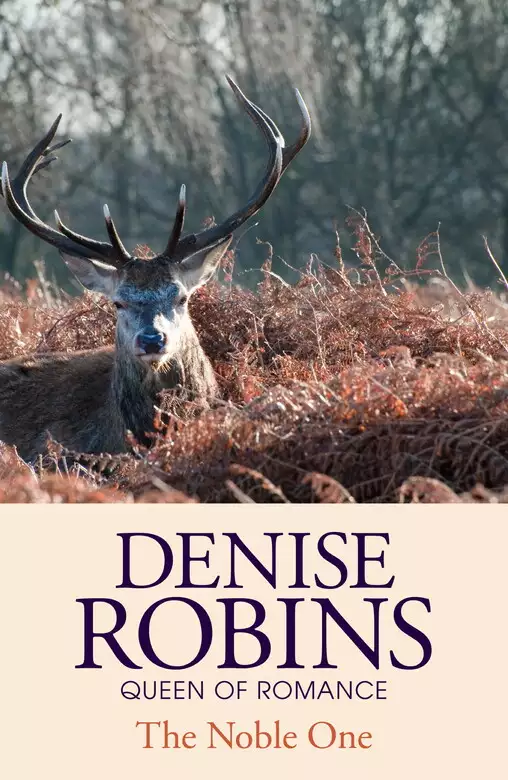
The Noble One
- eBook
- Paperback
- Hardcover
- Book info
- Sample
- Media
- Author updates
- Lists
Synopsis
Growing up in the rugged countryside of the Lake District, Dana loves the animals that roam among the hills, especially the majestic stag she calls The Noble One. When she learns that somebody is trying to kill the stag for the sake of its splendid antlers, she determines to fight for its survival. But the man behind the illegal hunting is also a man who claimed to be in love with her... The struggle is not an easy one ? but the arrival of Brett Chalmers, the new Assistant Game Warden, certainly has quite an effect. And not just on the fight for The Noble One?
Release date: February 27, 2014
Publisher: Hodder & Stoughton
Print pages: 300
* BingeBooks earns revenue from qualifying purchases as an Amazon Associate as well as from other retail partners.
Reader buzz
 Please log in to recommend or discuss...
Author updates
The Noble One
Denise Robins
Down at Mountaindale Hall—a big turreted house of solid Victorian appearance which stood under the shelter of the hill known as Blue Nod—a girl crept downstairs and let herself out through the kitchen door.
There she bent to caress a liver-and-white spaniel who was curled in a basket by the range. He sprang out and began to whimper and wag his whole hindquarters with joy.
She whispered:
“Down, Rooney … ssh … ssh … I say. The others mustn’t hear us.”
As if understanding, the spaniel quietened. He followed her in silence now, just as he had followed that straight young figure with implicit faith and obedience ever since from puppyhood he had realized that she was his mistress. Perhaps this morning Rooney was perplexed because she roused him at such an unusual hour of darkness. He had known her to do it before, but not often.
A church clock from the lakeside chimed half past four on this mid-May morning as girl and dog ran together across the wet lawn, out of the grounds and on to the road. There the girl turned and began to walk more slowly up the intake on to the moorland. Rooney raced ahead, but came back to heel at his mistress’s call, sniffing at the whitethorn hedges, scenting the rabbits which were becoming as rare in this district as in any other, following the terrible scourge which had almost eliminated the species.
It was still cold, with a fresh breeze, but Dana Carne had been born and bred in this Westmorland village, five hundred feet above the lake. To her the temperature was mild. She was used to bitter winters. She wore no coat, only a woollen polo-necked sweater over coarse blue linen jeans, and thick boots. Every night she painstakingly covered these boots in elk grease to preserve the leather and keep out the water.
She had been given a big jar of this elk grease two years ago in Norway, on her grandfather’s estate, and made it last. Her mother came from Oslo. Dana used to go there with Mrs. Carne for holidays but now the old man was dead and they did not go to Norway any more.
Breathing quickly, Dana climbed higher. She came to the gates that marked the boundary of the Forestry Commission and vaulted over them. She knew no boundary line, for she considered this her territory. She had learned to know and love it long before the Forestry Commission set up its offices in Mountaindale. She was permitted by the Conservator to go where she wished. The twenty-year-old girl was even consulted from time to time about local deer because of her special knowledge of them.
Once Dana stopped and looked up into the dark green branches of a tall larch in which she had caught sight of a small owl. It hooted and sped away at her approach. She laughed and waved after it.
“You know you need not be afraid of me, little owl!”
She was a friend to all the animals. She succoured the sick and dying. Rooney, the spaniel, quivered at her heel longing to be loose, bent on the hunting which he knew his young mistress deplored.
Now Dana stopped again and turned to look far below where the vapours of the dawn were curling around the lovely lake. She thought she heard a strange cry. It was a peacock’s harsh plaintive call, unusual sound in this district. As she turned and climbed up, walking almost as delicately and soundlessly as the deer themselves, she nodded to herself. It might well be a peacock, for she had heard that the newly arrived assistant to the Chief Game Warden had come from India, and brought not only peacocks but some strange Eastern birds which he kept in an aviary. She had not yet met him or seen his collection.
In the darkness, the girl’s face was a pale cameo. The light wind tossed her fair untidy fringe of hair into her eyes. It was beautiful hair, the colour of ripe wheat, tied back in a pony tail and there was something of a young colt’s grace about the movements of her straight long limbs.
When she reached the ridge of the hill she stood still again and raised to her eyes the binoculars which she always carried. There stretched below her, long straight rows of the trees that were being scientifically grown up here by the Forestry workers. Fine slender larches with their feathery green foliage. Little Japanese larches that were fast dying out in the area. Strong sitka spruces; the Norwegian ones which reminded her of her grandfather’s estate. The sombre Scotch pines, the silver birches, the graceful sycamores and the beeches.
As Dana stood there, light broke suddenly over Coniston. Dawn set fire to the hills and woodlands. The highest peaks of Scafell Pike and Great Gable came into focus. But much as Dana loved the splendour of this view, it was something else that she had come up here to see at this early hour. She walked rapidly, over the rough moorland, her boots tearing into the gossamer veil that the spiders had spun across the bog myrtle and the little white cotton flowers. Here the ground became swampy. Dana’s boots and Rooney’s paws plunged and squelched in mud. Against the skyline ahead of them rose the delicate tracery of a wrought-iron structure which Dana had climbed many a time. The observation tower for those who watch for forest fires during hot dry weather.
The girl moved on with a feverish expectant look on her face as though she was searching with all her heart and soul for one particular object.
Finally she reached the high vantage point of a great stone boulder and sprang upon it. With a gesture, she arrested the spaniel. He crouched motionless at her feet, watching her.
Every moment as it grew lighter, the mists dissolved. Dana raised the binoculars to her eyes and searched the horizon. Her gaze came to rest on one especial crag, silhouetted against the sky.
“He must come,” she whispered, “he must appear for me!”
And she continued to stare fixedly at that rocky crag. Soon the clouds billowed away and revealed a patch of heavenly blue sky. The sun began to turn the wet ground around her into a green blaze of diamonds.
“Come soon!” she said, and there was almost a sob in her throat.
The silence was intense. The dog stared with beseeching eyes at his mistress but did not move. A slender roe-deer appeared for an instant between two birch trees, gazed at Dana with startled eyes, then in a flash vanished afar down the ride. Dana loved the roe-deer; they were such graceful charming little creatures, and they were her friends. But it was something more that she was seeking and her whole being cried for it.
Suddenly she quivered from head to toe. He had come. Upon the crag against the rose-and-amber sky she saw him … the great red stag … the monarch of them all. There he stood with his strong lithe body, his beautiful branching antlers, like the branches of a lonely tree. They were not yet clean as they would be in another month or two. They were ‘in velvet’, which means that they were still covered with a marvellous velvety protection to the new horn structure. But it made the antlers look even larger and finer, springing stoutly from their princely coronets. This stag was a king among animals, proudly poised on the crag as though conscious of the passionate admiration in the eyes of the young girl who watched him.
Her heart beat fast. He had come as she had hoped … The Noble One.
That was what she had named the stag when she had first seen him standing on that same crag, three years ago. Younger, more slender then, less majestic perhaps, but always recognizable and marked out from the other deer. This was his territory. The crag, his favourite stance, as though he wished to survey from its heights the wonders of the world beneath him.
“My dear, my darling Noble One!” Dana whispered, and the tears suddenly filled her eyes and began to roll down her cheeks. “How can I go away and never see you again? My splendid Noble One, do not let them take me away!”
As though in answer to her appeal, the tawny-coated stag turned his proud head. He seemed to look straight at her. She had never been any nearer to him than this. No man could get close to The Noble One. But through her strong binoculars, Dana could see the nervous quivering of his nostrils and his great luminous eyes. Nobody else had ever seen him; not even her father who often came up here to walk with her. But she always seemed to be alone when The Noble One appeared. Always when he came, something extraordinary happened to Dana. Something good. He seemed to her to symbolize all that was fine. Not usually superstitious, for she was at heart full of simplicity, Dana was certain that The Noble One was a harbinger of good tidings. She had never needed those tidings more than now when her little world had crashed about her. Soon, unless a miracle happened she would be forced to leave Mountaindale and go with her parents to live in Manchester, in a flat. She hated the mere idea.
To leave this beauty of wild forests, of gushing torrents, of wind-swept lakes—to say good-bye to all the romance and mystery of the hills that had sheltered her from infancy—to be forced to exist as people do who live in cities, to Dana seemed like the sentence of death.
Now she concentrated on the marvellous sight of the red stag who was still looking in her direction. She called to him again:
“Do not desert me, my Noble One. Come and help me.”
Fantastic, perhaps … the guardian deer seen as in a vision by this unique girl who lived in a modern realistic, machine-ridden world. Nevertheless a magnetic sympathy ran across that long stretch of land between herself and the handsome animal that she was watching, and had waited so regularly to see.
As swiftly as he had appeared, the stag suddenly vanished into the cover of the trees.
Dana’s heart was no longer heavy but full of hope. She had seen The Noble One. Something would happen to prevent her parents from taking her away.
“Come, Rooney,” she said breathless with excitement, and sprang from the rock, slinging the strap of her binoculars over her head.
The dog followed her. The air was filled with the joyous sound of birds. The country-side was bathed now in the amber light of the May morning.
Dana kept thinking:
If only The Noble One brings me luck once again, I have nothing to fear.
Two years ago her father had been seriously ill and his life despaired of. It was just before his operation that Dana had seen The Noble One up here. Later that day she drove with her mother into a nursing home at Kendal, and learned that Mr. Carne had made a miraculous recovery. More recently, the life of Rooney, the spaniel, had been in danger. He was involved in a fight with a nasty-tempered mongrel, a stranger to the village, and left for dead. Mr. Wilson, the local veterinary surgeon, warned Dana that Rooney might die. That same morning, in bitter grief, the twenty-year-old girl went up to her moorland retreat and watched for The Noble One. She saw him and sure enough, Rooney lived.
The Noble One was not only the harbinger of life, but of love to Dana’s romantic mind. She fully believed that after his appearance this morning, her exile from the Lake District would never take place.
DANA had been born twenty years ago in Mountaindale Hall, the home which Oliver Carne had bought for his beautiful Norwegian wife, Signa. Oliver was the son of a cotton-mill owner, who, in his time, had been a man of wealth and vision. Old Carne died ten years ago leaving the mills and the greater share of his estate to his son.
Oliver met Signa on a holiday in Oslo and married her just before the Second World War. Signa had always been delicate; in need of a quiet life, and fresh mountain air. So he had brought her to Mountaindale where they lived happily enough until financial disaster overtook Oliver, mainly the result of double-dealing on the part of the man who was his partner, and following a bad patch in the cotton industry. Oliver had struggled vainly to save the situation. Now he was forced to put Mountaindale Hall up for sale, With what was left of his capital, he was joining a firm of brokers on the Manchester Stock Exchange. For the time being, he intended to live there.
Dana’s mother, at forty, was stronger than she used to be in her girlhood, and not at all dismayed by the prospect of leaving Mountaindale to lead a more social life in the city. But for Dana, the one and only child of the union, it was a bitter prospect.
Dana had had a unique upbringing. Both her parents had decided against a normal course of education. They had desired only their daughter’s happiness, and she had shown as a tiny child, a strange genius for managing animals, a passion for Nature and a dislike of civilization. When she was only ten, Dana had set up a little dispensary for sick and wounded animals, and birds, belonging to children. For miles around they came to her with their pets, and she tended them. She had been tutored by her great friend, Bill Wilson, the vet. By the time she was sixteen, Wilson used to tell people that young Dana Carne knew as much, if not more, sometimes, about the job than he did.
All her life Dana had walked over these hills and dales and observed the laws of the forest. If friends who came to Mountaindale raised their brows because she went to the local school and knew no other education, Dana’s parents remained unconcerned. Their beautiful little girl was strong, healthy, and utterly happy. If she wanted culture she could get it in her own home. Mr. Carne had a fine library and Dana’s nose was rarely out of a book during the long winter evenings. As for experience of a conventional social existence—she did not want it. She had her friends in the district and she went away only at intervals to Norway, there to lead much the same sort of open-air life. Once, and once only, her parents had taken her to London, The traffic, the noise, the fumes, and the mad rush of existence there appalled her. She rushed back to Mountaindale and flung away the clothes that had been bought for her.
Last night, her parents had discussed the future with her. Full of anxiety, Mr. Carne reproached himself as he told Dana the plans he had made to start a new life, a new job.
“Perhaps your mother and I have done wrong in not giving you a conventional education,” he said unhappily, looking at his Dana. “You are so different from other girls—how will you ever conform to life in Manchester?”
She answered:
“I don’t think I ever will, Daddy!”
But her pretty mother had been less sympathetic.
“It is more than time you learned to be as others, darling,” she said. “I agree we have been wrong to keep you isolated here in this lonely village. You, yourself, have become a wild young creature.”
“Oh, let me stay here—don’t take me away,” Dana begged.
Reluctantly, her father told her that he had lost so much money that he could not afford to pay for her to maintain a separate home in Mountaindale, neither could she live alone, at her age. She must inevitably share the new flat with them in Manchester.
A flat. Dana had shuddered at the idea. How, for instance, could her precious Rooney exist in a flat? She disapproved strongly of dogs like Rooney being kept in such surroundings. She would have to leave him in the country with friends. So she would be torn from him as well as from all the wild creatures she loved, and to whose service she was dedicated. And never, never again would she see The Noble One. That was the cruellest cut of all.
Then Mrs. Carne added something that distressed Dana even more.
“Really, darling, remember that you are out of your teens; soon you will come of age. You must put away these perpetual breeches and jeans and sometimes wear pretty dresses and find a husband.”
To that, Dana had made no reply, but the blood rushed to her face. Deep in her heart she believed that the day would come when she must meet the right man and wish to marry him. That was natural. She had already received a proposal of marriage, in Mountaindale. She had also learned that men found her attractive. What she did not realize, perhaps, was that her innocence, as well as her fresh grave beauty, set her apart in their eyes.
Keith Rankin, for one, was in love with her. He was the son of a ship-builder from Barrow, a friend of her father’s. The Rankins spent every summer at Windermere. Keith, who had just left Oxford, had a motor boat and raced it on that lovely water. He was good-looking and rich. He had known Dana since she was a child, and recently became conscious of her desirability as a woman. A week ago he had taken her out on the moor and tried to kiss her. The girls whom he knew in London, where he lived—or at Oxford—were very different from Dana. She had grown into perfect womanhood and begun to intrigue him. He wanted to make love to her. But when he took her in his arms, she fought him like a tiger-cat. So he laughed and actually asked her to marry him.
“I shall teach you quite a lot you don’t know,” he had said. “It might be amusing.”
But Dana suddenly found him objectionable. She could barely speak to him civilly when they met again.
It was not only because he was spoiled and selfish, but because he was a hard, insensitive type that she had grown to dislike Keith, once she grew older. Motor-boat racing was one passion with him—deer-stalking, another. Dana was well aware that he had no love of animals while they lived but his study walls were covered with trophies of blood-sports … and in particular, those preserved heads with the fine polished antlers, wrenched from the sweet dead deer.
She also knew that he and his friends used to join in those terrible mass slaughters which at one time took place every winter in this district. A cold-blooded crowd, as Dana called them, ruthlessly beating a way through the forest; then as the panic-struck deer rushed into the open, shooting and killing them indiscriminately. She used to shut herself in her room and bury her face in her pillow to deaden the sound of the shouting—the shooting. She was thankful that such drives were now forbidden in these forests. Shortly legislation might enforce closed seasons. The gentle hinds, the does, would no longer be killed so atrociously or wounded and their fawns left to starve.
But Keith had openly declared that he used to enjoy the excitement of the mass slaughters; he deplored the ban. For this alone, Dana refused to forgive him. And once she had spoken in front of him of The Noble One. He had listened to her fervent description of the stag, glanced at her unpleasantly out of the corners of his eyes, and said:
“I think I’ll come to Mountaindale to live this autumn and try to get that chap. If they are as fine as you describe, I’d like those antlers for my own collection. A fourteen pointer, eh?”
She had turned on him in a fury.
“If you kill or even injure him you will be as bad as a murderer. You just aren’t fit to live, yourself, you brute. And my stag is as fine and noble as you are the reverse.”
He laughed with amusement but his lips had a cruel twist to them.
“And you, my dear, have lovely golden eyes, like a fawn. But I fear you are in love with a myth and this mysterious stag has bewitched you!”
“Whether I am bewitched or not, I shall never let you find him and kill him for his antlers,” she retorted with passion.
This morning, as she walked down the hill-side, she remembered Keith Rankin uneasily. Her mother liked Keith—had always tried to influence Dana in his direction.
“You are a little stupid, darling, you just want to be more tolerant about his hobbies,” Mrs. Carne observed last night. “You know you could marry him. The Rankins are on the verge of buying Mountaindale for Keith’s sake—as he likes to come here for the deer-stalking. Then you would not have to leave what you call your paradise. You could stay on in your old home as Keith’s wife.”
Swiftly Dana replied:
“Keith is a serpent, and even our dear Mountaindale Hall would no longer seem paradise with him. I shall never marry Keith, never.”
Dana remembered this conversation unhappily, as she walked over the hills, this morning. Half-way down the slopes, Rooney suddenly darted forward sniffing at the ground, then plunged into the thicket, barking furiously. Dana called him. For once he was disobedient. She ran after him. And now she saw what had excited him. He had found a tiny new-born kid lying in a hollow. Quickly Dana knelt down and lifted the little animal on to her lap. Its body was warm. She could feel the little heart palpitating.
“My poor sweet one, then you are still alive,” she murmured and looked tenderly at the small black-pointed hooves, the graceful neck, the blunt little head, the fine spotted reddish coat. The kid’s eyes opened and blinked up at her from under heavy black lashes. It began to bleat piteously.
Another burst of friendly barking from Rooney took Dana farther into the scrub where she found the body of the mother. The doe was dead. From its mutilated condition, Dana guessed that the beautiful animal had probably been attacked by a fox which had been disturbed and made off. The victim had been left to die of shock and injuries.
The ready tears came to Dana’s eyes. She shuddered.
“Poor mother,” she whispered, and touched the doe’s head with her hand, “I will send someone for you. Meanwhile I will take your baby home and try to bring him up for you, and he shall grow fine and strong and—perhaps becomes as grand as my Noble One!”
Carrying the kid in her arms, Dana made her way quickly down the intake, trying to soothe the tiny animal as she went.
Suddenly she saw a man coming up the path towards her. She stopped. She had not seen him before but guessed that this must be Brett Chalmers—the new assis. . .
We hope you are enjoying the book so far. To continue reading...
