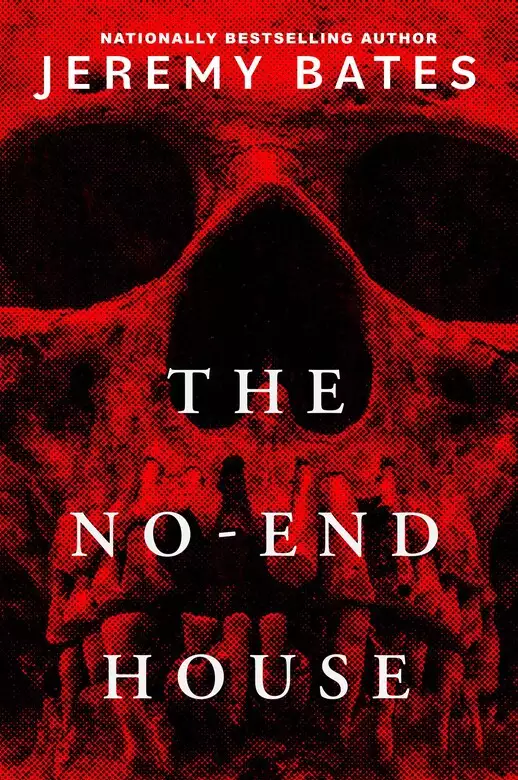
In the tradition of Saw and Eli Roth’s Hostel, but with the evil supernatural twists of Stephen King, Alma Katsu, and Christopher Golden, two strangers unwittingly volunteer for the ultimate haunted house challenge in Barcelona’s Gothic Quarter.
Nine rooms. Nine tests. One chance to get out alive.
Bestselling author Jeremy Bates invites you to spend the night in The No-End House. Where the nightmares begin as soon as you enter—and the terror never ends . . .
It’s the ultimate haunted house challenge. A crumbling stone mansion nestled in the Gothic Quarter of Barcelona, it may be the best-kept secret in Europe—a little-known attraction featuring nine escape rooms to explore, nine puzzles to solve, and a large cash prize for anyone who makes it to the end. There’s just one catch: no one makes it to the end of The No-End House. . . .
When Joe Hadfield hears about the house from a pair of backpackers, he’s intrigued but not interested. He’s trying to escape a nightmare of his own: the trauma of witnessing his wife’s grisly death. Traveling the world to ease his pain and grief, he meets a beautiful stranger named Helen who convinces him to try The No-End challenge together. Joe reluctantly agrees. But as soon as they enter its walls, meet its mysterious host—and sign an ominous contract—Joe begins to understand the seductive power of The No-End House . . .
It knows his darkest secrets. It feeds his greatest fears. It makes him do things he would never do. And there is no end to what he will do . . . to make it out alive.
Release date:
June 24, 2025
Publisher:
Kensington Books
Print pages:
320
* BingeBooks earns revenue from qualifying purchases as an Amazon Associate as well as from other retail partners.
I have beautiful ones of my late wife, Jen, and I have terrible ones, as well. I can recall her face and smile and laughter whenever I want, but I can recall the accident and her slow death whenever I want, also. Often I don’t have control over which memories, the good or the bad, will fill my head on any given morning, afternoon, or night; they simply appear, uninvited, and in the case of the bad ones, they stick around for far too long.
I began thinking about Jen this evening because I knew how much she would have loved Barcelona. She liked cities with character and charm, and Barcelona had that in spades on every landscaped boulevard and down every twisting back alley.
Jen would have insisted on browsing through every bohemian knickknack shop we passed. She would have found us a hidden-away café where we could enjoy a bottle of wine and nibble on seafood paella and other local dishes. She would have made me snap photos of her with all the costumed buskers along Las Ramblas. Hell, she would probably have convinced me to take one of those city bus tours, where she’d insist we sit at the front of the open deck so we’d have the best view of everything.
Gradually and inevitably, these thoughts turned to the accident that ended her life three years ago. She had been flying her final one-hour supervised flight in a Cessna 172. When she and the instructor landed, she had attempted to walk around the plane to thank him—and walked right into the still-spinning propeller. It sliced off half of her face, took off much of one shoulder, and severed her left arm below the elbow. Somehow paramedics got her to Arizona State Hospital alive, although her injuries were so severe the ICU doctors put her into a barbiturate-induced coma—only it wasn’t temporary. The brain trauma she suffered meant she would live the rest of her life in a vegetative state and require a ventilator to keep breathing.
The neurologist withdrew life support three days after Jen was admitted to the hospital.
Walking into a spinning propeller was a terrible way to die—but more, it was such a stupid way to die. I know I shouldn’t be angry at Jen, but I couldn’t help it. I was also angry at myself for buying her the Learn to Fly Solo flight course. She’d had two dreams she talked about since we met on Valentine’s Day in 2014: earning her pilot’s license and flying to all fifty states, and signing a record deal.
Although she was a talented singer and songwriter, she never found an equally talented band (in my opinion), and never landed a record deal. So I bought her the fifteen-hour flight course for Christmas.
More than anything, I was angry at the instructor for taking her out on that final lesson after dark. If he’d scheduled it in the daytime, like all the previous lessons, she would have seen the propeller, wouldn’t have walked into it, wouldn’t have died.
I suppose I was angry at just about everybody and everything when I thought about Jen, the good times we had together, the future we should have had together. Her death seemed so pointless and unfair.
I tipped the bottle of beer I was nursing to my lips and watched the activity on the street. The coffee crowds and window shoppers were gone, replaced by people who all seemed to have somewhere they needed to be. Shorts and singlets had been exchanged for pants and Polo shirts and breezy dresses. Flip-flops and sneakers for leather and heels. Even the dozen or so twenty-somethings that were gathering on the sidewalk out in front of the hostel (no doubt for some soon-to-be-messy pub crawl) were all dressed spiffily. It amazed me that they prioritized precious space in their backpacks for multiple pairs of shoes and fancy clubbing clothing.
In contrast, the items that rotated in and out of my backpack (which was considerably smaller than the gravity-defying Mountain Co-op ones you saw these kids lugging across Europe) were limited to a toothbrush and toothpaste, a stick of deodorant, three T-shirts, three pairs of shorts, three pairs of boxers, three pairs of socks, a journal, a Kindle, a first aid kit, and my phone and charging cable.
For chillier evenings like tonight, there was also what I was currently wearing: jeans and a long-sleeved white shirt. I also had a light tent and sleeping bag I attached to the bottom of the backpack, but those were necessities, because I wasn’t jumping on and off buses and trains: I was walking everywhere, and more often than not, I’d go days without a proper bed or roof over my head.
Two months after Jen’s funeral, I decided to walk around the world. It took me that long to realize I couldn’t keep going into the real estate office every day and pretending everything was all right. It took me another month to plan the trip, the route that would take me across every continent with as little bureaucratic red tape as possible, the allocation of finances to support me for several years, all that stuff . . . and also to get my head in the right place. I wasn’t stepping out for a Sunday stroll, after all.
I started the journey on a Sunday morning from my house in Green Valley, Arizona, and spent the next year walking south to Panama. From there I flew over the Darien Gap (a dangerous stretch of jungle where I was advised with much confidence that I would be robbed, if not murdered, if I attempted to cross it on foot), and I spent another year walking from Bogotá, Columbia to Montevideo, Uruguay. I caught a plane to the Argentinian-administered Marambio Base in Antarctica at the beginning of the summer and walked to Esperanza Base, a year-round civilian settlement, where I organized the necessary paperwork to travel to Europe. I landed in Scotland in September and wound my way south to Spain. I’d been in Barcelona for a week now. Next I planned to cross over to North Africa, travel through Morocco, Algeria, and Tunisia, and then crisscross back north through Eastern Europe. Eventually I’d reach Western and Central Asia. From there I would fly to Australia, and then—finally—back to the US.
Yes, some days my feet hurt, and some nights my knees hurt more. Yes, when I get caught in a torrential rainstorm, I wonder what the hell I’m doing. And yes, I get homesick when I think about my family and friends so far away. But at the same time, I’ve never been as fit and healthy as I am now, and I’ve never felt so free. Visiting Peru or France and lounging by the pool in a Hyatt is not the same as walking across a foreign country, from town to town and city to city, seeing how the locals live, understanding the world outside of my world, committing to something that only a handful of people have ever accomplished and ever will.
I’ll put up with sore feet, a bacterial infection or two, sunburns, rain, and whatever else nature throws my way for that. I have to now. I’ve gone so far that quitting is no longer an option.
For the last two days, I’d been at a place called Hola Hostel, and like most European hostels, it was tidy and offered a shitty but complimentary continental breakfast. Also, it had a bar in the lobby that opened at seven p.m. and sold cheap beer. I was currently on my second bottle of Hoegaarden, and that would likely be the last.
The twenty-somethings on the sidewalk were growing in number and getting louder and more boisterous. The guys were high-fiving, shoulder-bumping, and chugging beers while trying to outwit each other (some of their comments were so outrageous that they were actually funny). The girls gossiped about friends and enemies and just about anybody who wasn’t there to overhear them.
I was forty-four, probably nearly double the age of most of them, and while forty-four wasn’t too old, I felt old right then. Hostels did that to me. Because barring the occasional bare-footed, stoned-eyed hippy, I was usually the oldest person in every hostel. Sometimes I’d see a married couple in their fifties checking in or out, or someone in their thirties or forties scratching the backpacking itch later in their lives. But the majority, by far, was the early twenties crowd, recent college grads who didn’t want to give up the party they’d been living for the last three or four years.
Which was why I was intrigued by the woman with the orange hair seated at a nearby table.
She had been there ever since I sat down half an hour ago. A laptop was on the table in front of her, along with what looked like a mai tai. I’d guess she was a little younger than me, maybe forty.
Aside from the attention-getting hair, the rest of her didn’t look like someone you would find in a hostel. The champagne-colored blouse and black dress pants were too sophisticated. Her jewelry looked expensive. And the laptop was a late-model MacBook Pro.
She lifted her eyes from the screen and caught me studying her. I looked away and sipped my beer. The twenty-somethings were finally moving on to start their night. I wondered how many of them were going to make it back to the hostel before dawn and whether I was going to be taking a shower tomorrow morning in a puke-splattered stall.
I took another sip of beer and could still feel the orange-haired woman’s eyes on me. I was sure I was wrong; she was probably looking past me. Yet my curiosity got the better of me, and I glanced at her.
She was indeed staring directly at me.
I didn’t know what to do but look away again. I felt myself blushing . . . and when was the last time that had happened?
I took another sip from my beer and found it empty. I hesitated a moment, then got up without looking at the woman. I went to the lobby, past the bar, and pushed the button for the elevator. At the last moment, I turned around.
She was still looking at me . . . but now she was grinning.
The blush in my cheeks dialed up to a ten, and I finally identified the emotion I was experiencing: intimidation.
The elevator doors pinged open, and I thought, Fuck it. I went to the bar, bought another Hoegaarden from the German guy manning it, and returned to the patio.
I stopped at the orange-haired woman’s table and said, “Mind if I have a seat?”
“Please do,” she said.
Now that she’d won the battle of wills—or whatever the hell had just happened—and had me sitting down with her, she quit it with the crazy Jedi stare and turned her attention to her laptop. She clicked the mousepad a couple of times before closing the screen. She wrapped her lips around the straw sticking out of her mai tai and sucked until her cheeks dimpled. Then she said to me, “Are you always this forward?”
I laughed and said, “I’m being forward?”
“Walking over to a strange woman’s table and asking to join her. Seems pretty forward to me.”
“I—” I shook my head and sipped my beer. She knew exactly why I had come over. “I’m Joe.”
“You look like a Joe.”
“What does a Joe look like?”
“You.”
My jaw tightened. I didn’t know what was going on. I’d thought the Jedi stare was a come-on, and while I had no interest in a relationship, or even a one-night stand, I wasn’t averse to spending an evening with an attractive woman, even if all we did was chat.
Walking around the world on your own was a lonely business. But now . . . well, I wasn’t sure if I was the butt of some obtuse joke. I decided on bluntness. “Have we met before?”
“Ooh. I thought you’d have a better line than that.”
“I mean, do you know me?” An idea was forming in the back of my mind: somehow, she’d heard that I was walking around the world. When some people learned that, it made them act a little weird. Back in Chile, I was invited to a local wedding by the groom, and the guests began lavishing me with so much attention that my presence overshadowed the newlyweds, and I left before the cake was cut.
“I know you now,” the woman said.
“What’s your name?” I asked her.
“Helen.”
“You don’t look like a Helen.”
“You know many Helens?”
“No.”
“Then how do you know I don’t look like a Helen?”
“I was referring to Helens from popular culture.”
“I’m intrigued. Which Helen from popular culture do I not resemble most?”
I wasn’t slow-witted, but right then my mind was racing to keep up with her pointed questions. “Helen of Troy.”
The woman’s brown eyes sparkled. “Touché, Joe. I don’t resemble the most beautiful woman who ever lived. I don’t know whether you’re purposely disparaging me or simply sticking your foot in your mouth.”
Hell, I didn’t know either, but it was likely the latter.
“And what’s more,” she said, still smiling, “I don’t think Helen of Troy was black.”
“How about we start over?” I said.
“Sure,” she said. “Let’s.” She extended a lithe hand. A silver bracelet engraved with the double Gs of Gucci encircled her wrist. “I’m Helen.”
I accepted her hand. “I’m Joe.”
“You look like a Joe.”
“You look like a Helen.”
Her eyes sparkled again. “Any in particular?”
“Helen of Troy.”
She tilted her head back and laughed, an unexpectedly sweet and girlish sound, and it was then I decided to stick around until I finished my beer.
I ended up sticking around for a fair bit longer than that. Another four beers, to be exact, and when I checked my wristwatch, I was surprised to discover it was almost midnight.
“Time flies,” I said, thinking I hadn’t stayed up this late in months.
“When you’re having fun . . .” Helen said. She had matched my four beers with four mai tais, but if she was feeling a buzz, I couldn’t tell.
“To be honest . . .” I said.
“I like honesty,” she said.
“When I first sat down, I didn’t know what to make of you.”
“Oh?”
“You were intimidating.”
“Don’t mince words.”
“You were a bit full-on.”
“Just say it.”
“Say what?”
“You thought I was a bitch.”
“I didn’t think that.”
She gave me a droll look, as though she knew what I was really thinking and was waiting expectantly for me to say it.
“All right,” I said. “Maybe it crossed my mind.”
She slapped the table. “You did think I was a bitch!”
“I didn’t know what to think. I thought a lot of things.”
“I’m only teasing you, Joe. I know what I can be like. I live with myself every day, don’t I?” She shrugged. “I don’t mean to be bitchy. I don’t want to be. It just happens when I’m nervous.”
I was surprised. “You were nervous . . . ?”
She shrugged again, a cute lift of her shoulders accompanied by a self-deprecating smile. “A little bit.”
“You seemed pretty confident to me with that whole Jedi-stare thing.”
“Jedi-stare thing! Are you going to tell me I look like Yoda next?”
“Yoda crossed with Helen of Troy.”
“That’s a little better—I’m seeing . . . God, I don’t know. I turn dumb when I’m drunk.”
“You don’t seem drunk.”
“I’m good at covering things up.”
She had revealed little bits about herself like this over the last two hours, and it was endearing . . . so much so that it was becoming scary.
I looked at my beer bottle; it was empty. I checked my watch again. It was now five past midnight.
“Somewhere you have to be?” she asked.
“I should call it a night.”
The surprise that flashed in her eyes disappeared in a blink.
“I’ll—uh, walk you to the elevator,” I said. “What floor are you on?”
We both stood up.
“I’m not staying here,” she told me. “I’m at a hotel down the road.”
Now it was my turn to show surprise. “They don’t have mai tais at the bar there?”
“I was walking past this place. The patio was enticing, and it wasn’t filled with all those kids then.”
I frowned, feeling suddenly self-conscious about staying at the hostel. If Helen were staying at the hostel, too, that would be different. But she wasn’t, and I’d never mentioned the walking around the world stuff, and that made me just some middle-aged chump who couldn’t afford a proper hotel room.
It was especially ironic considering that in my previous life, I owned a closetful of tailored suits, drove a BMW, and had enough money banked to dabble in the stock market and not worry about whether I was any good at dabbling or not.
I cleared my throat. “All right . . . um . . .”
“You could walk me to the elevator in my hotel if you’d like?”
I hesitated. “I . . . can’t.”
“Can’t?”
“It’s complicated.”
“Complicated. Right.” She lowered her eyes. They might have gone to my ring finger . . . which wore no ring. I wasn’t advertising that I was single. The journey I’d embarked on was, in part, an effort to move forward with my life, and seeing that ring on my finger every day had made moving forward really tough.
When Helen’s eyes met mine again, there was nothing in them. It was like we were strangers. “Good night, Joe. Enjoy your time in Barcelona.”
“Good night, Helen,” I replied, and watched her walk away.
I wasn’t surprised I dreamed of Jen that night.
Helen and I were on Hola Hostel’s patio, as we had been earlier in the evening, and Helen noticed someone standing across the street, watching us. She urged me to find out who it was, so reluctantly I went.
The person wore a monk-like robe that covered their body and face. As I approached, I asked them who they were and what they wanted. They didn’t answer. I stopped directly in front of them. For some reason, I couldn’t see into the cowl. There was only darkness where the face should have been. I yanked the cowl free and discovered Jen staring back at me.
At that moment, my heart felt like a small bird that had flown down my throat and died in my chest, because Jen was missing the parts of her face that had been sliced off by the propeller. That included most of her mouth and some of her jawbone, which was why she hadn’t answered me. She recognized me, though. I saw that in her eyes, along with stark terror, as if she were back on that tarmac in Arizona, knowing she was about to walk into the propeller but unable to do anything about it.
I was horrified to see her like this, but I was also so grateful she was alive that I wanted to throw my arms around her.
Now, as I lay awake on the lumpy hostel mattress and recalled the dream, it occurred to me that the real reason I never embraced Jen was that I knew, beneath the monk robe, she would be missing much of her left shoulder and arm, the wounds would be raw and unbandaged and unforgiving, and any kind of hug would end with her screaming in pain.
A couple of the twenty-somethings with whom I shared the small room were talking in the dark. It was their voices that had woken me, I believe.
“He was munted, bro,” said one of them in a New Zealand accent. “It was all bullshit.”
“But five grand,” said his buddy, attempting to whisper. “Just for some internet challenge.”
“He didn’t say it was an internet challenge.”
“Why else would someone dole out that much loot? They prolly got a million YouTube subscribers. They’ll make heaps more than five grand by filming and posting us all scared and shit.”
“Scared? It’s a fucking haunted house, bro.”
“Exactly, cuz. It’ll be a piece of piss. So let’s do it.”
“We’re going to Madrid tomorrow.”
“Bugger that. We put it off for a day.”
“Nah, bro. It’s sus. I ain’t wasting my time.”
“He said the place was across from the Picasso Museum. That’s by that tapas bar where we met those Swiss girls.”
“So?”
“It’s not far from where we gotta catch the bus to Madrid. So we check out the house, and if it’s sus, we get on the bus.”
A grunt.
“Yo, yo?”
Nothing.
“Cuz?”
No reply.
“Cuz?”
And then silence, finally.
I tried getting back to sleep.
I was woken a second time that night by a different kind of talking. It was a guy trying to get into a girl’s pants—literally. They were on the bunk above me. They weren’t there when I went to bed, so they must have come in at some point during the night.
They were speaking quietly—much more so than the two Kiwis—and I probably wouldn’t have heard them if they hadn’t been right on top of me.
“Come on,” the guy said.
“No . . .” the girl said.
“Come on.”
“Then, a bit distressed: “Stop.”
“Come on.”
“I’ll take off my top, but that’s all.”
“Come on.”
“Stop that.”
“I’m not doing nothing.”
“Not there.”
“Come on—”
“Hey, pal,” I said loudly and sharply, and there was noise above me like one or both of them had shot up straight. “She said no. Understand?”
I heard little more after that except for someone, at some point, descending the ladder by my feet, and then the door to the room opening and closing . . . although by then, I was half asleep and dreaming once more.
No puke greeted me in the shower stall in the morning, thankfully. I soaped up, shampooed—these things were luxuries when you couldn’t do them every day—and toweled off, drying my shaggy brown hair as much as possible. Back in the room, I pulled on dark jeans, a long-sleeved shirt, and a light jacket. I withdrew an orange pill bottle from the rear pocket on my backpack and frowned when I saw that it was empty. I’d been meaning to stop by a pharmacy and refill my prescription, but I hadn’t gotten around to it. The prescription had been written by a doctor in the States, and I’d had no problems so far using it in any of the countries I’d passed through.
I produced the little tattered piece of paper with the doc’s scratchy handwriting on it from my backpack, stuffed it in my pocket along with the pill bottle, and went downstairs to fuel up on the continental breakfast. I toasted and buttered a couple of slices of white bread but ignored the electric kettle, the jar of instant coffee, and the little box of dried milk. My sleep had been lousy, and I felt like a double-shot espresso to get me going.
When I stepped through the glass doors to the patio, my eyebrows jumped. Helen—I didn’t know her last name, I realized—was sitting at the same table as the previous night, with a newspaper open in front of her. She glanced up at me, smiled, said, “Oh, hi, Joe!” and then nonchalantly returned her attention to her laptop.
A dozen questions crossed my mind. The one I asked was, “You haven’t been h. . .
We hope you are enjoying the book so far. To continue reading...

 Please log in to recommend or discuss...
