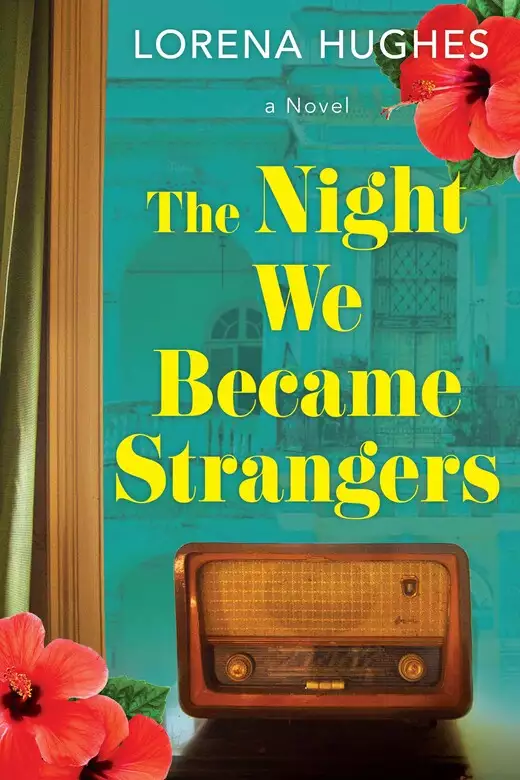
An immersive, historical novel based on true events: In 1938, Orson Welles’s legendary radio dramatization of H.G. Wells’s novel The War of the Worlds terrified Americans into believing Martians were invading. Eleven years later, an Ecuadorian radio station adapted the show—with catastrophic consequences. Now, two young journalists are determined to uncover what really happened to their families that night—even as secrets endanger their future.
1957: Aspiring photojournalist Valeria Anzures returns to her hometown of Quito with a secret purpose: to discover the truth about how her parents really died. The disastrous 1949 War of the Worlds show caused a mob to torch her family's radio station—and the newspaper run by their closest friends, the Monteros. The tragedy shattered the families’ relationship—and left the station on precarious financial ground. Now, expected to save her family’s legacy through an arranged marriage, Valeria will risk everything to find out the truth. Even if it means allying with the man she's always loved—but who now treats her like a stranger.
For Matías Montero, the scars of that night run deep. He saved his mother but blames himself for not rescuing his father. As a journalist, he views Valeria as a rival. Still, they’re both on the same mission. Perhaps, together, they can unearth the past their families and friends would rather remain buried.
Valeria and Matías soon find trusting each other is as dangerous as the attraction they can't resist. Between their families’ mutual hatred, duplicitous witnesses, and insidious lies, and ruthless manipulations, exposing the real story will put their future on the line—and ignite revelations no one saw coming.
Release date:
September 30, 2025
Publisher:
Kensington Books
Print pages:
304
* BingeBooks earns revenue from qualifying purchases as an Amazon Associate as well as from other retail partners.
The chaos in the street woke me up. The bedside clock indicated that it was five minutes after 9:00 p.m. I’d grown tired of waiting for my mother to come home and had fallen asleep on top of the covers with my clothes still on. It was unusual for her to be gone so late at night—she never left home after seven. My father, well, that was a different story. He was gone several nights a week to play cards with his friends. Tonight was one of those nights.
I couldn’t pinpoint with precision what noise had awoken me. A loud screech? The clash of metal? There was some sort of collision outside my window and people were screaming. I moved the curtain aside, pulled my window open, and leaned over the white metal sill to peek at the street three stories down.
Don Jacinto’s 1946 Buick Roadmaster had just hit another car. I could imagine the scene I was about to witness. Don Jacinto was fastidious about his automobile. If either I or my friends so much as touched its smooth chassis as we walked by, he would curse at us, call us vagabundos, and immediately wipe our fingerprints with a red flannel specially designated for that purpose.
Don Jacinto owned the barbershop across the street, but he constantly kept an eye on his beloved vehicle. I had to admit that sometimes we messed with his car just to get a reaction from him, me being the primary instigator. At my thirteen years of age, the barber’s outbursts were hilarious and broke the monotony of those sleepy weekday afternoons in my dull neighborhood, if only minimally.
My predictions were all wrong. Instead of the brawl I envisioned, Don Jacinto got out of his car and extended his fat arms, conciliatory, toward González, the pharmacist, who got out of his Chevy and reciprocated the hug.
“I’m sorry, vecino, it was my fault,” González said. “I shouldn’t have stopped so abruptly.”
“No,” Don Jacinto said. “It was completely my fault.”
All around them, people were running up and down the street, frantically. Nobody was stopping to look at the car damage or offer an opinion. Curious bystanders, who normally surrounded an accident scene to voice their assessments of guilt—unconcerned with the preservation of evidence or the status of the victims—were nowhere to be seen tonight. People were minding their own business as though they were late for an important appointment.
I rubbed my eyes. Was I still dreaming?
My parents and I lived in a three-story house in the heart of downtown Quito—a house entirely too big for the three of us and our maid, Delia, but it was only a few blocks away from my family’s newspaper, Crónicas. It was convenient and comfortable, and my father’s family had owned this property for generations.
“Niño Mati!” Delia said, bursting into my room.
Her sudden presence and the use of “niño” followed by the diminutive of my name annoyed me. Didn’t she realize I was no longer a child? I was taller than my mother and just a bit shorter than my dad, for God’s sake! Even at school they called me “Señor Montero.”
“Something horrible has happened!”
“Yes, I saw. Don Jacinto’s Buick hit the pharmacist’s Chevy.”
“Martians have landed!”
If I weren’t so irritated with her, I would’ve laughed. She must be demented, or sleepwalking.
“Let’s go to the kitchen, and I’ll prepare you a té de tilo,” I said as a peace offering.
“No! There’s no time for tea! That’s not what I’m doing the last minutes of my life.”
“What on earth are you talking about, woman?”
“They just announced on the radio that Martians have attacked Latacunga, and there have also been UFO sightings over the Galapagos Islands!” Her voice trembled a little. “Come!”
Questioning her sanity, I followed her to the living room on the second story, where my dad kept his Telefunken radio covered with a piece of white cloth to prevent it from getting dusty.
“Where’s my mom?” I asked.
“I don’t know. She’s not back yet. ¡Virgen Santísima! Maybe the Martians got her!”
It was hard not to laugh at the stupidities coming out of her mouth. I expected her to burst out laughing any second, but Delia didn’t have a sense of humor. She was always businesslike and busy. No time for chitchat or distractions. Then how could she have fabricated this outrageous lie? I’d never known her to possess any acting skills, either, and her performance, I hated to admit it, was credible.
Wearing her pink nightrobe and curlers on her head, she approached the radio and turned the volume up. Stranger than her senseless ramblings was not seeing her in her customary light blue uniform.
“This is unbelievable,” the radio announcer was saying. “People are running through the streets. They can’t escape! Listeners, the city of Latacunga has been destroyed by a swarm of aliens, and they’re headed for Quito! I repeat: they’re headed for Quito!”
His voice sounded broken.
“Dear listeners, our civilization is wounded,” the man continued, dramatically. “Our species is facing its own extinction. Ladies and gentlemen, let’s accept the inevitable. The incredible news we’re delivering is coming to us from legitimate international agencies and, of course, sources at our own capital’s daily newspaper, Crónicas, which operates in this very same building. This news bulletin is brought to you exclusively by Naranjada, the unbeatable orange soda. Now in pineapple flavor, too.”
What was this nonsense? As a heartfelt pasillo resumed, Delia got on her knees, her long, bony fingers coming together in a praying gesture, her slender frame being swallowed by the oversized cotton robe. At the top of her lungs, she recited the Padre Nuestro.
“Kneel down, Niño Matías!” she ordered. “Let’s pray for our salvation.”
I hesitated. I needed to know if what Delia and the radio announcer were saying was true. And I wouldn’t find that out on my knees.
Without speaking another word, I darted toward the stairs and out into the street.
Ecuador, July 1957
I lost my parents to twenty minutes of radio drama. I never knew exactly how it happened, and nobody wanted to tell me the details, but my life was never the same after the incidents of February 12, 1949—incidents I was determined to uncover now that I was finally an adult and free from the hasty exile my Tío Bolívar had forced me into.
One thing I knew: There was a name that couldn’t be spoken aloud, one related to the events of that evening that had become taboo in my family.
My mother’s name.
The shiny red train from Riobamba to Quito was packed this morning. Navigating between legs and arms, valises and boxes, I made my way to an empty seat by the window in one of the back rows. Bodies boiled around me and something putrid permeated the air. Somehow, it didn’t bother me. Neither did the thought of being crammed into this closed space for the next six hours. Today, the future looked bright. I was finally going back to Quito after eight long years locked in a boarding school. I set my two valises, which held all my belongings, in the compartment over my head and squeezed in front of a woman with a black hat and blue poncho.
“Permiso,” I said, reaching the window seat, but she didn’t answer. She clung onto a cage with a green parrot inside. “What’s its name?” I asked.
“Tico,” she said.
For the next six hours, that was all she said. The parrot, however, kept repeating his cheerful “hola” in a high-pitched voice, way after we’d made each other’s initial acquaintance.
I kept my gaze outside the window, where green pastures extended. My thoughts were lulled by the train’s prolonged whistle and the discordant rattle of the engine, sporadically interrupted by the wind sneaking through the window’s gap. I entertained myself counting Holstein cows and horses and campesinos wrapped in ponchos. A boy and a girl cheerfully ran beside the railroad tracks and waved at us. I waved back.
What would become of me when I arrived in Quito? I certainly had a lot of plans. And dreams. My life has been shaped by nothing but dreams.
I was the family pariah—there was no doubt about it, though I didn’t understand why. Of course, Tío Bolívar would tell a different story. He’d say he’d sent his only niece to a prestigious private institution so she could receive the kind of education most women of her time could only dream of. He’d boast about how I grew up surrounded by girls my age, cared for by loving nuns in a quaint little town, rather than alone in a cold, empty house. He’d brag about how I sang in the school choir and how impeccable my needlework was. I had left Riobamba, ready to become the perfect wife.
But if you asked me, I would say I never understood why I couldn’t move in with my uncle’s family. I would’ve loved to grow up next to his daughters—two older cousins I’d idolized during my childhood—and his four sons, in spite of how rambunctious they’d been. It was apparent that I wasn’t welcome in Tío Bolívar’s home. If at least I had a sibling of my own to commiserate with, things would’ve been more bearable, but no, I was an only child, so my parents’ tragic fate was mine to carry alone.
My family’s rejection had always stung, but I tried not to dwell on resentment. Tío Bolívar showed his affection in other ways. He visited me once a month, bringing along expensive dolls, dresses, and stylish saddle oxfords, and taking me out for helados de paila. I looked forward to those Sundays with embarrassing anticipation. No other girl in my school had an uncle who showered her with as much affection as he did. Nobody else sported the latest fashions, even if it was only on weekends when I could finally remove the plaid school uniform I was forced into from Mondays to Fridays.
When I was fifteen, however, he gave me the most precious gift of all—one that I was sure to cherish all my life and would establish the path to my dreams.
A Kodak Brownie 127.
Behind the lens, the world looked more interesting. I could frame a moment just right and keep it forever. Being that my late mother’s best friend and her husband owned Crónicas, one of the largest newspapers in Ecuador, I was certain I could get a job as a photojournalist. All I had to do was ask my Tío Bolívar to talk to them on my behalf.
I felt the shape of my precious camera inside my camel leather bag and turned toward my travel companion, beaming with anticipation. There was yet another reason for my excitement, perhaps the strongest one.
I was finally going to see Matías again.
“Isn’t it a beautiful day?” I said.
The woman frowned, while the parrot repeated “hola.”
Tío Bolívar was waiting for me at the train station in Quito. The rain had stopped, and he stood alone by a puddle of water reflecting his dark suit, thin black tie, and the cigarette that always dangled from his mouth. He must have been approaching fifty, but he didn’t look it, not with that open forehead—free of wrinkles—his dark mane peppered with erratic gray highlights, and his pudgy cheeks. Tío Bolívar was my father’s younger brother, an accountant who’d been consumed with work responsibilities and a large family, and who, from one day to the next, had been solely in charge of a disgraced radio station and an orphaned niece—me.
I’d hoped that at least my youngest cousin would’ve come to the station with him. Last I heard, his two older boys were married and so was his older girl. The only girl who remained at home was Graciela, whose biological clock was desperately ticking at twenty-one, and two younger brothers, ages sixteen and eight. I hadn’t seen any of them in years because I spent every holiday and summer breaks at my dad’s cousin’s house in Ambato.
My dad’s cousin, Amparo, was a middle-aged, crooked woman with jet black hair that she religiously dyed every three weeks. Her dark pixie cut created an interesting contrast with her pasty white skin and her many wrinkles, not to mention the overwhelming rouge on her cheeks to match her bright, carmine lips. Everyone called her Doña Amparito, and she had always been kind to me. She was a distant cousin and very busy with her fonda, a humble restaurant where I helped during my breaks. She had never married, but her parents had left her the business and a one-bedroom apartment. By the end of my visits, my back was in shambles from having slept on her sofa for weeks.
It always baffled me that I couldn’t go back to my hometown during the summer break. I knew Tío Bolívar had his hands full with six children and a radio station, but I’d always had the feeling that this forced separation was deliberate.
I hated the nickname Valerita. Why did people in Quito always add diminutives to names?
“Hola, tío,” I said, running my gloved fingers by my mint swing skirt, attempting to flatten the many wrinkles that the long train ride had left behind.
He picked up my two valises, and I followed him outside the station. As we passed by a window, I glanced at my own reflection. Flying hairs expanded like sun rays all over my high ponytail. I did my best to comb them with the palm of my hand. I’d wanted to make a good first impression on Tío Bolívar’s family, but that was not going to happen.
We got into a teal-and-white 1955 Ford Fairlane. The scorching leather seat burned the palms of my hands as I settled on the passenger seat. Tío Bolívar unrolled the driver’s window and started the vehicle.
“How was the trip?”
I’d forgotten all about his nervous energy, which seemed to come and go with his moods, but today, it was fully activated. He kept nodding his head with quick small movements, even though I wasn’t saying anything.
“Long and tedious,” I said. “But I took some pictures.”
“You still have the camera I gave you?”
“Of course!” I perked up. “In fact, Tío, I was hoping you could introduce me to the Monteros. I would love to work for Crónicas as a photographer.”
In spite of being good friends with my parents, I wasn’t sure the Monteros remembered me after so many years. I had many memories of Mrs. Montero, my godmother, and her first husband coming for dinner at my house, and bringing their son, Matías, to play with me.
We stopped at a red light. He tapped his thigh repeatedly.
“I don’t know, Valerita. Things have changed.”
Valeria.
“Oh, yes, they’re no longer in the same building as the radio station, right? I heard about that.”
He lit a cigarette, eyes squinting. He didn’t say anything, so I filled the silence.
“For nine months, they printed the paper at El Día until they fixed their printing press and got their new building.” I wanted to impress him with my knowledge. A photojournalist, after all, must be well informed.
As the light switched back to green, he accelerated, his gaze back on the road. “Well, we’ll see about that.”
I didn’t like the dismissive tone of his voice, but I was prepared for this. I had been planning my response for the last three years. “I know it’s not customary for women to work, especially at a newspaper, but I think I can do it. I’ve been practicing so much, and my friends say I’m really good.” I tapped the bulge in my bag. “I brought some photos to show you. Besides, I don’t want to be a burden to you. I can make my own money.”
“Oh, you don’t need to worry about that,” he said.
He gave me a sideways smile, but didn’t say another word as he drove toward downtown Quito.
The city had grown vertically in the last eight years, and imported vehicles crammed the streets. As we drove past Cine Pichincha, a big sign advertised Silvia Pinal and Pedro Infante’s latest movie, El inocente. I was finally in the capital and could watch a variety of Mexican and American films whenever I wanted, not the same old film over and over again.
I lowered the window to breathe in the city air. There was noise all around: vendors announcing to the world that they had plenty of oranges and tangerines at cheap prices, cars honking, the brakes of an old bus behind us, construction workers whistling at an attractive woman sauntering down the street, a crowd laughing.
Quito was alive. And I felt invigorated by it.
Tío Bolívar lived in an old two-story house a few blocks away from the infamous radio station that, according to hearsay, was slowly regaining the credibility of its listeners. As we entered the dim vestibule, my heels clacked against the mosaic tile. A warm, yeasty aroma permeating the air left no doubt that something tasty was in the oven. It also made me realize how hungry I was. But it was way past lunch time.
“Marga!” Tío Bolívar said, calling his wife.
I had a vague recollection of Tía Marga. She’d been pregnant when I left, that much I remembered, because I’d been fascinated by how enormous a human belly could grow. She’d had little to say back then, at least to me, but had been a pleasant woman with big brown eyes. Last I heard, she’d had a son, Joselito.
It was a shock to see Tía Marga now.
She’d lost all the pregnancy weight and then some. A life of hardship reflected on her face with bulging cheekbones and brownish blemishes across her skin. Her eyes, which in her youth had been the focal point of her face, now looked muted and somber. Her mane, held in a tight bun, was more gray than black. How could that be when Tío Bolívar looked so youthful?
“Look who’s here,” he said in a cheerful tone that came out forced. He set my luggage by the staircase as his wife came toward us.
“Hola, Valeria,” she said, extending a weak hand for me to shake. “Forgive my appearance, but I was in the kitchen.” She was wearing an apron splattered with flour. “Goodness, I didn’t remember you having so many freckles!”
I did my best not to touch my nose, which in summer months became covered in freckles due to my long hikes, mostly to get the perfect shot. I owed my fair skin and toasted caramel hair to my mom, but I was not about to ruin the mood by mentioning her.
“Did you tell Valeria about tonight?” Tía Marga asked her husband.
“Not yet.”
“What about tonight?” I asked.
Discretion was not my forte.
“Oh, we’re having some friends over for dinner,” he said. “To welcome you back.”
“The Monteros?” I asked, barely able to hold my excitement. These city people took advantage of every moment to celebrate.
He avoided my eager gaze. “No, not them. Other friends I want you to meet.” He picked up my suitcases. “Is Graciela upstairs?”
“Yes, she’s getting the room ready,” my aunt said.
As we started our climb up the stairs, a boy came running down and nearly bumped against Tío Bolívar and me.
“Hey, watch it!” Tío Bolívar scolded. “Why don’t you behave like a gentleman for once and say hi to your cousin?”
“Hi, cousin,” he said with a quick, dismissive bow. His long bangs nearly covered his eyes.
“Her name is Valeria,” Tío Bolívar said, maneuvering my two valises as his young son attempted to rush past him down the stairs and reached the bottom with a leap. “And this is Joselito,” he said, with a resigned sigh.
“Hi,” I said.
But Joselito was already running to the front door. All I’d been able to assess was his short tan pants and suspenders. Tío Bolívar and I renewed our climb.
“You will stay in Graciela’s room,” he said. “We only have four bedrooms, and the boys use the other two.”
I had a few memories of Graciela. She’d been taller than me, and her hair had been so straight that the pin curls her mamá worked so hard on creating every morning would wane by the middle of the day. I looked up to her since she was the cousin closest in age to me. When I first moved to the boarding school, I’d sent her letters filled with drawings. She’d answered a couple of them but slowly, and sadly, our correspondence had died.
She was nearly unrecognizable now. For one, she was shorter than me, and the once self-assured child who’d encouraged me to climb rooftops and dared me to eat dirt in order to borrow her bicycle would barely look me in the eye.
Her hair came down to the nape of her neck, held on one side with a rhinestone barrette, and she was still attempting to curl the bottom—with mixed results. A tailored blouse and a pencil skirt highlighted her small frame. Her fingers were long, her wrists tiny. So much so that when we shook hands, I was afraid I might break one of her bones.
“Graciela, help her get settled, will you? I have to go back to the radio station for a couple of hours,” my uncle said, bringing my luggage inside the first room to the right.
My cousin nodded. I’d yet to hear her voice.
“Thank you, Tío,” I said as he headed to the stairs, and I followed Graciela into the bedroom.
This had been the girls’ room before—I remembered as much. It had once been a pink paradise with flower-print curtains and a rosy doll crib that matched my cousins’ furniture. Well, the room had drastically changed. The wallpaper was more subdued now, with tiny olive leaves spread throughout. Gone were the two canopy beds from their childhood in lieu of two twin beds with matching sage bedspreads. A night table with a walnut RCA Victor radio stood between them.
“Oh, you have a radio,” I said, applauding. Back in the boarding school, we’d only been allowed to listen to an hour of radio a day, after dinner, while we did our needlework. I always picked the station, and invariably, I chose a radionovela, as I was enthralled with the stories of unrequited love and betrayal. But if there was still time, we’d listen to a Colombian radio station that featured live bands playing boleros and guarachas.
“Do you like radionovelas?” I asked her.
She started to smile, but as she did, she immediately covered her mouth with her hand. She nodded.
“Which is your favorite?” I said, and the two of us said in unison. “¡El derecho de nacer!”
As she opened her mouth to speak, I realized the source of her shame. Her front teeth were terribly crooked, to the point that one seemed to be climbing on top of the other. As soon as she was done speaking, she covered her mouth again.
Caray, this was a big leap from the poised child she’d once been.
“Come meet my brothers,” she said, heading for the door.
Joselito was not in his room, but his colorful marbles were. So was his train set—pieces scattered all over the floor. This bedroom had once belonged to the oldest son, as I recalled, but he was a married man now and had moved to a house of his own.
We didn’t linger and Graciela opened the next room. A teenage boy raised his head from a book filled with numbers and formulas. On his desk was a strange contraption built with metals and wires in some sort of mysterious circuit.
“Germán, say hi to our cousin Valeria.”
“Hi,” he said, barely moving his chin up and making no attempt to get up to greet me.
While my aunt and her maid killed, plucked, and baked a couple of chickens, Graciela helped me unpack my valise. She was thrilled to have new reading material and peeked through several of my textbooks.
“You can have them,” I said, as I’d already read them.
I showed her my camera and told her about my plans to work at the newspaper. She listened in pensive silence, but didn’t utter an opinion. The one thing that fired her enthusiasm was to help me pick a dress for tonight’s dinner with my uncle’s mysterious friends.
I wanted to look my best, so I chose a black crepe top with a creamy taffeta skirt that Amparito had sewn for me. She had a talent for duplicating any magazine design with cheaper fabrics.
My cousin wore a sky-blue sleeveless dress with a matching flare skirt. She pinned my head up in a twisted bun and I borrowed her blush and lipstick since the nuns didn’t let me buy my own makeup. But that was about to change!
Together we headed down the stairs, where I could hear my uncle’s voice and some laughter. Nothing this exciting had ever happened to me since the days my parents were alive and hosted dinner parties themselves.
The stiff petticoat under my skirt slightly scratched my legs as I descended the stairs. “Your brothers are not joining us?” I asked Graciela.
“No. And trust me, it’s better that way.”
She still covered her mouth when she spoke, but in the afternoon, there had been times when she’d forgotten her problematic teeth.
Tía Marga had changed into a navy dress with lace sleeves. She sported a pair of glasses that were somewhat incongruous with her fine gown, but she looked much better than she had in the afternoon. What a little grooming could do to a woman!
“Here they are!” Tío Bolívar said, opening his arms to welcome Graciela and me as we entered the parlor.
In the muted living room were an older couple and a young man—a redhead. Out of habit, I pin. . .
We hope you are enjoying the book so far. To continue reading...

 Please log in to recommend or discuss...
