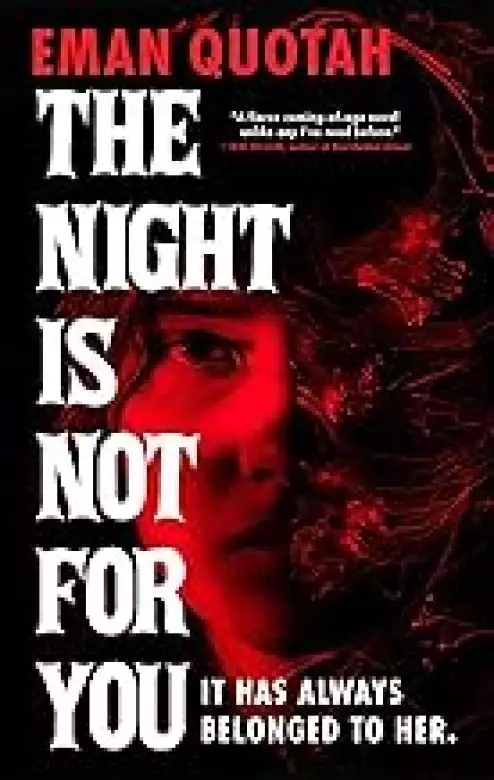
From the award-winning author of The Bride at Sea comes this visceral tale of feminine rage and magical realism as Layla learns the very human pains of growing up and realizing the world isn't as safe a place as it should be.
A man's body is found viciously murdered behind a neighborhood's corner store, sending shockwaves through the tight-knit community in this small-town neighborhood. All the victim's family and bystanders want is to make sense of this brutal crime and move on with their lives.
But all seven-year-old Layla wants is a pet donkey. To her, a donkey is the epitome of freedom and being self-sufficient—to think for herself, go anywhere by herself and live an independent life.
As the killings continue, Layla's world unravels. Rumors start to fly of supposed hoofprints and a woman with hair like black silk. As the ambiguous messages in lipstick and sweet smell of perfume cause the finger of blame to point towards the women, Layla herself grows into a woman.
The kind of woman she has always dreamt of becoming—a woman with sharp instincts. A woman who cannot be tamed.
The night is not for you. It has always belonged to her.
Release date:
October 7, 2025
Publisher:
Orbit
Print pages:
352
* BingeBooks earns revenue from qualifying purchases as an Amazon Associate as well as from other retail partners.
Imagine his eyes when she came at him, wild and unholy with disbelief and terror. Imagine the pure evil rushing through her as she raised her blade and then thrust it into him, ignoring his screams and pleas. Imagine her cackle as she hacked into his neck a gaping wound like a distorted second mouth. Next, sliced into his chest. Left a raw and glistening hole, left him to die, his lower body as naked and exposed as the day his mother bore him.
No one in town disputed the terrifying details of what happened late at night in the alley behind the Murad family’s twenty-four-hour corner store. Whoever the murderer was, she stabbed her victim over and over, carved out his heart, and wrote a note on his forehead in lipstick:
“Love kills.”
It would take a week to clean up the blood, feces, and guts that had transformed the alley into a grisly butcher-shop scene, and longer to even begin to erase the neighborhood’s memory of what she had done to a man right outside the store where most people shopped daily.
She. The murderer had to be a female, Mr. Murad said, because the scent of ambergris and jasmine in the alley was stronger than the stench of rotting banana peels or death, and her coral lipstick was smeared on the poor man’s body, along with all that blood. She had to be an outsider, too, someone passing through with a vendetta, because no God-fearing person in town, whatever their faith, would murder someone. Not like that.
His certainty was somewhat strange. Even stranger was that he swore to God he’d found a set of bloody, Pepsi-y, hoofprints on the sidewalk tile, and had shooed three emaciated stray cats away from the victim’s pulsing heart, which had been wholly removed from his body.
The cutting out of his heart was simply vile. But no one knew what the hoofprints could mean. A marauding donkey? A murderer on horseback?
“Half-woman, half-jinn,” whispered Mr. Murad’s father, a man of ninety. No one latched on to the idea, because who believed in those old-timey stories anymore?
The corner-store owner claimed he hadn’t retched at the sight of the naked and mutilated corpse. He hadn’t even gagged. He’d seen everything and served everyone, he said. Rich, poor, and everything in between. Nothing in the neighborhood got by him—except this murder, it seemed—and nothing surprised him. He was up at dawn to serve coffee to the early risers. After school, he stopped secondary school children from stealing snacks. In the evening, he sold milk for tomorrow’s breakfast to busy mothers with just a few bills in their purses.
Most people were good, he said, but he watched satellite news all day on a little television behind the counter. He’d seen horror films. He knew the evil in the world.
The truth of what had happened when Mr. Murad found the body was different from the tale he told. He’d opened the back door, a trash bag in one hand, and stopped at the sight in front of him, as though he had been transported to another, more violent place, a place inside a screen. One where men were carved up, their hearts served for dinner.
The murderer, whoever she was, had set the heart on top of the green dumpster. It throbbed, and the corner-store owner’s live, hardworking heart nearly skidded to a stop. Then his heart sped up, beating faster than he ever thought it could, pounding against his insides, as though it wanted to escape his chest. He fell to his knees, sobbing, unable to move, unable to escape the alley, a wave of fear nearly drowning him. Nearly killing him right there.
That could have been me, he thought. That could have been me.
The municipal workers in their green suits scrubbed away the blood, bit by bit, washed it away with soapy water, imagined how it had all got there. They were told, “Keep quiet. Don’t share the gory details.”
Their silence went unnoticed. No one else wanted to contemplate, for longer than they had to, the awfulness of how the body in the alley had met its end.
Still, people had many questions. Questions about how to avoid a similar fate, about why it had happened to him, about how he’d ended up in that alley.
No one could say. The victim’s family hadn’t seen him since lunch the day before—he was thirty-five, divorced, living in his parents’ block of flats, the pink one on Green Forest Road. His friends who got coffee with him every day said they’d wondered where he was the morning Mr. Murad found him. His boss at the plastics factory said he’d been regularly tardy for work, on his way to losing his job.
No one in the neighborhood wanted to tell his mother he was dead. They especially didn’t want her to know how gruesomely he’d died. They’d never heard of a death so terrible! Not here, in this semi-rural town, in this neighborhood. They didn’t want to watch as the mother’s escalating worry over her son’s disappearance transformed into shrieking grief. Everyone, her distraught husband and other grown children included, let her believe her son was merely missing. In a cheek-by-jowl neighborhood in a small town, everyone could rally together, even as devastated as they were with terror and sorrow. Keeping the man’s mother in the dark was not hard. For days folks hid the truth from her, and for days she insisted her boy must have gone to the city to look for work. He’d talked about that a lot. Then one day, his oldest sister sat their mother down and said, “People are coming to mourn my brother.”
Passersby on the street that day paused to stare upward as the mother nearly threw herself out the third-floor window and the daughter yanked her back by the waist, both screaming in agony like goats.
Of course, people blamed the victim for his own death. “What did he do to deserve such a thing?” And they blamed the victim’s family—especially his mother—for raising a man who would give into who-knows-what temptation and be murdered for it.
No one in the neighborhood or the town wanted to believe the killer would return. Some came to agree with Mr. Murad. She had to have been a malevolent, vengeful stranger. She had to be long gone. She couldn’t possibly strike again. No one deserved a death like that—and if anyone did, well, he was gone now. They pushed fear away, bit by bit, day by day, and went on with their lives.
Still, those who prepared the desecrated body for burial, and those who heard their first-person accounts, woke up night after night, shaking and sweating from nightmares that looped through their minds and followed them throughout their days. They saw the murdered man first from above, as though they themselves were the killer, saw him shrinking back from them as though he could escape down, down through the concrete. Then, they were him, cowering in the alley, with some monstrous creature hulking above. A veil or blindfold over their eyes kept them from seeing her, but the searing pain, the nauseating smell of a perfume that had once been whale excrement, the gallop of fear in their chests—
They knew they were dying.
Seven-year-old Layla meets a beast. Adults begin to fear.
My name is Layla and here is how I come to be: I grow up in a neighborhood on the edge of town, in a town on the edge of the hilly countryside, on the edge of change, on the edge of time.
How do I come to be?
How do I come to be that is different from how you came to be?
I start as a little girl with hopes, just like anyone’s, but all my own. Earliest memory: When I am seven, I ask my father for a donkey, fully believing that because he loves me, he will say yes.
Since I can remember, I’ve wanted more than anything to be self-sufficient. To think for myself, walk on my own two feet, get myself wherever I’m going. So, I convince myself that trotting to school on a donkey would suit me much better than taking the bus or riding in Baba’s white pickup truck with my brothers and sisters.
Baba loves his truck, and often tells me I should grow up to be a teacher. Why in God’s name, he must think, does Layla want a beast of burden? It isn’t a normal thing for a little girl in our town to want. Riding a donkey is a vestige of the past unless you’re a farmer. And fewer and fewer people in our region farm anymore.
Most of my parents’ generation have moved to town from the country, looking for better jobs, more reliable electricity, modern plumbing, even though our little town has few industries and few resources, unlike the port city a few hours away. When one family member moves to town, others follow, often settling in the same neighborhood or the same building and working in the same professions or selling the same goods and sharing one car or truck among several branches of the family until everyone saves up for their own.
That’s how my family got here. The animals that prowl or scurry or strut around our neighborhood are stray cats with patchy fur, geckos with missing tails, and pigeons with French fries in their beaks. Not donkeys.
None of that matters to me, a child who stares out the open window for hours a day. A child who speaks her mind. I have thought long and hard about the benefits of a donkey. My reasoning goes like this:
I am too young to drive a car.
I really, really want a pet.
My brothers are allergic to cats.
Baba is always late to pick us up from school.
No one else in my second-grade class has a donkey.
Also, in my young imagination, a donkey’s life represents freedom. A donkey, I imagine (though as an adult I’ll realize it’s not all true), can go where he or she wants, pull a heavy cart, eat when she wants, be ugly, be smelly, never bathe, live alone. If a donkey is late, it’s because the donkey wants to mosey, wants to sniff the world around her as she goes. When a donkey is sad, she eats clover.
As much as I want to have a donkey, I want to be like a donkey, too. Want my ears to grow long and sensitive to the sounds of crickets and birds, want my nostrils to widen, my teeth to thicken, my hands and feet to harden into hooves. I want a tail to shoo away flies.
That such a transformation can never happen leaves me with the same bone-deep sadness as not getting to eat sweets every day, never being able to be the eldest child, or knowing no human has ever learned to fly.
“Layla, Layloula,” my father says when I tell him I want a donkey. He smells like the smoky incense he burns every morning in a shiny incense burner he plugs into the wall in my parents’ bedroom. The incense annoys my mother, who prefers cleaner scents—perfume for her, cologne for him, bootlegged French and American brands.
I love his smoky smell.
“Baba,” I say.
I rub my forehead on his goatee and kiss his cheek. When I perform these small affections before I ask him for things, he almost always says yes.
On the topic of a donkey, he’s skeptical. “Why do you want a donkey?”
“I told you why.”
“Who will take care of this animal?”
“I would take care of my donkey. I would never be late for school.”
“Where will we keep the donkey?”
“Tie her up in the alley!”
“How about your bedroom?”
“She’ll poop in there and my room will stink.”
“What if someone steals the donkey from the alley?”
“Baba! Stop teasing!”
My father will not give in, but he never wants to disappoint me. One weekend morning soon after I ask for the donkey, Baba packs thickened cream and jam sandwiches, two bananas, two clementines, and a thermos of Lipton, straps me into the passenger seat of his pickup on top of several volumes of the dictionary he inherited from my grandfather, and sets out for a farm twenty minutes outside town. The cab of his truck is like a tiny home for the two of us. Outside my window, the balconied five-story buildings of town give way to cute little brightly colored houses and date and citrus farms, greenish hills crisscrossed by low stone walls, and a trickling stream that arrives only once or twice a year after the rains. In all other seasons, there is a dry, rocky bed. Today is a warm winter day, not hot like summer and not chilly enough for a sweater like it will be later this evening. The inside of the cab heats up like a greenhouse and smells like vinyl. I press down the window button so the breeze can touch my face; I breathe in the scents of greenery and loamy soil. It’s a treat to be out with my father without my two younger brothers, my two older sisters, and my mother, who usually sits in the cab while we children ride dangerously in the truck bed, the boys on my sisters’ laps. Without cousins or aunts and uncles in a caravan behind us, probably gossiping about us, finding fault, conjecturing, even though they love us as they love their own parents and children. No, today it’s me and Baba, on our way, I believe with all my heart, to buy a donkey.
At the farm, Baba’s friend, whom I call Uncle, waits in the dirt yard wearing an old-fashioned cotton robe. He has a little knife on a belt, the kind all men used to arm themselves with in the old days. Behind him are a chicken coop and a goat on a long, fraying rope tied to a fencepost without a fence. A hen and a rooster roam around, kicking up their feet like Spanish dancers. A duck and its babies sleep in a cozy circle. An orchard of palms stands to the left, ahead of us a small barn, and in the back, rows and rows of spindly bushes. On later trips to the farm, I will see and smell these plants in full bloom: roses.
I’m disappointed. There are no donkeys in the yard. On the barn’s roof, a white, brown, and orange cat dozes with its belly offered to the sun.
My father and Uncle kiss each other on both cheeks. Then the farmer bends his knees, as grown-ups do to come face to face with a child. He shakes my hands with both of his.
“Donkeys are misunderstood,” he says. “Most people think they’re worthless, smelly animals, but we know they’re beautiful and useful in their own way.”
“Thank God for donkeys,” I say. “I’m going to ride mine to school.”
Uncle laughs and puts his arm around my father. “Your father won’t let me sell you my donkey, and to be honest, I don’t want to lose my strong beast. I grow wheat back there, and watermelons. Tomatoes. Fig trees over there. And my wife grows ginger, for stomach ailments, and flowers and herbs for perfume: roses, lavender, lilac, sage, basil. We need our donkey.”
There’s a kernel of anger in me ready to unfurl itself and grow. My father has betrayed me.
“I’ve got a lot of birthday and holiday money,” I say. “I can pay for the donkey myself.”
The men laugh. They think I’m being cute. My father asks if I want to pet the donkey, Bumbo. Uncle sweeps his arm toward the barn, inviting me forward. I rush ahead. I’ll figure out a way to take Bumbo home!
Behind me, Baba and Uncle’s conversation sounds like wiss, wiss, wiss, wiss, wiss. Their voices are too low for me to make out the words at first, but then Uncle starts to sound agitated. He struggles to keep to a whisper. I pretend to ignore them, taking in the smell of manure, the scritch-scratch of hay under my jelly sandals. A high-pitched braying comes from the far corner of the barn. I follow the sound.
Here is something most children know how to do: Pretend they are invisible to adults when they are right in front of them. It works half the time. On this day at the farm, the more the two men talk, the less they remember—or care—that I’m underfoot.
“Horrifying,” Uncle says. “My wife and I can’t sleep at night. We’ve told our older sons to stay away from town. I’ll run the errands myself. The other children only go for school. No visiting friends anymore.”
“God protect us, I think it’s safe in town,” Baba says. “Only one incident. We shouldn’t exaggerate it into more than it is.”
“If I lost one of my children—to that. No one could console me. God protects us, and we have to tie up our animals to keep them from being stolen. We have to keep our children under our watchful eyes.”
“Sure,” Baba says. “Protect your children and your possessions. But don’t lock them away from the sun. They’ll wither.”
“More people think like me than you’re aware, Dr. Sami.”
While they talk, I find Bumbo, his chin resting on the door of his stall as though he’s been waiting for me. I rub his long gray-brown forehead, his white blaze, his velvet nose. His lips grab my fingers and his tongue licks between them. He’s hoping for a taste of sugar that I don’t know to offer. The wet, sloppy tongue on my skin makes me giggle—and yearn even more for my father to listen to my wishes.
“Look, Baba,” I say. “He’ll fit in the pickup!”
My father’s distracted, already telling me it’s time to go when we just got here. I’ve hardly spent a minute with Bumbo, hardly had enough time to admire his fluffy ears and pet his scraggly mane, or to work on Baba and beg him to take Bumbo home. I want to tell my father he’s being mean and unfair. But Uncle is standing right here, and my father won’t put up with disrespect in front of another adult.
I growl. I blink long and slow, hoping the men don’t see my tears.
“I’m hungry,” I say.
“We’ll eat in the car,” Baba says.
Uncle points to a stump and tells us we can sit and eat there. He has a field to mow. His son brings sodas and sweet biscuits to round out our meal.
We eat our sandwiches and fruit in the sun with our backs to each other, bees buzzing at our knuckles and in our ears, while my father thinks about a dead man and God’s plan and mortality, and I fantasize about stealing a donkey, about independence, about leaving and never coming back. How far could I get? How fast could Bumbo go?
Baba turns on the car’s air conditioner on the way home, and I fall asleep with the seatbelt pressing into my cheek. When I wake up, he’s carrying me upstairs to our flat. My head is on his shoulder. I lift it, because I’m still angry, but I’m too sleepy to try to get down from Baba’s arms.
“You fell asleep,” he says, as though I might not remember that the last moment I was awake, we were in the truck.
Mama is at the open door at the top of the shadowy stairwell. “Thank goodness! I was worried you wouldn’t get home before dark.”
Baba puts me down. I stumble inside.
“It’s not even four o’clock,” he says, kicking off his slides, in a rush to be home. “This one met a donkey today.”
Mama kneels and hugs the air out of me. “You’re the donkey of all donkeys,” she says. “The goat of all goats.”
Stubborn, she means.
“The eye of our eyes,” Baba says.
“Our moon,” Mama says.
Beloved, they mean.
I keep thinking about Bumbo, about roads, about the world outside.
My parents worry about murder, about safety, about things I cannot yet grasp.
Second victim.
On the mirror on the lift’s back wall, in the aging block of flats across from where the corner store used to be, a message had been scrawled in blood or nail polish—no one was sure which at first. It said:
“Lust kills.”
One year had passed since the murder in the alley, and most people had gone back to spending their days and nights as they had before, feeling safe again. But now, on a cool fall night, a man had been sliced in two.
The ingenious killer had pilloried her new victim with the tarnished brass grate on the building’s rickety lift. The horrific killing was difficult to believe unless you saw it with your own eyes. And if you saw it with your own eyes, you could never forget. The body, somehow, miraculously, remained standing, hugging either side of the grate, stiff and motionless as a wax statue. With a knife or sickle, she’d carved deep trenches into the victim’s cheeks and back.
Up and down the building, the dying man’s screams had violently severed residents from their dreams, but only Zaynah, a seamstress and mother who lived and worked on the third floor in the flat nearest the central stairwell, heard the clop-clop-clop of hooves. For the rest of her life, she would keep the sound a secret, convinced it was a hallucination, the trick of a terrorized mind.
While the screaming went on and on, everyone huddled in their beds, frozen with fear. When the screaming stopped, mothers and older sisters held young children close as fathers and older brothers opened their doors, peered into neon-lit hallways, and carefully investigated the scene, wondering who among their neighbors they would soon be mourning and what had brought the monster back. Soon, some people let their consciences overtake them and propel them downstairs, though in their hearts they wanted to hide in a wardrobe with a flashlight, their spouses and children, and their elderly parents. A scream like that, torn from the soul, could only be caused by murder, could only be caused by a monster of a human being, these dwellers of the upper floors told each other as they tiptoed down the steps toward the ground floor.
“I saw a stranger loitering about, a woman with silky black hair,” someone whispered.
“Like any woman here who hasn’t gone gray or dyed her hair?” Zaynah said.
“She held a sharp, curved blade.”
“You lie. You didn’t see a thing!”
“What if the killer is still among us?”
They had not arrived at the body in the lobby yet, but they’d had twelve months to speculate on the reasons behind the monstrosity of the Corner Store Killer. To stare across the street at the alley, full of shadows, and imagine her triumphantly standing with a human heart in her cupped palm. Mr. Murad had moved the corner store around the block, and the old place was empty, its metal gate vandalized: “Leave our neighborhood alone.”
Uncountable theories had circulated in the beginning, like incense being fanned into a pitcher of water. A spurned woman, a jealous husband, a maniac, the secret service, a business or romantic rival, religious fanatics, an overseas gang. One of the Murad sons made fun of his grandfather’s superstition by weaving . . .
We hope you are enjoying the book so far. To continue reading...

 Please log in to recommend or discuss...
