“A twisty, compulsive read - I couldn’t put it down.” —Sarah Pearse, New York Times bestselling author of The Sanatorium
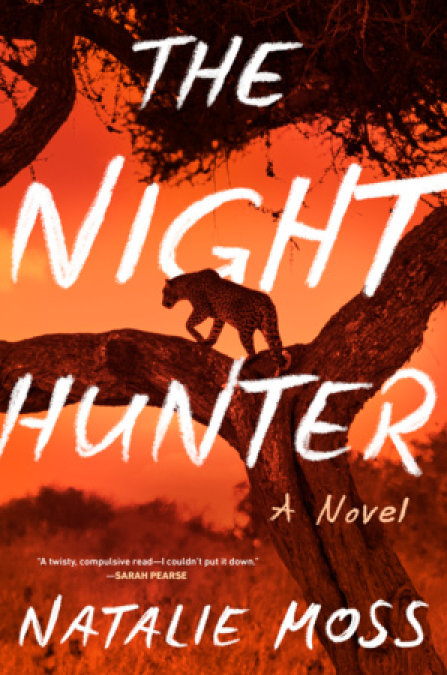
In a remote corner of the South African bush, two sisters reunite to bury a family secret once and for all, but when they’re stranded among the wild animals, they find a predator far more dangerous waiting for them in the shadows. . . .
When their conservationist mother passes, Danielle and her estranged sister Grace must return to their isolated family house nestled within a wild-game reserve. While Grace, their mother’s favorite, clings to nostalgia, only Danielle carries the knowledge of her final request: “Find the storehouse . . . Burn everything inside.”
To ease the pain of their homecoming—and the tension between them—each sister invites two friends on the two-day journey into the bush. What starts as a safari adventure, turns into a nightmare when one of them is murdered the first morning at the campsite. In the chaos that follows, they crash their vehicle, stranding them, with no way to call for help.
Now, with dwindling supplies and only one rifle, Danielle must lead them on foot across miles of merciless savannah. They have days of walking ahead…if they survive that long. As the group navigates land where every rustle could mean death, a truth emerges: someone is sabotaging their escape.
Breathtaking and tense, The Night Hunter maps the treacherous terrain of family duty and loyalty as the two sisters confront what they’ve spent years trying to forget.
Release date:
July 28, 2026
Publisher:
Berkley
Print pages:
352
* BingeBooks earns revenue from qualifying purchases as an Amazon Associate as well as from other retail partners.
They arrive in waves, tumbling out of tourist planes, buses and taxis, carrying their animal checklist in one hand and newly unboxed DSLRs in the other, seeking a kind of bloodshed that's absent from their lives.
Most of them come for the cats-the cheetahs, leopards and lions that live in these South African parks and make up the main cast of nature documentaries and children's cartoons. Some, mostly those who have been here before, look for more nimble hunters: jackals, hyenas, birds of prey and packs of wild dogs that tear their prey limb from limb.
Not me. I'm here because of the creature that killed my mother-one small enough that it could perch on the palm of my hand.
Blinking through the sting of sweat and sunscreen, I stare past the eight-foot game fence that cuts across the cracked earth, drawing a border between the Impala Ridge Private Game Reserve and the outside world. It's one of the few private game reserves that bulge out to the west of the Kruger National Park, and it is by far the most remote. These private reserves and natural parks are the last real sanctuaries for the animals that used to roam all over the continent.
I was certain I'd never have to come back. I thought I'd built enough defenses with my corporate law career, my zone-two new build and my debt-free bank account. I have a sudden longing to be there-back home, in London, sipping cafetière coffee and making poached eggs, sumac and crumbled feta for my boyfriend, Elliot, and me to eat in my shoebox of a shared garden. I made sure I would never need anything from here. But I didn't account for Grace. My sister insisted that we had to come back, together, and after what had happened, how could I say no?
The wind picks up, carrying dust into my face. The air is raw, and the heat of it coats the back of my throat, warming my lungs with each breath. It's the bush, as my mother called it, with the reverence that some reserved for church. Most of it is empty. Grass and thicket cling to the dust. Thorny tangles of acacias battle with red and russet bush willows, their leaves brushed brown with thirst.
It's not the kind of place most people stay for more than a week, definitely not a place to let kids run around unattended-not that my mother cared about that fifteen years ago.
If you ask Grace, our mother is the only reason she's still alive. If you ask me, our mother is the only reason we were out there in the first place.
A family of vervet monkeys bursts from under a bush, shrieking at one another in momentary frenzy. They each turn and glare at me with black eyes. Something must have spooked them. The biggest one stares me down through the fence, his wild expression unreadable. Then he looks at something behind me.
I whirl around to find Jacques watching me from under his bush hat. His dark eyes twinkle with amusement.
"Howzit? What are you doing out here on your own-hunting for shongololos?" he asks, smiling down at me as if I am still young enough to play with millipedes. "This isn't the UK. You'll fry out here."
As if he's not sweating under that thick khaki material all the guides wear. He's a thin man, wiry in the way of someone who subsists on biltong and nuts. His uniform hangs loosely on him, as though he's still the young boy I remember from school, trying on his father's clothes.
"It's nothing," I mutter, resisting the urge to wipe the sweat off my brow. "I was waiting for you to finish up our registration so we can enter the reserve. Elliot and my friend Naomi are killing time in the shop. What took so long?"
Jacques rubs his chin. "Just a little mix-up at the office. All sorted now. And there was something at reception for you."
He holds out a small parcel of three envelopes secured with an old rubber band. I grab them from him in a hurried swipe. The one with the heavy lump will have the keys to the house. The other two are letters carrying our names-Danielle, Grace-one for each of us.
I'm careful to keep the expression on my face neutral as I stuff the letters into my pocket. I should have picked them up myself, but I was waiting for Grace to arrive. That's the excuse I'm going with, anyway. Or maybe I was just trying to work up the courage. The solicitors had warned me that they were sending these when I told them we were coming. I thought they were joking. We'd already read out the will months ago, and I'd assumed that surely there was nothing left from her. My mother wasn't the type to write letters-she wasn't that sentimental-yet here they are, and they're in her handwriting all right.
"Thanks. These'll be the keys," I say, ignoring Jacques's bemusement. I turn back to the game fence to hide my unease. Beyond the fence is an expanse covered by a carpet of sharp grasses and umbrellas of thorny trees. It's wild apart from a few roads, a handful of contained lodges and campsites-which are mostly in the south of the park, where the most animals are-and three private houses in the north of the park, including my mother's.
Well, ours now.
The house is on what used to be cattle farmland. A group of landowners sold it in the fifties, one of several plots that was turned into the Impala Ridge Private Game Reserve. My grandfather offered to buy one of the houses as a stake in the reserve, and he was allowed to on the condition that he took down all the farm fences-barring those around the house itself-and let the land grow wild.
I haven't been back to see it since the night of the hyena attack. Grace's voice floats through my mind: I found it. I found our castle.
"So, can we get going?" I say, impatience tingling in my fingers. We arrived after our twenty-plus-hour flight, which landed yesterday, and we still have a long day ahead of us. "I can call the others. Grace should be arriving any minute now."
Jacques clears his throat, looking uncomfortable. "Well, can you show me the route?"
A flicker of annoyance distracts me from the letters. "Didn't you get the coordinates I sent?"
"Maybe it's easier if you show me."
I inhale hot air and then paste on a plastic smile. "Of course."
Of course he hasn't checked our route. Of course it's taken an hour to complete what should have been a routine registration. I feel like I'm guiding him rather than the other way around. He must have barely passed his field guide training. And didn't he take that year off in Europe?
Jacques works not for the reserve but as an independent tour guide for Bushsweep Safaris, which means that he doesn't have to meet the reserve's standards of accreditation and experience. Looking at him now, I realize that I should have done more research on him-especially after he insisted on being paid up front, in full.
Hiring him to guide our safari was my sister's idea, and idea is a nice way of putting it. I'd already spoken with Themba Ndlovu, one of the head rangers of the reserve, when Grace sent me an email. She hadn't made a call-never a call with her these days-but sent an email insisting that we should hire her old school friend to guide us instead. I remember tagging along with them during their playdates, feeling like the odd one out even then. It's so like Grace to track him down. She's as obsessed with reconnecting with her past as I am with leaving mine behind.
"You good?" Jacques asks, his brow furrowing.
I nod, wishing his repeated concern didn't feel so much like prying.
We walk back to the gate, the main entrance to the reserve.
It's a three-hour drive to the nearest town. This entrance serves as a rest stop of sorts and is made up of a cluster of thatched buildings, including the shop, reception area and picnic spot. It's the last bit of civilization before we enter the reserve.
Apart from a few disinterested staff, no one is here. It is the low season. If it weren't for the drought, rains would be in full force, allowing the animals to hide in lusher bush. This means that the wealthiest parkgoers, the ones who insist on seeing at least a lion within the first twenty-four hours of their safari, will be booked later in the year. Still, I didn't expect business to be this bad.
It didn't use to be.
Jacques and I walk under thatched arches and pass the reception building. Its walls are lined with kudu and buffalo skulls rangers have collected over the years. I can't believe they're still here. Their weathered bones and crack-veined faces are as familiar to me as my childhood dolls. Past them is the main noticeboard, where there is a large map of the reserve, covered in colored pins for the day's animal sightings. We stop in front of it.
"The house is here." I point to an area in the north, miles away from any of the reserve's boundaries. "We'll take this road up, stopping at this campsite for the night, and arrive at the house by tomorrow evening."
I trace the route from memory.
My eyes drift over to the right side of the board, where there is a collection of notices, posters and advertisements. There are some used-car sales, appeals for recent pictures of endangered ground hornbills and adverts for an upcoming charity auction. Something else catches my eye. Red letters adorn the bottom of a printed page of A4: missing.
The woman depicted on the poster reminds me of my sister, even though her skin is dark while Grace's is fair. They're around the same age and carry the same mischievous glint in their eyes.
"That poor girl."
Jacques glances over at the poster, frowning.
"You don't know her?" he asks. "Don't know anything about this?"
"No. I've not been here for years. Do you?"
He shrugs, turning his face away from me. "It was on the local news for a bit. You know what it's like out there. It's a wild sanctuary. You can't forget where you are."
It takes me a second to find my voice. This is a kind of harsh sentiment my mother would have had. "Of course, but this doesn't happen often, does it?"
"She's probably fine. If she's still out there, the rangers will find her. You shouldn't worry. Shall we jump in the car?"
Tearing my gaze away from the poster, I turn and gesture at the restaurant and gift shop, the last place for supplies and air-conditioning we'll come across in the next week. "My lot are there. Grace should be here by now. Her bus must be late."
Trust my sister to insist on the overnight bus rather than hop on the flight I offered to pay for. She's coming up from Cape Town-where she's finishing off a degree in environmental studies at UCT-whereas Naomi, Elliot and I have all come from London. If she'd only flown up with us, we could have had dinner together last night. The last time we were here together ended with her in hospital. It would have been nice to regroup somewhere neutral first, before making our way to the house.
"So Team Danielle is ready, then?"
"I guess you could say that."
"Lekker," Jacques says, his guttural accent deepening on the single Afrikaans word. He brushes a strand of his long sandy hair out of his eyes. Then he looks at the map, where the house is. "You know, I hadn't seen your mother since I moved back up here," he says in a softer voice. "But I know someone who interned with her, and I heard good things. I'm sorry for your loss."
Sorry for your loss. He sounds sincere, in a way only someone who's lost someone close can be. This is the first time I've heard the phrase since the funeral, eight months ago. It's strange to think of myself as still being in mourning. When Dad died, I was twenty-two and Grace was only seventeen. It took years for me to feel normal again. But it's different with my mother. She was different.
"Thanks," I say, embarrassed by his sympathy. "I didn't know she took interns."
"She did, once. Your mum was good to work with, no matter what the papers said."
I pause. "Papers? Newspapers?"
Jacques waves a hand dismissively. "They're just using the rumor mill to sell copies. Let's focus on rallying the troops. The sooner we get the six of us ready and settled, the sooner we can go."
I frown. My mother hated publicity. She avoided most interviews, even if they would have helped her charity work. But I'm distracted by the second thing he said.
"Five of us, you mean," I say, hoping I haven't been charged for an extra guest.
When he doesn't respond, I count off our party. "You, me, my boyfriend, Elliot, my friend Naomi, and of course Grace."
No reply. He's looking past my shoulder. A bald white man stands by the front offices, watching us. Jacques starts for a moment. Then he speaks to me.
"I need to get us some spare firelighters. I'll grab the others and meet you by the car."
I try to protest, but Jacques is already walking toward the man. The man lifts his chin and mutters something, too low for me to hear, and Jacques responds, puffing out his chest and putting his hands on his hips. He's clearly not happy. Based on his khaki kit, the man could be one of the resident guides employed by the reserve to take the paying tourists out. Or he could be one of the rangers, the men who don't work directly with tourists but protect, maintain and patrol the reserve. I'm not close enough to the man to see the logo on his kit and be sure, but resident guides don't always play nice with the independent guys, who steal the highest-paying customers even when they don't know the area.
Whatever they're talking about, the conversation is over quickly, with the bald man shaking his head once, and a small smile playing on his lips as he disappears into the reception area. Jacques frowns, then retreats in the opposite direction, to the small reserve shop, presumably to get the firelighters. I bite down on my curiosity. I shouldn't get involved. I already know enough to get around on my own if Jacques can't handle it.
We hope you are enjoying the book so far. To continue reading...

 Please log in to recommend or discuss...
