Chapter 1
Out in the dark, the crickets were screaming. It sounded like
every cricket on Earth had descended on Ruby’s property. There’d
been one hell of a lot of rain in the spring, and her grandma al-
ways said that meant a mighty swarm of crickets as summer wore
on. Now here was evidence that the old lady had known her stuff.
September had sped past, but summer lasted longer these
days. It was early October, and the heat and humidity still blasted
Texas, forcing her to keep the air-conditioning running at least
till sunset. A lot of older folks seemed to thrive in this weather,
endured it with a hard-edged pride. Ruby admired their fortitude
and considered herself lucky.
Tonight, she sat out on her screen porch, guitar in hand. A
warmth pulsed through her, and her muscles melted, thanks to
the raspberry-flavored gummy she’d chewed just before she’d
come out here. The day had been hot as hell, and after dark, it
didn’t seem much cooler, but the humidity had withdrawn for a
time, and she wanted fresh air. The pregnant blonde who tried
to predict the weather on Channel 42 had said to expect a mess
blowing in from the Gulf—a tropical storm, maybe a hurricane—
but Texas had seen a hundred storms worse than this, so nobody
seemed worried. Ruby felt grateful the storm was coming. Its ap-
proach had vacuumed all the moisture from the air like the water
receding the moment before a big wave crashed onto the sand.
The humidity would come back worse than ever, but tonight,
053-132485_ch01_5P.indd 1 28/01/25 5:16 AM
2 • CHRISTOPHER GOLDEN
she could breathe. She strummed a couple of chords she’d been
toying with, trying to find the song in her head. At night, it grew
so dark she had to rely on the stars to illuminate the patch of yard
back there, but she didn’t need to see the strings to find the notes.
After a lifetime knowing this house, it felt strange to live alone
here. Her grandfather Bill Cahill had died and left it to her,
along with his guitars and his vinyl music collection. Ruby had a
younger sister named Bella, but she was off in Louisiana some-
where. There’d been the occasional phone call for the first few
years after she’d left and one strange postcard from a place called
Breaux Bridge that gave them a return address.
When lung cancer had snuck up on Grandma Dot and killed
her in a week, Ruby had sent Bella a letter and tried to track down
a phone number. She’d even called the police in Breaux Bridge to
see if they were willing to make a notification. They were able
to confirm Bella was alive and living locally, and they promised
to pass on the message. Even so, the wake and funeral came and
went without an appearance from Bella. Not so much as a flower
or a card. Not even a phone call.
Grandpa Bill never mentioned Bella’s name again after that,
but when he followed Grandma Dot to the grave, Ruby learned
her sister hadn’t merely been left out of the will—their grandfa-
ther had explicitly disinherited her. Anyone gives that girl anything
of mine, either goods or cash, I’ll haunt them to the end of days, he’d
written. Don’t give her so much as a dime from my sofa cushions or a
tomato from the garden.
Not that it mattered. When word reached Bella Cahill that her
grandfather had died, she’d written her sister another postcard.
I’m sorry, Rubes, she had scrawled. I know you loved him.
That was that. No call, no visit, no flowers or other remem-
brance. Just the postcard. Grandpa Bill hadn’t left her anything,
and it seemed Bella didn’t want anything from him. Which left
Ruby without family, alone with her music and her memories.
“Ah, hell, old man,” she whispered to Grandpa Bill now. She
053-132485_ch01_5P.indd 2 28/01/25 5:16 AM
THE NIGHT BIRDS • 3
didn’t know whether he’d ended up in heaven or hell, or just
turned into a ghost, floating around and keeping an eye on her.
That would have been just like him. Whatever had become of
his soul, she missed him. Grandpa Bill had left her a house full
of memories, including all the records he ever played her and the
guitar on which he’d taught little Ruby her first chords.
During a momentary lull in the cricket chorus, she heard a
clink of ice shifting in a glass. It was a pleasant sound, a reminder
that she’d come out here to do more than tinker with a new song.
She’d come out to drink, even taken the time to fix herself a small
pitcher of sweet tea margaritas.
Ruby plucked her glass off a little metal table. She twisted the
glass around to find the spot with the most salt still on the rim. If
a woman troubled herself to mix sweet tea margaritas, she ought
to get the most out of it. Of course, that meant finishing her
drink before melting ice diluted it any further.
A challenge, but she was up to it.
She took another sip. Shivered with the pleasure of the alco-
hol’s burn. Set the glass down and pondered the chords again,
shifting on the cushions, missing the old buzzard as she always
did. When Ruby had ditched college halfway through freshman
year to pursue music, Grandpa Bill had been the only one who
didn’t treat her like she’d just stepped out into traffic. He’d had
faith in her, and when the rent on her shitty little apartment in
Austin was overdue, Grandpa Bill had always paid it.
Times had changed. She’d inherited this house just when she’d
started earning enough money from her music that she could’ve
afforded to buy one. The irony hurt.
With the crickets for company, Ruby sipped her sweet tea
margarita and enjoyed the solace of loneliness. She’d written a
song called “The Gift of Grief” and was surprised by how many
people couldn’t accept that the pain of losing loved ones could be
a gift. It cut deeply, carved out bits of your heart that you could
never get back, but that pain meant you had loved deeply and
053-132485_ch01_5P.indd 3 28/01/25 5:16 AM
4 • CHRISTOPHER GOLDEN
fiercely, and been loved in return. Without love, there was no
grief, and despite the pain, that was beautiful.
Her eyelids grew heavy. The sugar in the sweet tea wasn’t
enough to balance out the alcohol and the gummy and the
screaming song of the crickets. It was too loud to be a lullaby,
and yet she felt she could nod off easily. The guitar lay across her
lap, waiting.
Then the crickets fell silent.
Ruby blinked, suddenly alert. She frowned at the darkness be-
yond her porch screen. The metal mesh reflected back a bit of
the glow from her lamp, which made it even harder to see any-
thing out in her yard. The quiet seemed unnatural. Folks went to
sleep early out here, which often meant the only ones awake with
her after midnight were hound dogs and horses stabled at least a
quarter mile away.
Tonight, she had no company at all. Not a whinny or a bark.
Not even the crickets, now.
Ruby ignored the last dregs of her drink. She rose from her
chair, set aside her guitar, and went to the screen door, trying
to see out into the dark. Nothing made crickets go quiet like
that except maybe the roar of thunder or the sudden arrival of
an unexpected predator. Not that they were in any danger from
predators. They were just crickets.
But they knew when to hold their breaths.
Out in the dark, something moved. Footsteps shushed against
the tall grass.
“Ruby,” a woman’s voice rasped. “You have to hide us.”
“Who the hell is that?” Ruby asked, one hand on the handle
of the screen door. She peered into the dark and saw a pair of
frightened eyes staring back. “Bella?”
“Not Bella,” the voice said.
Ruby could make out the shape of her in the dark and the
small, squirming bundle in her arms.
A baby.
053-132485_ch01_5P.indd 4 28/01/25 5:16 AM
THE NIGHT BIRDS • 5
It began to cry.
Frightened eyes blinked in the dark.
“For his sake and for your own,” the dark shape said, “let us
in.”
And Ruby did.
2
The windows rattled at the front of the Gumbo Diner. When a
big gust hit, the plate glass seemed to breathe, straining against
the window frames. Galveston had a long history with hurricanes
trying to blow the city off the map—just blast across the island
and sweep every trace into the Gulf of Mexico. Locals had been
worried for a week, but if the latest forecast proved correct, they
were in the clear. The hurricane had shifted to the east, expected
to ease down to a tropical storm by morning. They were only
going to get the outer edges, a lot of rain and bluster.
Even so, there’d be no work tomorrow.
Book felt like the only one unhappy about that.
“Come on, man,” Gerald said. “Don’t be stupid.”
Luisa tapped the table. “That’s a little harsh.”
“You’re right.” Gerald raised both hands. “Stupid’s the wrong
word. But staying out on the Christabel during this storm is not
smart. I’m not going to say it’s irrational, but this decision and
irrational are definitely neighbors.”
Book smiled. Somehow, Gerald always managed to needle him
without making it hurt. It seemed strange that he was an only
child, because Gerald Coleman would have been the perfect little
brother.
“I’m aware you guys think I’m nuts,” Book said. “But I’ll be
fine.”
He felt confident about that. Relaxed, even. Book appreciated
053-132485_ch01_5P.indd 6 28/01/25 5:16 AM
THE NIGHT BIRDS • 7
the way stress and calamity narrowed options to just a few. He
glanced around at the team.
Gerald sighed. “Your funeral, Book.”
Luisa Hidalgo hadn’t taken her yellow raincoat off throughout
the meal, just sat there dripping as she ate. “I know better than to
try talking you out of something stupid.”
The fourth member of their team sopped up the remainder of
his jambalaya with a piece of bread and popped it into his mouth,
chewing as if none of this were any of his business. Alan Lebowitz
sipped his homemade root beer and then dabbed at the corners of
his mouth with a napkin. He behaved as if he were sitting at the
next table over.
Book had known and admired all three of them before starting
on this project, but he had assembled this team based on more
than just their credentials. The project required they spend an
awful lot of time together, much of that time in close quarters
and isolated from the rest of the world, so he had chosen col-
leagues whose company he thought he would enjoy. There had
been moments of friction in the early days, but time had shown
the wisdom of his selections. In a relatively short time, they had
become a bit like family, with all the teasing and bickering that
word often entailed.
If they were a little like family, then Alan was the lovably
grumpy uncle. Book might be the project manager, but Alan had
decades on the rest of them, and often a single grumble or sigh
from him would set the others laughing, even as he kept them
focused. People talked about the wisdom of age as if it were some-
thing every senior citizen acquired with time. Book thought that
was bullshit—assholes and fools never grew wiser, they just be-
came old assholes and old fools. But as much as they teased him,
what Alan had to say always mattered to the rest of the team.
“Alan?” Book said. “You going to chime in here?”
He issued something half grunt and half chuckle. “There any
point?”
053-132485_ch01_5P.indd 7 28/01/25 5:16 AM
8 • CHRISTOPHER GOLDEN
“Come on,” Book replied. “I know you’ve got something to
say.”
Alan leaned back in his chair, hands on his belly as if he had
a gut worthy of Santa instead of being slim as a fence post. “My
view isn’t going to change your view, is it? Men my age are known
to be stubborn as mules, but I’ve never met anyone as stubborn
as you.”
Luisa hugged herself as if the gusting wind outside had blown
right through the glass. Her raincoat crinkled loudly. “And if you
thought he would listen, what would you say?”
“I’d say Gerald had the right word,” Alan replied. “Sleeping out
on that old junker is stupid as heck. You don’t know how bad this
storm’s gonna get, but it won’t be fun. The docking platform may
be welded in place, but there’s no telling what a strong-enough
storm could do. If it breaks away, getting you off the ship after
the storm will be a nightmare. There are too many variables.”
Book opened his hands like a preacher, about to explain the
research that went into installing the stairs and the docking plat-
form on the hull of the ship, but Alan shook his head.
“No, no, Mr. Book. I’m not trying to persuade you,” the old
professor said. “Just answering Luisa’s question. And now that I
have, I’d like to get some coffee in me and go hunker down in my
bed until this storm blows over.”
Alan glanced around for their waitress and grumbled when
he didn’t see her. He reached into the pocket of his baggy pants
and tugged out his phone. In a moment, he would be lost on
Instagram or down some other rabbit hole. At sixty-seven years
old, Alan spent more time vanished into his phone than the rest
of them put together. Gerald had nicknamed him “the screen-
ager.”
“I appreciate the concern,” Book said, looking around the table.
“Whether it comes as questions about my sanity or otherwise, I
recognize it, and I’m grateful. But I promise you, I’ll be fine.
053-132485_ch01_5P.indd 8 28/01/25 5:16 AM
THE NIGHT BIRDS • 9
That freighter has been out there forever. It’s been through
multiple hurricanes that caused significant damage, and this
storm is nothing in comparison.”
Luisa nodded. “I know. You’re looking forward to it. You’ve
already said.”
“I look at it as just more research.”
Book spotted the waitress and waved her over. As she ap-
proached, he caught Gerald giving him one last admonishing
glance.
“I know you’re stubborn as hell,” Gerald said. “But if you
change your mind, you come and sleep on the sofa in my hotel
room. I promise not to give you shit about it till the storm blows
over.”
Book nodded his thanks but wanted to move off the subject,
so he was glad when the waitress arrived. The Gumbo Diner’s
menu offered dessert, but somehow none of them ever ordered
anything but coffee after dinner. They ate there nearly every Fri-
day night, after a long week out on the water, and by the time
coffee arrived, everyone seemed eager to retreat to their respec-
tive corners.
Luisa had rented a tiny apartment outside the city. Alan
lived in a B&B patterned after an old-fashioned boardinghouse,
where a seventy-five-year-old woman made his bed and gave
him breakfast every day. He liked being taken care of but didn’t
have anyone in his life willing to do the job. Gerald had spent
these months in a midrange hotel in the midst of downtown.
He liked to be in the middle of things, to eat good food, drink
good whiskey, hear live music, and shop for hats and shoes and
expensive clothes.
As for Book, he had started out in that same hotel, but soon
afterward, he had moved on board the Christabel. They all thought
he was out of his mind, and Book understood. The freighter had
been sitting belly-deep in the water off Pelican Island since the
053-132485_ch01_5P.indd 9 28/01/25 5:16 AM
10 • CHRISTOPHER GOLDEN
Big Blow of September 1900, and the ship wasn’t going anywhere.
You couldn’t sink a boat that had already been sunk.
The freighter had run aground way back then and been towed
to Pelican’s eastern shore not long after. Its dismantling and re-
moval had been planned a dozen times, but there was nothing
government did better than steal money from itself. Every time
it seemed this eyesore was slated for removal, the funds had been
diverted elsewhere.
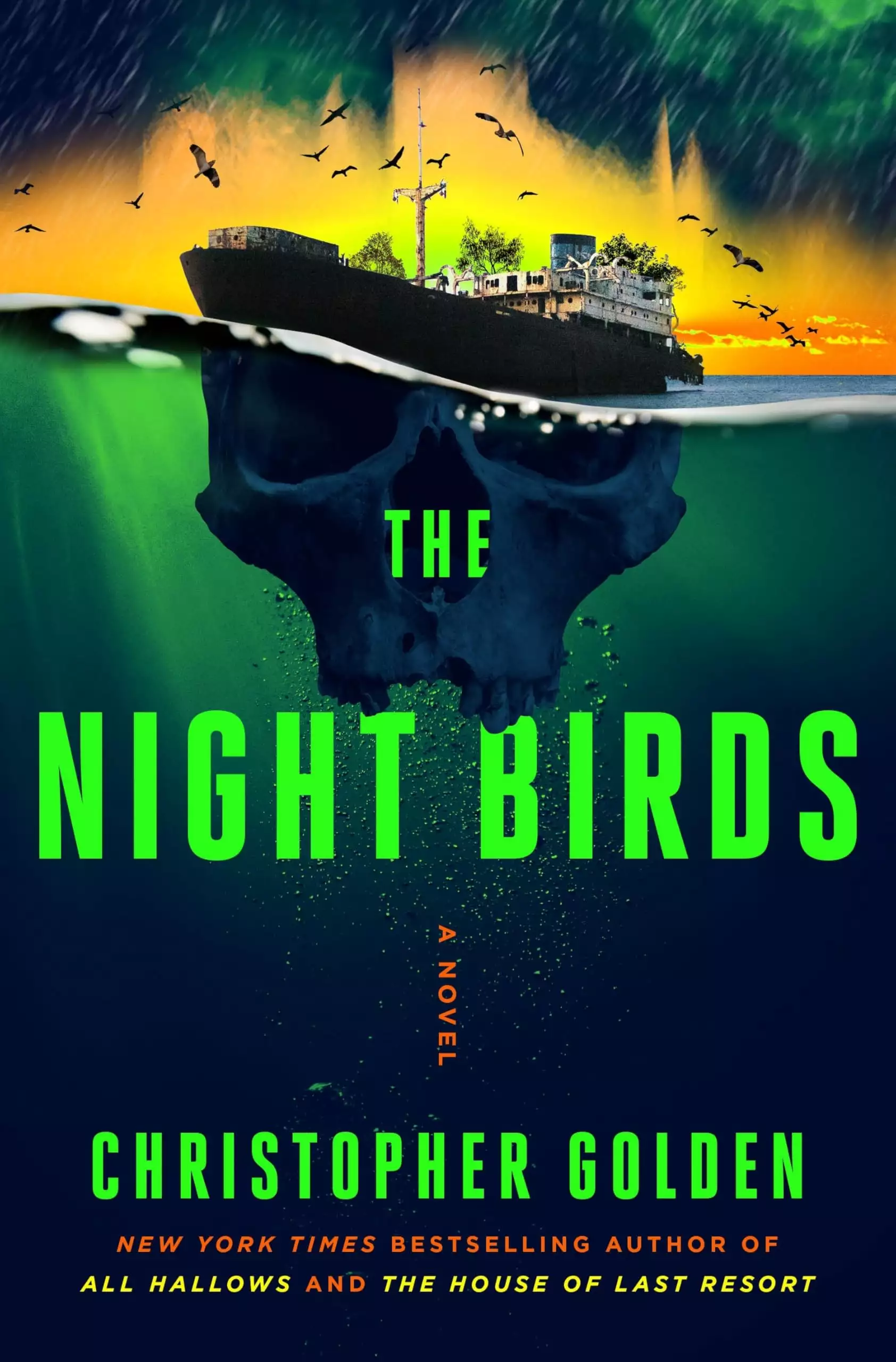
Over the years, in a stunning example of nature laying claim to
something forged by human hands, the ship had been infiltrated
by mangrove trees. Roots from the nearby shore grew underwa-
ter and up through the rusted iron hull, around broken masts and
smokestacks. The trees spread, growing across the still-intact
deck, braiding themselves into something beautiful and seem-
ingly impossible—a small mangrove forest that rose forty or fifty
feet above the deck. There was something spiritual about it all,
but Book didn’t dwell on that element of the floating forest. He
was here for the science.
Book liked to call it the floating forest, but when the Texas Parks
and Wildlife Department put together the funding request,
someone in the statehouse started referring to it as “the Chris-
tabel Project,” and it stuck. Book had gotten over it quickly. The
beauty of this strange phenomenon brought him serenity—which
was the main reason he had been living on board the Christabel
instead of in a Galveston hotel like the rest of the team.
Peace. Nature. An experience no one else could claim. As a
scientist, he didn’t believe in magic, but sometimes the world
around him offered moments and places and extraordinary ex-
periences that filled him with a sense of wonder and delight, and
that was magic enough.
So he would sleep out there tonight, just as he had every night
since he had departed the hotel more than three months ago.
The check came, and Book paid. Texas Parks and Wildlife
would reimburse him.
053-132485_ch01_5P.indd 10 28/01/25 5:16 AM
THE NIGHT BIRDS • 11
Alan stuck his phone back into his pocket. He sipped his café
au lait and glanced around at the rest of them. “Weird being here
on a Wednesday night.”
Gerald smiled thinly. “You’re not used to you and Book being
the only white people in the place.”
Alan shrugged. “There’s that. It’s also just quieter.”
“Might be because of the storm as much as it being a week-
night,” Luisa said.
“I don’t mind,” Alan added. He searched Gerald’s face. “I actu-
ally prefer it quieter. I also don’t mind being one of the only white
faces in the joint. Feeling out of place is not new to me.”
Gerald gave a knowing look, raised his coffee mug, and the
two men clinked cups.
Book’s mug was still half-full when he slid his chair back and
stood. “You all take your time. I’ve got a little bit of a drive, so I’m
going to head out. Assuming we don’t have a miraculous change
of weather, just stay home and enjoy the day off tomorrow, and
I’ll see you out on the wreck on Friday morning.”
“Book,” Luisa chided him.
He smiled, nodding. “I know. If we want the funding for this
thing, I need to stop calling it the wreck. I’ll see you in the forest,
then.”
The floating forest. That magical place, on a bed of rusted iron
and seagull shit.
As he left the Gumbo Diner, the door blew out of his hand. A
bell above the door jangled angrily as he managed to wrestle it
closed. The rain pelted him at an angle as he darted across the
parking lot toward his decade-old Subaru Forester. It had been a
deep green when he’d bought it, but now in the rain and the dark
and with the years gone by, it looked like the dusty chalkboard in
the old Pennsylvania schoolhouse in the town where he’d grown
up. He loved the Forester the way he’d loved that schoolhouse.
The car started right up, reliable as ever. The radio came on,
but static grated on him, and he clicked it off. The rain and the
053-132485_ch01_5P.indd 11 28/01/25 5:16 AM
12 • CHRISTOPHER GOLDEN
windshield wipers kept him company as he backed out of his park-
ing spot, then pulled into the street and headed for the bridge to
Pelican Island, happy to be on his own again.
Some people hated isolation, but Book thrived on it. The last
thing he’d want tonight would be company.
But the universe had been spoiling Book lately, giving him
exactly what he wanted. Tonight, that was going to change. ...
We hope you are enjoying the book so far. To continue reading...
Copyright © 2026 All Rights Reserved

 Please log in to recommend or discuss...
