At the darkly glamorous height of the Roaring 20s, an independent Black intellectual and her bi-racial foster child are immersed in the vibrant world of the Harlem Renaissance – and a shocking murder on Striver’s Row – in this thrilling Jazz Age mystery for reader of Nekesia Afia, Jacqueline Winspear, Avery Cunningham’s The Mayor of Maxwell Street.
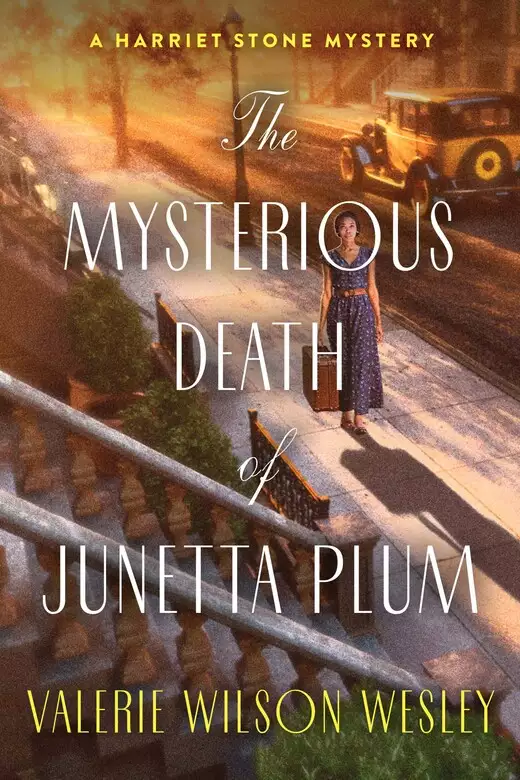
1926: Harriet Stone, a liberated, educated Black woman, and Lovey, the orphaned, biracial, 12-year-old she is bound to protect, are Harlem-bound, embarking on a new, hopefully less traumatic chapter in their lives. They have been invited to move from Connecticut by Harriet’s cousin, Junetta Plum, who runs a boarding house for independent-minded single women.
It’s a bold move, since Harriet has never met Junetta, but the fatalities of the Spanish flu and other tragedies have already forced her and Lovey to face their worst fears. Alone but for each other, they have little left to lose—or so it seems as they arrive at sophisticated Junetta’s impressive brownstone.
Her cousin has a sharp edge that makes Harriett slightly uncomfortable. Still, after retiring to her room for the night, she finally falls asleep—only to awaken to Junetta arguing with someone downstairs. In the morning, she makes a shocking discovery at the foot of the stairs.
What ensues will lead Harriet to question Junetta’s very identity—and to wonder if she and Lovey are in danger as well. It will also tie Harriet to five strangers. Among them, Harriet is sure someone knows something. What she doesn’t yet know is that one will play a crucial role in helping her investigate her cousin’s murder . . . that she will be tied to the others in ways she could never imagine . . . and that her life will take off in a startling new direction . . .
Release date:
December 16, 2025
Publisher:
Kensington Books
Print pages:
336
* BingeBooks earns revenue from qualifying purchases as an Amazon Associate as well as from other retail partners.
What is the worst thing that can happen? We could die! I chuckled and kept the thought to myself. It wasn’t the kind of thing you shared with a child, especially one as smart as Lovey. We rode in a crowded, smelly train headed for New York City, and neither of us was afraid of death. We’d seen too much of it creep up on those we loved: a sudden sore throat turned fatal, lungs bleeding beet red, bodies in death as blue as a jaybird. You’d kiss somebody good night, and they’d be stone-cold dead before daybreak. Spanish Lady, they called it, or Spanish flu, Purple Death, and a half dozen other names no proper lady said in public.
Seven years ago it came for Lovey’s mother, Alveda, leaving her five-year-old wailing and alone until my father picked her up and brought her home. A year later it came for my mother, Laura, and my brother, Robbie, who would be the same age Lovey was now. I knew Alveda from school; she was smart, sweet, too quick to smile. A girl who loved and let herself be loved too easily, which was how folks claimed she got the baby in the first place. Some took it upon themselves to warn us about loose behavior passing down from mother to child. But there was nothing careless about Lovey. I’d never seen a more serious child, one who rarely smiled and whose wide eyes always saw more than she let on. Lovey took nothing for granted and knew a lie when she heard one, so I never lied to her.
Her eyes were red now and stinging like mine from the fumes. Our car was filled with locomotive smoke, the price you paid for not having the money or status to sit at the front of the train. Those privileged ones were separated from burning cinders by the baggage and mail cars attached to ours. I was grateful that we would be changing to a different train in New Haven, one free of smoke and commotion. We were the only passengers left on this leg of the journey, and the conductor threw us a sour look when he glanced around the car. He was a thin, dour man who smelled like onions and whose pale skin had a yellowish hue. He stared hard at Lovey, probably wondering if she belonged up front, then gave a careless shrug and punched our tickets.
“I hate it when people look at me like I’m some kind of a jigsaw puzzle,” Lovey muttered after he’d gone. I knew what she meant. She’d heard more judgments based on notions about her race and color than any twelve-year-old should hear. We’d had this conversation before.
“Well, you do have unique pieces,” I said, trying to lighten things up.
“Unique pieces? I’m a child. You’re a grown-up lady. Can’t you come up with something better than that?” Lovey wasn’t having it.
“Half the time, I forget you’re a child, and half the time I forget I’m a grown-up lady,” I said, which was the truth. “I’ll tell you this, though. Someday all your unique pieces will come together. Perfectly.”
“That’s something Papa Stone would have said,” she said quietly. Papa Stone was what she called my father, whom she missed nearly as much as I did.
“Just wait till you get grown,” I said, offering another bit of wisdom from Papa Stone.
She scrunched her lips together in a smile like Alveda had, which brought her mother to mind, though they looked nothing alike. Alveda’s skin was the color of pecans, and Lovey’s like almonds, close to that of her father, the fun-seeking son of the rich white man Alveda had worked for. Alveda had never actually told anyone who had fathered her child, but most of us had guessed. Had she loved this man, been too ashamed or afraid to admit it? What about Lovey, crying there beside her as she died? Had she told her daughter who he was, or assumed in her carefree way that she’d tell the child when she grew up?
I picked up the cardboard box wedged near my feet in which our neighbor had packed some food for us to eat on the way. It was a short trip, but this was Bertha Carter bidding us good-bye. We’d gobbled down the fried chicken the moment the train pulled out of the station, and now I dug in for a Baby Ruth and a bag of jelly beans for Lovey, the only kid I knew who hated chocolate. We munched our candy in silence until, once again, I pulled out the crumpled letter stuffed in the bottom of my handbag.
I write to offer my condolences for the loss of your father, my dear cousin Robert. I board single women trying to make a way in this hard old world. I live in a brownstone left by my late husband. Since you are kin and we are both alone, I believe we can be of service to one another. I need your assistance and support as soon as you can come. Family is the only thing we have. Times are hard and getting harder for those like us. If you have never been to Harlem, now is the time to come. Everything is new and beginning, yet nothing is ever as it seems. I will send the money you need for travel.
It was signed Junetta Plum, the “dear cousin” my late father had never bothered to mention, and I would have remembered a name like that. She’d probably read about his death in a newspaper that published the obituaries of notable men, and Robert Stone was one. He was a boulder of a man, firmly lodged in the present, who never spoke about his family or his past. I knew he’d been enslaved as a child and freed by the woman he called “the General.” He named me, his firstborn, Harriet Tubman Stone, to honor her. Unfortunately, I never felt comfortable with this name. It was simply too heavy a mantle to carry. Though I wasn’t exactly a coward, I was often too cautious.
He died in October, age and illness having snatched away all his savings. His beloved barbershop was gone before he was. “Only place in Hartford a colored man can get a decent shave,” he used to brag. I missed that shop as much as he had. His apprentice, Solomon, who had been my fiancé, had died from drinking bad liquor the year before, and those two deaths had left me alone, broken, and in sole charge of a sassy twelve-year-old. If there was ever a time I needed the old warrior’s courage, it was now. This letter had found me right on time.
I board single women trying to make a way in this hard old world.
I would have been one of those women except for Lovey and Papa Stone. My friends who had lived through the plague and the war were hungry for life and felt it owed them a slice. Grief curtailed my appetite, leaving me in the past. Until one momentous day, I realized I was the only woman on the street whose skirt hit her three inches below her knees. I was unmarried, childless, and living in the house where I was born. If nothing more, packing up and fearlessly heading to New York City would give folks something to talk about. Considering that fact brought to mind Bertha Carter, fryer of chicken, whose bountiful body offered comfort whenever I needed to be hugged.
“Harriet, you don’t know what’s going to happen to you in a city as big as Harlem,” she warned when I told her I was leaving. “Prune? Who is this woman, anyway?”
“It’s Plum, and Harlem is a small part of the city, not the whole thing,” I explained politely, not for the first time. “Besides, Junetta is family.”
She shook her head in slow warning. “Family is not always what it seems. You don’t know nothing about her true nature, what kind of soul she has, nothing about her that matters.”
“What matters to me is that I trust things will turn out fine.” I could think of nothing better to say, though I wasn’t sure I believed it
“Harriet, you can’t trust things will turn out fine anymore. Folks can’t tell right from wrong. Gangsters and hoodlums have turned this country upside down. Killing, stealing, young girls using their fannies to make a buck.”
“That’s everywhere, Bertha, not just in cities. Thanks to Prohibition.” I treaded carefully, knowing she was a devoted member of the Woman’s Christian Temperence Union. Bertha had been my mother’s close friend and had lived next door to us for as long as I could remember. She’d endured the troubles we’d all seen with grace and grit, despite a lying husband who betrayed her every time he stepped out the door. Her advice was not to be taken lightly.
“Did you see that thing in the paper about the Klan meeting in Fairfield? That’s not that far from here,” I said, determined to change the subject and win a point.
Bertha wrinkled her brows and agreed. “Some folks just don’t know when to let it go. Remember the Klan marching down Pennsylvania Avenue couple months before your daddy died? Enough to send a good man to his grave. Some be smiling in your face, selling you a loaf of bread, and next thing you know, they done pulled on a sheet.”
A new round of lynchings was happening again. What people called Black Wall Street had been burned to the ground in Tulsa a few years back, and fear of that had hit my father hard. He was a proud small businessman, too, like those whose lives had been taken in Oklahoma, and he knew if you weren’t humble enough, you’d end up paying, like they had. Our boys had gone to war and come back men unwilling to scrape and bow. Pride had taken root in men’s souls, and they had paid a price for that. Two years after the war had ended, so much blood was spilled, folks took to calling it the Red Summer. Hatred and evil knew no boundaries.
“Hartford is safe. Nothing will happen to you here,” Bertha continued. “Folks know you, look out for you, just the way your daddy did.”
When we’d needed comfort, love had always embraced us here, from the pews of Talcott Street Church to the roughest alley in Hartford’s North End. Plates of food—fried, boiled, stewed—would pour in from all over town. Notes would be scribbled by those who found writing hard, and prayers said aloud by those who couldn’t read. Papa Stone’s barbershop had been a place of goodwill, a space for people to laugh, shout, and know they were safe. Men could say things there they dared not say in public, including quoting lines from copies of The Crisis and The New York Age, which were scattered throughout the shop. When it closed, a hole was torn in the heart of Afro-American Hartford.
Yet a small city is as confining as a small town, as gossipy and cruel. We had had money when my father was alive, a place to fit in and be. But despite the freedom women my age were supposedly enjoying now I was unmarried, with no prospects. I had cast my vote for the past six years, had had my say when I felt like it. A few years ago, I could buy liquor, take a nip, and not end up dead like Solomon. I was trained as a teacher and had worked as an accountant for my father, but I suspected people pitied me now, considered me a “spinster,” one saddled with somebody else’s child. Nobody knew where to put either of us.
The older Lovey got, the less sure of herself she became. I’d seen her turn shy and stumbling, fearful around kids she’d known all her life. She was tall for her age, and some of it was simply being twelve—betwixt and between—yet it was harder for Lovey. Sides were chosen—black, white, rich, poor, pretty, plain—and she didn’t fit. Her spark, so lively and sure, was dimming.
“Don’t you dare forget me, Miss Harriet Stone, and don’t you let Lovey, with all that thick, pretty hair, forget me, neither,” Bertha warned more than once. Lovey’s hair, long, often tangled and remarked upon, was a gift from Alveda. “You sure you got to go?”
“Auntie Bertie, I need a change. An adventure!” I said, pleading for understanding, using the name I’d called her as a child.
“Then be on your way. Do what you got to do.” She didn’t bother to hide her disappointment.
I was too proud to tell her how poor my father’s death had left us. We were living in a house I could no longer afford and I’d had to sell, and the money from that was dwindling fast. I needed more help, financial and otherwise, than she or any other well-meaning neighbor could imagine. I had no choice.
If you have never been to Harlem, now is the time to come. Everything is new and beginning, yet nothing is ever as it seems.
Two months after my father died, Alain Locke’s anthology The New Negro came out and saved what life I had left. There is a “fresh spiritual and cultural focusing,” Locke had written in his foreword. Sadly for me, that spiritual focusing had come, gone, and left me sitting on my behind in Hartford. Countee Cullen, Langston Hughes, Anne Spencer—writers I’d never heard of who were nearly the same age as me—were cracking open a world I’d missed out on. That book became a bible for me, read last thing at night, before I went to sleep, and first thing in the morning, when I drank my coffee. Five years ago, there’d been a wave of excitement in Hartford when Florence Mills became the toast of Broadway, but this world was newer, faster, touching everything, waiting for nothing.
Where had I been? I’d read The Great Gatsby in one sitting last year and yearned to make my way in New York City as fervently as Nick Carraway, but Papa Stone had been alive then, and it had been a fanciful dream. Now red tulips had pushed their way up, and the pink hyacinths on the corner were about to bloom. It was Friday, the second day of April. I hoped I wouldn’t end up as some kind of April fool.
I was determined to meet whatever came my way with some semblance of style. I was a reasonably good seamstress, with an eye for copying patterns. Inspired by Harper’s Bazaar, I cut my long-waisted tunic with its matching pleated skirt from a cheap navy jersey, then hemmed it short so it hit me right at my knees. With Madame Walker’s help, I tucked my mind-of-its-own hair under a classy black cloche, then looped my mother’s pearls around my neck. Three times, so I could pass for a flapper (if you squinted and didn’t look hard).
I thought about my mother, dead six years now, her death and that of my brother marking the end of the plague as surely as Alveda’s had marked the beginning. I was blessed to have had her for as long as I had, each memory as precious and singular as these pearls. Far luckier than Lovey. I’d been “the mother” in her life far longer than Alveda. When she came to live with us, I was too young to become the “grown lady” she desperately needed, and was more like an older sister. Unfortunately, that was still the case.
I watched her pick through the bag of jelly beans now, eating the black ones first, then the reds, and finally the greens.
“Penny for your thoughts?”
“Dollar!”
I reached in my handbag and gave her the one I had tucked away for emergencies.
“You got ten?”
“When I get it.”
She parted her lips into half a smile and bit the last green jelly bean in half before eating it.
“Did you tell her about me, this Junetta lady we’re going to live with?”
“Of course,” I told her. “Why? Did you think I wouldn’t?”
She shrugged and gazed out the window before answering. “So what did you say?”
“That you’re family.”
“What about the rest of it? My unique pieces?” She rolled her eyes dramatically.
“Of course I told her.”
“What did she say?”
“What do you mean, what did she say?”
“Harriet, you know what I mean! What did she say?”
“Well, all we know for sure is that she sent the money,” I said, which brought a grunt of a laugh from Lovey before she grew serious again.
“We’re going to be okay, aren’t we?” Fear filled her voice and those unblinking eyes.
I waited before answering, wondering if maybe now I should act like a grown-up lady and tell this child that things would be fine, that I’d made the right decision, that our lives would change for the best. After seven years, though, I knew better than that.
“Lovey, I really don’t know,” I said, speaking the only truth there was.
We stopped dead in our tracks on the way to meet Junetta Plum. Penn Station was said to b. . .
We hope you are enjoying the book so far. To continue reading...

 Please log in to recommend or discuss...
