She watched as the final hours of The Artist is Present passed by, sitter after sitter in a gaze with the woman across the table. Jane felt she had witnessed a thing of inexplicable beauty among humans who had been drawn to this art and had found the reflection of a great mystery. What are we? How should we live?
If this was a dream, then he wanted to know when it would end. Maybe it would end if he went to see Lydia. But it was the one thing he was not allowed to do.
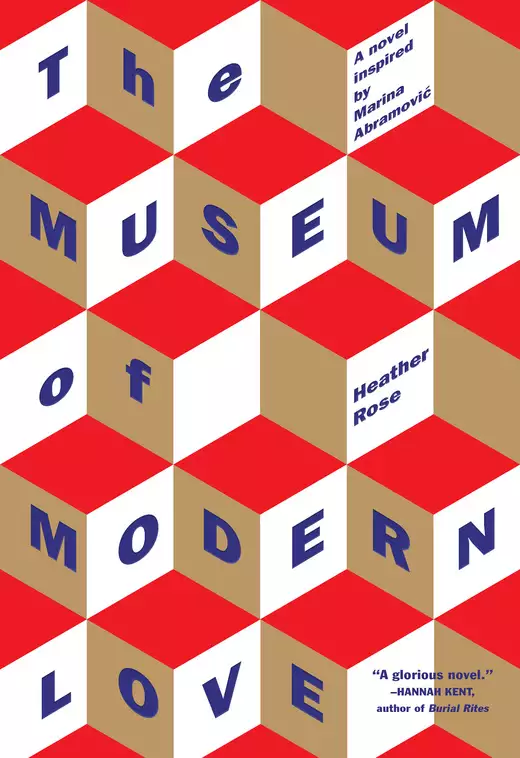
Arky Levin is a film composer in New York separated from his wife, who has asked him to keep one devastating promise. One day he finds his way to The Atrium at MOMA and sees Marina Abramovic in The Artist is Present. The performance continues for 75 days and, as it unfolds, so does Arky. As he watches and meets other people drawn to the exhibit, he slowly starts to understand what might be missing in his life and what he must do.
This dazzlingly original novel asks beguiling questions about the nature of art, life and love and finds a way to answer them.
Publisher:
Algonquin Books
Print pages:
288
* BingeBooks earns revenue from qualifying purchases as an Amazon Associate as well as from other retail partners.
He was not my first musician, Arky Levin. Nor my least successful. Mostly by his age potential is squandered or realized. But this is not a story of potential. It is a story of convergence. Such things are rarer than you might think. Coincidence, I’ve heard, is God’s way of being discreet. But convergence is more than that. It is something that, once set in motion, will have an unknown effect. It is a human condition to admire hindsight. I always thought foresight was so much more useful.
It is the spring of the year 2010 and one of my artists is busy in a gallery in New York City. Not the great Metropolitan, nor the Guggenheim, serene and twisted though she is. No, my artist’s gallery is a white box. It’s evident that within that box much is alive. And vibrating. But before we get to that, let me set the scene.
There is a river on either side of this great city and the sun rises over one and sets over the other. Where oak, hemlock, and fir once stood besides lakes and streams, avenues now run north–south. Cross streets mostly run east–west. The mountains have been leveled, the lakes have been filled. The buildings create the most familiar skyscape of the modern world.
The pavements convey people and dogs, the subway rumbles, and the yellow cabs honk day and night. As in previous decades, people are coming to terms with the folly of their investments and the ineptitude of their government. Wages are low, as are the waistbands of jeans. Thin is fashionable but fat is normal. Living is expensive, and being ill is the most costly business of all. There is a feeling that a chaos of climate, currency, creed, and cohabitation is looming in the world. On an individual basis, most people still want to look good and smell nice, have friends, be comfortable, make money, feel love, enjoy sex, and not die before their time.
And so we come to Arky Levin. He would like to think he stands apart from the riffraff of humanity, isolated by his fine musical mind. He believed, until recently, that he was anesthetized to commonplace suffering by years of eating well, drinking good wine, watching good movies, having good doctors, being loved by a good woman, having the luck of good genetics, and generally living a benign and blameless life.
It is April 1, but Levin, in his apartment on Washington Square, is oblivious to the date and its humorous connotations. If someone played a practical joke on him this morning, he would be confused—possibly for hours. The morning sun is spilling into the penthouse. Rigby, a gray rug of cat, lies sprawled on her back on the sofa with her paws stretched high above her head. In contrast, Levin is curled forward over a Model B Steinway, his fingers resting silently on the keyboard. He is so still he might be a puppet awaiting the first twitch of the string above. In fact, he is waiting for an idea. That is usually where I come in, but Levin has not been himself for many months. To write music he must hurdle over a morass of broken dreams. Every time he goes to leap, he comes up short.
Levin and I have known each other a very long time, and when he is like this he can be unreachable, so caught on the wheel of memory he forgets he has choices. What is he remembering now? Ah yes, the film dinner from the night before.
He had expected questions. It was why he’d avoided everyone, hadn’t attended a function since December. It was still too raw. Too impossible. For the same reason he’d ignored emails, avoided phone calls, and finally unplugged the answering machine in February after one particularly upsetting message.
And then last night, in a living nightmare, three of them had gotten him at one end of the room and harangued him, berated him. Outrageous claims of abandonment and lack of responsibility.
“You don’t seem to realize I had no choice in this,” he had told them.
“You’re her husband. If it was the other way around . . .”
“Her instructions are perfectly clear. This is what she wants. Do I have to send you a copy of the letter?”
“But, Arky, you’ve abandoned her.”
“No, I haven’t. If anyone has been abandoned . . .”
“Please tell me you are not suggesting, Arky, that you have the raw deal here?”
“You can’t just leave her there.”
“Well, what exactly did you have in mind?” he had asked. “That I bring her home?”
“Yes, for God’s sake. Yes.”
They had all seemed stunned at his reluctance.
“But she doesn’t want that.”
“Of course she does. You’re being unbelievably blind if you think anything else.”
He had excused himself, walked the twenty blocks in a rage, aware also that he was weeping and grateful for the handkerchief he never went anywhere without. The bitter taste of helplessness lingered on his tongue. He scratched at the rough patch on his hand that might be cancer. He thought of the night sweats too. Waking drenched at 3 a.m. Having to change his soaked pajamas and slide over to the other, empty side of the bed where the sheets were dry. He wondered if it was his heart. If he died in the apartment it could be days before anybody noticed. Except Rigby, who would possibly settle on his corpse until she realized he was not getting up to feed her. It would be Yolanda, their housekeeper, who would find him. Yolanda had been in their life for years. Ever since they were married. Lydia had thought it as normal to employ a maid as keeping milk in the fridge. She had stayed on, Yolanda, through the move to Washington Square. Levin never liked to be home when Yolanda came. Lydia was good at small talk with shop people and teachers and tradespeople. Levin was not.
Levin thought that if he died, the trees on the deck in their tall glazed pots would almost certainly die too for lack of water. He got up and made another pot of coffee, sliced an onion bagel, and lowered one round into the toaster. Within minutes it was smoking and blackened. With the second half he assumed complete vigilance, spearing the thing with a knife when he sensed it was ready, hoisting it up, and reinserting it in a slightly different position. Why had Lydia bought this particular toaster and not a version that didn’t destroy his breakfast every morning? How was it possible they could invent drones to kill a single man somewhere in Pakistan, but not perfect the toaster?
Leaving his plate and cup in the sink, Levin washed his hands and dried them carefully before returning to the piano. On the music ledge was an illustration of a Japanese woman with long blue-black hair and vivid green eyes. He wanted to write something spellbinding for her. A flute would be good, he had decided a few days before. But everything he came up with reminded him of The Mission. He felt like a beginner again, searching through old melodies, attempting transitions that didn’t work, harmonies that tempted and then became elusive.
And so for the next few hours Levin immersed himself in the process, moving from the Steinway in the living room, where so many of his ideas began, to his studio in the western end of the apartment with its Kurzweil keyboard, Bose speakers, and two iMacs giving him every variation of instrument at his fingertips. He took the ink drawing with him and put it back on the corkboard where storyboard sequences in the same distinctive style were pinned. There were also more illustrations of the same Japanese woman. In one she was bending over a pool of water, her dress the green and shimmer of fish scales. In another she was reaching out to touch the nose of a huge white bear. And in another she was walking with a child along a snow-laden path, red leaves the only touch of color.
Levin switched from flute to violin on the keyboard, hearing the same transitions from C to F to A minor. But violin wasn’t right. It was too civilized for forest and river. I suggested the viola, but he dismissed me, thinking it too melancholy. But wasn’t melancholy what he was looking for?
I had encouraged him to take this film score because solitude may be a form of contentment when you live in a fairy story, but not when you are an artist in New York who believes your best years are still ahead of you. Artists are stubborn. They have to be. Even when nothing is happening, the only way through is to work and work.
I drew Levin’s attention to the day outside. He went to the window and saw sunlight dazzling the fountain in Washington Square. Purple tulips were blooming on the walkways. He looked again at the audio file on his screen. I reminded him of the previous evening, before the women had pinned him against the table. He had sat with his old mentor, Eliot, who had told him of the Tim Burton exhibition at MoMA. It was not the Burton I wanted him to see, but it was a way of getting him there. For all he wasn’t listening to my musical suggestions, he was amenable to an interruption.
“You will have to wait,” he said to the Japanese woman, but he might as well have been talking to me. In his bedroom he chose a favorite blue Ben Sherman jacket and his dark gray Timberland slip-ons.
He took the E train and got off at Fifth Avenue, crossed the street and walked into the Museum of Modern Art. With the membership Lydia bought them each year, he skipped the lengthy line for tickets. The narrow corridor to the Burton exhibition was jammed with people. Instantly he was surrounded by the warmth of bodies, the gabble of voices. Within a few minutes the illustrations of stitched blue women, their wide-eyed panic and long-limbed emptiness, mingled with the odor and proximity of warm bodies, began to make Levin nauseated. He saw with relief an exit sign. Pushing open the door, he found himself in an empty corridor. He stopped, leaned against the wall, and breathed.
He intended, at that moment, to go downstairs and sit in the sculpture garden to enjoy the sunshine. Then the murmur from the atrium drew him in.
In the atrium of MoMA, visitors were observing a woman in a long red dress sitting at a table. It was a blond wood table with blond wood chairs, as if it had come from IKEA. Opposite the woman in the red dress, a younger woman sat wearing a lightweight beige coat. The two women were gazing into each other’s eyes.
Levin noticed white tape on the floor marking out a square. People rimmed this square. Some were standing, others were sitting cross-legged, and all of them were watching the two women at its center.
Levin heard a small girl ask, “Mom, is that lady plastic?”
“No, of course she’s not,” the mother replied in a hushed voice.
“What is she, then?” the girl asked. “Mom? Mom?”
The mother had no answer and her gaze did not leave the spectacle in front of her.
Levin could see the child’s point. The woman in the red dress was like plastic. Her skin looked as if the floodlights had bleached her to alabaster.
Suddenly, without any cue, the young woman got up and left the table. The woman in the long dress closed her eyes and bowed her head, but remained seated. After some moments a man sat down in the empty chair. The woman now raised her head and opened her eyes to look directly at him.
The man had a crumpled face with untidy gray hair and a short hooked nose. He looked small opposite the woman. The two of them gazed into each other’s eyes. More than gazing, Levin thought. Staring. The woman did not smile. She hardly even blinked. She was entirely still.
The man rearranged his feet and his hands twitched on his lap. But his head and eyes were very still as he looked back at the woman. He sat like that for maybe twenty minutes. Levin found himself absorbed by this spectacle, unwilling to leave. When the man finally left the chair, Levin watched him walk to the back of the atrium and lean his forehead against the wall. Levin wanted to go ask the man what had happened as he sat. How had it felt? But to do so, he realized, would be like asking a stranger what he prayed for.
By then another woman—middle-aged, broad-faced, tortoiseshell glasses—was sitting. Levin moved toward the black lettering on the wall that read: The Artist Is Present—Marina Abramović. The text beneath was obscured by the crowd entering and exiting the room.
A professional photographer appeared to be documenting everyone who came and went from the table through a long lens mounted on a tripod. Levin nodded to him and the young man smiled briefly. He wore black pants and a black turtleneck, a three-day growth on his perfect jawline. When you lived in the Village you could be forgiven for thinking that cantilevered cheekbones and sculptured bodies were taking over the world.
The middle-aged woman sitting opposite the person Levin assumed was Marina Abramović had never been beautiful. She left after only a few minutes and the crowd took the opportunity to dissipate. Levin heard comments as people made their way to the stairs.
“Is that all that happens? Does she just sit?”
“Don’t you want to see the Picassos?”
“Do you think there’s any chance we’ll get a table? My feet are killing me.”
“Do you really want to try to get to M&M’s World today?”
“Have you seen the Tim Burton? It’s so crowded.”
“Is there a restroom on this floor?”
“What time was she meant to be here?”
Levin returned to the side of the square where he could see both people in profile once more. He sat down on the floor. A young man now sat opposite the woman. He was strikingly handsome with luminous eyes, a wide mouth, and shoulder-length curls, the face of an angel sent to visit dying children. Levin was interested to see if the woman would respond to this aesthetic but she didn’t, as far as he could see. She maintained the exact same gaze she’d been giving everyone else. She gazed gently and intently. Her body didn’t move. She sat very straight with her hands in her lap. From time to time her eyelids blinked but nothing else.
A hush descended on the atrium. It became evident that the young man was weeping. It wasn’t a dramatic gesture. Tears were running down his face while his glistening angel eyes continued to gaze at the woman. After some time, the woman began to weep in the same silent passive way. The weeping went on as if they could both see they must settle for losing something. Levin looked about and realized the atrium had quietly filled again and everyone was staring at the two people.
Levin thought there ought to be music. The woman in red was surrounded by the crowd and she was alone. It was utterly public but intensely private. A woman beside Levin pulled out her handkerchief, wiped her eyes, and blew her nose. Catching his glance, she smiled self-consciously. Along the row of faces watching the performance, Levin saw that many eyes were wet with tears.
Time went by and the man at the table was no longer weeping. He was leaning in toward the woman. Everything between the man and the woman became microscopic. Levin felt that something was lifting right out of the man and creeping away. He didn’t know if it was a good thing or a bad thing, but it was unfolding. The woman seemed to become enormous, as if she stretched out and touched the walls and stood as tall as all six floors of the atrium. Levin closed his eyes and breathed. His heart was racing. When he opened them again, she was once more a woman in a red dress, the right size, no longer young but full of virility and elegance. Something about her was as alluring as polished wood or light catching a sleeve of antique silk.
The afternoon passed. Levin didn’t want to leave. The man on the chair stayed too and the gaze between him and the woman never wavered. People moved in and out of the room, their mingled voices rising and falling. At 5:15 p.m. an announcement over the loudspeaker informed them the gallery would be closing in fifteen minutes. The suddenness of it made Levin jump. People leaned away from walls and looked about. Men and women rose from the floor, stretching out knees and hips and calves. Gathering their belongings, they smiled at one another, lifting their eyebrows in looks of mutual curiosity. Others shook their heads almost imperceptibly, as if they had quite forgotten where they were and how late was the hour. Soon there was just a smattering of onlookers keen for the last moment.
The man and the woman remained motionless in the center of the room, their gazes still locked. At 5:25 a MoMA official walked across the square and spoke quietly to the man. He bowed his head to the woman and stood up. Some people clapped.
“The gallery is closed,” another official said. “Please leave.”
Levin stood and stretched. His knees ached and numbness became pain as he walked toward the stairs. The woman was alone at the table, her head bowed. Only the photographer remained. Levin looked for the man with the angel eyes in the emptying lobby, but he had disappeared.
Emerging onto West 53rd, he heard a woman remark to her female companion, “She must be dying for the restroom.”
“What day is this?” the friend asked.
“Day twenty-three, I think,” the woman replied. “She’s got a long way to go.”
“I expect she has one of those tubes,” the companion offered. “You know, and a bag. I mean, who could wait all day?”
“You mean a catheter?” the first woman asked.
They disappeared into the subway entrance. Levin headed east to Fifth. He walked hearing nothing but the hush of the gallery crowd and the silence between the man and the woman. It was an oboe, he thought. An oboe that played off against a viola.
Once home he wished that Lydia was there. He wanted to tell her about the woman in the red dress and the crowd and the walk home. But the apartment was silent. He sat at the Steinway and, working up and down the keyboard, he teased out the melody he had glimpsed. He played as the city grew black and neon suffused the sky.
I watched him. There is nothing more beautiful than watching an artist at work. They are as waterfalls shot with sunshine.
Night crowds ebbed and flowed across Washington Square below. Levin’s shoulders and hands grew weary. At last, in an act of utter tenderness, he let his hand drift across the black sheen of the piano before closing the lid over the keys.
In bed, he turned onto his right side, imagining that at any moment Lydia would slip in beside him and hold him, and darkness would wing them to sleep.
There I left him and went back to MoMA. I stood in the atrium and considered the two empty chairs and the simple table. Every hour of the day an artist falls to earth and we fall beside them. I fell a long time ago with Arky Levin. But I fell before that beside Marina Abramović.
Jane Miller was not an artist. She noted Levin’s dark pants, white shirt and blue linen jacket, his wavy silver hair and round glasses, the slip-on shoes and manicured hands. She would have liked to speak to him but he seemed lost in thought and she did not want to interrupt. The lunchtime crowd about her was swelling along the boundaries of the square. A boy of maybe sixteen was sitting opposite Marina Abramović. Jane observed the great mop of brown hair above the boy’s elfish face. The sweet turned-up nose. The oversized jacket the boy wore and his long feet. He slouched in the chair as if Abramović was a school principal about to lecture him on his behavior. But he did not take his eyes from hers.
Earlier that morning Jane had strolled through the lobby of her hotel and out onto Greenwich Street, catching sight of the silhouette of a man standing high on the edge of a nearby building. She had squinted, puzzled, ready to be alarmed. But then with a thrill she recognized it as one of the Antony Gormley sculptures dotting New York’s skyline through spring. On rooftops uptown and down, the city was being visited by watchful beings who appeared to speak not to the mortals moving on the pavements below, but to the space beyond the building. Take one step and fall twenty, thirty, fifty storeys down.
What was the space beyon. . .
We hope you are enjoying the book so far. To continue reading...

 Please log in to recommend or discuss...
