'Even more thrilling than the plot is the atmosphere of shuddering suspense . . . No one brews it better than Agatha Christie' Daily Express
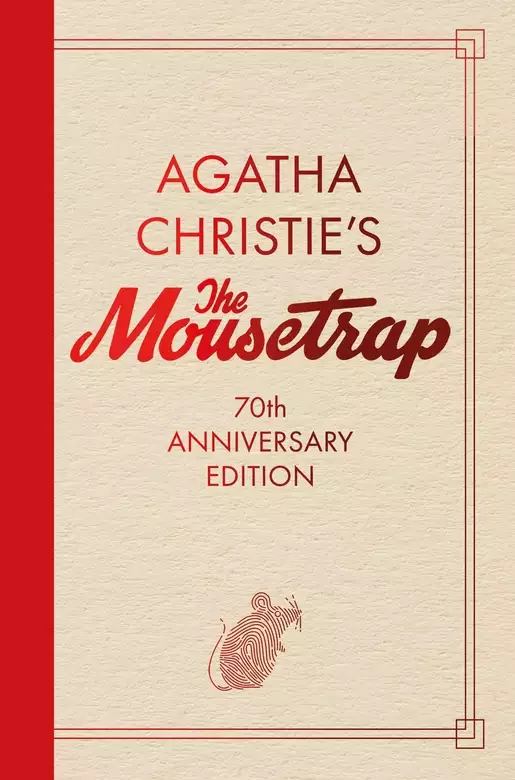
For more than 70 years, Agatha Christie's The Mousetrap has kept millions of people, from every corner of the globe, on the edge of their seats, and it continues to be a sell-out hit of London theatre. This brand new edition of the world's longest-running play contains a new introduction by Sophie Hannah, bestselling author of the authorised Agatha Christie Poirot continuation novels, as well as the official play script and a host of exclusive material from the show's archives.
As news spreads of a murder in London, a group of seven strangers find themselves in a remote countryside guesthouse. When a police sergeant arrives, the guests discover - to their horror - that a killer is in their midst. One by one, the suspicious characters reveal their sordid pasts. Which one is the murderer? Who will be their next victim? And can you solve this world-famous mystery for yourself?
This beautiful 70th anniversary edition contains an introduction by Sophie Hannah, the official playscript, an exclusive interview with producer Adam Spiegel, a treasure trove of letters, speeches, photographs, and other fascinating insights into the making of this iconic play.
Release date:
March 30, 2023
Publisher:
Orion
Print pages:
224
* BingeBooks earns revenue from qualifying purchases as an Amazon Associate as well as from other retail partners.
My favourite story about Agatha Christie’s The Mousetrap is one that Mathew Prichard, Christie’s only grandson, told me: he remembers being in the bath one day at his childhood home in Wales, and through the bathroom door he overheard a conversation between Christie and her son-in-law Anthony Hicks. Christie had just found out that there was a potential problem with giving her forthcoming stage play the same title as her radio play upon which it was based: Three Blind Mice.
Christie originally wrote Three Blind Mice in response to a request from Queen Mary, the wife of King George V, for a new Agatha Christie story for her 80th birthday. The BBC approached Christie and she agreed. The 30-minute play was broadcast in 1947. Christie then wrote a short story version, also called Three Blind Mice, and this was published in Cosmopolitan magazine in the US in 1948 and later in the 1950 collection Three Blind Mice and Other Stories. When asked to turn the story into a stage play, Christie’s original intention had been to use the same title, but the producer of a completely different West End play called Three Blind Mice insisted that a new name be found.
Mathew Prichard remembers hearing his grandmother expressing frustration about the need to ditch a perfectly good title and find a new one. He heard Anthony Hicks say, ‘What about The Mousetrap?’ and Christie concede that, yes, The Mousetrap might work as an alternative. Ever since Mathew told me this story, it has stuck with me – the accidental overhearing by a child, who couldn’t possibly have realised the significance of the conversation at the time, of the moment at which this vital artefact of cultural history, the world’s longest-running play, was named.
The Mousetrap is, of course, the perfect title for Christie’s dramatic masterpiece. It also strikes me as ideal that it was prevented from having the same name as its radio play predecessor. No one knew how significant and famous the play would become when the possibility of a stage version was first mooted, but it feels entirely right that it has its own unique name.
In her autobiography, Christie wrote that she expected the play to run for a maximum of eight months; it broke the record for the longest-running West End play in 1957 and is now the longest-running play of any kind in the history of theatre. On his ninth birthday, Mathew Prichard was gifted the rights to The Mousetrap by his grandmother, who might not have known that he had been hoping for a bike! The film rights to the play were sold in 1956, but a clause prevented the film being made while the West End show was still running and, to this day, the only film adaptations in existence are unofficial Bengali and Russian versions.
My personal connection to The Mousetrap began with a spoiler! A famous and crucial feature of the play is that, having discovered whodunnit, the audience is sworn to secrecy before they leave the theatre. Well, I spoilered The Mousetrap for myself by inadvertently reading an online blog about some of Christie’s major works, which gave away the secret without first issuing a warning. By this time, I had been asked by none other than Mathew Prichard and his son James to write the first new Poirot novel since Christie’s death, and I had eagerly accepted the challenge. Part of the reason I was offered the opportunity was that I was known to be a Christie superfan: I had been reading and re-reading her novels since the age of twelve and raved about their brilliance in public whenever I had the chance. But I had not yet seen The Mousetrap and, knowing it was among the crown jewels of her oeuvre, I was planning to go as a special treat for me and my family, as soon as I had finished and delivered the manuscript of my first Poirot novel.
My dismay upon reading this spoiler, therefore, was not insignificant. However, I soon perked up after reminding myself that one of the great things about Christie’s work is that it is equally enjoyable to read or watch when one knows the solution as when one does not. This is one of the key pieces of evidence that Christie is not merely a superb mystery plotter but also a genius in a more literary sense; the pleasure offered by every word, line and scene, and in watching how it all comes together, even when one already knows some or all of the details, is immense, and the reader, or watcher, is impressed every time by much more than the simple answers to the questions of who- and whydunnit.
When my husband, children and I finally went to see The Mousetrap, I was the only one of our party who was a fan of murder mysteries, but all four of us absolutely loved the play. I remember the kids’ faces shining with delight at the end. ‘That was so brilliant!’ they said, before I had a chance to ask them if they had enjoyed it. My husband, whose favourite form of entertainment theatre is not, and who enjoys critiquing things he has seen (particularly if he has been ‘encouraged’ to watch them by his bossy wife), had not one single criticism to offer. ‘Amazing,’ he said. ‘Loved it. Just brilliant.’
As we left the theatre, I wondered aloud to my family, ‘Will there ever be another murder mystery play as brilliant as The Mousetrap? Probably not.’ As I said those words (well, perhaps ten or twenty seconds later, to be strictly accurate), I had a brilliant, simple, high-concept idea for a murder mystery play: a stranger arrives at the home or office of a detective or amateur sleuth, says nothing more than ‘I am the murderer’ and then disappears. The detective’s task is to find out a) who this man is and b) what murder or murders he has committed, if any.
When my family and I got home, I sat down immediately with my notebook and developed the idea further, thinking of it as ‘my Mousetrap’. (Note: I did not for a second think it might be as good or as successful as The Mousetrap; nevertheless, it had been very clearly inspired by watching Christie’s play, so the nickname stuck.) With the help of my composer friend Annette Armitage, I added songs (for which Annette wrote the brilliant music), because I love musicals as much as I love murder mysteries, and soon The Mystery of Mr E was being performed in several locations in the UK. As I write this introduction, filming of the screen adaptation is just about to finish. None of this would be happening if I had not been to the theatre to watch The Mousetrap that day and been so inspired by it.
The Mousetrap’s popularity and prominence shows no sign of subsiding. It has been staged in more than 27 languages and 50 countries, and after 70 years as a UK stage hit, it’s heading to Broadway.
Long may it reign!
Sophie Hannah, February 2023
The Mousetrap’s first programme
SCENE – The Great Hall at Monkswell Manor. Late afternoon.
The house looks not so much a period piece but a house which has been lived in by generations of the same family with dwindling resources. There are tall windows up C; a big arched opening up R leading to the entrance hall, the front door and the kitchen; and an arched opening L leading upstairs to the bedrooms. Up L leading off the stairs is the door to the library; down L is the door to the drawing room; and down R the door (opening on stage) to the dining room. R is an open fireplace and beneath the window up C a window seat and a radiator. The hall is furnished as a lounge. There is some good old oak, including a large refectory table by the window up C and an oak chest in the entrance hall up R. The curtains and the upholstered furniture – a sofa LC, an armchair C, a large leather armchair R, and a small stool down R – are shabby and old-fashioned. There is a combined desk and bookcase L, with a radio and telephone on it. There is another chair up RC by the window, a Canterbury containing newspapers and magazines above the fireplace, and a small half-circular card table behind the sofa. There are two wall brackets over the fireplace which are worked together; and a wall bracket on the L wall, one L of the library door and one in the entrance hall, which are also worked together. There are double switches L of the arch up R and on the downstage side of the door down L, and a single switch on the upstage side of the door down R. A table lamp stands on the sofa table.
Before the CURTAIN rises, the house lights fade to a complete BLACKOUT and the music of “Three Blind Mice” is heard.
VOICE ON THE RADIO:
... and according to Scotland Yard, the crime took place at twenty-four Culver Street, Paddington.
(The lights come up, revealing the hall at Monkswell Manor. It is late afternoon and almost dark. Snow can be seen falling heavily through the windows up C. There is a fire burning. A freshly painted signboard is standing on its side on the stairs against the archway L; it has on it in large letters: MONKWELL MANOR GUEST HOUSE)
The murdered woman was a Mrs Maureen Lyon. In connection with the murder, the police are anxious to interview a man seen in the vicinity, wearing a dark overcoat, light scarf and a soft felt hat.
(MOLLIE RALSTON enters through the arch up R. She is a tall, pretty, young woman with an ingenuous air. She puts down her handbag and gloves on the armchair C then crosses to the radio and switches it off during the next speech. She places a small parcel in the desk cupboard)
Motorists are warned against ice-bound roads. The heavy snow is expected to continue, and throughout the country there will be a certain freezing, particularly at points on the north and north-east of Scotland.
MOLLIE:
(calling) Mrs Barlow! Mrs Barlow!
(Receiving no reply, she crosses to the armchair C, picks up her han. . .
We hope you are enjoying the book so far. To continue reading...

 Please log in to recommend or discuss...
