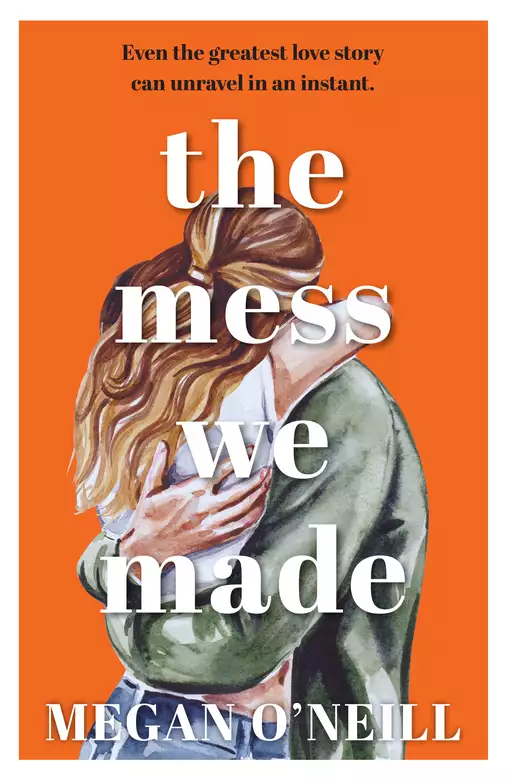
The Mess We Made is an addictive will-they-won't-they debut love story about whether there can ever be a second chance for your first love.
Quin and Henry meet as kids and quickly become inseparable... They are high-school sweethearts until one night, one bad decision shatters everything.
Years later, Quin's stuck working at a local takeaway. She's not spoken to Henry since he left town nine years ago. She barely talks to her twin brother Josh, and their mum has early-onset Alzheimer's - Quin's dealing with the fact that she might get it too.
When Henry suddenly returns - and keeps showing up at work to walk Quin home - she feels herself falling all over again. But his reappearance triggers the secret she's kept buried for the past nine years, and she doesn't know if she can trust Henry not to disappear on her when he learns the truth.
If you love the millennial angst of Normal People and the addictive appeal of It Ends With Us and Daisy Jones and the Six, you will be captivated by Quin and the enigmatic Henry.
Release date:
July 30, 2024
Publisher:
Hachette New Zealand
Print pages:
336
* BingeBooks earns revenue from qualifying purchases as an Amazon Associate as well as from other retail partners.
Matt realised I existed on a nondescript Tuesday afternoon. He had dimples, shaggy blond hair; he knew how to use hair gel and, rumour had it, he could make the librarian, Ms Ling, drop to her knees with one smile. He was confident, cool. He had a duffel bag slung permanently across his back and he never rode the bus to school. I didn’t know what made him notice me sitting by myself that Tuesday among the books in the library, but heat seeped into my face and I turned a page to prove I was busy, not just alone.
He sat down across from me. The hair on his forearms was dark and coarse. He smelt like heat and gym, sweaty and sour, like my brother after rugby training. It felt foreign amid the scent of books and worn carpet.
‘I don’t believe the rumours about you,’ Matt said, having barely talked to me in all my life before. I wondered if it was a joke, but no-one was laughing.
It was not a day for laughter. It was the day my mother woke up and threw a cup at me for cutting her toast wrong. Dad had asked what the problem was, mumbling some response before heading out the door to work. The cup lying broken beside my left slipper had read: London, Mind the Gap.
Matt settled his intrusive arms on my table. ‘So, you’re going to let me believe the rumours?’ he asked in the cocky voice of one who owns the hallways. He glanced at his friends standing in the doorway before turning back to me. He’d come for something, and I hadn’t given it to him yet. ‘Because I don’t believe the rumours, Quin Dawson. You’re a nice girl.’
He smiled.
I motioned him closer. He leaned his head toward mine.
‘Believe the rumours,’ I said quietly, ‘whatever they may be, and go fuck yourself.’ I expected him to walk off, but he threw back his head and laughed, propping his arms up behind his head. I wanted to look away but the small blue veins on his upper arms were like road maps, tracing muscles, creeping under his shirt. I had the sudden urge to follow one with my fingertip. He smiled at me in a languid way, and for the first time in months there were no concerned eyes on me, no quiet questions about my future, no sense of heavy responsibility, no picking up the broken pieces, no crying myself to sleep. Matt glanced over my shoulder and brought his hands back to the table as if he’d been caught doing something wrong.
‘Josh, my man,’ Matt said.
‘What’s up, O’Connor?’ My brother did some handshake, the one he always seemed to know, regardless of which friend group he met. ‘Didn’t know you were a library man,’ Josh said.
‘Just chatting to your hostile sister.’
As if realising why he had entered the library, Josh slammed the table with his hand. ‘Quince, I need help. My English paper is due last period.’
‘And?’
‘It has not been written,’ he said, smiling big and wide and hopeful. Matt said he’d catch Josh later and catch me later, who knows where. Josh watched him walk away before turning back to me. He was clearly thinking something, but for once in his life he didn’t say a word.
‘I think I’m failing English. Ask Henry,’ I said.
‘I have. He said I deserve to fail. So you have one hour to tell me everything you know about love, morality and autonomy in Jane Eyre. Hey, what’s autonomy anyway?’
I sighed loudly and motioned for Josh’s laptop. I was onto the third paragraph when Henry appeared beside the table, holding a large book called The Relationship between Religion and Science. Josh squinted at the title, before his eyes slid in my direction. Typical, they said. Henry sat down beside me and started reading.
‘Whatcha up to, Henry?’ Josh asked, his voice higher than usual.
‘It’s a library,’ Henry replied, turning a page, his elbow close to mine. The skin on my forearm tingled with his presence. Our silence continued and Henry looked up, glancing between us before his eyes settled on Josh’s laptop in front of me. What the fuck is autonomy anyway? sat in bold font across the top of the screen.
‘A working title,’ I said.
Josh didn’t care enough to ask what I meant. He was carefully watching his best friend, who smiled back at him across the table as if they knew something I didn’t.
‘What?’ I asked.
‘Nothing,’ Josh said.
Henry went back to his book. He turned to another page, his arm inched away from mine and without looking up, he said, ‘Josh offered me twenty bucks to write that paper.’
Josh sighed at him, sighed even louder at my expression and reached for his school bag as if finding his wallet was a major inconvenience.
The next day in the hallway, as I passed Matt and his friends, Matt stopped his conversation and picked up a new one with me. He was arrogant, vain, a touch on the wrong side of condescending. I liked his attention. He never once looked at me like I needed saving, never once climbed through my window and lay there wide awake, worried about my future, never cared enough to see me beyond himself. At seventeen I didn’t understand the significance of his attention, as my final high-school year started to unfold differently, like a door swinging wide and letting in a snowstorm.
The Cod Father Fish and Chip Shop wasn’t glamorous or challenging. It wasn’t pretending to be a career or giving me options in life, but at twenty-seven years old, I didn’t need options, I needed to pay rent. It was past midnight on a Friday, and I reeked of floury batter, bitter oil, warm cooked fish. I kicked the wooden door shut. I wanted to shake off the smell, shake off the day, take a bath. It all clung to me: the fish, the oil, my mother. I stepped outside and locked the shop door, noticing the man walking toward me, the tall frame, the long stride, the auburn hair, the way he held his chin just a little higher than most. I dropped my keys on the pavement, becoming hyper aware of my flour-stained shirt, messy hair, greasy jeans. It had been nine years, and yet here he was – my childhood – coming to a purposeful stop in front of me.
‘Long time, no see,’ he said.
Nine fucking years. When I didn’t reply, he lowered his chin slightly. His eyes stayed on me. I hated when he did that. I picked up my keys and pulled my shirtsleeves down, crumpling the cuffs in my fists as I crossed my arms.
‘I’m back,’ he said. That was Henry. I stood under his gaze, beside a grimy window, on a street away from where we grew up, as the chasm of nine years stretched between us. He didn’t breathe a word, and yet standing on the pavement while a handful of people went about their lives around us, I felt like he was practically screaming. Just slice me open, Henry, I thought. Stomach to throat.
‘What do you want?’ I asked, not meaning to sound so angry.
‘To be friends again.’
‘I don’t want to be friends with you.’
‘Ouch.’ He grabbed his chest, so much broader than I remembered. His smile was cheeky and wide and on any other day I might have considered it beautiful. ‘Is that a smile, Quin? Careful, people might think you’re happy to see me.’
‘I’m not.’
I felt a pinprick of desire and could recall the warmth of his body, the thrill of lying near, his nose right up close to mine on the pillow. I thought I could smell him, smell my childhood – bare feet, school bags, cut grass, electric-blue chocolate-chip muffins – but as quickly as the impression came, it faded. I didn’t know him anymore and it made me feel incomplete. I thought my heart had healed, but the discomfort across my chest suggested I’d used a few cheap Band-Aids and done a hasty patch job.
‘Why are you here?’ I asked.
He thought about that for a moment. ‘Habit,’ he said, smiling slowly. It seemed the boy I once knew had been swallowed by the confidence Henry found in being a man.
‘I have to get home,’ I said.
‘I’ll drive you.’
‘It’s not far.’
‘I’ll walk you.’
‘It’s a little further than not far.’
‘Quin.’ My name came as a warning. Henry looked down, pinching the bridge of his nose. It was something I’d never seen him do, like he wasn’t the same boy that I grew up with, and perhaps he didn’t know me well anymore either. ‘May I please walk you home, Quin?’ he asked, so polite, so like him.
I became aware of the layers of clothing between me and Henry as we walked along a street filled with grey concrete, warm greasy smells, darkened shop fronts, discarded litter and rusted bike stands. This part of town wasn’t home, but it wasn’t pretentious or intimidating or pretending to be something it wasn’t. It was cheap rent. Near the university. Henry’s leather boots hit the pavement rhythmically. They were solid, reassuring footsteps. I noticed the laugh lines around his eyes, and wondered whether he’d had more fun without us the past nine years. Certainly, I imagined, he would have had more peace.
A car accelerated behind us; we heard a distant siren; a TV blared through an open window, inside a house that was warmer than our friendship had been in years. I could hear the theme song to Friends, and remembered lying on the carpet after school, Josh and Henry on the couches behind me, watching that episode where Ross and Rachel get married in Vegas. I remember because they were drunk and happy and laughing when Mum and Dad came into the room, looking the complete opposite.
I wanted to ask Henry if he remembered that episode, that moment we found out Mum’s diagnosis and our lives changed, but it felt so strange to have him walking beside me that it seemed impossible.
‘There’s this invention they call a jacket, Quin. Should I bring one for you next time?’ he asked, teasing me with his talk of next time like I wouldn’t be counting the days. Long dormant butterflies stretched in my stomach. I felt electrified by his words, his presence, and irritated by my inability to stay angry with him. A mess of emotions swirled inside me and I wanted to push them down before he could see them on my face.
‘You walk fast for a short person, Quin,’ he said.
‘I’m not short. You’re just too tall.’
‘For what?’ His laughter irked me, so familiar despite the years. I remembered how he’d stood on our driveway, just after graduation, his arms hanging at his sides as he told me he was leaving. He hadn’t even stepped off the gravel to stand on the bottom step, as if touching a piece of our home would suck him back in.
We walked past Jerry, always a local and often a drunk. His eyes were half closed. A tiny glob of white gunk sat in the crease of his mouth, stretching and pulling as he called me a whore for walking past. Henry walked backward for a few steps, but he didn’t say anything. The street was quiet after Jerry, but for six blocks, not a single significant word left my mouth. I wanted to ask what Henry had done the last nine years. Whether he’d forgiven me.
I opened my mouth. Said nothing.
We reached the corner of Oakley and Palms and I stopped, not wanting Henry to walk me to my door, not wanting him to meet my flatmate, not wanting to subject my childhood life to a blunt can-opener. Rosie’s voice floated out the kitchen window, followed by the lower, deeper tones of her sometimes boyfriend Duncan.
‘That’s my house,’ I said. Henry stood for a moment, opening up a delicate silence, and when I turned back, I found him watching me.
‘Tell me,’ he said, weighing his words the way his father would, ‘why are you and Josh not talking these days?’
I felt the tiniest bit of guilt rise to the surface at my brother’s name, dividing like oil on water every time I tried to push it back under. ‘We talk,’ I said.
‘He needs you. And he’ll be the last to admit it.’
‘I don’t care.’
Henry lifted his chin, his gaze so direct.
‘I don’t care,’ I said, more firmly, ‘And don’t tell me what Josh needs. I know my own brother.’
The look Henry gave me was unsettling.
‘I should go,’ I said.
‘Should you?’
He studied the outside of my flat. His gaze always felt so significant, no matter where it landed. This place wasn’t home. Home was a street called Butternut Crescent – a cul-de-sac on the very edge of town. The Fringe, my brother used to say. We were The Butternuts, a bunch of kids always first on the bus in the mornings and last off it in the afternoons. With the exception of Connie Walters (who at fifteen, fell both pregnant and off the face of the planet) we were bonded for life because of that extra travel we endured each day. Bonded by bus rides and through blood, after Henry saw the idea in a movie, and Josh cut his palm deep enough for three stitches.
No, we definitely weren’t home.
Rosie’s loud laughter escaped through the window. I wanted to push it back, away from Henry, feeling an old sense of urgency as if she had the power to steal the moment from us.
‘Look, Quin, about Josh—’
‘Maybe I’m just taking some time to find myself, okay? Maybe I’m sick of being the other half of a twin instead of a person myself,’ I said.
‘Yeah? How’s that going for you, finding yourself?’ he asked, in a tone that suggested he already knew. ‘Have you looked behind the deep fryer? Or by the frozen chips, or that place they keep the newsprint? What’s that called? Maybe you could find yourself there?’
‘How are your parents?’ I asked, not nicely.
‘I saw some dumpsters back there by that drunk guy. Did you try to find yourself behind them?’
‘Yeah, Henry, I did,’ I said. ‘Actually, I thought I’d found myself there, but on closer inspection I realised it was just a half-eaten cheeseburger.’
His laugh was loud and rich and full of life.
‘I’ve missed you, Quin,’ he said, dropping it like an unpinned grenade on the pavement. It clinked and rolled. I waited, my heart pounding, but nothing happened. Henry said goodnight and I watched him walk away, leaving me with the sense of being left behind, of trying to grasp and hold onto something that had always felt intangible.
Inside the house the voices were argumentative, energetic, the type of voices that come from a bottle or two of wine. Rosie sat on the kitchen bench arguing with Duncan. At the table was Thomas, a guy who often showed up unannounced, even when Rosie wasn’t home. He wore tweed jackets with elbow patches and styled his hair to look naturally windswept. In the world of Thomas, it was gusty every day. I liked Rosie and her friends. They didn’t notice things. They were loud and self-absorbed, and they philosophised for the sake of philosophising. They were completely oblivious to real, dirty life, to me standing numb in the doorway, having let my best friend walk away from me. Again.
‘Quin!’ Rosie put her glass down mid-sip, wiping her mouth with the back of her hand. ‘Who was that?’ she asked, jerking her head at the window. ‘You little minx!’ I forced a smile. The lie rolled easily off my tongue. I’d said it a thousand times before. But Rosie was more perceptive than usual. ‘Hell, chick,’ she said, ‘I would be one seriously confused girl if my “practically brother” smiled at me like that. Dunc! Hand me a glass. Do you drink merlot, Quin?’ she asked, pouring it without a response. ‘Sit! Thomas is about to start another idealistic tangent no-one wants to hear.’
Thomas smiled at me like we shared a secret. I didn’t like sharing anything with anyone, so I looked away. Later that night, I found his eyes on me again. A slow smile spread across his face. He was looking right at me, but he didn’t see me.
The following day, I went to Thomas’s apartment where we talked and laughed and fucked. I felt nothing under his unperceptive eyes, but while walking from his apartment to The Cod Father, I decided Thomas wasn’t the worst way I could spend a Saturday afternoon.
I used to think I helped make Henry. Not the other way round. Like I was the one who made him who he was in school. Doesn’t matter where you go, or how big the group of friends is, there’s always a leader. And I was it. Quin, the dreamer, would argue she was. But anyway, we’d both agree that Henry definitely wasn’t.
I remember his first day of primary school. He came in with the principal. Told everyone his name was Henry and he came from Austria. Told us he was seven years old. Told us his mum was born here so he was half Kiwi. He was just like any other new kid who’d started that year. Except when he opened his mouth he spoke all broken and slow like he didn’t know words very well. His clothes looked different too. Quin was the only one who put her hand up when Mrs Brown asked who wanted to show him around; the only one who walked him to class; the only one who sat by him at lunch when he read books that weren’t in English, asking him to read words aloud and giggling when he did. But me and Quin had seen him before that day. We’d spent the weekend peeking through the fence, watching a moving crew carry all sorts of stuff into the house next door. Quin said it was the biggest TV she’d ever seen. I said I’d seen bigger. But I hadn’t.
We watched Henry follow a suited man around who told him what to carry, what to do and where to put stuff. I thought it was his dad. Quin thought he looked like part of the mafia, and they had been relocated to our town to keep an eye on the one hundred and one stolen carpets in Mrs Wentworth’s second-hand shop.
I wasn’t sure about Henry to start with, not because of Quin’s stupid imagination, but because he was different. But once we got to high school, I realised he wasn’t just popular because I was popular. I made the First Fifteen rugby team and started hanging out with different people. Henry thought rugby looked like grown men wrestling in mud. But he’d come to my games and lean on the railing beside Quin, pretending to be interested. Some people thought he was shy. When he got older, others thought he was snobby. He was just Henry. And Henry was clued the fuck up. At parties he’d sit back and watch things. Things other people didn’t see. Then he’d say the perfect line to a girl, calm an argument with a comment, or have a long debate about fusion energy or how light travels in waves or some shit. He just knew how to talk to anyone. Everyone. Then on the car ride home he’d switch it off like it was a character he played sometimes.
I remember one ride home. Quin was asleep in the back seat and Henry was riding shotgun, one of his leather boots up on the dash. He was the only person our age who could wear leather boots without looking like a complete dickhead. Or maybe he did look like a dickhead to start with but he didn’t care, so other people stopped caring too. That was Henry.
Henry looked out the passenger window, rolling his lighter around in his hand, tapping a joint against his jeans. He wasn’t smoking. He wasn’t talking. I dipped my headlights for another car. When I glanced across he was looking right at me. ‘What?’ I asked.
‘You haven’t slept with Tracey Hamilton have you?’
‘What? No.’ One of the few who hadn’t. Tracey Hamilton spoke three thousand words a minute, never looked me in the eye, and – according to Quin – wore a face-load too much make-up. I waited for whatever Henry had found out. People told him stuff. I called it talent. He called it creating silences people felt the need to fill. He continued to tap the joint against his jeans. Thinking hard like he wanted to tell it just right.
‘She’s given chlamydia to half the First Fifteen,’ he said.
Not hard to tell. ‘No shit. Poor boys.’
‘Poor girl,’ Henry added.
‘Because everyone knows she’s got chlamyd?’
I felt Henry’s eyes on me again. ‘No,’ he said slowly, ‘Only you, Quin, half the First Fifteen and I know. And who calls it chlamyd?’
I told him Quin was asleep. He didn’t even look over his shoulder to check. He lit the joint and then held it up between the seats. Two of Quin’s neon green fingernails reached out and took it away. ‘Poor girl because she has issues,’ Henry said. ‘What makes a girl get drunk five nights out of seven and fuck anyone in sight?’
I shrugged. Didn’t care. But he kept talking, wondering about Tracey Hamilton.
Quin rested her hand on his shoulder to pass the joint back. She stretched her legs out on the centre console, her toes hanging between us. I shoved her but Henry pinched her big toe softly, resting his arm on her legs. I turned onto Butternut Crescent and motioned for the joint. When Henry handed it over, he was smiling. Just a bit. ‘Moral of the story?’ he asked.
‘You tell me, bro.’
‘Don’t believe everything you hear. And,’ he said, pausing for emphasis, ‘don’t fuck anyone in the rugby team, just in case.’
‘Noted.’ I held up the joint. ‘Want more, Quince?’
She reached out from the back seat, her coloured nails flashing as we drove under the lamp post before our driveway. ‘Fuck you, Henry.’ She kicked his arm off her leg. His smile widened. Like I’d missed something. Like when they talked to each other they were really talking about other shit I couldn’t follow. It wasn’t until Quin started dating Matt that I realised Henry had seen it coming.
They fell out pretty bad back then. Henry and Quin. I remember the night. The party. I remember Quin wearing her favourite yellow dress with blood red sunflowers. I remember the exact turning point in their friendship. Quin used to say Henry didn’t trust easy, but when he gave friendship, he gave it for life. But that party really tested her theory.
We didn’t have secrets, me and Henry. He was my best friend. My brother. But we never talked about why he stopped trusting Quin. After he left, she didn’t even want to say his name. She went silent for a while. Like real silent. Quin used to say that type of silence would make her think a person might be screaming inside. For a while I couldn’t deal with it and spent most nights getting drunk. Just trying to forget about life, you know. Just like Tracey fucking Hamilton. The Butternuts would carry me home, and when they were too tired to go out with me, I went with the boys or by myself. Just sat at the bar and drank.
I thought not seeing my mother deteriorating, my father who spent his days pretending to be okay and my silent sister was better, easier. Until I found Quin on the bathroom floor covered in her own blood at 4 am while I was drunk off my face and couldn’t see straight. I freaked out. Just freaked THE FUCK out and started yelling for Dad. Trying to lift her off the tiles. Like taking her away from the blood would mean it wasn’t hers. Wasn’t her life there spreading across the bathroom floor like a beer I’d knocked off the table earlier that night.
I never told Henry about that. We talked all the time. Saw each other all the time. On the chaotic sweaty streets of Thailand, powdered slopes of Japan, Spanish beaches, Ibiza parties, the pubs of London. Whenever I needed a break from life, I’d call him up and we’d meet anywhere. Everywhere. We’d spend two weeks laughing and partying and just forgetting, you know, making better memories than the ones we had. But we never talked about Quin lying pale white on the bathroom floor against the red, or the stained towels I threw in the trash the next day. Just threw away, like she’d tried to do with her life.
Couple years ago, I got brave and asked Quin why she did it. She just laughed. Said she’d never wanted to die. She just wanted to know what it was like to be in control and on the verge of something bigger, or some poetic shit like that.
In control of what? I thought.
There was a lot of fucking blood.
Everything within Gloria Park Retirement Home was white, but not quite. The floors, the reception desk, the flower vases, hallways, nurses’ uniforms, window frames, bed linen, couches, even the frosted glass doors I exited daily, feeling a little more twisted than I’d felt before entering – all white, but not quite. I came for Mum and Frank, who despite the thirty years between them, were both trapped among the shades of white for similar reasons. As I entered the car park, the two storeyed brick building pricked the sky, straight and stiff like a middle finger to the ou. . .
We hope you are enjoying the book so far. To continue reading...

 Please log in to recommend or discuss...
