1
MRS. B
Friday morning found Mrs. B rummaging for fruit among the leaves that engulfed two sides of her cottage. The passion fruit vine intertwined with bougainvillea and trumpet flowers, like a quilt sewn together by an old lady with a needle in one hand and a margarita in the other.
When a thorn pricked her wrist, Mrs. B grumbled about her papery skin. Still, she appreciated the contrast of fragile beauty and piercing barbs. You took the sweet with the sharp, didn’t you?
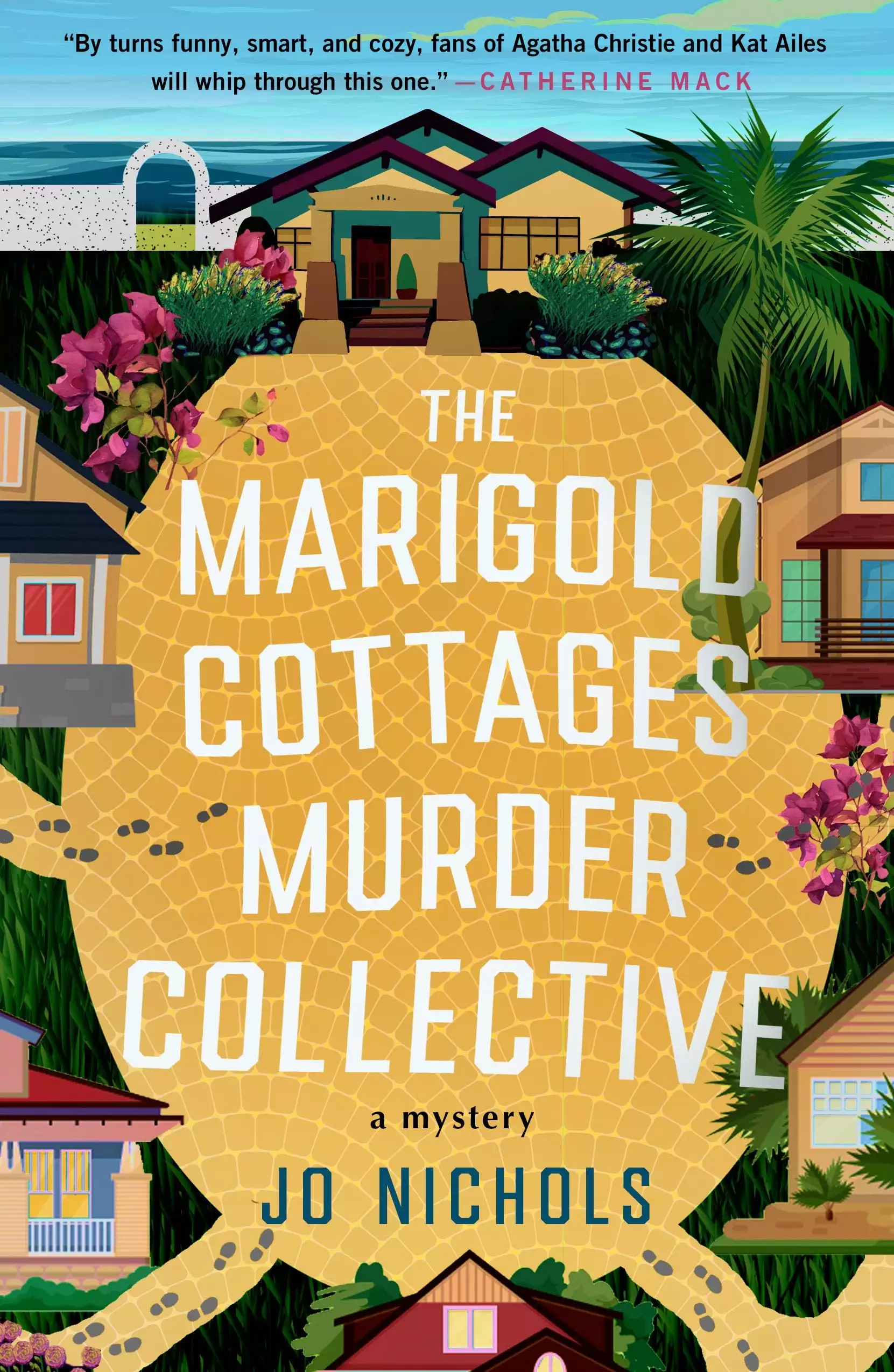
She’d planted the first vines forty years earlier, after her late, reckless, adoring husband had invested an undeserved windfall in the Marigold Cottages, a cluster of units a few blocks from State Street. They’d been built following a long-ago earthquake, and she liked to imagine her fairy circle of cottages sprouting from the rubble. There were six Craftsman-style buildings, with tiny front porches, shingled sides, and multipaned windows.
Mrs. B had painted them a matching sage green before she discovered that she was more drawn to diversity than uniformity. Now walls of aubergine and gold, chalk blue and forest green surrounded a drought-friendly, desert-scaped courtyard ornamented by oversized ceramic pots decorated with marigolds.
She enjoyed how eclectic her vines were, too. She’d spent years coaxing them into a bright, raucous balance, more of a mediator than a gardener. And she was attempting the same with the tenants who rented the cottages.
Nicholas lived in the biggest unit, with his secrets and his stilted heart. Then there was overeager, off-kilter Hamilton, because who else would care for a middle-aged man afraid to leave his house? Beside him came the indomitable Lily-Ann, who needed someone to love, and the wounded Sophie, who needed someone to protect.
Ocean and her children rented the cottage beside Mrs. B’s—Ocean was the daughter Mrs. B had dreamed of having, before those dreams dimmed. And last was Anthony, with his criminal past and uncertain future.
People were lovely. If you really talked to them, if you really listened, you couldn’t help but notice. Of course, sometimes the loveliness was as well-hidden as a passion fruit buried in leaf litter—because people weren’t merely lovely, they were also broken.
The world didn’t produce unbroken people. Some people despaired of living in a flawed world, but the thought just made Mrs. B want to plant flowers and restock her Little Free Library. Maybe she wasn’t clever enough to feel the despair. She’d considered that. Only briefly, though; who had time for self-doubt when there were hummingbirds to feed?
When she finally found a ripe passion fruit, she almost laughed at its wrinkled skin. So familiar.
The flawed, broken—if not wrinkled—people of the Marigold Cottages belonged to her, as surely as she belonged to them. And they needed her help, whether they knew it or not. They were as flawed and foolish as she was—but so young, so absolutely brimming with potential. So she’d ask for their help, and she’d show them how to help each other. That’s what you did for the people you loved.
And, of course, you protected them.
2SOPHIE
The man was at the bus stop again. A big, hulking man sitting alone on the dark street. Long past midnight, even though I knew that MTD bus service ended at 11:40 p.m.
Yeah, I’d checked.
I wouldn’t normally care about him sitting on the bench outside the Marigold Cottages. Minding his own business, not bothering anyone. It wasn’t like the Upper Eastside was a high-crime neighborhood. Of course, neither was anywhere in town, really.
Santa Barbara was safe. Not that I’d come from a rough area. I grew up in the Bay Area, surrounded by every kind of middle-class privilege. A good high school, a great track coach. Summer camps and family vacations and caring—if overbearing—parents. I’d gotten into my top college choice and thrived in the theatre department, and even with my minor in marketing, until my junior year when everything had gone suddenly, terribly wrong.
Safety was a big reason I’d moved here, but every time I went for a run on the hilly streets of the Lower Riviera, I fell in love all over again.
The coastline faced south, not west, and was sheltered by the long, low Channel Islands. The fog of the marine layer kept the mornings cool, then rolled back and opened a curtain on to the most glorious set ever designed. The sun warmed the red tile roofs, and the Courthouse tower and Grenada building stood sentry over the bustling, almost-European downtown adorned with flowering trees, perennials, and palms.
So the area was gorgeous and safe, but the man’s appearance at the bus stop still made my stomach knot.
I wasn’t indulging in hypervigilance, though. I wasn’t. It’s just that I’d already caught the man sitting there the previous week, when I’d come home late after drinking with friends downtown.
Well, when I’d staggered home.
I’d never seen him before then, but he’d given me a look that had been much more than a casual glance of appraisal. More like he’d recognized me. Or expected me to recognize him.
Which felt worse, somehow.
He’d turned away quickly, almost guiltily. And now he’d returned.
It wasn’t my imagination. Not this time. It was the same guy. No doubt about it.
He was impossible to miss: an intimidating slab of muscle with a shaved head and cheap tattoos on his arms, neck, and face. He wore a black T-shirt and jeans and looked like an extra I’d cast to play Serbian Thug or Death Row Inmate.
That is, if my job was casting for a production, instead of answering phones and organizing fundraisers at the community theatre company.
Anyway, I was right for worrying, because here he was again. And this time he wasn’t alone. At least not for long.
Mrs. B tottered from her front door toward him, wearing one of her finest caftans, midnight blue velvet with gold embroidery. If I ever managed to write this as a play, the costume designer would have a field day with Mrs. B’s outfits.
Mrs. B was my gossipy, grandmotherly, strategically doddering landlady who charged a (probably illegal) sliding scale for rent. Dream casting: Judi Dench. When Ocean, the artist who lived across from me with her kids, lost one of her teaching jobs, Mrs. B had requested a Protect Trans Kids painting in lieu of rent. Last month, she’d baked Lily-Ann a birthday cake decorated like a sunflower … and Lily-Ann was not a sunflower. She was more of a magnificent, well-rooted magnolia tree, but Mrs. B still saw the sunshine in her. Mrs. B escorted Hamilton, the older guy who was terrified of leaving his cottage, to emergency dental appointments. She chatted to crows “just in case,” and gave dog treats to the UPS driver to distribute on his route.
In short, Mrs. B was an eccentric, beneficent fairy. So when I saw her wandering toward the Serbian Thug in the middle of the night, I grabbed my phone and followed.
I stopped at the mailboxes fifteen feet away and pretended to check my mail while Mrs. B sat next to the man at the bus stop. Like directly beside him, absolutely inside his personal space.
The man frowned at the top of her white pixie cut. Then he frowned toward the Cottages.
“My first lover had a tattoo,” Mrs. B told him.
Which was a strong opening line for the play I dreamed of writing, but maybe not the best thing to say to a scary man at a bus stop.
The man didn’t give his line. He just watched her.
“He was in the Merchant Marine,” Mrs. B prompted.
The man grunted.
“He had two tattoos. A heart and an anchor. That’s nothing these days, but back then it was a little shocking.”
I started filming, just in case. When I zoomed in on the man, my phone caught details of the tattoo of an angel’s wing on his throat. The feathers became flames behind his ear. As he turned to listen to Mrs. B, a sloppier tattoo came into sight on his cheekbone: it said jewels, except the W looked a little like breasts.
Which was a bit much, even for my Serbian Thug character.
“I’m Mrs. B,” she told him. “Well, I’m Golda Bakofsky, but everyone calls me Mrs. B. And you are?”
“Anthony. Lambert.”
“Not ‘Mr. L,’ then?” she inquired, with a burble of laughter in her voice. “Well, give it time, you’re still young. Do you have a heart, Anthony?”
“Depends who you ask,” he said, his voice a rumble.
“Ha.” Mrs. B prodded his thick arm with her finger. “You know what I mean. A tattoo.”
“I have three hearts, but no anchor,” he said, and frowned toward the Cottages again.
Or maybe toward me, like he knew I was recording. I couldn’t tell. My breath came fast and my hands trembled and I had to tell myself that this wasn’t anything like What Happened Before.
“My husband once mentioned me in a speech,” Mrs. B told the man—Anthony—as if they were chatting at a tea party. “He said, ‘After all this time, you still have the eyes of the girl I fell in love with.’ So I said, ‘Yes, in a jar under the bed.’”
Anthony blinked.
“It was at a fundraising event for organ transplant people. Probably not the place for that particular joke.”
Mrs. B tended to blurt out whatever was on her mind, but I wasn’t sure where that had come from. I guess I’d hoped she’d tell the guy to stop loitering at the bus stop and scaring her tenants. Instead she was talking about eyeballs.
“You live in the front house, right?” he asked. “With all the flowers?”
“For forty years,” she told him.
When he stood from the bench, he loomed. “Then let’s get you home.”
I lowered my phone, my heart clenching. Mrs. B would definitely invite the man—Anthony—into her house, which was cluttered with her collection of possibly valuable baubles from around the globe. A set designer’s dream, but also a burglar’s. I mean, c’mon. A Serbian Thug, at one in the morning?
I needed to do something. I needed to at least call the other tenants. Except I didn’t have time to scroll through my contacts. Why didn’t the Marigold Cottages have a group chat?
“Is that what you do?” Mrs. B asked the man, resting her hand on his tattooed forearm as she stood. “Find lost women in the night, and shepherd them home?”
He eyed her with a sudden intensity. “That and dishwashing.”
“Ah.” Mrs. B peered up at him in her birdlike way. “So you’re a dishwasher, Anthony?”
“Yeah.”
“That sounds terribly boring, but I suppose one must pay one’s bills. I’ve been having trouble with that myself, lately.”
“Yeah?”
“It’s very frustrating. So…” Mrs. B considered as they walked together. “Were you ever in jail?”
“Prison,” he said.
Well, that cut through my hesitation. I took a breath and marched down the stairs toward the bus stop.
“Oh, is there a difference?” Mrs. B asked him, with bright curiosity.
“Mrs. B!” I called. “There you are!”
“Good evening, Sophie.” She smiled at me, unsurprised, like she’d known I’d been there all along. “Any interesting mail?”
“Sorry,” I said, suddenly conscious of my empty hands. “C-could you come to my place for a minute? I have a question about, um … rent.”
The man glowered at me. One of his eyebrows was broken by a scar, and the ligaments in his neck looked like axe handles. I chewed my lip when he watched me for a beat too long, and forced myself not to abandon Mrs. B. He turned away suddenly, without speaking. Instead of returning to the bench, he stalked along the sidewalk until the gloom swallowed him.
After that night, I checked constantly but never saw Anthony Lambert again, almost as if I’d imagined him.
Until two months later, Mrs. B rented him the studio apartment attached to Ocean’s cottage.
That’s when I started jotting down notes. Toying with writing a play about an outsider’s arrival disrupting a small community. Trying to recapture my excitement for the endless possibilities of playwriting. And to calm my fears.
3LILY-ANN
What Lily-Ann enjoyed, after a long day of work, was curling up on her lilac linen sofa in her cream cashmere robe, and getting a little more work done. She didn’t care about the specific task. Heck, she didn’t care about the specific job. What she loved was ticking items off her list, making progress toward a specific, achievable goal.
A therapist had once suggested that perhaps her perfectionism caused her workaholism. Yes. Of course her perfectionism caused her workaholism. That was obvious. Lily-Ann didn’t mind a little obviousness, but the therapist also wanted to talk about Lily-Ann’s weight. She thought the fact that Lily-Ann’s weight wasn’t a problem for Lily-Ann was a problem.
Lily-Ann loathed leaving things unfinished; still, she only completed three of her eight scheduled sessions with that therapist.
She sipped her chardonnay, then tapped her laptop as she scanned the purchase order on the screen. She made a few alterations. After a moment, she made a few more. Better. Done. Finished, like so many things in her life.
Including her marriage and social life.
Not that she’d entirely ended her marriage, not yet. She was merely separated from Piotr, and from their three-bedroom, south-facing house on the Riviera with its spectacular views of downtown Santa Barbara and the harbor. Lily-Ann used to lounge on the flagstone patio, watching the sun fill the clouds with white light in the morning, then paint orange streaks across the sky at dusk. When she’d gazed over the city, from the volleyball beach to the Mission tower, everything had felt orderly and calm—and expansive.
Now look at her. Living in a cottage with one bedroom and no view aside from the neatly trimmed hawthorn hedge out back. Working for mediocre pay as a proposal manager for a transport company. Alone, without even a cat to comfort her.
A humbling fall from grace. Humiliating, except at the moment she was happily enjoying a glass of Au Bon Climat chardonnay while making her way through a colleague’s backlog of work.
If she set aside the bitter, nagging awareness that she shouldn’t wholeheartedly enjoy her current situation, Lily-Ann wholeheartedly enjoyed her current situation.
She clicked to the next spreadsheet, and her phone dinged.
Sophie Neighbor
Copyright © 2025 by Lee Naftali and Joel Naftali
We hope you are enjoying the book so far. To continue reading...
Copyright © 2026 All Rights Reserved

 Please log in to recommend or discuss...
