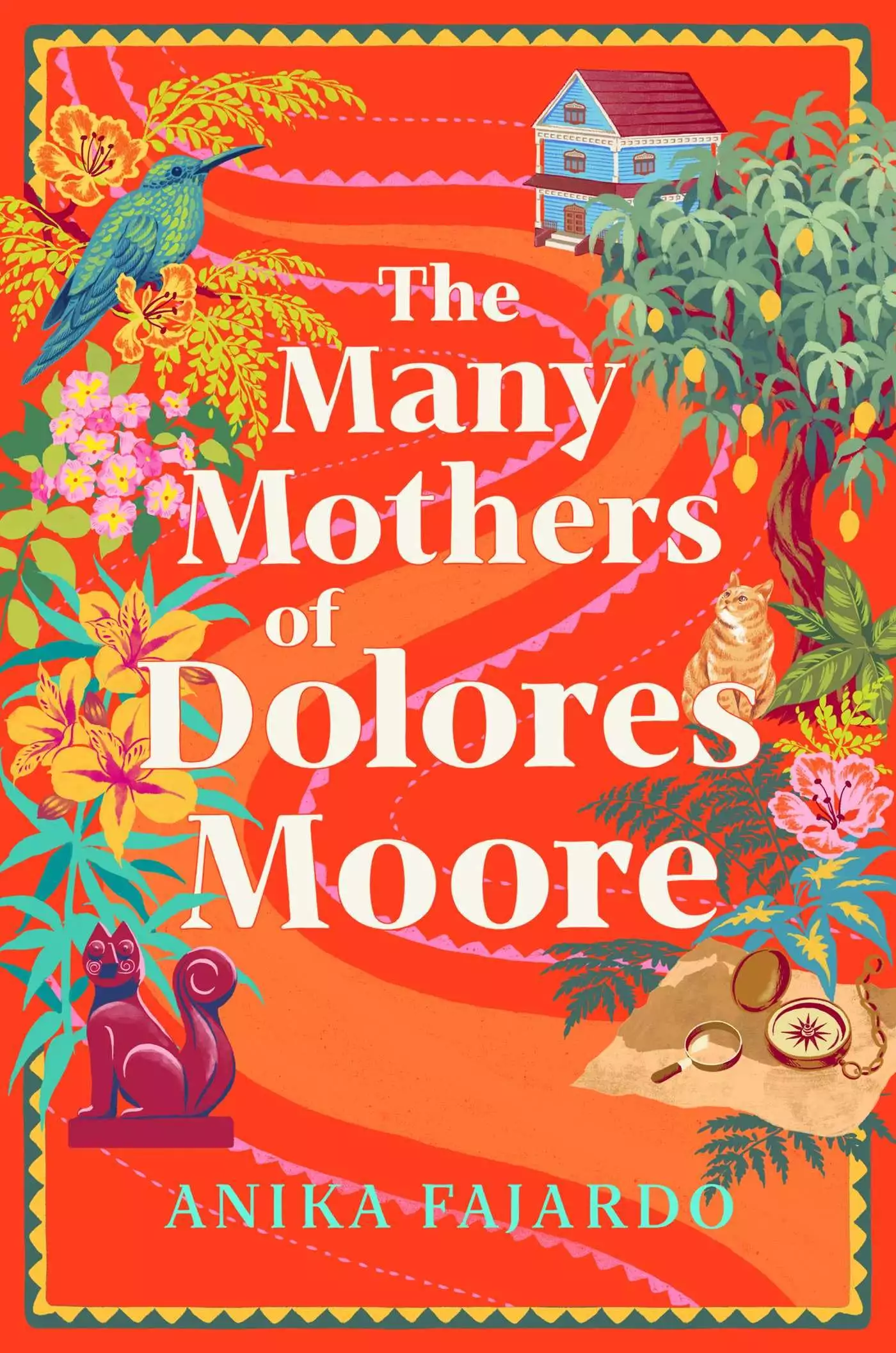
For fans of Rebecca Serle and Elizabeth Acevedo, a magically insightful novel about a woman's journey to discover her roots and what it means to carry our ancestors with us.
In the span of a year, Dolores Moore has become a thirty-six-year-old orphan. After the funeral of her aunt and adoptive mother Jane—the last of her family—Dorrie has never felt more alone. That is, except for a Greek chorus of deceased relatives whose voices begin to follow her around giving unsolicited advice and opinions. And they won’t stop talking about her deathbed promise to Jane about returning to her birthplace in Colombia.
But with a recent break-up, losing her job, and facing a daunting inheritance of an old Victorian house and two orange tabbies, there’s no way she can leave the country. But when an old flame offers to housesit, the chorus agrees that there's no room for excuses. Armed with only a scrap of a hand drawn map, Dorrie sets off to find out where—and who—she came from.
Release date:
September 16, 2025
Publisher:
Gallery Books
Print pages:
384
* BingeBooks earns revenue from qualifying purchases as an Amazon Associate as well as from other retail partners.
Prologue PROLOGUE When I was about fourteen or fifteen, I asked my mothers, “Do you ever hear ghosts?”
“Ghosts?” repeated Jane.
“Hear them?” asked Elizabeth.
My mothers were in the midst of their annual winter holiday decorating blitz, which involved equal measures of Midwestern traditions like the Norway pine and spritz cookies, and also kente cloth and a menorah. Jane had gone to an art fair and bought a Guatemalan nativity scene, which—despite being from the wrong country—was supposed to function as a connection to my roots. They knew their quasi-hippie holiday practice was both culturally appropriative and embarrassingly stereotypical for two middle-aged lesbians, but they had wanted to expose their daughter to as many rituals as possible.
“Right. People who are gone? Do they ever talk to you?”
“I don’t think so.” Elizabeth lit a candle in the menorah, and the smoke danced into the highest corners of the twelve-foot Victorian ceilings.
“Like who?” Jane was rearranging the nativity scene on the mantel.
“I don’t know.” I ran my fingers over the wooden ornaments. Mary, Joseph (whose staff was broken), a cow, a manger, and a donkey. “Just… just people who aren’t around anymore.”
“Dorrie, honey, do we need to take you to see Scottie?” Elizabeth had asked. Scottie was a New Age therapist to whom my mothers had taken me several times during my childhood. “Just a tune-up,” they would say brightly, and I would sit on his scratchy sofa and insist that I didn’t mind having two moms, that I wasn’t scarred from my unusual origins, and that I would tell someone if I felt like hurting myself.
“Never mind.”
The wooden ass clattered to the floor. Elizabeth extinguished the match in a vintage bubble-glass ashtray and bent to retrieve the figurine.
“I was just wondering.”
Even now, I can still smell the tree—a real one, of course—in my mothers’ Minneapolis house, see the lights twinkling like a miniature solar system. When I first studied the work of Claudius Ptolemy in college, I had been comforted by the geographer’s certainty, by his theory that the arrangement of the stars and planets overhead at the time you were born not only determined everything about you as a human but also situated your place in the world. Destiny set at birth.
But I was born far from here.
Chapter 1
CHAPTER 1
I extracted the silk-blend black sweater and charcoal skirt from the staticky plastic of the dry-cleaning bag, where they had been since my last loss. Growing up with an abundance of older and elderly relatives, at thirty-five I had been to every kind of memorial service. The moment I laid my funeral outfit on the back of Mama’s green floral sofa, Bojangles leaped up, followed by Django, shedding their long orange hairs all over the V-neck.
(Cats are for barns, not homes, came the unseen voices tutting in their typical, unasked for way.)
I ignored them and scratched Bojangles’s ears until he purred. Puffs of fur floated in a beam of morning light and settled on Mama’s sofa. Mama and Mommy—the names I called them until my first family-tree assignment in elementary school. That’s when I decided those weren’t quite the right terms and switched to their first names.
(Dorrie’s always liked precision, commented a voice in the empty house.)
Django kneaded his large paws on the skirt, and more fluffs of hair drifted down onto the sofa. The green had faded over time, turning more mint than kelly, and the pink cabbage roses had yellowed slightly, but no matter how much Mommy and I would tease, Mama never got around to reupholstering the worn fabric. And now it was mine. All mine. The sofa, the two orange tabbies. Even the Victorian itself, which Jane had bought when the interest rates were high but home prices in Minneapolis were low. It all belonged to me now, and I had no idea what I would do with any of it—the old house, the worn furniture, the cranky cats. My new life.
A hiccup started in my chest, and I pounded it and coughed, willing the choked feeling—whatever it was—to go away. I chewed on a pink tablet of Pepto-Bismol, not sure if it would help, but the chalky taste distracted me enough to pull on the pencil skirt and slip into the black pumps, to get on with it already.
Get on with it already. That’s what Jane always said. Or had that been Elizabeth’s quip? Did it matter? They were both gone. And now I was the last of the Moores. Alone. Single. And I was an orphan.
Again.
“Please join me in prayer,” the chaplain said amid the damp sound of noses being blown. Behind him, red and gold light streamed through the vaguely nondenominational stained glass of the college chapel.
Alone in the front row, I bowed my head but kept my eyes open. Since Jane passed ten days ago, I hadn’t cried, as if I were some kind of character in a novel, the proof of my mental state evidenced on the page by my lack of tears. But I didn’t want to be a heroine in a book. I wasn’t a heroine, I had always been a supporting character, the only child in a family of an older generation of academics and Midwestern farmers and do-gooders, the serious analytical one who brought a book to holidays, was used to keeping quiet, listening. Always listening.
Lying open on the pew beside me, the program recounted Jane Moore’s biographical history: undergraduate from UCLA, graduate work in women’s studies at the University of Minnesota, two years in London, tenured faculty at the college for twenty-five years, preceded in death by her wife, Elizabeth Pelletier, longtime college library director, survived by her only daughter, Dolores Moore. Mama’s whole life summed up in a paragraph of accolades and achievements. Elizabeth had had a similarly impersonal memorial service last year.
(Dorrie should be paying attention, the voices scolded.)
I folded the program and tried to listen to the chaplain.
I heard the first voice when I was in kindergarten, after the first loss. My grandma Virginia Pelletier, Elizabeth’s mother, who spent her entire life on a farm in Iowa, had passed away from congestive heart failure. I remembered sitting solemnly on a dark, hard pew in the Lutheran church, the hymnal heavy in my lap, wearing my first funeral outfit: a navy blue skirt and cardigan with a calico blouse. My feet, in white tights and patent leather shoes that pinched as much as my heels did today, swung above the burgundy carpet, while Mommy sniffled beside me. I knew I was supposed to be sad, but I was having trouble grasping what Mama had told me: that Gigi was gone.
“Where did she go?” I kept asking, but no one could give me a satisfactory answer.
Gigi’s funeral and reception was a large community affair, and while my mothers, aunts, and bereaved grandpa were occupied with cleaning and company and caterers, I was left to wander the Pelletier house alone, the one child among a forest of adults. I stood on a stool in the upstairs bathroom of my grandparents’ house, now home to Baba only, and smoothed my long black hair and straightened my favorite headband—red-checked with cherries.
I’m so glad I chose the cherries and not the sunflower, I heard a voice say. I turned around, but no one was there. The red goes so much better with Dorrie’s complexion.
I climbed down from the stool and checked behind Gigi’s flowered shower curtain. No one was there.
And it was on sale too, added the voice.
Almost ghostly, the voice wasn’t coming from inside my head and not outside it, either. Even so, I wasn’t frightened; I was pretty sure I knew whose it was.
“Thanks, Gigi?” I whispered timidly.
Instead of responding, the voice tutted, She sure needs a haircut.
I asked for a trim when we returned home.
“Amen,” recited the crowd, not quite in unison.
“Jane’s family has asked that a poem be read in lieu of a eulogy,” said the chaplain.
It had been my only request as Jane grew weaker and weaker. At first we blamed the chemo and the third surgery, not quite willing to acknowledge that her frailty was a result of her inevitable mortality. But Jane had insisted we talk about the end. She and Elizabeth had always structured our lives carefully, everything scheduled and organized in their particular way.
“Mama, please don’t make me speak at the funeral,” I had pleaded.
Jane laughed—or what passed for laughing at that stage—and patted my hand. When speaking at Elizabeth’s funeral, I had been so nervous and distraught and—what was it? Something unnamable—that I stopped midsentence and escaped to the chapel’s unisex bathroom, where I threw up the donuts I had eaten at the funeral parlor. Jane had agreed to my plea.
“?‘For what is it to die,’?” recited the chair of the theater department, whom I had asked to read because of her deeply resonant voice, “?‘but to stand naked in the wind and to melt into the sun?’?”
I tried bringing my focus back to the echoey chapel and the words of Kahlil Gibran chosen by Jane, but I pictured her in the coffin, riddled with the cancer that had taken two tries to kill her.
“And now a reading from Ecclesiastes,” said the chaplain.
Jane went into remission after the first bout of breast cancer, when she was in her midfifties, and my mothers had celebrated by getting matching tattoos, sideways figure eights inked on the spot between the breasts, or where Jane’s breasts had been. The infinity symbol was supposed to signify “forever.”
The new president of the college approached the pulpit and cleared her throat delicately. “?‘A time to mourn, and a time to dance,’?” she said. Her black two-piece dress gaped at the chest. I was certain she didn’t have a tattoo on her breast.
“Please rise for ‘We Will Walk Together.’?”
I stood but didn’t sing. I thought about my two mothers’ breastbones. Behind them, their hearts. Jane, like those swans that die of heartbreak after losing their mates, rattled around the Victorian after Elizabeth passed away sixteen months ago, until her cancer reappeared in the lymph nodes and I moved home to care for her. Another job I had failed at. Jane had made me talk about the end—the hymns she wanted and the flowers for her gravesite—but not what it would mean for me, the only child left behind. With the exception of the promise I had made her, she hadn’t told me what came next for me, the orphan, the last of the Pelletier-Moores. There were some things we never talked about. Across the aisle, a woman’s wobbly soprano scratched my ears.
(A funeral, said a voice, is no time to show off one’s vibrato.)
I never told anyone—not even my mothers—about Gigi’s auditory appearance after her own funeral. When June Moore, my grandmother on Mama’s side, passed away from complications of pneumonia six months later, her voice joined Gigi’s. She’s a good kid, my favorite granddaughter, Grandma June had said, and I giggled, wishing I could remind her (as I had when she was alive), that I was her only granddaughter.
“Hi, Grandma June,” I had said, although I knew from my experience with Gigi that she wouldn’t or couldn’t talk with me, only at or about me.
She’s got those Moore ballerina hands, she said, an offhand comment that sent me begging for ballet classes like Mama had had when she was young. When Grandma June said, Dorrie looks nice in that red sweater, I took to wearing it nearly every day.
Humph, she’s awfully small for her age, Gigi commented, a farmer’s wife forever. She should finish her milk. I doubled down on drinking the glasses of 2 percent Elizabeth poured for me.
What a nice job Dorrie did on that spelling test, Gigi might comment.
All the Moores are good at spelling, Grandma June would agree, the two of them in constant conversation now, unlike they had been in life. But she should work on her addition and subtraction facts.
So I worked on math and practiced my ballet moves. As my female relatives—both the Moores and the Pelletiers—left this world, their voices multiplied into what became my own Greek chorus of sorts. Gigi and Grandma June were soon joined by the opinionated Great-Aunt Maureen, the Moore spinster who had made a fortune on derivatives in the 1980s, after her lifelong pack-a-day habit caught up with her at age seventy-eight. Then Aunt Dot, who wasn’t an aunt at all but actually Grandma June’s cousin, was suddenly voicing her opinions and often arguing with Great-Aunt Maureen. Judith Pelletier, Elizabeth’s bleeding-heart but childless sister, didn’t join until I was in college, and by then I wasn’t surprised to hear her.
One by one, as my family dwindled, the chorus grew—all of them talking among themselves, observing me as if I were a weekly TV program. Nothing—not even death, it seemed—could stop the Pelletier and Moore women (with one exception) from doling out opinions and commentary from the beyond, and I became accustomed to the cacophony that faded in and out between static as if a radio dial was being turned.
“Please join Jane’s daughter in the Community Hall immediately following the service,” the chaplain announced after another prayer and a rambling benediction.
The grandly named Community Hall was simply the chapel’s basement all-purpose room that smelled perpetually of burned coffee and antiseptic spray. A brick-lined tunnel connected the chapel to Admissions, both of which were erected in the late 1890s, the first buildings on the campus, which had once been a teacher’s college. As a child, I used to run back and forth through the tunnel on days my mothers brought me to work with them, a delicious kind of freedom that made me appreciate boundaries and borders.
“Refreshments will be served,” added the chaplain as the recessional began.
(You should have seen the spread at my mother’s funeral, came Gigi’s voice. Fresh strawberries and meringue. And that liver pâté. My chorus grumbled that I’d allowed the college-sponsored catering to provide the selection of cheeses and crudités.)
But before I could get to the food, I was intercepted by the condolences and reminiscences from people I couldn’t quite place and others I was sure I didn’t know. In the impromptu reception line at the back of the chapel, I shook hands and accepted awkward embraces.
“I’m so sorry for your loss,” they said.
My mothers’ coworkers, who had watched me grow up; Olga and Jenn from my sporadic book club; my mothers’ former students; Jane’s occupational therapist, who had come to the house a half dozen times over the past six weeks.
“Unseasonably warm for April,” they commented.
(The least Dorrie can do is smile, said the voices.)
Always obedient, I smiled.
A group of fresh-faced coeds approached wearing what they must have thought passed for funeral wear.
(In my day, someone said, we had to kneel to prove our skirts were long enough.)
“We’re so sorry,” said the young women as they glanced at my sensible, low-heeled shoes and neat pencil skirt. What did these girls see in me? Was I a spinster? Did they see an orphan?
“Professor Moore was definitely my favorite teacher ever,” one of the young women said.
“We loved your mom so much.”
Mom, I repeated in my head. Mom was a funny word. A palindrome. Backward and forward, it’s the same thing. I could feel my lips pursing. Jason had always made fun of me for mumbling my thoughts aloud. Neither of my mothers had planned to become mothers, or even thought they could be. They had chanced upon motherhood and seized the challenge with their typical zealousness, a trait I had neither learned nor inherited. Articulating the M made a strange rumble in my chest as if the sound alone was enough to make me weep. I stopped myself from both speaking aloud and crying.
The young women moved on—college students were always drawn to free food—as the longtime sciences dean approached. “We remember when you were running around here in pigtails.” Dr. Lundgren’s overgrown white beard was yellowing slightly, and his eyes looked rheumy. He reached out as if to pat my head. I ducked.
I shook another hand, murmured another response.
Lundgren moved to my left, apparently having made it his job to stand beside me as if I needed a man—however elderly—to survive this. “Are you still a cartographer?” he asked.
I didn’t know how to answer. Despite my education and experience, despite the years of work I had put in, I was unemployed, laid off in what CommSys had said was restructuring, the day after Jane was put on hospice, the week after I moved out of Jason’s duplex.
“Sort of,” I told Lundgren. But without a job, was I cartographer? Without a mother, was I still a daughter?
“We’d love to get you over here.” He talked about the legacy of my mothers at the college, how important they had been, groundbreakers, how they had been instrumental in the unionization of faculty, the shift to increased renewable energy, the establishment of the first community-wide LGBTQ conference. I only half listened as the endless line of mourners—or gawkers—continued to file out, bombarding me with handshakes and opinions and clouds of eye-watering perfume. I kept my eyes focused on the vibrant map of the college affixed to the wall next to the exit. The library, Ham Hall, the south dorms, the natatorium.
“Might be a vacancy in the Geography Department,” Lundgren was saying.
(Imagine! Dorrie with a job at the college, exclaimed my chorus. I wished I could roll my eyes in protest, but that’s the trouble with people who are gone: you can’t argue with them.)
I nodded noncommittally and continued shaking hands and staring at the map on the wall. Something about it wasn’t right.
“Be sure to take care of yourself,” the funeral-goers advised. I smiled blandly as instructed by the chorus.
“Don’t do too much too soon,” they said.
But I had stopped paying attention.
I squinted. A key in the lower left-hand corner of the map defined parking rules and walking trails, and the buildings were labeled and color coded, the quad a brilliant green dotted with pink trees as if it were perpetually spring here. But that wasn’t the problem.
“What’s next for you, Dorrie?” someone asked.
(That’s what we’d like to know, chorused my voices. She needs a job. She should sell the house. She should join one of those dating apps.)
And then I realized that, despite its attention to detail, the map lacked the bright red YOU ARE HERE sticker that the others around campus had. That location marker, combined with an accurate map oriented appropriately, was how a new student found their way to the next building, how the visiting parent located the bursar’s office. Even before there was written language, humans used the position of the stars to anchor themselves. In order to move forward and navigate the world, you had to know where you were.
I looked at the map on the chapel wall. How could you find your way if you didn’t know where you started?
We hope you are enjoying the book so far. To continue reading...

 Please log in to recommend or discuss...
