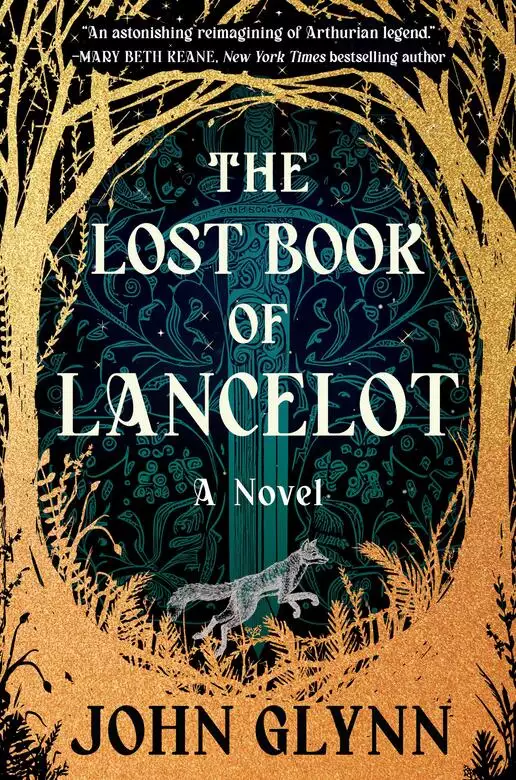
A “richly detailed and evocative” queer retelling of the legend of Sir Lancelot, following the famous knight as he grows up orphaned, falls in love, and attempts to fulfill his destiny at the Round Table – a stunning debut novel from the author of Out East (Mary Beth Keane, New York Times bestselling author).
Hidden away on the Isle of Women, a nameless orphan has grown up among the island's sisterhood, but always at a distance. He hears whispers of a prophecy that may shed light on his destiny—and his true identity. Lancelot. Determined to master the skills and knowledge worthy of the knight he is meant to be, he begins training alongside the handsome Galehaut. As the two grow closer, they guide one another towards their truest selves. But no matter how tightly they cling to one another, each has a role to play in the wizard Merlin's grand prophecies.
When Lancelot is forced to follow Merlin to Camelot, he fights to protect his heart while seeking the fabled Holy Grail. As he grows closer to his fellow knights, Lancelot must keep an explosive secret to himself—the truth of what he left behind on the Isle of Women, of the man he truly is beneath the armor. All the while, Roman legionaries too scour far and wide for the grail. As an army encroaches on their kingdom, King Arthur and his knights must race to ensure that this powerful object doesn't fall into the wrong hands.
Steeped in rich medieval lore, THE LOST BOOK OF LANCELOT is an immersive, poignant reexamination of the most famous knight of the Round Table. It is the story of a once vulnerable boy who is forced to rise to the occasion, of a kingdom under siege, and of the battle between the old world and the new.
Release date:
May 12, 2026
Publisher:
Grand Central Publishing
Print pages:
384
* BingeBooks earns revenue from qualifying purchases as an Amazon Associate as well as from other retail partners.
I was a son of the Distant Isles. Or so I believed. When I was young they told me that my father died in battle, my mother in childbirth. Viviana rescued me, and raised me as her own. I was the lone boy on her Isle of Women.
For the first years of my life, I had no name. I was “Prince,” or “Boy,” or “Little One.” Now I long for the simplicity of that time. A time before the legends were burnished.
“Don’t swim out too far, Little One,” Viviana called while I rode the waves.
“I’ll stay close,” I shouted, chest scraping the sand.
But of course she worried. She knew what was coming.
Time moved differently on the Isle of Women. Over the span of a few nights my pudgy limbs elongated. My muscles emerged, sinewy and lean. My face became hard and angled, like the sharp curves of a ship.
I went about my chores and studies, unaware that I was experiencing the passing of years in a different manner than most. A day could last for months, but weeks compressed into hours. I aged rapidly, and I began to feel things. Inklings at first. Itches I couldn’t scratch. I did not understand, until I met Galehaut, that time was both venom and its antidote. Or maybe time was a snake eating itself.
Viviana and I lived in one of seven large wooden dwellings on the island. Ours was a good-sized home, modern, with a hall for eating and visiting, a library and two sleeping chambers. Behind this structure stood a kitchen and stable. We had the luxury of windows, and we kept them open to let in the ocean breeze. Wisps of salt air cut through the humid days and carried sounds of the waves as we fell asleep.
We lived in perpetual summer on the Isle of Women. Hot days, cooler nights, and storms that seemed to arise without warning. Every morning was fog-swept, wet. The haze is what I remember most.
I was a quiet child, with an accepting nature and sun-bleached curls. Accepting, that is, until my emotions took over. One day I found a clear pool in the woods and made a game with my reflection. I pretended my mirror image was another boy, and that together we would save the island from invading Saxons. Each day, after my chores, I slipped to the woods and communed with the boy in the pool. I told him about my studies in numbers and histories, and my dreams of becoming a knight. He, of course, had all the same ideas, aspirations and complaints.
But over a span of a few hot days the pool dried up. One afternoon I returned and the boy was gone. All that was left was leaf muck.
I knew I shouldn’t have cared. It was just my reflection, just a silly game. I was often left to my own devices and had an active imagination. But even as I tried to dismiss it, I felt my body reacting. My skin went hot. My chest became a vise. Amid the wet mud my eyes roved frantically, half expecting my aqueous reflection to materialize, fully embodied, from behind a tree. The foolishness of this thought was a blade on flint, and suddenly it became hard to breathe. A great sadness filled my lungs like smoke. I sensed that if I didn’t move, I’d suffocate.
I sprinted through the woods until I reached the temple. The tension within me continued to intensify, and I released a guttural yell. Around me the sacred objects of the sisterhood—oil vessels, statues, a gold-leaf harp—seemed to buzz and quiver. I kept trying to close my eyes, willing the whole afternoon to revert or shift. But each time I opened them, I was greeted with the same pathetic truth. Even my reflection had abandoned me.
Pathetic. That’s how I felt. I fought the urge to smash the sacred items on their plinths.
Just then the temple door swung open. Two of the island’s women glowered from the archway.
“What has gotten into you?” demanded Ganieda, her frizzy hair like a cloud of gnats.
I grabbed my throat, cords sore from wailing. In my frenzied state, I couldn’t think up a lie. I heard my own tale of the mirror boy echoing off the temple walls, heard the piteous strains of the telling, and my cheeks flushed with shame.
Ganieda trembled with disturbed recognition. But Glitonea’s eyes were cold marble.
“Next time, take your tears to Viviana,” she said, with a dismissive wave that jangled her ruby bracelet.
There were rules, I sensed, rules rumbling beneath us like the earth’s vibrations. The seven women who lived permanently on the island—Ganieda, Glitonea and my adoptive mother, Viviana, among them—comprised the sisterhood. They were descendants of the island’s original inhabitants, the priestesses who had settled there, generations ago, to protect their power from the outside world.
Others came and went, staying in the smaller huts that lined the shore. Men were permitted to stay for up to three days (I was an anomaly), but women could reside as long as they liked. Some were outcasts, widows, accused witches, delivered to the island to begin a process of renewal that I, as a boy, could never access. Many women came with nothing but the hope of what the island could offer them, and left with a bit of the magic that Viviana and the others wielded.
And the island, for its part, offered all things in abundance. Rivers flush with fish, and forests teeming with deer, boar and other wild beasts. Strutting peacocks, their opalescent plumage blinding in the sun.
The profusion, at times, could be overwhelming. The air carried an ancient wildness that permeated my dreams. Asleep, I had visions of gods and goddesses, of gold clouds and swirling storms and monstrous creatures that still resided at the edges of our world. I’d wake up, bathed in sweat, and peer out the window. The mountain at the center of the island was covered in mist.
Only one of the descendants, Elinor, indulged my games and stories. She lived in a hut raised on stilts and wedged between beech trees. To get inside, she climbed a ladder through a hatch in the floor.
“Why do the other women ignore me?” I asked her one day over a table game.
She was stick thin and spry, with a plait of silver hair—the eldest of the sisterhood. She grabbed my hands across the game board.
“The other women love you in their way,” she consoled me. “But they are devoted to our goddess. The protector of the island. The goddess Danu.”
Elinor had coltish blue eyes and long eyelashes. Normally I could relax into the warmth of her smile, but that day my thoughts battered about. I knew of Danu. But when I tried to pray to her, she did not respond.
“Why are you and Viviana the exception?” I asked. “Why do you take so kindly to me?”
“Viviana brought you here.” She laughed. “Of course she takes kindly to you. And as for me, how could I not?”
I shook the bone dice, let them clatter.
“So I don’t scare you?” I asked.
“Three and one. Good roll. Of course you don’t scare me, fair foundling.”
I didn’t know what Elinor saw in me, at least not then. Perhaps she was simply more benevolent than the others. Or maybe Danu had gifted her a larger wedge of kindness. But I worried the answer was far more obvious: she just felt bad for me. I wondered if they all did.
A few nights later I was in Viviana’s library, struggling through my Latin transcriptions, when out the window I caught a flash of auburn.
In the clearing behind our cottage sat a fox.
Despite the island’s fecundity, I had never seen a fox before. He was small, with a snowy chest, attentive ears and an upturned mouth. His legs were dark, as if dipped in ink, save for one white paw, which extended neatly in front of him. I ran out the back door.
He sat dead still, his liquid-gold eyes piercing the twilight. Did he take me for prey or predator? I could not tell, but his stillness unnerved me. I wondered if he was lost.
I stepped closer and he darted towards the forest path. Then he turned back and stared.
Was he beckoning me to follow? I looked around, unsure what to do. I was not permitted to explore the island alone after sunset. But something about this fox—the tilt of his snout? The blue-black depth of his pupils?—compelled me in a way no creature had before.
I followed him into the woods, but he did not abide by the path. As my eyes adjusted to the dark, I struggled to keep up. Thorns clung to my tunic and scratched at my hair. I navigated a tangle of branches and brambles, swiped through a spiderweb, afraid to lose him.
When he skidded to a stop on a sharp ledge, I looked down. Twenty feet below stood a grove illuminated by torchlight.
In the center, a vase-shaped hazel tree hulked out of the earth. Under its branches, the sisterhood gathered in a circle. They wore matching blue robes and all manner of jewels, their gold sandals incandescent in the firelight.
They seemed to be in the middle of a heated discussion. A heated discussion, I quickly realized—about me.
“… that’s what I’ve been saying all along.” Elinor’s voice caromed off the granite. “He needs to get a sense of the world. To interact with others his age.”
Glitonea spoke up. “Perhaps if he spent time as a page for a noble family…”
“A page?” Viviana let out a crazed laugh. “That’s absolutely out of the question. He is too young.”
“He’s not too young.” Elinor spoke in an even tone. “He’s just the right age. But—”
“But you’ve seen him,” Viviana cut in. “He’s gentlehearted. He just needs to learn to control his emotions. He needs nurturing. He needs—”
“Nurturing? Is that what he gets here?” Elinor turned to the other descendants. “I see the way the rest of you dismiss him, the coldness in your gaze.”
“He lives here at the pleasure of the sisterhood,” said Mazoe, whose cottage sat on the north shore. “But we are not his caretakers. Viviana is. This is what we agreed to.”
“We can’t risk him gleaning our ways,” added Sebile, the youngest of the seven. “A man with magic is too dangerous. Remember the last time?”
“I don’t disagree,” said Elinor. “But you won’t even let the poor boy have a name. How do you expect him to become a knight—”
“Is he not learning the skills that will aid his knighthood?” Viviana’s voice was nearly hysterical. “Do you think me a terrible mother?”
“No, dear one.” Elinor softened. “You have provided a great life for the boy, and unlike Mazoe, I am not suggesting he become a page. But I think we need a plan for his training.” She turned to Sebile. “One that still protects our magic.”
My blood thrummed with nervous excitement. I’d read of knightly training—of swordcraft and horsemanship and courtly etiquette. I’d always longed for such experiences. But could I, a nameless boy on a strange island, really rise to that rank?
“I’ve had a plan all along.” Viviana grew defensive. “He’s learning his letters and numbers. He’s already begun archery…”
A resigned silence filled the grove. Though they had no hierarchy, Viviana was the implicit leader of the seven. No one, it seemed, wanted to challenge her.
“You set sail for Sorelois soon, don’t you, Viviana?” said Elinor.
“After the next half moon.”
Once a month, Viviana visited Sorelois, another island in our archipelago. There she sold her potions and elixirs and offered guidance to those who sought her counsel.
“Take him with you,” said Elinor. “It is only for a day, and he has never left the island.”
“It’s too unsafe,” replied Viviana.
“With your power?” Lotta’s laughter shook her emerald neck-ring. “He will be fine.”
“But what if people talk—”
“People will talk no matter what,” Elinor cut in. “Please, for the love of Danu. Bring him along. We can figure out the rest at another time.”
Viviana folded her arms.
“Fine. He can come with me. But if anything happens…”
“Relax, Viviana,” Glitonea said. “Nothing will happen. He is not a dog to be kept on a leash.”
The sisterhood moved on to other matters, but I could no longer hear them. My heart was pounding too loudly in my ears.
I was going to Sorelois.
One day, I would become a knight.
I looked down, but the fox was gone. He would not return for some time.
We arrived at the docks of Sorelois on a hot, sticky morning. The journey did not take long. With Viviana at the helm, our sails fluttered and puffed, the winds seeming to conform to her whims.
We disembarked at a bustling harbor. Never had I seen so many people, a mix of men and women, and, for the first time, other boys my age. Viviana grabbed my hand, palm like ice.
“Sorelois can be overwhelming,” she said. “Stay close to me.”
I thought back to the night in the hazel grove, how Viviana had resisted the idea of me accompanying her. I knew I shouldn’t have eavesdropped and was smart enough to keep my mouth shut, but in the intervening days I’d begun to wonder what she was afraid of. Why was she so determined to keep me from the rest of the world?
Despite any misgivings, I took in the sights of Sorelois with confused delight. This was a real town, practically a city, with roads, buildings, shops, a square. I had only read of such wonders, and they felt both awe-inducing and alienating. No one else batted an eye at the wagons and carts, the nets heavy with silver fish, the cacophony of chirping from vendors’ birdcages. As I walked among men and women, some dressed in fine clothing, I felt woefully inadequate.
But at the same time I was captivated. How was it, I wondered, that all these people had converged on this one island? On this one dock? On the same day that we too should get to visit? Suddenly the great expanse of the world unfurled before me. Its promise glimmered like magic.
I ran from stall to stall while Viviana watched me nervously. I knew she had business to attend to, potions and poultices to trade. But as she pulled me away from a cart of elderberries, I learned there were more surprises in store for me.
“Come, my prince. It’s time for the tournament.”
On our way to the arena, the crowds seemed to part for us. Women shot Viviana strange looks. Small children hid in the folds of their mothers’ gowns.
Viviana commanded attention. She drifted down the road in her cascading blue dress, flowers adorning her shimmering hair, eyes heavy with an ancient knowledge most could never access. Soon I would learn the rumors. Viviana was a witch, apprentice of Merlin. Viviana possessed dark magic, and Merlin was her lover. The Isle of Women was enchanted. If you walked upon it, you’d live forever. The island was cursed. Step foot on its shores and your limbs would melt off. The island was a fairy realm, home to a hidden lake at its center.
Of these rumors only the last one was true.
“Pay those children no mind,” she said, squeezing my hand. “You’re a son of the Distant Isles, too.”
I tried to lift my chin the way she did.
We watched as knights squared off on opposite sides of a tilt. The crowd was rowdy and ale-soaked. Viviana cringed at their foul language, but I was too focused on the field to care. The sight of the warriors—glinting chain mail, blunted lances, royal insignia—left me awestruck. Even the violent clashes seemed laced with a camaraderie I yearned for. This was the future I had always craved.
One knight in particular prevailed again and again.
“Who is he?” A little boy grabbed at his father’s arm.
“She,” Viviana corrected the boy. “And her name is Bagotta.”
The winning knight removed her helmet to reveal a strong pale face and slick, white-blonde hair.
“She’s the greatest knight of the Distant Isles.”
Then I saw him. He stood on the side of the arena, Bagotta’s son and squire. He had red hair and freckled skin and was dressed in fine samite. I watched as he wrapped Bagotta’s shield in a protective cloth. With a delicate touch, he removed her horse’s leather barding. He was swift, attentive, methodical. When he was done with his tasks, he picked up her lance, appreciating its heft.
I knew what he was doing because I was doing it, too. He was imagining himself onto that trampled field, astride that horse. A secret part of him felt that he too could be great.
I remember the next few hours in wisps. A narrow, dank apothecary. Rolls of blue silk like water through my hands. A spice merchant offered me a lick of cinnamon, the taste tickling my nose. With each new sight, my world expanded. It left me craving more.
On the walk back to our boat, Viviana purchased me a slice of plum cake. It was soft and chewy, not too sweet. Bits of fruit clung to my molars.
“Look,” Viviana exclaimed. “There’s Bagotta now.”
Out of her armor, she was strikingly beautiful, the tallest woman I had ever seen, taller than nearly all the men on the docks. Her face was cold, inscrutable, but the slight curve of her mouth hinted at something softer, a wry humor perhaps, a sense that we were all jesters in her court.
My eyes moved to the redheaded boy beside her. He carried Bagotta’s heavy armor over his shoulder. Beads of sweat dappled his brow.
“Bagotta!” Viviana called to her. The giantess—and that is what she was—approached.
“I’m a sweaty mess,” she apologized as they hugged. “My first tournament in a long while.”
“You were spectacular,” Viviana said.
She grabbed Viviana’s hand as if to thank her, then she said, “I know.”
They broke into laughter, and Bagotta introduced the redheaded boy. As he bowed to Viviana, his eyes caught mine. I guessed us to be around the same age, though what exact age we both were, I didn’t know for certain.
I was introduced quickly, and Bagotta and Viviana launched into a high-spirited conversation. By then the redheaded boy had my full attention. He was living the life I wanted. He had everything.
“What are you eating?” he asked me, sliding the armor off his shoulder.
I was so captivated by his eyes that I’d forgotten about my treat.
“Plum cake,” I told him, my mouth gone dry. I had never spoken to a boy my own age before.
He noticed the hunk in my fingers. “Can I try?”
I didn’t want to part with my last bite. But I wanted to please him.
“Have the rest,” I said.
The gesture surprised him. Gingerly, he plucked the treat from my fingers, consuming it in one voracious chomp.
“She’s your mother?” He nodded to Viviana.
“Yes.”
He absorbed this detail, piercing me with his brown eyes again. Surely he was noting my strangeness, my difference.
“Funny,” he said, craning his neck up at Bagotta. “I don’t resemble my mother much either.”
His big smile took me aback. So did the fact that we had something in common. I wanted to know where he was from, what his life was like and how boys like him moved through the world. But I was, of course, too embarrassed to ask. I felt both an aching need to be next to him and an overwhelming desire to retreat from his gaze.
Without realizing, we had drifted away from the docks. We stood now at the foot of the road, amid an influx of passing merchants.
“My name is Galehaut,” he said. “What is yours?”
I froze. How to tell him I didn’t have one?
But before I could fumble through an answer, I felt a coarse hand wrap around my neck. An arm encircled my chest and lifted me off the ground. My body was being dragged away, my heels kicking up dirt along the road.
I didn’t even have time to register that I was in danger. I was too shocked to call out or react in any way.
I was being abducted.
Viviana looked back, eyes wide as coins, her gaze darting first to Galehaut, then to me, then back to Galehaut, as if to blame him. I was choking, growing lightheaded. Someone was dragging me towards the woods. My vision was fading. I could still taste the plum cake.
Viviana raised her arms in the direction of my captor and me. A cold blue blast knocked us over, along with everyone else in its radius. Stunned, face in the dirt, I looked up and got a glimpse of the man who wished me harm. As he scrambled away, his long, unkempt hair obscured his features, but there was no missing his belt of daggers. One of those blades had been meant for my neck.
I ran back to the docks. Viviana pulled me close and clutched her temple. Her powers, seldom used, were overextended.
“Stay away from him!” she screamed in the general direction the man had run. I could feel her heart pounding as she hugged me.
In my memory it was always this. The redheaded boy, the grip on my throat, the plum cake. It would be years before I learned about the prophecy that led men to wish me death. Years before I saw Galehaut again.
After that day in Sorelois, Viviana would not let me leave the Isle of Women for a very long time.
Some nights I snuck down to the beach and stared up at the stars. Their sharp light filled me with a tingling dread.
The greater world, I knew now, was a dangerous place. People beyond our shores were out to get me. Viviana reinforced this belief.
“I should not have let you talk to that Galehaut boy,” she said. “If you had stayed by my side in Sorelois, you would have been safe.”
I did not blame Galehaut. But I did begin to question my own courage. In the face of an attack I had frozen up, needed rescue. I worried I lacked the mettle of a knight, and Viviana seemed to agree.
Days came and went and I did not begin my training. Instead I continued with my chores and studies. I milked the goats. I scoured pans. I reread Plato, Ovid and Herodotus and felt the uncertainty of my life acutely.
“What is my purpose here?” I asked Viviana. “Where am I from originally? Why did you save me?”
Time and again, I received the same response. “Trust the sisterhood, little one. This knowledge is not yet yours to possess.”
But the not knowing made my skin go cold. The not knowing frightened me. I worried if I didn’t find out, I might one day lose my mind.
When, on rare occasion, other men came to the island, I hid in the shadows, occupying myself with the mending or milking, preferring not to be seen. Some came on passing ships, looking for goods or trade. Others were relatives of the descendants. The island’s magic seemed to ward off those with ill intentions. I had no reason to be so aloof. But while these men stayed in the beach huts, I found excuses to head into the woods or to the island’s high meadows, off to forage for berries or set hunting traps—activities permitted by the sisterhood. I was safe there, I reminded myself. I could stop looking over my shoulder. But the seeds of my paranoia had already been planted. I was a ghost, prowling between two worlds, belonging nowhere.
The forest must have sensed my desperation. I was practicing archery one day, when a gorse shrub stirred at the edge of the clearing.
The fox took a few tentative steps into the grass and shook himself off. A long time had passed since our last encounter, but I recognized his right paw—a shock of white. I rummaged around my pocket for a leftover date.
“Come have it,” I whispered, extending my palm.
He paced closer, digging his claws into the earth, pinning me back with his bright gold eyes. I lowered my hand to his level.
“I won’t hurt you,” I promised, “if you won’t hurt me.”
Up close I could see the quiver of his whiskers, the pink spoon of his tongue. His breath felt warm and wet on my hand. When he yawned, revealing sharp teeth, I reared back. But then, with the gentlest of mouths, he removed the date from my palm. And then he darted back the way he came.
I took the encounter as a portent. Perhaps the island was listening. I coveted wild things, craved the right to rove and explore. After much beseeching, Viviana agreed to loosen the rules, giving me free rein of the island, even after sunset.
“Just don’t tell the sisterhood,” she said.
And so I lowered myself into hidden grottos and scaled the tallest trees. I sailed from one goblet-shaped cove to another other. I carried a pouch with morsels for the fox, who took to shadowing me. Yet even as I was making new discoveries, the island still seemed reluctant to reveal its best secrets. The goddess Danu would never appear to me, and I would never learn Viviana’s magic. I was caged from the outside world, but walled off from the center. Sometimes, the mere act of existing felt like rough wool against my skin.
Such were my turbulent thoughts one afternoon when I swam out past the waves. The tension had reached a breaking point. I pulled myself down to the ocean floor, past the depth where my ears popped. Then I held my breath.
I was an estranged, pathetic creature. My loneliness was crushing, and I was too afraid to keep living. I promised myself that no matter how much I wanted to, no matter how badly it hurt, I would not come up for air.
I kept hoping, as my lungs tightened, that I’d reach a place beyond the pain. But of course no such place existed, and my body refused to comply. Eventually the pressure became too much and I broke to the surface.
I could not, I had learned, escape myself. Neither land nor sea offered any relief. Instead I retreated into my studies, the page my last true respite. The library was crowded with poems, histories, herbals and leechbooks. I was permitted to read anything I desired, even the delicate scrolls in the cabinet drawer, which I regarded with the same reverence as unhatched eggs. As I unfurled their ancient vellum, breathing in the animal scent of their pages, I read of healing stones, Aquilo winds, earthquakes and chess. I read of lands covered in snow, and whole cities absorbed. . .
We hope you are enjoying the book so far. To continue reading...

 Please log in to recommend or discuss...
