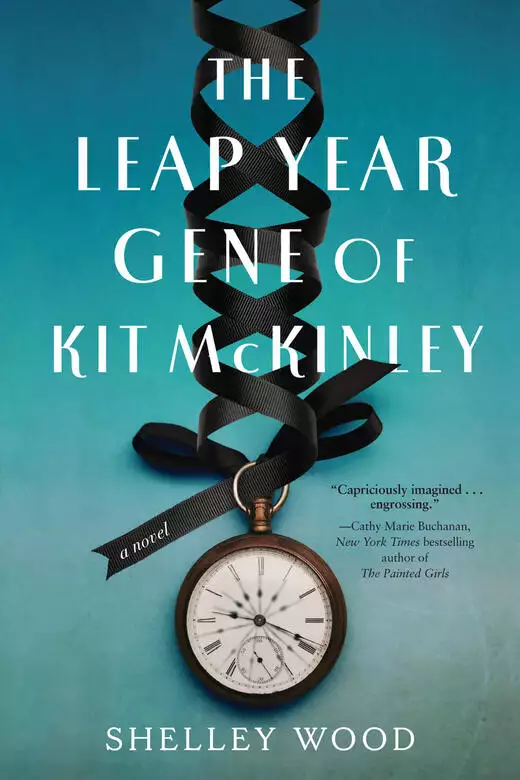
An inspired, sweeping, historical epic tracing the remarkable life story of a baby girl born on leap year day who grows one year older every four years. The Leap Year Gene imagines the fascinating life of Kit McKinley from WWI up to the present day, told through the voices of Kit and her family members, whose lives are forever altered by her secret.
“A capriciously imagined historical epic that captures the essence of a century through the remarkable life of Kit McKinley. . . . Wood deftly weaves genetic discovery and society's fascination with eugenics into a highly unique, engrossing tale of love and family.” —Cathy Marie Buchanan, New York Times bestselling author of The Painted Girls
February 29, 1916: After an unusually long pregnancy, Lillian McKinley, whose husband has been killed in the war, gives birth to a baby girl on Leap Year Day. Kit proves to be a happy and intelligent child, but unnaturally slow to age. For decades, she and her family must keep on the move to protect her secret—from insatiable newshounds, Nazi scientists, doctors, and pharmaceutical companies. When Kit at last can pass for an adult, she must decide whether she wants to stay perpetually on the run or form lasting ties. Ultimately, once the human genome is mapped and research on altering it begins, she’ll need to make some difficult choices about the strange quirk in her DNA that has made her who she is.
Perfect for fans of Kate Atkinson's Life After Life and Audrey Niffenegger's The Time Traveler's Wife, The Leap Year Gene is a race through the past century’s burgeoning understanding of genetics, eugenics, and what constitutes “normal,” while exploring the tensions, love, and sense of duty that can bind families together or split them apart.
Release date:
August 6, 2024
Publisher:
Union Square & Co.
Print pages:
400
* BingeBooks earns revenue from qualifying purchases as an Amazon Associate as well as from other retail partners.
Ernest McKinley stepped into the welcome gloom of his foyer, dropping his briefcase and shutting the door against the sun. First things first: he peeled off his shoes and socks, then took off his hat, tossing it to its hook, where it spun once, twice, before settling down like a dog on a rug. He shrugged out of his jacket, then tugged at the knot of his necktie to loosen it around his throat, it being too damnably hot for ties. If he could have been certain Marie had left for the day, he’d have stripped down to his underclothes. But his housekeeper worried about him enough as it was—unmarried and nearing thirty, both parents passed, and Thomas, his only brother, seven months dead having found himself shot to ribbons his very first week in France. Ernest closed his eyes against the images trying to jostle their way to the front of his thoughts and settled for yanking his shirttails from his belt. He wasn’t lonely or singular. He was merely a busy man, and a private one. A man whose skills, during wartime, were in high demand such that thoughts of a wife welcoming him home, smelling of biscuits, her soft hands hastening to take his jacket, or of a child rosy from her bath waddling to the door to meet him: these were the furthest things from his mind.
The knock at the door made him jump. He caught a glimpse of himself in the hall mirror as he reached for the doorknob, his red curls unsticking themselves from his damp temples, his untucked shirt draping from his broad chest like a nightshirt. He snatched his hat from the coat stand and tapped it back on his head. Then he drew himself up and opened the door.
On the steps stood a young woman in a brightly patterned dress, at least six feet tall but no more than seventeen or eighteen, thin as a reed and wavering from foot to foot as if stirred by the heat rising from the flagstones. She had a toothy smile and was clutching a large purse in one hand and in the other a hat, decadent but squashed. The woman and her smile were recognizable without quite being familiar, as if he’d seen her in a toothpaste advertisement in a magazine.
“Can I help you?”
She darted a look at his bare feet, then his hat, which he sensed was askew.
“I’m sorry to disturb you, Mr. McKinley. I’m Natalie Kenil-worth, Lillian’s sister. We met at the funeral and—”
Ernest squinted up at her, trying to lift any features from her girlish silhouette, backlit by the sun outside his door, and find a match in his overstuffed brain. That he couldn’t instantly place her was unsettling. Her nose and chin, even her small ears, were pointy, almost elfin, everything pulled forward toward a center point on her face as if cinched. Her skin was fair and smooth and her lashes pale and short, so that they seemed insufficient for warding off any stern scrutiny of her wide, blue eyes, which, Ernest realized, was what he was doing that very minute.
“Natalie?” she repeated. “Lillian’s sister. So, Tom’s sister-in-law? We met very briefly at the service for Tom back in May.”
Ernest’s head jerked and his eyes smarted, fleetingly, as if someone nearby were peeling a lemon. Thomas’s funeral. That would explain it. If ever there had been a time when his powers of observation had failed him—well. He blinked the sensation away.
“Lillian’s sister? My goodness. Is everything all right? Please.” He ushered Natalie inside and felt a sudden flush, although he couldn’t be sure if it was the heat of the afternoon sun sidling into the foyer with Natalie or a flood of grief and guilt. Burying himself in his work to keep from dwelling on Thomas’s death, Ernest had all but forgotten about Lillian, his brother’s young widow. He’d written to her at least three times, four surely, after the funeral, but she’d never replied, then he’d been swamped with new duties, and—
“Is she—is Lillian—all right?” His voice came out strangled. “What’s happened?” Natalie raised her hands, fingers spread. He felt his breath catch in his throat.
“No, please,” Natalie said. “I don’t mean to alarm you. Lillian is fine.” She sucked a deep breath of air. “Well, no, not fine. I mean—she is …”
She stopped, pinched her lips, then shook her head as if to start fresh.
“Mr. McKinley—I’m not sure Lillian has even told you. In fact, I don’t believe Tom knew of it either.”
Ernest prided himself on—indeed, in his line of work, was famous for—his poker face. But hearing his brother’s name spoken aloud so many times, after so many months, he could tell: it showed. He could feel sadness pulling at his eyes with tiny ropes and pulleys.
“Lillian is … going to have a child,” she told the loose knot of his tie, then risked a look at his face.
The words sent zaps of feeling through him: surprise, then grief, then joy. Then confusion.
“Lillian is with child,” he repeated. He couldn’t help himself and counted the months back to the day Thomas died, and to the day, not so many weeks before, that Thomas had set sail for Europe in the first place.
“With Tom’s child?” he asked finally, a whistle of doubt creeping in. Natalie held his eye. “Thomas’s child?” he said again.
“Tom’s child.” Natalie repeated it back to him firmly. “But Lillian—something’s not right. She refuses to leave the flat. She’s not eating as she should. She needs …”
Ernest had already snatched his jacket and jammed his feet, sockless, back into his shoes. “A doctor! She needs a doctor. Of course. It’s wonderful news, wonderful. But is the baby coming now? It’s time?”
Natalie stepped past him, deeper into the dim foyer, and set her purse down, rooting through it. “Well, she has a doctor, or at least she used to have one.”
He watched her reflection in the mirror, her sharp face furrowed, then saw himself bobbing to and fro behind her, his hat lopsided, his face scrambled. After more rummaging, she gave a low growl of irritation and started raking the contents of the bag onto the table—writing utensils, lipsticks, several small pots of what looked to be womanly unguents, two dime-store novels, a small mallet, a packet of pin nails, a sheaf of folded leaflets, and—at last—a small notebook. She snatched it up and the paper pamphlets fluttered to the floor. She ignored them. As she paged through the book, he stooped to retrieve them. “VOTES FOR WOMEN!” the front of the pamphlet proclaimed in large block letters over a blotchy photograph of a lady with a long, stern nose. Yes, this rang a bell—Thomas and his bride had both been passionate about a range of socialist and feministic causes.
A Meeting of the Canadian Alliance for Women’s Suffrage
Thursday, August 17, 1915
Address by Prof. Carrie Derick
“Women in Academe” with Musical Numbers by Mrs. Wendy Nightcap and Mlle. Nadine Dupré
“Dr. Percival Lawrence.” Natalie poked at a name in the notebook, meeting Ernest’s eyes in the mirror as if she expected him to know it. “I got his name from an advertisement in the directory because he did house calls and she was feeling so poorly. It was Dr. Lawrence who told Lillian she was pregnant, diagnosed her right after she got the news about Thomas.” Natalie bit her lip. “But he wasn’t nice about it. Said she was too young and pretty to be widowed and she’d be better off giving up the baby and starting anew. Lillian tossed him out and said she never wanted to see him again.”
Ernest bristled. The very idea of his brother’s child being handed off to strangers. He scarcely knew Lillian—Ernest was ten years older than Thomas and had been abroad when his brother was at university, where he’d met his bride. She’d had a missionary upbringing, as he recalled, somewhere exotic, parents now deceased, sharp as a tack with a passion for the natural sciences. Ernest had not returned from his overseas post until after Thomas had shipped out: the first time he’d met Lillian had been at his brother’s funeral. Ernest was renowned for his photographic memory, but grief had surely meddled with the shutter speed, leaving several months blurred and smudged. He had the wedding photograph Thomas had sent him on his mantelpiece, yet Ernest might have passed Lillian on the Montreal streets without a second look. He felt sick at the idea of this young lady grieving his brother’s death, confined to her bed, then getting such heartless advice from some quack of a doctor.
Then he remembered his mental arithmetic and gestured for the door. “But it’s time, is it? The baby is coming? We should hurry. Please—we can take my car.”
Natalie had crammed everything back in her handbag and was shaking her head. “No, that’s just it, Mr. McKinley. That’s what I came here to say. Lillian is fine and the baby—the baby is fine, we think. We can feel her kicking.” She smiled. “Lillian insists she’s a girl.”
Ernest smiled, too, the fact of a baby taking hold, squeezing something in his chest.
“It’s not urgent, is what I’m saying.” Natalie took a step toward the door. “And Lillian doesn’t know I’ve come here. But it is time for the baby—it must be. Past time.”
She paused, dabbing the back of her glove against her brow, her blue eyes edging to meet Ernest’s again. “The thing is, the baby isn’t coming. She won’t come, it seems. And she shows no sign of coming soon.”
For the entire journey across town from Westmount to the French side of the city, Natalie prattled like an auctioneer—the humid weather, the terrible sinking of the Lusitania by the German U-boat, the perils of automobile driving in the city. She directed him to park by a faded dépanneur on La Main, and they hastened through the door and up the stairs to the apartments above, passing a young couple on the first floor with a brood of young children. At her own door, Natalie’s hands were so nervous or eager that the key seemed to buck at the keyhole, unable to find its way in.
When the lock finally relented, he hesitated, his eyes roving over the gloom and clutter: a living room, dining room, and kitchen all in one, smelling of rose water, boiled eggs, and the peppery tang of a laundry pile. The flat was big enough, perhaps, for Thomas and his bride—young students and newlyweds sharing a bed—but Natalie had told him she’d been staying with her sister ever since they got the telegram announcing Tom’s death.
Grouped around a small table in the center of the room were four spindly chairs, their wooden backs heaped with blouses, skirts, and undergarments, one so heavily weighed down it had slumped against a wall, its front legs pawing at the air. The little table itself was taken up with neat piles of what looked to be the same pamphlets in Natalie’s purse. Drapes in a drab green print were drawn over the tall windows, giving the room an underwater feel. Lillian, propped among pillows on the settee, was in shadow.
“Lillian?” Natalie turned to the window, tugging the curtains aside so that the evening sun streamed into the room. “You have a visitor.”
Ernest squared his shoulders. “It’s me, Lillian. Ernest McKinley. Your sister told me your excellent news.”
Lillian blinked in the light and pushed herself higher on the pillows. To Ernest she looked much the same as she had at the service for Thomas—her thick, brown hair heaped high on her head, a lovely flush to her smooth cheeks, eyes deep blue pools under dark, bushy brows. She and Thomas had married so young—children, really, both of them scarcely very far along in their studies. Now, less than a year later, she was far too young to be a widow. Ernest stole a look at her stomach. Lillian, he recalled, was tall like her sister but with a more generous figure. To Ernest’s unpracticed eye, she didn’t look much more sizable around the middle than she had at the funeral. But when he stepped tentatively toward the sofa, her hand snaked protectively over her waist.
Natalie, as if thinking they needed a moment of privacy, made to slip into the adjoining bedroom but knocked over a clay umbrella stand, which toppled thunderously. Ignoring the broken pieces, she clapped the door shut behind her.
Why hadn’t he tried harder to stay in touch with this poor woman? Lillian was grieving Thomas every bit as much as he was; indeed, far more. He held out his hand, awkwardly, and she reached out and took it, which had the effect of making his eyes tickle. She was so pale, as if she’d kept herself fathoms deep in the folds of this room. He recalled Natalie’s words: She refuses to leave the flat.
“Is the baby coming soon, Lillian?” It took fortitude to keep from glancing at her midriff.
Lillian shrugged, idly stroking her stomach. “Not yet, I don’t think.” She smiled wanly.
“Should we call the doctor then?”
Lillian jerked her head. “I won’t have that man back here! And I don’t need a doctor. Natalie is taking good care of me.”
“I don’t quite understand,” Ernest said. He scraped at his mustache with his lower teeth, a nervous habit that made him look like a bulldog.
“If the baby is …” His question trailed away. He cupped his other hand over Lillian’s and cleared his throat. “Lillian, the baby must be due very soon, or else”—his voice caught—“or something’s not right.”
Lillian snatched her hand from Ernest’s, balled her fingers into fists to shift herself higher on the settee, then swung her legs around, plunking them heavily on the floor and pushing herself to standing. He risked a glance at her waist, enough to satisfy himself that it was indeed substantially thicker than it had been in her wedding photo and at the funeral, but not, it seemed, burdened with a full-term infant. Straightened to her full height, Lillian stood almost half a foot taller than Ernest. When she inclined her head to his, her eyes were flashing like knives.
“This baby is Tom’s,” she said, slow and firm, as if to a child. “There’s been no one else and there never will be. She’s smart enough to know this is no time to be born into a world gone crazy with war. You, Ernest, are going to be an uncle, and you—Natalie? Natalie! Get back in here.”
Natalie emerged from the bedroom, nearly tripping a second time on the broken umbrella stand.
“You, Natalie, should have let me tell Ernest when I was good and ready.”
Lillian turned back to him, a frown still crimped across her features. Then her face softened. She put one hand on her belly and tapped her blouse where he could see the fabric pulled taut—the swell of her stomach seeming larger and firmer than he’d first thought. “There she is,” she said, gazing down at her tummy. “Poking a foot to say hello.”
And yes, as if his own hand was resting beneath hers to feel a tiny kick, he felt wonder wash across his own face so that his ears twitched and his forehead smoothed. Lillian seemed to sense it and nodded. Her words came out with a catch. “That’s your niece, Ernest. Tom’s baby girl, saying how do you do. Nice of you to stop by.”
Each time he visited, Ernest tried to bring a surprise: an electric table fan in August, a duck-down comforter when the weather turned cold, a roast ham with carrots and butter potatoes that Marie put together, jams and jellies, licorice allsorts, and, today, a Christmas pudding. Lillian, he’d learned, had a sweet tooth. Today’s other surprise, he feared, would be less welcome.
Ernest hesitated on the threshold. For once Lillian was not stretched out on the settee but bent over a notebook at the table, consulting a book with her eyebrows knitted, two fingers splayed to keep the pages flat. She looked up but didn’t set down her pen.
“Lillian!” Ernest’s voice was louder, jollier, than he’d intended. “You’re looking well,” he said. This wasn’t the case. Both his lie and the truth pained him. Lillian had dark circles under her eyes, and her skin was so pallid it was almost blue. Her morning sickness had long since cleared, but according to Natalie, Lillian still refused to venture outside. It was understandable. More than ten months since Tom’s death and fourteen since his departure, Lillian at last looked pregnant, enough that it might set people talking. Lillian regarded him with a long, blank look that suggested her mind was elsewhere, then returned to her scribbling. He cleared his throat and beckoned for the woman waiting in the hall.
“Lillian, I’ve brought someone to see you. A lady physician.”
Lillian looked up again, startled, her book fluttering closed. He watched her size up the visitor. The doctor was wearing spectacles and a faded but fussy dress surely dating from the last century and was stout with jet-black hair combed back in a tight bun that framed her round, serious face. Thirty-five? Forty? It was hard to say. She grasped a black leather bag with both hands.
“Lillian, I’d like you to meet Dr. Margaret Hampston, from Boston, where she did her medical training.” Ernest found he was bobbling, one foot to the other, his nervous habit. He had spent some time relying on his network of sources to find a doctor who was not only a woman, but also had certain special interests. “Dr. Hampston has some experience with”—he groped about for the right word—“unusual pregnancies.” He then played his trump card. “And like you, Dr. Hampston is a member of the National Council of Women and one of the leading voices pressuring McGill and Laval to open their medical schools to women.”
Dr. Hampston was already inching into the room, removing her hat and puzzling at the overburdened coat stand. Natalie hurried forward to take her things.
“Ernest and I will step out for a bit, shall we?” Natalie was already hustling onto the landing, the doctor’s coat still draped over her own arm as if she intended to wear it.
By the time Ernest and Natalie had returned, stomped the snow from their boots, and mounted the steps to the top-floor flat, both Dr. Hampston and Lillian were seated on the sofa, discussing not babies or birthing, but rather the book Lillian had been poring over when Ernest arrived. It was, he swiftly learned, a collection of blistering satirical essays arguing for women’s suffrage recently published by Mrs. Nellie McClung. “Some of it is very funny, but some of it I quite disagree with,” Lillian was saying. “I’m happy to lend you my copy when I’m finished.”
Dr. Hampston gestured for Natalie and Ernest to sit, which they did.
“Everything is progressing,” she said in a flat, confident tone. “By all accounts, things are delayed—much delayed—but the mother is healthy and the baby’s heart is lusty. It is unusual, but not entirely undocumented.”
“But—” Ernest couldn’t help himself. “When will the baby come?” All eyes fell to Lillian’s stomach, which she swiftly covered.
Dr. Hampston’s features were smooth and unworried. “Certainly not before Christmas. Late January, possibly, but I’m putting my money on February or March.” Ernest was aware of Natalie beside him, pink-nosed from the cold, her jaw falling open at the words. He must have looked similarly gobsmacked because Dr. Hampston regarded them sternly over her glasses. “While the timeline is exceptional, nothing appears particularly out of the ordinary, although given the length of the pregnancy, there is certainly the risk of malformations and specifically polymelia, as I’ve explained to Lillian.”
Natalie was trying to repeat the term soundlessly, her mouth moving around its shape, likely committing it to memory so she could look it up later. Dr. Hampston saved her the trouble. “Additional limbs,” she stated, matter-of-factly. “A rare congenital abnormality believed to be caused by protracted gestation. Surgical correction is an option and the mental faculties of the baby are usually unaffected.” This news had apparently already been shared with Lillian, who was looking stoically at the doctor.
“None of this is preordained,” Dr. Hampston said, her face relaxing into a smile. “Everything seems, to me, to be perfectly in order.”
Ernest paced. What a cliché! He paced between the overstuffed bookshelves and the table in his socks, one of which was wet on account of a leaky boot. He left a loop of spongy, unmatched footprints in the worn carpet and tried not to grimace at the sounds emitting from Lillian in the bedroom. Natalie, dispatched by Dr. Hampston to fetch more water and towels, had burst out of the bedroom and lunged for the kettle, whisking it off the stove and into the sink so that the teapot sailed across the room like a football, landing mercifully in a pile of ironing. Before she could hustle back to the bedside, they heard the newborn’s first spluttering cries.
Later, tucked to his chest, the baby felt like a pot roast wrapped in flannel, not long from the oven. Curly, coppery lashes nestled on rosy cheeks, and a fuzz of ginger hair peeped out from under her cap. The warm heft of her sent him tumbling back to Tom’s birth, twenty years ago. Ernest had been ten years old and someone—Father? Nanny?—had asked if he wanted to hold his baby brother. Ernest had held out his arms, just so, and Thomas had been nestled against the thump of his heart. Looking down at the tiny, crumpled lips of this child sipping at life, Ernest realized that whatever lingering doubts he’d had about the baby’s parentage in the months since Natalie had knocked at his door had evaporated.
“She’s a McKinley, no doubt about it,” he murmured, saluting the fact as it sank in. Dr. Hampston had been induced to stay for a dram of whisky, then another, to toast the baby’s miraculous arrival, on the leap year, no less. February 29, 1916. No spare limbs or ears, big bright eyes, and a robust set of lungs. All her fingers and toes were accounted for, with none to spare.
Ernest, Natalie, and Dr. Hampston clinked their teacups together softly in the living room while Lillian slept, the door ajar. Dr. Hampston nodded sagely. “I’ve never delivered a normal baby after such a long gestation, but there have throughout history been reports of women who’ve experienced a physical or mental trauma that appeared to have altered what we generally consider to be the normal incubation period. Lillian, with her background in the phytological sciences, is well aware of the impact of external stressors on successive generations of plant species, so she has a number of theories as to what might have happened embryonically here. And there is much we don’t know about the breadth of what I’d term ‘normal variations within the human species.’”
Ernest lowered his nose toward the baby, feeling the puff of her teensy exhalations against his cheek.
Dr. Hampston nodded, agreeing with herself. “This baby had a slow start, but she shows every sign of being a healthy, happy little girl.”
For a long moment, she peered glumly into the bottom of her empty teacup. “Can I ask you, Natalie? Who knew that Lillian was pregnant? Family, friends?”
“Our parents are gone,” Natalie said. “They died when we were young. Yellow fever.” She saw the expression on Dr. Hampston’s face. “They were missionaries in West Africa. Lillian and I lived there, too, when we were little, but we were sent back to Montreal, to boarding school.”
She shifted a troubled look at Ernest, as if ashamed. “I don’t remember them well at all. Our grandmother lived here, in Montreal, but she’s gone now, too.”
Ernest, watching her solemn face, felt a fresh pang for these two sisters. They’d been through so much and were so very alone.
“During her pregnancy, did you do any entertaining here or did Lillian go out much?” Dr. Hampston asked gently. “You said she dropped out of university after Thomas died, but did she keep in touch with her classmates or attend any meetings of the National Council of Women? The local suffrage society?” Dr. Hampston spiraled her cup thoughtfully in its saucer, then peered over her glasses at Natalie. “What I’m asking is, how many people were aware that Lillian was pregnant, and for how long?”
“No one,” Natalie said slowly. “Well, Ernest, of course, but no one else. Lillian was so miserable. People came to the funeral, but after that, she shut everyone out.”
Dr. Hampston looked relieved as she smoothed her skirt over her knees. But Ernest saw that Natalie was winding her ankles, one behind the other, and had started gnashing on her lower lip. Ernest raised an eyebrow.
“Actually, Dr. Hampston, I’m sorry, but there was once, not long after Tom died, such a difficult time—it seems so long ago now. I’d only just graduated and moved straight here from boarding school. There were two women who visited Lillian, acquaintances from before the war who are also very involved with the Council of Women, I gather. Upper crust, Anglophone, looking around the flat with their snouts in the air. One of them had married into that big newspaper family and just had a baby, a girl.” She flickered a timid look at Ernest. “Do you know who I mean? She and her husband were at Tom’s service—this woman was still with child then, and he was the stuffy, sour-looking man in a top hat.”
Ernest startled. She was referring to Harold Southam. The damnable fog of that funeral! He’d all but forgotten he’d noticed Southam there and been furious. The man was the worst sort of scandalmonger, likely hoping to get fifteen inches of sensational tattle for his battlefield column. How on earth had Lillian come to be friends with the man’s wife?
“It was this lady, and another, who came by unexpectedly several months later, after the snooty one had her baby.” Natalie swallowed. “Things were still very bad with Lillian then. She was sleeping most of the day on the couch, very indisposed, very low. She talked about her sadness as if it was a physical weight, pinning her down. I figured it was better for Lillian to have some company while I ran my errands, so I don’t know how long they stayed or what was said, but I know they upset Lillian somehow, bringing that baby by. They left some tracts devised at a recent Montreal Suffrage Association meeting. Nothing to do with the franchise bills before Parliament but all about ‘guardian mothers’ and why well-bred women need to reproduce and preserve lineage during times of war, that kind of thing. You’ve probably seen their newspaper advertisements. Nasty stuff. I burnt them in the fire.”
Natalie shot a sheepish look at Dr. Hampston. “Lillian was in such a stew after they left, I can only assume that they preached about their cause during their visit. She certainly never invited them back. And”—Natalie hesitated—“Lillian was showing by then, her belly was about so.” She hovered her hands over her stomach, then held them up, looking from one to the other and widening them as though alluding to a fish that got away. “I assumed they would have noticed.”
The baby mewed in the silence that followed, everyone thinking, no doubt, just how stubbornly tardy the baby had been, refusing to be born. Ernest felt a rising anxiety pushing against the feeling of deep calm radiating into him from the warm little loaf, asleep in his arms.
“And you, Mr. McKinley?” Dr. Hampston’s round glasses fixed themselves on him. “You’re Thomas’s older brother and you have some high-up position in government, I believe?”
Natalie, he noticed, was also looking at him expectantly. “Just so,” he said. “Department of External Affairs. International affairs, the Commonwealth, strategic relationships, and the like.”
The two women regarded him blankly. Even the baby opened one sleepy eye, but it quickly drooped closed. “Diplomatic intelligence-gathering, if you will.” In fact, diplomacy had less and less to do with it. Natalie drew her eyebrows together. “No legwork on my end. I’m merely—” He swirled a hand. “An administrator. Writing reports. Attending meetings.”
Dr. Hampston looked dissatisfied, but only said, “Family? Your parents.”
He shook his head. “Scottish. They’ve both passed.” He felt the baby’s heat, snug and reassuring. “Thomas was my only sibling.”
Dr. Hampston gave another authoritative snap of her head.
“I don’t mean to make you anxious.” She gave a rueful smile. “What I might advise, if I may, is that we keep the details of the baby’s time in utero to ourselves? As Lillian herself will have gleaned from McClung’s book of essays, which I’m returning by the way”—she took a book from her black bag, the same book Lillian had been poring over before Christmas—“there is a growing concern in certain circles, including some of the more vocal heroines of the women’s movement, unfortunately, about children born with any kind of mental or physical deficits, really anything particularly outside the bounds of normal. While this baby shows every sign of being a perfectly normal child, we can all agree that her protracted incubation time may raise unwelcome scrutiny.”
Dr. Hampston pushed up her wire spectacles, digging the heels of her hands into the dark hollows of her eyes, then let the glasses drop back into place. “I think we’ll let time be the one to decide what traits fall within the bounds of normal for this little one, shall we?”
A shout from the adjoining room made them start, and Natalie leapt to her feet so that Ernest had to reach out and steady the whisky bottle.
It was Lillian, growling sleepily from her bed. “Katherine,” she said a second time. “That’s her name. Katherine Margaret McKi
We hope you are enjoying the book so far. To continue reading...

 Please log in to recommend or discuss...
