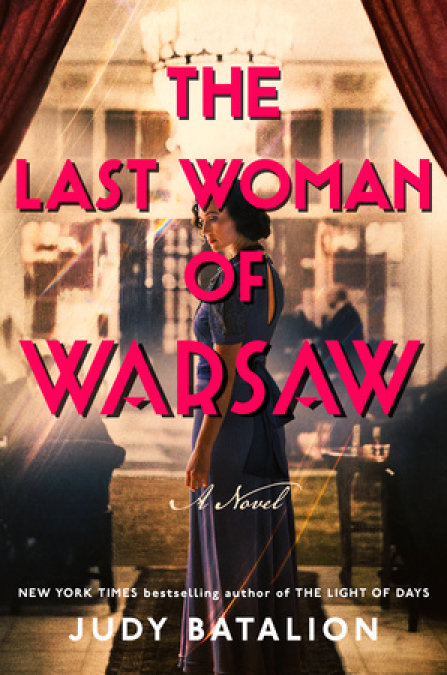
A debut novel by the critically acclaimed New York Times bestselling author of The Light of Days, following two very different Jewish women in Warsaw in the late 1930s as they unexpectedly come together in their search for love, meaning, and a sense of home, and as they grapple with the storm clouds gathering around them
1938: Fanny Zelshinsky is a sophisticated, modern daughter of the city’s Jewish elite who wants nothing more than to be recognized as a legitimate artist by her family, her radical professor whom she idolizes, and the world at large. And all while she wonders if she is really going to go through with her wedding.
Meanwhile, Zosia Dror has left behind her small northeastern shtetl and religious family in the wake of violence. Part of a budding youth movement that believes in social equality and creating a Jewish homeland, all she wants is to not get distracted by the glitz and hubbub of the city—or by the keen eyes of a certain tall, handsome comrade.
When legendary artist Wanda Petrovsky—both a member of Zosia’s movement leadership and Fanny’s beloved photography professor—goes missing, the two young women are thrown together in the pursuit of the elusive firebrand. Is Wanda simply hiding, or is her disappearance connected to the rise in antisemitic laws and university practices? Fanny and Zosia may be the most unlikely of allies, but they must bridge their differences to help someone they both care for—and dodge the danger mounting around them in the process.
Release date:
April 7, 2026
Publisher:
Dutton
Print pages:
336
* BingeBooks earns revenue from qualifying purchases as an Amazon Associate as well as from other retail partners.
The leśny mech, or wooded moss, was usually Fanny's favorite. Today, it comprised a spectacular bright green, spotted with lush red cherries, resembling a forest floor in bloom. Next to it, a square of sweet-cheese cake was bedecked by a perfect fractal of sliced apples and thick blackberries. The herbatniki biscuits, crunched with chocolate, sat by a grape meringue placek, which looked like a layer of thick snow, still fresh, perched atop the soaked fruit, reminding Fanny of her childhood winters on the slopes. The miodowiec, a dainty palimpsest of biscuit and custard, sat quiet but firm, while the lemon glaze on the poppy seed makowiec glistened in the afternoon sun's rays.
Fanny's eyes scanned the cakes, taking them all in as the baker went on about creams and wafers, melts, and mélanges. It was a veritable visual symphony of sugar and sweetness and joy joy joy. And yet.
All these delicacies in front of her, but Fanny couldn't fathom swallowing a thing. This was all supposed to be happy! Once in a lifetime, Mamo had told her. You only get married for the first time once!
Mamo, of course, was divorced.
"How delicious!" her mother now said, waving an icing-streaked fork in the air.
"Nu, try . . ." The caterer stabbed tines into a burgundy gelée and offered it to Fanny. The woman, round and doughy like her food, stood on the opposite side of the counter from Mamo and her.
Fanny moistened her lips, hoping in vain that this would catalyze a hunger pang. Action creates reaction, she'd once read. She brought the fork to her mouth. "Tell me again what's in this?"
"Whinberries," the woman replied. Then she addressed her mother. "These cakes you've selected could have been served to Piłsudski himself. What excellent taste you have, Madame Zelshinsky. You are more Polish than the Polish!"
Mamo beamed. "Well, what am I supposed to serve . . . babka?" To Fanny, who was clearly not eating, she added, "Don't be nervous, Fan-Fan. We'll pick one type for the main wedding cake, but we'll also serve three or four desserts in addition. Of course, they'll all be decorated with pastel roses of the finest confection. There's no need to hold back." And then, to the baker, "Put it on her father's tab."
Fanny noted how each piece of silverware was perched on the side of its plate like a row of soldiers standing at attention. If only Fanny could capture the angle . . . it reminded her of Professor P's ashtray shots, where she'd positioned articles to create a mood. Even inanimate objects, her mentor had explained, could evoke feelings. Fanny looked to the side of the kitchen where she'd left her camera bag; hidden but safe. She exhaled and forced herself to take a bite. The cake was soft like a pillow, but with a tangy cream nestled inside. A surprise twist.
"Remind me, where is the wedding taking place?" the caterer asked. "At a synagogue?"
"At the synagogue," Mamo said. "The Great Synagogue." For someone who didn't even fast on Yom Kippur, when it came to marrying off her only child, Mamo was strangely obsessed with religion.
"And when?"
"Six months to the day!" Mamo answered.
That feeling again, in the pit of her stomach.
"Try this torte and tell me more." Fanny noted how this woman handled Mamo. She'd sniffed out her soft spots, using them instead of fighting them. She'd just met her and was better at managing her than Fanny was after twenty years. "Who's the lucky bridegroom?"
"Simon Brodasz," Mamo replied. "He's on a professional tour, traveling all over Europe and even America. His mother's family are bankers, and the father, import-export. Like Fanny's father."
"I know the name."
"You do?" Mamo looked so pleased, but Fanny could tell that the old woman didn't.
Simon Brodasz. Fanny said it to herself. She'd known him since she was a young teenager, from weeks spent at their summer house just outside Radzymin, near what had been her grandparents' sugar factory. Their families had long been friends; they used to eat dinner together on the grand porch. Simon was always attentive, making sure she had sufficient servings of meat pâté, goose neck, and entertaining repartee. ("Do I impress you with my wit?" he'd once asked. "What wit?" she'd teasingly replied. "This wit," he'd said, and flexed his arms.) She could tell he fancied her, and Fanny liked being fancied. Eventually, Simon began to take her for long walks, and then, last year, dates in Warsaw, to gourmet ice-cream parlors and new restaurants whenever he was in town. Fanny had always known she had to marry someone, and here was a suitor who suited her needs: financial security, kindness, and a union that would bring their families together with so much joy, even providing Mamo with relatives of a sort. Simon had proposed a few weeks earlier, in Padereweski Park where he embraced her near a sculpture of a bathing woman. He'd wanted to set the wedding date before he left on his travels; they'd settled on a week after his return, in six months. The ring was a Brodasz heirloom, the cut a little gaudy, Fanny had thought.
She tried the name on in her head: Fanny Brodasz.
She picked up the next fork from the silverware cue but couldn't even manage to bring it to her lips.
"You're so pretty," the baker told Fanny. "And you're getting married so young! Most people are marrying later these days . . . I suppose it's good to get those children out of you quickly. Those gorgeous hips of yours-well, at least you had them for twenty years!"
"Yes, well, Fan-Fan is meant for marriage," Mamo asserted. "She was trained to be a beauty. A balabusta! She was never trained to work. She can't hack independence, like you, Pani."
Fanny opened her mouth, but nothing came out.
She reminded herself: She'd said yes, and Simon was nice and handsome, and he liked her, and he was more athletic than Jerzy, the law student with the acne, and more interesting than Michael, who had more horses than books. He was gentler than almost all the men Mamo had insisted she meet at the Europejski Hotel, the spot where years earlier Mamo had taken her to a ball and the newly released Nikodem swing had bounded through the lush interiors as Mamo had shown her off to celebrity actors and directors. More recently, her mother had been setting her up with growing urgency while awaiting Simon's proposal, just in case it didn't come. But he'd asked, and she'd said yes. Fanny would have a good life, experience the best there would be of 1938, 1948, 1958 . . . She'd be able to continue with her passions, wouldn't she?
"Well, I suppose for your strata, you're not that young. The shtetl Jews marry later, they need to save up."
"Exactly," Mamo said. "Not for the cream for Warsaw!"
"Warsaw," the old woman repeated and winked. "You know, it was not named for war, but for love."
Fanny knew this. She shook her head and looked down to avoid any more address. That's when she noted her watch. "Oh no, I'm late."
"For what?" Mamo asked, irritated.
"For class." She didn't mention which class, certainly not now.
"What a beautiful timepiece," the baker said.
"Thank you," Fanny said, but Mamo was already explaining how it was a Cartier, a gift from the betrothed.
"What should I do with the rest of these cake samples?" the baker asked. "Do you want them? Sometimes I give them to beggars outside . . . So much poverty these days."
"Let them eat cake!" Mamo laughed as Fanny cringed. "Fanny, tonight we must discuss dance lessons, and the flowers. Time is of the essence."
Fanny grabbed her bag and her coat, thanked the baker, and headed out the door to where her bicycle was parked.
"Oh, maybe we could do a bouquet with thyme!" Mamo called after her, giddy as ever, but Fanny didn't turn back.
{
Warszawa was not named for war but for love, Fanny repeated as she pedaled faster. This, she knew, was despite the city’s long history of siege and recovery, of endless ransack and renewal. Its motto: “defying the storms.” And yet the story goes: Sawa was a mermaid who chanted sweet tones. Wars was a fisherman who fell in love with her voice. But even if he caught her in his net, he could never have her for on land she would expire. Her beauty only existed where he could not go.
Fanny took her eyes off the road and looked out at her beloved Vistula, the longest river in Poland, connecting every one of its main towns and bisecting the capital. The water reflected the sky, an ombre of orange and red, and the farther Fanny traveled down the hill toward the university, the more of the view appeared. More of the river, more leafless winter trees, more white and cream brick buildings, each moment hinting at how much there was left to see, at how much one hadn't seen before.
The few bites of cake felt heavy in her stomach.
Fanny wanted to stop, to capture the scene in this particularly bucolic part of town, but . . . she checked the Tank watch. She was terribly late for class. It may not have been the wisest idea to use a bicycle on January roads, and Fanny pedaled faster as the cold wind cuffed her cheeks the way Nanny used to spank buckwheat pancakes with thick flour. Fanny reached up to secure her silk kerchief, cream with blush pink roses that reminded her of summer.
What had Professor Wanda Petrovsky said about photographing water? Was it to capture reflected rays? To show movement? Did water ever stop?
Could we ever really feel water, or did we just feel its temperature?
She couldn't recall how Professor Petrovsky-or Wanda, as Fanny referred to the legendary photographer in the privacy of her own head-had answered these questions. But Fanny did remember one thing her teacher had declared: Art is like water. It soaks your hand while slipping through your fingers. Contrast, juxtaposition-these were Wanda's guiding aesthetic ideals, shown in her close-ups of ornate Jugendstil-inspired office buildings with their wailing gargoyles, Art Deco vases posed like triumphant eagles, and illegal union marches.
Fanny's own portfolio sat awkwardly in her bicycle basket, and each bump caused her heart to skip within its shell. She was proud of its contents. Of course, her fashion photography was less broody than her teacher's oeuvre, but these were some of her best shots, including eleven close-ups of a customer at the Fashion Café who wore a woven pillbox hat-or rather, Fanny thought with some derision, the hat wore her. Though straight from the pages of La Femme Chic and Przegląd Mody, this hat was perched on the woman's head so gawkily it looked like it might topple off at any moment. The rest of the outfit, too, was all work, labored and ungenuine. Fanny's photos, she hoped, captured the effort behind how this woman presented herself, how "effortlessness" did not really exist. Oh, how she wished, how she prayed Wanda would call on her to present them! She usually called on the art majors, not the French ones, but maybe, just maybe, fate would be on her side today.
Suddenly, the road turned to reveal a new element of the vista-the water reflected not only the sun's rays but the side of the hill, sky and land, light and dark, breath and constriction, the sky reiterating the water, reiterating the sky.
Fanny jerked back on her breaks, jumped off her bicycle, kicked the stand, and took out her prized Leica camera from her satchel. Click, click, click.
The Vistula was the country's lifeline, its spiritual aorta. Fanny had toddled around its banks as a child at their family friend's country estate in Kazimierz Dolny, where all four of her Jewish grandparents-the Yiddish side and the Polish side-met for summer picnics. Her Dziadek had told her the legend of Princess Wanda who became the queen of Poland after the death of her father, King Krak. When Princess Wanda refused to marry the German Prince Rudiger, he took offense and invaded Poland. The Poles fought him off, but nonetheless Wanda committed suicide by throwing herself into the Vistula, all to ensure that he and the Germans would never invade their country again. This ancient waterway, Fanny saw now, flowed with legends, connected and divided at the same time.
Fanny brushed off these deeper thoughts and wasted no time jumping back onto her bicycle. Thank goodness for her new racing green lace-ups with only the suspicion of a heel. "Allons-y!" she said out loud as she picked up speed for the final sprint to the lecture hall, keeping one hand on her portfolio to make sure its precious contents stayed secure. She barely noticed her new ring.
{
“Coincidence, contagion, or epiphenomenon?” Professor Petrovsky asked, but with her booming voice it came out more like a proclamation.
Fanny could feel her pulse beat through her whole body. At the front of the class, Wanda held up an enlarged print. It showed a political rally, young people crushed together in central Warsaw. Framing the scene were two women, both shielding their eyes with their hands in the exact same way, same angle, same form.
"Did these women catch this gesture from each other unawares, or was it happenstance?" Wanda probed. "Did a separate phenomenon cause them both to shade their faces this way? Does this mirroring reflect nature's underlying logic, or has the artist imposed her eye on the scene? Do we search for the patterns in this world, or"-here, she paused and cast her sharp eye over the crowded classroom-"do we create them?"
These lofty ideas made Fanny feel faint, as if her whole self could just buckle. Instead, she gathered herself and leaned over her fellow students to get an even better view of Wanda's masterpiece. Wanda was barely even older than Fanny, maybe in her late twenties. And yet there was a generation gap of knowledge.
"The religious do not believe in coincidence," Wanda declared. "Neither does Freud!"
Wanda's short hair sat flat along her cheeks and her sweater had a fashionable sailor-suit collar. Even if not a bohemian, she was still a true artist. Fanny imagined herself ten years in the future as an art professor, her photos hung at all the city's important cafés and galleries. "The photography queen of Warsaw," she would zip around town on high-speed metros but, in contrast to Wanda's curt functionalism, would wear long flowing gowns bedecked in shimmering floral prints, which, she was sure, would be the cutting edge of design in 1948.
We hope you are enjoying the book so far. To continue reading...

 Please log in to recommend or discuss...
