
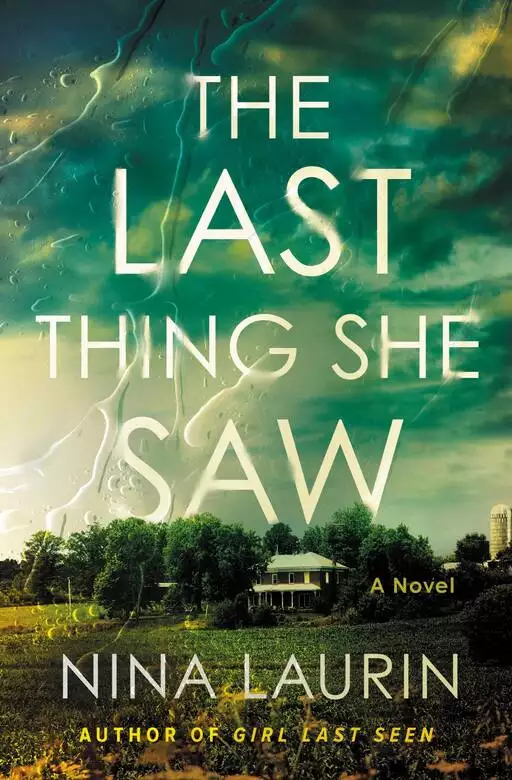
The Last Thing She Saw
Available in:
- eBook
- Audiobook
- Book info
- Sample
- Media
- Author updates
- Lists
Synopsis
The latest thrilling and intense psychological suspense from the bestselling author of Girl Last Seen follows a rural town in Quebec as it grapples with long-buried secrets.
Publisher: Grand Central Publishing
Print pages: 336
* BingeBooks earns revenue from qualifying purchases as an Amazon Associate as well as from other retail partners.
Reader buzz
 Please log in to recommend or discuss...
Author updates
Close
The Last Thing She Saw
Nina Laurin
2017
And so the prodigal daughter returns. Again.
I come back the same way I left the first time when I was seventeen: on a shabby Greyhound bus that smells like dandruff. The bus route from Montreal to Marly is a dense web of detours because, I guess, there aren’t enough passengers to justify a direct line. It takes me through the picturesque, hilly, tourist-friendly Eastern Townships and then leaves them behind before I’m 10 percent into my audiobook. The rest of the way is a dull expanse of fields, not very attractive in the early spring, with all the stops in boring little towns with no charm and no hopes of drawing lucrative American visitors. Even if the audiobook could hold my attention for more than five minutes at a time, I know I better not drift too far off or I just might miss my boring little town.
Fortunately, the book is no good. Or maybe it is good, but it’s not doing it for me, the same way most books lately haven’t managed to grab me. As it is, the middle-of-the-road thriller, deal-of-the-day for $0.99 meanders in slow and torturous zigzags, unsure where it’s headed. Maybe we just have too much in common.
Last time I came back to Marly, almost two years ago, I was in higher spirits, not to mention in my own car. Both the car and I were maybe a little worse for wear but functional and nice-smelling. But, to be fair, the town isn’t exactly at its best now either.
It’s typical as small towns go. There’s its own shred of history to which it clings with disproportionate pride: Everyone knows their heritage and proudly displays it via bumper stickers and little flags that protrude out of everything. A large population of displaced Acadians, an equally large community of farmers going back generations, and, oddly enough, a sizable community of Irish descendants. To which I suppose I belong. Other than that, there are the alliances that last for generations and feuds that last for even longer. And everybody has heard who’s cheating on whom with whom, and everybody knows whose mom drinks too much.
And of course, the town has its own town mystery, although, perhaps, not for much longer. My podcast might be dead in the water—the irony—but maybe Michelle Fortier hasn’t had her last word yet.
In any event, people are talking about Marly.
Climate change succeeded where I had failed: It put Marly, a forgettable small town lost in the Beauce region, on the map. At last, it made the national news. What it took was the river Chaudière, bloated by a record-breaking snowmelt, escaping its narrow confines and flooding the central street of Marly, along with all its small businesses and centennial buildings. The media decried a tragedy—although I doubt that any of these grave-faced Montreal journalists could have found the place on the map two months ago. The river, having done its worst, pulled back and continued its polluted slog, carrying agricultural runoff steadfastly toward the Saint Lawrence River, and left the town to deal with the mess. Many of those centennial houses had to be demolished, as had many others no one mentioned because they were of no interest to the local conservation society. Just a bunch of ugly sixties and seventies bungalows no one would miss.
In one of those bungalows, the demolition team found the remains of Michelle Fortier. Back after forty years to cause trouble.
The bus pulls up to the terminal and I get out, my tattered duffel slung over my shoulder to avoid hitting the two or three remaining passengers on my way. The doors close behind me, stranding me in a perfectly empty lot. I check the time on my phone—it’s almost thirty minutes after the supposed arrival time—and instantly know that Laura forgot I was coming.
I search my soul for any signs of shock, surprise, or, at least, disappointment. I don’t find any. I suppose there was a reason I idly checked the walking route to my destination before I got off the bus. Last time I was here, I drove, so I was unpleasantly surprised to discover that it’s a forty-minute walk at a leisurely pace. The weather sucks—the wind darts back and forth, sharp little gusts that tug at my thin coat, and I hope the little drizzle of rain doesn’t decide to pick up.
The last time I was in town might be only two years ago, but the last time I had to walk to this bus terminal was in an era just before smartphones. So, with the help of Google Maps, I start on my way.
When I came here two years ago, with my Toyota and the typical smugness of one of the lucky ones who escaped, I’d taken in all of Marly’s progress with condescending approval. Our very own Walmart, nice! A smattering of new fast-food chains had to signify progress in these parts. All the people I went to high school with who lived there still—good for them. They too can have a Beyond Meat double cheeseburger.
I was just fine in my Rosemont apartment with my glamorous job working for a local media outlet, thank you very much for asking. Now, since I failed my assignment and my podcast had been deemed unsatisfactory, the media outlet let me go. The Toyota’s sale paid for a month and a half of rent on the ludicrously priced one-bedroom. My phone bill is past due. My $38 bus ticket had to be put on my credit card. Those farms and local businesses my classmates had inherited no longer look all that bad. All I have to come back to is the O’Malley manor, the two-bedroom mobile home on the outskirts of Marly that Laura inherited from her own parents.
It’s not personal, sweetie, my boss at the media outlet said with a shrug. She had a deceptively soft voice and girlboss energy, not to mention really expensive hair. It’s just that it’s not that interesting to our target audience. Young, urban Montrealers. A country girl who disappeared long before they were born, it’s just not as relevant.
I wanted to point out that no one seemed to think so when they greenlit the idea. And had the podcast been a success, Expensive Haircut would have gladly taken all the credit. But since it wasn’t a success, the blame had to be shifted to where it wouldn’t splash mud on her $700 boots. So the moment the higher-ups deemed the podcast an epic fail, it all became my idea from start to finish. And the truth is that it’s not a question of relevance—a local, 100% made-in-Quebec true crime podcast should have been a hit. Would have been, if only there had been something, anything, to chew on. As Expensive Haircut correctly pointed out, most of it is just baseless speculation. No viable theories, no interesting evidence to support them—nothing.
In the distance, the flashy sign of a gas station and the fast-food places that flank it grow closer. Is it just me or is the rain getting heavier? I’m really just looking for an excuse to go inside and get a combo on a plastic tray with as much soda as I can drink. Maybe even a hot coffee. I wasn’t going to succumb to temptation, but something tells me Laura doesn’t have a welcome-home feast getting cold on the table as it awaits my arrival.
Distances here are always so much longer than they look. I thought I was a short walk away from the beckoning signage, but in reality, it took close to twenty minutes of trudging next to the road on the narrow strip between cars roaring by indifferently and the rigid remains of snow. I make it to the gas station muddy and winded. That fast-food trio is now more of a necessity than an indulgence. At least I tell myself so.
As I get close though, I see another problem I’d simply overlooked two years ago from the vantage point of my proverbial high horse. The fast-food place is drive-thru only. I’m on foot. How the mighty have fallen.
I ponder just how much I’m willing to humiliate myself as I watch the cars line up.
Then, suddenly, “Stephanie?”
I turn around. The F-150—nice, shiny, new, the size of my regretted city apartment—rolls toward me slowly. The window is down, and from it, Luc is grinning at me.
Back in the city, I self-styled as Stevie—to stand out from the million other Stephanies but also in a mostly subconscious bid to pander to the English-obsessed younger crowd. But I guess there’s no one to show off to anymore.
“Hi,” I say.
“Since when have you been back?”
“As of a few minutes ago,” I reply.
“So this time I finally intercepted you,” he says with a grin.
I feel my face warm. My last stay in town was meant to last a month, but I left after two weeks. We’d only crossed paths once, awkwardly, in the parking lot of the strip mall by the police station. If he was hurt that I didn’t bother to get in touch, he hadn’t shown it. But I guess it did get to him.
Fact is that there was a reason I hadn’t bothered to get in touch with him. I didn’t plan to stick around beyond my one allotted month, and after that, I planned never to come back, ever. No reason to reconnect with my high school sweetheart when the future held followers and fame and hopefully money, and, down the line, a hipster boyfriend who only wore Metallica T-shirts ironically.
I grin. You got me. “Looks that way.”
“Hey. Do you by any chance need a ride?”
Somehow, he took one look at me and grasped the full extent of my sad situation: no money, no car, no Laura, not a soul who gives a damn if I accidentally get run over by a tractor. Yet the offer is made with such sincerity and a total lack of gloating.
“Thank you,” I say honestly. Honesty is the least I can do. That, and I’m genuinely grateful when I climb into the passenger seat of the F-150 and the dry, warm air from the whirring fans envelops me like a comforting blanket.
He drives off. Thankfully, it’s not going to be a very long ride, at least not long enough to have heart-to-heart conversations about why I’m back or why I came back the first time and hadn’t even said hello. For the first few minutes, he stays quiet, and so I stay quiet too.
“So,” he says at last, and I brace myself. “Do you want me to take you there?”
I blink. “Where?”
“Oh, come on. I know why you’re here.”
He says this without a shade of malice, just a statement of fact.
“They found Michelle Fortier. Everyone knows, the town is abuzz. That’s what your show was about, right?”
“My podcast,” I correct, a little vexed.
“Yeah, yeah, your radio show.” Oh, Luc. Luc never did stop wearing the Metallica T-shirts unironically. Even now the logo, crackled white on faded black, peeks out from under his checkered flannel. He still manages to be good-looking, which is a feat considering that the majority of dudes our age who stayed on after high school (that is, pretty much all dudes our age) look like John Goodman by now. That flannel could be hiding a multitude of sins, but Luc looks fit. His face is scruffy and his hair is in need of clippers but not in an intentional way. Which should detract from the overall impression but strangely doesn’t.
And I don’t suppose he listens to podcasts much. The car’s sound system might be paired with an iPhone rather than a tape deck but the music coming out of the speakers at a low volume is still the same semimainstream nineties rock we used to listen to together in high school. I’m pretty sure we made out to this exact song a number of times. Is this resistance to new things genetically ingrained? Is it a Marly thing? A country thing? Who knows.
“Yeah, my dad told me you were here to make a documentary show on Michelle,” he clarifies. Unnecessarily, because of course someone would have told him sooner or later. “So I guess you’re here to make the follow-up?”
I ponder just letting him think that. It’s better than admitting that sure, I’m here for that but also because I’m broke and shit out of luck.
I guess I ponder for too long because he seems to take my silence as acquiescence.
“I’ll take you to the house. I think we should be able to get all the way there by car by now. They’ve reopened most of the streets the other day, now that the water’s gone.”
Right. The flood.
“And then I suppose you’re going to Laura’s?” He gives me a shrewd look. Or so it seems to me. “I mean, the inn is closed because of water damage. It was right on the lowest point of the Main, so…”
“Just my luck,” I say with a shit-eating grin. “Laura’s it is.”
We drive into town. I wonder if he still remembers the exact way to my place. I mean, Laura’s place. After all these years. I can’t decide whether it’s cute and romantic or just a sign to what extent everyone here has absolutely no life.
Then the F-150 turns onto the main street, and I forget whatever I was thinking about. I crane my neck, staring out the window like a tourist. The feeling that invades me is strange, hard to describe. The sight is unsettling. Nauseating, even. It’s profoundly bizarre to see the place I know so well undone like this.
Luc had been right about the inn—it’s cordoned off by tape and cones, the door and ground-floor windows boarded up. The same fate befell many of the other buildings, the quaint family-owned stores, the bakery. I begin to understand how tough it might be for a town like Marly that clings to its history like it has nothing left. I watch it all float by outside the car window, unsure what to say.
“There’s already talk of not rebuilding much of the old town,” Luc says glumly.
This gets even me. “What?”
“There was a town hall meeting, all these environmentalist groups came.” He grimaces. “They say, give it back to nature, it belongs to nature. No matter that these buildings are more than a hundred years old. Global warming is a thing, apparently, so to hell with all that. Town council is pushing for a dike, like the one in that town near Montreal that was on the news last year. But that’s gonna cost a fortune, so no one knows if it’ll work out. The prime minister was here last week. A lot of talk but nothing real, naturally.”
“Naturally,” I echo. The truth is that I expected to feel something like schadenfreude. This stupid town I hate, the town I barely escaped from, with its pathetic pride and its misbegotten ego, finally brought down into the mud it always belonged in, at least in my eyes. But now that I’m seeing it in person, all I feel is queasy.
Finally, we leave the historic part of Marly behind, and I barely have time to breathe a sigh of relief. Here are the newer, uglier constructions from the sixties onward: the dentist’s office, the new drugstore, the garages and repair shops. And then Luc slows the car down in front of one such garage. SUSPENSION PARTS REPAIRS, reads the faded sign. Behind it and to the side is the house that belongs to the garage owner, a squat bungalow with an exterior of burnt-orange tiles tarnished by time. Its one window that faces the street is intact but pitch-black. The walls are stained gray up to a sharp line a couple of feet off the ground; this is how high the water reached. Not all that high, compared to the houses down the street that were hit much worse, but this particular house is surrounded by twice the amount of police tape that flutters nervously in the wind. As I open the window and lean out, I glimpse the padlock on the front door.
“This is the place?” I ask, even though it’s not necessary. In my peripheral vision, Luc nods.
“So it was the Gagnons this whole time,” I muse.
“Not necessarily.” Luc seems to bristle. “And anyway, he died a couple years ago, right before you came back for the first time. She closed the garage and then sold the house.”
“And? How does that mean it wasn’t them?”
Luc shrugs. “I’m not saying it definitely wasn’t. It’s just that there’s no one to hold responsible anymore.”
“It’s not a question of holding anyone responsible,” I say. “It’s a matter of giving justice to the victim. And closure to the family.” I feel stupid as the words leave my mouth. I feel like I’m talking to my boss. Or to my microphone. I don’t sound like me—I sound the way I’m expected to sound. Nobody actually thinks in such words.
“Is that why you wanted to do your show in the first place?” Luc asks. Again, I can’t tell if he’s being charmingly naive or sneaky and sarcastic.
“Something like that,” I mutter. I reach for the door handle and undo my seat belt with the other hand.
“Where are you going?”
“I’m going to have a look.”
“You can’t. It’s a crime scene.”
Aren’t you the law-abiding citizen all of a sudden, I think. If memory serves me right, we used to steal beer out the back of the convenience store and then trespass on private land to go drink it. I ignore him. I get out of the car and walk toward the house, stepping gingerly on the squelching front lawn. There’s debris everywhere so I better not step on some rusted nail. The nearest hospital is in the next village over, a thirty-minute drive, and the last thing I need is tetanus.
I come to a stop at the edge of the scene. The yellow police tape flutters against my shins. I can’t bring myself to go farther. The house draws my gaze and at the same time repels it; I want to look away but can’t.
There are more squelching steps behind me, and a moment later, Luc is by my side. “They were ripping out the plaster in the basement,” he says. “You know, to dry everything so mold and other crap wouldn’t take hold. That’s what they were told to do, at least in houses that could still be salvaged. And there, behind the plaster, they found a body.”
That must have been pretty damn traumatizing. Luc seems to be thinking the same thing. “The new owners are nice,” he says with a shrug. “I feel bad for them.”
I sort of tune him out. I keep staring at the house that seems to have had all the answers from the start. It’s exactly halfway between Laura’s and the store where I got my cigarettes. I’d driven past it so many times two years ago, twitching from nicotine withdrawal, and meanwhile, what I came here for was inside. Immured in an ugly, late-seventies bungalow with popcorn ceilings. Michelle Fortier, the town mystery, lurking behind a plaster wall while the house’s residents watched Habs games in their rec room.
“Well, they can congratulate themselves. They’re part of town lore now,” I say.
“Assuming it really is Michelle,” he points out.
That remark makes me turn my head, finally, and face him. “What do you mean? Who the hell else could it be?”
“They haven’t formally identified her yet,” he says. And, come to think about it, he’s right. The news never said explicitly the body was Michelle. A child, they said, presumed to be Michelle Fortier.
“It’s Michelle,” I say darkly. “There’s no one else.”
I mean it. There hasn’t been a missing person in Marly since before Michelle was even born. And no other missing child.
“It’s such a shame,” Luc says.
“What’s a shame?”
“We probably won’t know what really happened. It’s been forty years. And what you were saying about closure for the family—there won’t be much of that, either.”
He’s not wrong. Gaetan Fortier died ten years ago, and his wife, Marie, has been in a care home for the last three with worsening dementia. When I was here last, the house, a mansion by Marly standards, had just been put on the market. I don’t even know who managed their affairs on Marie’s behalf—probably some distant relative, since the Fortiers had no other children.
“Did the house ever sell?”
He shook his head. “And now I doubt it will.”
“What do you mean?”
“It’s right by the river. At a low point. It got flooded too.”
Luc is right. It is sad.
“Come on,” he says, and shifts from one foot to the other as if sensing that this is it—I’m not going to go inside and start poking around. “I’ll take you to Laura’s.”
We go back to the F-150. Only once we’re back on the road and the house fades in the rearview mirror does it occur to me to wonder: “So aren’t you in the police, like your dad?”
“Nope,” he says.
Wow. Frank must have shat a brick.
“I decided to get into the whole agricultural game,” Luc says. I glance at him sideways and instantly feel a prickle of alarm. He’s avoiding my gaze, looking at the road a little too intently.
“What?” I tease. “Don’t tell me you’ve started a grow-op in some old barn. They’re gonna legalize that stuff soon anyway.”
“No,” he replies quickly. “Nothing like that. Nah, I’m growing soy these days.”
Oh.
Oh.
“Yeah,” he says guiltily. “Cath’s dad, you know, he retired, and Cath has no siblings so it’s pretty much just me.”
No further explanation is needed, thank you, good night.
“Cath won’t be mad once the entire town tells her they saw me in your truck?” I ask, unable to keep the sour note from my voice. How on earth was I here for two whole weeks last time and I never even heard of this? And why didn’t Laura say anything? You’d think she’d be the first to gloat.
Luc winces. “Come on, Steph. It’s not like that. It’s been like twenty years.”
Fifteen. But I don’t correct him.
“We got married a few years back,” he says, hangdog.
Wow. Cath sure as hell didn’t waste any time.
In that moment, he takes a turn, then another turn, and then, here it is, the second to last in the row of mobile homes. Laura’s. I never in my life would have imagined I’d be thankful to see it. But as it stands, the sight of it snaps me right out of my head, where I’d been imagining the most gruesome scenes involving my high school boyfriend and Cath naked in bed, together.
“Here you are,” says Luc in a much more hopeful tone. I bet he’s just as glad the r. . .
And so the prodigal daughter returns. Again.
I come back the same way I left the first time when I was seventeen: on a shabby Greyhound bus that smells like dandruff. The bus route from Montreal to Marly is a dense web of detours because, I guess, there aren’t enough passengers to justify a direct line. It takes me through the picturesque, hilly, tourist-friendly Eastern Townships and then leaves them behind before I’m 10 percent into my audiobook. The rest of the way is a dull expanse of fields, not very attractive in the early spring, with all the stops in boring little towns with no charm and no hopes of drawing lucrative American visitors. Even if the audiobook could hold my attention for more than five minutes at a time, I know I better not drift too far off or I just might miss my boring little town.
Fortunately, the book is no good. Or maybe it is good, but it’s not doing it for me, the same way most books lately haven’t managed to grab me. As it is, the middle-of-the-road thriller, deal-of-the-day for $0.99 meanders in slow and torturous zigzags, unsure where it’s headed. Maybe we just have too much in common.
Last time I came back to Marly, almost two years ago, I was in higher spirits, not to mention in my own car. Both the car and I were maybe a little worse for wear but functional and nice-smelling. But, to be fair, the town isn’t exactly at its best now either.
It’s typical as small towns go. There’s its own shred of history to which it clings with disproportionate pride: Everyone knows their heritage and proudly displays it via bumper stickers and little flags that protrude out of everything. A large population of displaced Acadians, an equally large community of farmers going back generations, and, oddly enough, a sizable community of Irish descendants. To which I suppose I belong. Other than that, there are the alliances that last for generations and feuds that last for even longer. And everybody has heard who’s cheating on whom with whom, and everybody knows whose mom drinks too much.
And of course, the town has its own town mystery, although, perhaps, not for much longer. My podcast might be dead in the water—the irony—but maybe Michelle Fortier hasn’t had her last word yet.
In any event, people are talking about Marly.
Climate change succeeded where I had failed: It put Marly, a forgettable small town lost in the Beauce region, on the map. At last, it made the national news. What it took was the river Chaudière, bloated by a record-breaking snowmelt, escaping its narrow confines and flooding the central street of Marly, along with all its small businesses and centennial buildings. The media decried a tragedy—although I doubt that any of these grave-faced Montreal journalists could have found the place on the map two months ago. The river, having done its worst, pulled back and continued its polluted slog, carrying agricultural runoff steadfastly toward the Saint Lawrence River, and left the town to deal with the mess. Many of those centennial houses had to be demolished, as had many others no one mentioned because they were of no interest to the local conservation society. Just a bunch of ugly sixties and seventies bungalows no one would miss.
In one of those bungalows, the demolition team found the remains of Michelle Fortier. Back after forty years to cause trouble.
The bus pulls up to the terminal and I get out, my tattered duffel slung over my shoulder to avoid hitting the two or three remaining passengers on my way. The doors close behind me, stranding me in a perfectly empty lot. I check the time on my phone—it’s almost thirty minutes after the supposed arrival time—and instantly know that Laura forgot I was coming.
I search my soul for any signs of shock, surprise, or, at least, disappointment. I don’t find any. I suppose there was a reason I idly checked the walking route to my destination before I got off the bus. Last time I was here, I drove, so I was unpleasantly surprised to discover that it’s a forty-minute walk at a leisurely pace. The weather sucks—the wind darts back and forth, sharp little gusts that tug at my thin coat, and I hope the little drizzle of rain doesn’t decide to pick up.
The last time I was in town might be only two years ago, but the last time I had to walk to this bus terminal was in an era just before smartphones. So, with the help of Google Maps, I start on my way.
When I came here two years ago, with my Toyota and the typical smugness of one of the lucky ones who escaped, I’d taken in all of Marly’s progress with condescending approval. Our very own Walmart, nice! A smattering of new fast-food chains had to signify progress in these parts. All the people I went to high school with who lived there still—good for them. They too can have a Beyond Meat double cheeseburger.
I was just fine in my Rosemont apartment with my glamorous job working for a local media outlet, thank you very much for asking. Now, since I failed my assignment and my podcast had been deemed unsatisfactory, the media outlet let me go. The Toyota’s sale paid for a month and a half of rent on the ludicrously priced one-bedroom. My phone bill is past due. My $38 bus ticket had to be put on my credit card. Those farms and local businesses my classmates had inherited no longer look all that bad. All I have to come back to is the O’Malley manor, the two-bedroom mobile home on the outskirts of Marly that Laura inherited from her own parents.
It’s not personal, sweetie, my boss at the media outlet said with a shrug. She had a deceptively soft voice and girlboss energy, not to mention really expensive hair. It’s just that it’s not that interesting to our target audience. Young, urban Montrealers. A country girl who disappeared long before they were born, it’s just not as relevant.
I wanted to point out that no one seemed to think so when they greenlit the idea. And had the podcast been a success, Expensive Haircut would have gladly taken all the credit. But since it wasn’t a success, the blame had to be shifted to where it wouldn’t splash mud on her $700 boots. So the moment the higher-ups deemed the podcast an epic fail, it all became my idea from start to finish. And the truth is that it’s not a question of relevance—a local, 100% made-in-Quebec true crime podcast should have been a hit. Would have been, if only there had been something, anything, to chew on. As Expensive Haircut correctly pointed out, most of it is just baseless speculation. No viable theories, no interesting evidence to support them—nothing.
In the distance, the flashy sign of a gas station and the fast-food places that flank it grow closer. Is it just me or is the rain getting heavier? I’m really just looking for an excuse to go inside and get a combo on a plastic tray with as much soda as I can drink. Maybe even a hot coffee. I wasn’t going to succumb to temptation, but something tells me Laura doesn’t have a welcome-home feast getting cold on the table as it awaits my arrival.
Distances here are always so much longer than they look. I thought I was a short walk away from the beckoning signage, but in reality, it took close to twenty minutes of trudging next to the road on the narrow strip between cars roaring by indifferently and the rigid remains of snow. I make it to the gas station muddy and winded. That fast-food trio is now more of a necessity than an indulgence. At least I tell myself so.
As I get close though, I see another problem I’d simply overlooked two years ago from the vantage point of my proverbial high horse. The fast-food place is drive-thru only. I’m on foot. How the mighty have fallen.
I ponder just how much I’m willing to humiliate myself as I watch the cars line up.
Then, suddenly, “Stephanie?”
I turn around. The F-150—nice, shiny, new, the size of my regretted city apartment—rolls toward me slowly. The window is down, and from it, Luc is grinning at me.
Back in the city, I self-styled as Stevie—to stand out from the million other Stephanies but also in a mostly subconscious bid to pander to the English-obsessed younger crowd. But I guess there’s no one to show off to anymore.
“Hi,” I say.
“Since when have you been back?”
“As of a few minutes ago,” I reply.
“So this time I finally intercepted you,” he says with a grin.
I feel my face warm. My last stay in town was meant to last a month, but I left after two weeks. We’d only crossed paths once, awkwardly, in the parking lot of the strip mall by the police station. If he was hurt that I didn’t bother to get in touch, he hadn’t shown it. But I guess it did get to him.
Fact is that there was a reason I hadn’t bothered to get in touch with him. I didn’t plan to stick around beyond my one allotted month, and after that, I planned never to come back, ever. No reason to reconnect with my high school sweetheart when the future held followers and fame and hopefully money, and, down the line, a hipster boyfriend who only wore Metallica T-shirts ironically.
I grin. You got me. “Looks that way.”
“Hey. Do you by any chance need a ride?”
Somehow, he took one look at me and grasped the full extent of my sad situation: no money, no car, no Laura, not a soul who gives a damn if I accidentally get run over by a tractor. Yet the offer is made with such sincerity and a total lack of gloating.
“Thank you,” I say honestly. Honesty is the least I can do. That, and I’m genuinely grateful when I climb into the passenger seat of the F-150 and the dry, warm air from the whirring fans envelops me like a comforting blanket.
He drives off. Thankfully, it’s not going to be a very long ride, at least not long enough to have heart-to-heart conversations about why I’m back or why I came back the first time and hadn’t even said hello. For the first few minutes, he stays quiet, and so I stay quiet too.
“So,” he says at last, and I brace myself. “Do you want me to take you there?”
I blink. “Where?”
“Oh, come on. I know why you’re here.”
He says this without a shade of malice, just a statement of fact.
“They found Michelle Fortier. Everyone knows, the town is abuzz. That’s what your show was about, right?”
“My podcast,” I correct, a little vexed.
“Yeah, yeah, your radio show.” Oh, Luc. Luc never did stop wearing the Metallica T-shirts unironically. Even now the logo, crackled white on faded black, peeks out from under his checkered flannel. He still manages to be good-looking, which is a feat considering that the majority of dudes our age who stayed on after high school (that is, pretty much all dudes our age) look like John Goodman by now. That flannel could be hiding a multitude of sins, but Luc looks fit. His face is scruffy and his hair is in need of clippers but not in an intentional way. Which should detract from the overall impression but strangely doesn’t.
And I don’t suppose he listens to podcasts much. The car’s sound system might be paired with an iPhone rather than a tape deck but the music coming out of the speakers at a low volume is still the same semimainstream nineties rock we used to listen to together in high school. I’m pretty sure we made out to this exact song a number of times. Is this resistance to new things genetically ingrained? Is it a Marly thing? A country thing? Who knows.
“Yeah, my dad told me you were here to make a documentary show on Michelle,” he clarifies. Unnecessarily, because of course someone would have told him sooner or later. “So I guess you’re here to make the follow-up?”
I ponder just letting him think that. It’s better than admitting that sure, I’m here for that but also because I’m broke and shit out of luck.
I guess I ponder for too long because he seems to take my silence as acquiescence.
“I’ll take you to the house. I think we should be able to get all the way there by car by now. They’ve reopened most of the streets the other day, now that the water’s gone.”
Right. The flood.
“And then I suppose you’re going to Laura’s?” He gives me a shrewd look. Or so it seems to me. “I mean, the inn is closed because of water damage. It was right on the lowest point of the Main, so…”
“Just my luck,” I say with a shit-eating grin. “Laura’s it is.”
We drive into town. I wonder if he still remembers the exact way to my place. I mean, Laura’s place. After all these years. I can’t decide whether it’s cute and romantic or just a sign to what extent everyone here has absolutely no life.
Then the F-150 turns onto the main street, and I forget whatever I was thinking about. I crane my neck, staring out the window like a tourist. The feeling that invades me is strange, hard to describe. The sight is unsettling. Nauseating, even. It’s profoundly bizarre to see the place I know so well undone like this.
Luc had been right about the inn—it’s cordoned off by tape and cones, the door and ground-floor windows boarded up. The same fate befell many of the other buildings, the quaint family-owned stores, the bakery. I begin to understand how tough it might be for a town like Marly that clings to its history like it has nothing left. I watch it all float by outside the car window, unsure what to say.
“There’s already talk of not rebuilding much of the old town,” Luc says glumly.
This gets even me. “What?”
“There was a town hall meeting, all these environmentalist groups came.” He grimaces. “They say, give it back to nature, it belongs to nature. No matter that these buildings are more than a hundred years old. Global warming is a thing, apparently, so to hell with all that. Town council is pushing for a dike, like the one in that town near Montreal that was on the news last year. But that’s gonna cost a fortune, so no one knows if it’ll work out. The prime minister was here last week. A lot of talk but nothing real, naturally.”
“Naturally,” I echo. The truth is that I expected to feel something like schadenfreude. This stupid town I hate, the town I barely escaped from, with its pathetic pride and its misbegotten ego, finally brought down into the mud it always belonged in, at least in my eyes. But now that I’m seeing it in person, all I feel is queasy.
Finally, we leave the historic part of Marly behind, and I barely have time to breathe a sigh of relief. Here are the newer, uglier constructions from the sixties onward: the dentist’s office, the new drugstore, the garages and repair shops. And then Luc slows the car down in front of one such garage. SUSPENSION PARTS REPAIRS, reads the faded sign. Behind it and to the side is the house that belongs to the garage owner, a squat bungalow with an exterior of burnt-orange tiles tarnished by time. Its one window that faces the street is intact but pitch-black. The walls are stained gray up to a sharp line a couple of feet off the ground; this is how high the water reached. Not all that high, compared to the houses down the street that were hit much worse, but this particular house is surrounded by twice the amount of police tape that flutters nervously in the wind. As I open the window and lean out, I glimpse the padlock on the front door.
“This is the place?” I ask, even though it’s not necessary. In my peripheral vision, Luc nods.
“So it was the Gagnons this whole time,” I muse.
“Not necessarily.” Luc seems to bristle. “And anyway, he died a couple years ago, right before you came back for the first time. She closed the garage and then sold the house.”
“And? How does that mean it wasn’t them?”
Luc shrugs. “I’m not saying it definitely wasn’t. It’s just that there’s no one to hold responsible anymore.”
“It’s not a question of holding anyone responsible,” I say. “It’s a matter of giving justice to the victim. And closure to the family.” I feel stupid as the words leave my mouth. I feel like I’m talking to my boss. Or to my microphone. I don’t sound like me—I sound the way I’m expected to sound. Nobody actually thinks in such words.
“Is that why you wanted to do your show in the first place?” Luc asks. Again, I can’t tell if he’s being charmingly naive or sneaky and sarcastic.
“Something like that,” I mutter. I reach for the door handle and undo my seat belt with the other hand.
“Where are you going?”
“I’m going to have a look.”
“You can’t. It’s a crime scene.”
Aren’t you the law-abiding citizen all of a sudden, I think. If memory serves me right, we used to steal beer out the back of the convenience store and then trespass on private land to go drink it. I ignore him. I get out of the car and walk toward the house, stepping gingerly on the squelching front lawn. There’s debris everywhere so I better not step on some rusted nail. The nearest hospital is in the next village over, a thirty-minute drive, and the last thing I need is tetanus.
I come to a stop at the edge of the scene. The yellow police tape flutters against my shins. I can’t bring myself to go farther. The house draws my gaze and at the same time repels it; I want to look away but can’t.
There are more squelching steps behind me, and a moment later, Luc is by my side. “They were ripping out the plaster in the basement,” he says. “You know, to dry everything so mold and other crap wouldn’t take hold. That’s what they were told to do, at least in houses that could still be salvaged. And there, behind the plaster, they found a body.”
That must have been pretty damn traumatizing. Luc seems to be thinking the same thing. “The new owners are nice,” he says with a shrug. “I feel bad for them.”
I sort of tune him out. I keep staring at the house that seems to have had all the answers from the start. It’s exactly halfway between Laura’s and the store where I got my cigarettes. I’d driven past it so many times two years ago, twitching from nicotine withdrawal, and meanwhile, what I came here for was inside. Immured in an ugly, late-seventies bungalow with popcorn ceilings. Michelle Fortier, the town mystery, lurking behind a plaster wall while the house’s residents watched Habs games in their rec room.
“Well, they can congratulate themselves. They’re part of town lore now,” I say.
“Assuming it really is Michelle,” he points out.
That remark makes me turn my head, finally, and face him. “What do you mean? Who the hell else could it be?”
“They haven’t formally identified her yet,” he says. And, come to think about it, he’s right. The news never said explicitly the body was Michelle. A child, they said, presumed to be Michelle Fortier.
“It’s Michelle,” I say darkly. “There’s no one else.”
I mean it. There hasn’t been a missing person in Marly since before Michelle was even born. And no other missing child.
“It’s such a shame,” Luc says.
“What’s a shame?”
“We probably won’t know what really happened. It’s been forty years. And what you were saying about closure for the family—there won’t be much of that, either.”
He’s not wrong. Gaetan Fortier died ten years ago, and his wife, Marie, has been in a care home for the last three with worsening dementia. When I was here last, the house, a mansion by Marly standards, had just been put on the market. I don’t even know who managed their affairs on Marie’s behalf—probably some distant relative, since the Fortiers had no other children.
“Did the house ever sell?”
He shook his head. “And now I doubt it will.”
“What do you mean?”
“It’s right by the river. At a low point. It got flooded too.”
Luc is right. It is sad.
“Come on,” he says, and shifts from one foot to the other as if sensing that this is it—I’m not going to go inside and start poking around. “I’ll take you to Laura’s.”
We go back to the F-150. Only once we’re back on the road and the house fades in the rearview mirror does it occur to me to wonder: “So aren’t you in the police, like your dad?”
“Nope,” he says.
Wow. Frank must have shat a brick.
“I decided to get into the whole agricultural game,” Luc says. I glance at him sideways and instantly feel a prickle of alarm. He’s avoiding my gaze, looking at the road a little too intently.
“What?” I tease. “Don’t tell me you’ve started a grow-op in some old barn. They’re gonna legalize that stuff soon anyway.”
“No,” he replies quickly. “Nothing like that. Nah, I’m growing soy these days.”
Oh.
Oh.
“Yeah,” he says guiltily. “Cath’s dad, you know, he retired, and Cath has no siblings so it’s pretty much just me.”
No further explanation is needed, thank you, good night.
“Cath won’t be mad once the entire town tells her they saw me in your truck?” I ask, unable to keep the sour note from my voice. How on earth was I here for two whole weeks last time and I never even heard of this? And why didn’t Laura say anything? You’d think she’d be the first to gloat.
Luc winces. “Come on, Steph. It’s not like that. It’s been like twenty years.”
Fifteen. But I don’t correct him.
“We got married a few years back,” he says, hangdog.
Wow. Cath sure as hell didn’t waste any time.
In that moment, he takes a turn, then another turn, and then, here it is, the second to last in the row of mobile homes. Laura’s. I never in my life would have imagined I’d be thankful to see it. But as it stands, the sight of it snaps me right out of my head, where I’d been imagining the most gruesome scenes involving my high school boyfriend and Cath naked in bed, together.
“Here you are,” says Luc in a much more hopeful tone. I bet he’s just as glad the r. . .
We hope you are enjoying the book so far. To continue reading...
Copyright © 2026 All Rights Reserved
