
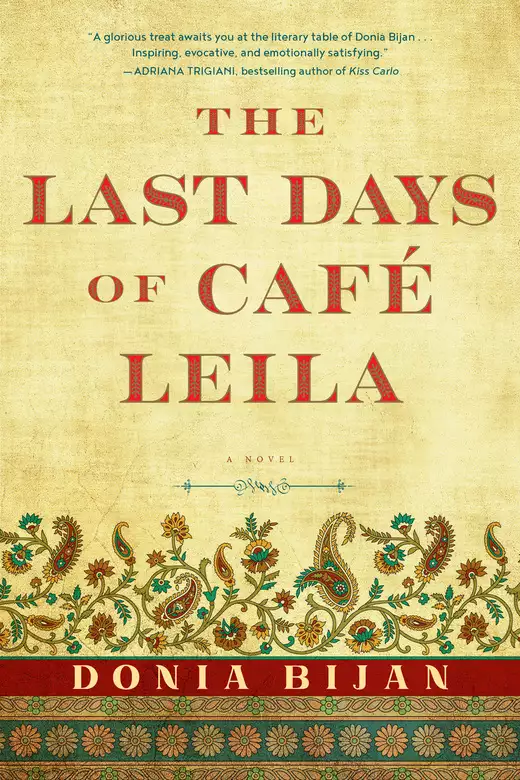
The Last Days of Café Leila
- eBook
- Paperback
- Audiobook
- Hardcover
- Book info
- Sample
- Media
- Author updates
- Lists
Synopsis
Set against the backdrop of Iran's rich, turbulent history, this exquisite debut novel is a powerful story of food, family, and a bittersweet homecoming.
When we first meet Noor, she is living in San Francisco, missing her beloved father, Zod, in Iran. Now, dragging her stubborn teenage daughter, Lily, with her, she returns to Tehran and to Café Leila, the restaurant her family has been running for three generations. Iran may have changed, but Café Leila, still run by Zod, has stayed blessedly the same—it is a refuge of laughter and solace for its makeshift family of staff and regulars.
As Noor revisits her Persian childhood, she must rethink who she is—a mother, a daughter, a woman estranged from her marriage and from her life in California. And together, she and Lily get swept up in the beauty and brutality of Tehran.
Release date: April 17, 2018
Publisher: Algonquin Books
Print pages: 304
* BingeBooks earns revenue from qualifying purchases as an Amazon Associate as well as from other retail partners.
Reader buzz
 Please log in to recommend or discuss...
Author updates
The Last Days of Café Leila
Donia Bijan
TEHRAN, APRIL 2014
Zod marked time by the postman’s arrival, usually by four p.m., quarter past at the latest, except on Fridays when he didn’t come at all. Friday was the day of rest, when if anything, Zod grew more restless with every rigid minute ticking by. Waiting for the mail on Saturday, he spent the last hour watching the clock, and at half past three, he stood up to look out the window with his hands in his trouser pockets. A breeze sent flurries of wisteria into the courtyard. The trees had sprouted new leaves. You would never believe how lifeless they had been just a few weeks before, their splayed branches bare and brooding. Now it was April, true spring, each day warmer than the last, each bud becoming a frilly blossom. He observed a family of finches nesting in the eaves, touching down to pick up a suitable stick and then off again in busy bouncing flight.
Except for this pause in the afternoon, Zod didn’t have much time to watch the world. Naneh Goli came in from hanging the wash to stand beside him, nudging in mock reproach for here he was again. “What on earth are you waiting for?” as if he didn’t stand there every afternoon expecting the faint drone of the mail scooter and the puffs of dust from the alley. He pushed away from the ledge and crossed the hall to go outside, leaving his jacket on the peg and the old woman framed in the window.
Already he felt light-footed, less pain in his joints when he tested the first step with one shoe. He considered leaving his cane, but Naneh Goli was watching him and Zod didn’t want to hear her fair warnings. Sometimes he deliberately prolonged the short walk to the garden gate, pausing to examine a chipped tile or tuck away the loose tendrils of jasmine curling forward from the brick wall. How far was the carrier from him now? Had he reached the traffic circle? It was best to approach the gate just when he arrived so as not to seem too anxious.
Letters from America took sometimes two to three weeks to arrive, and there had been no post at all the past month. Noor still wrote to her father and he kept her letters neatly bundled in his dresser drawer. Letters that lately spoke of nothing much at all except domestic matters, but it wasn’t so much the content anymore as it was the thread that reassured him, that drew him into her life. A silence this long was unusual and he was afraid that something had happened. Children didn’t even answer their telephones anymore and Zod couldn’t stand speaking into the hollow space after hearing their recorded greetings. He still preferred a penned note. It must be today, please let it be today.
Yet whether a letter came or not, Zod greeted the postman with a warm smile. And today, when the carrier said, “I have something for you,” Zod took the envelope from his hand and folded it into his pocket in a casual way and continued to exchange pleasantries, as if the man could be deceived into thinking that the envelope from America wasn’t from Zod’s daughter, as if it were a utility bill, as if his restless thumb wasn’t twitching to part the glue. All in a moment, the waiting gave way to joy. The letter came alive in his grip, pulling him at once into two worlds: one on the threshold of Café Leila, where every day he listened for the sound of a motor drawing near, and another world in his pocket, with his children, where he had to curb a desire to run, to shout, to draw out the paper and wave it to and fro.
One
Noor stood at the sink with her sleeves rolled up peeling yellow potatoes and dropping them into a water bath. The long blade of her knife, sharpened without a scratch, gleamed on the chopping board. Her father believed that anything cut with a knife is tastier than mauling it in a food processor, so even in her modern San Francisco kitchen, she didn’t own one and took special care of her knives. She liked to use her black cast-iron skillet to cook the onions with crumbled sage from the dried bouquets above her stove, cooking them in oil until they were quite tender before adding the sliced potatoes. Already the onions’ sweetness wafted through the house, settling into the linens. She knew that her daughter would not like the pungent smell, so she closed her bedroom door and opened the tall windows to the cool morning air and the sound of a faraway lawn mower.
Most of her recipes came from her father, but Noor learned how to make the luscious potato cake from Nelson’s mother. The recipe her mother-in-law had whispered into Noor’s ear was the authentic one used by Nelson’s great-grandmother. In its own unpresumptuous way, the Spanish Tortilla is an honest love omelet, and every bite must be suffused with fragrant olive oil—in this case, too much of a good thing is not a sin. Even when Noor was an amateur and the potatoes were sometimes raw, Nelson would say, “Oh my God! That was the best tortilla of my whole life!” Which of course wasn’t true, but he was acknowledging the effort of peeling and slicing immense quantities of potatoes.
What she loved most about Spanish food was its lusty simplicity, so unlike the gastronomical somersaults of French cuisine or the complexity of the Persian food she grew up with. When she was little she could eat pyramids of saffron rice and rich meat stews, but she now associated the colors and perfumes of her husband’s native cuisine with their courtship, with paddleboats and honeymoons and champagne in silver buckets, with flamenco and candlelight and little fried sardines with sea salt by the water. Her postcards were menus, smudged and wine-stained, saved from their meals, addressed to herself and read carefully like romance manuals.
With just two hours to prepare a picnic, there would be no time to get her nails done before going to work. It seemed a waste of time when she could better spend that hour layering rows of cured black olives with roasted red peppers. There were still cucumbers and radishes to slice, strawberries to wash. She thought about how Nelson would point at each bowl like a giddy child and speculate with excitement on what the food would taste like and then enjoy it all a hundred times more than painted fingernails. And when would they ever be as eager to celebrate as now, as today, their sixteenth anniversary, on a ferry over to Angel Island at dusk? They saw so little of each other lately that her heart was set on this annual tradition, which coincided with the first days of spring, when they would break away from work to escape to the harbor, leaving their patients in the care of their colleagues.
“There we are,” she said to herself. “I just have the lemon left.” She cut a lemon into eighths and placed it with sprigs of cilantro on a blue butter dish from a set they were given as a wedding present, then rinsed the knife under hot water, drying it with a dish towel before placing it in the drawer. From the cupboard she took a wicker picnic basket and put it on the kitchen island to begin the careful assembly of silver, two china plates and crystal flutes, each item nestled between linen-covered tiers. No matter how hungry they were, there was a certain slowness to unpacking the basket, to unfurling their napkins and popping the champagne, that made the afternoon last longer, allowing them more time to tell each other stories they had kept to themselves until now. It was as if before Nelson she had eaten in the dark, and when he came into her life their meals became as companionable and good as grilling sausages and peppers over an open fire under the stars.
On the counter lay a note for her daughter that she would be home late, with instructions on how to heat the veggie lasagna when she returned from volleyball practice. Lily had only recently become a finicky eater, vowing not to swallow anything that could walk, fly, or swim, but Noor felt safe with pasta. All that was left was to brew a thermos of black coffee and remove the tortilla from the mold before leaving for the hospital. She hummed and flitted about the kitchen like a moth in a kind of ecstasy, catching a glimpse of her flushed face in the glass oven door, her cheeks ablaze.
THE HOSPITAL BREAK ROOM was small and sparsely furnished with a watercolor painting and not much more than the necessities of a microwave and a refrigerator. Here the staff relished any indulgence, from party napkins and frosted cakes to the contents of their lunch boxes, which could be anything from barbecued chicken to carrot raisin salad—whatever added cheer to the drab decor and their long shifts. Thus they broke into a wild cheer with the appearance of flowers, especially from boyfriends and husbands.
The anniversary bouquet for Noor arrived just as she started her shift, and the nurses paused their lunchtime banter to tease her good-naturedly when she brought them into the break room. Noor took her flowers to the sink to clip their stems. She rinsed a vase and filled it with cool water, then carefully cut the thick ends of two dozen red roses with surgical scissors before placing them in the vase on the nurses’ table.
There was an outburst of sympathy when Noor read Nelson’s note out loud: “Mi vida, can we postpone our picnic? I’m so sorry, I have a surgery this afternoon.” This had never happened before. She said nothing and sat down with her arms wrapped around herself. It was good how disappointment slowed things down so she could ease back into the chair with her coffee and look out on the spray of roses, letting the chatter continue without her. Amy took her hand and squeezed it as if they were thinking the same thing, but Noor was thinking about the basket in the trunk of her car beneath a blue-and-white checked tablecloth. What about all that food? she thought. There’s no sense in wasting the tortilla; he has to eat after all. She would drop it off for him after work. With that, she went to check on her patients, who looked at her kindly and with renewed relief as if she had been gone for weeks.
Nelson was an in demand heart surgeon, though he rarely missed family occasions and even managed to coach Lily’s soccer team. Noor would have walked to cardiology when her shift ended, but being on the other end of the compound, it was easier to drive rather than carry the food over. Her eyes were focused on finding a parking space until they were drawn to a familiar shape near an unfamiliar car. Nelson, in pale blue scrubs, stood in the parking lot at arm’s length of a nurse Noor met once at a staff Christmas party. He leaned forward to tuck a strand of hair behind her ear and she smiled up at him. Noor had just pulled in, and without needing to see or hear more she knew the affection in this small gesture revealed everything between them. One glance told her what was lost and could not be mended. A little gasp of surprise escaped her lips.
Without thinking, she drove straight home and unpacked the picnic as if it had simply rained and there was a change of plans. She threw away the olives and the peppers, dumped the tortilla in the garbage, and poured the champagne down the drain. As she washed the Tupperware, she slipped her wedding ring off her soap-slippery finger and left it by the kitchen sink. Then, seeing the school bus across the street, she ran outside and startled Lily with a hug.
The separation was swift and Nelson had not resisted, infidelity being a genetic cliché he couldn’t deny. His parents had been happily married for over forty years, but “women found Papa irresistible,” he yawned, “like velvet.” There had been others, he confessed nonchalantly—an attitude that served him well when he removed a broken heart and fastened a new one in a patient’s chest. Noor, somewhat anesthetized, didn’t see the point of demonizing him, sparing him Lily’s judgment, although Lily blamed her and she could’ve at least bought herself some sympathy. It was as if Noor believed the odds of having a good marriage like her parents were so little that it was no wonder hers had failed.
There were no battles, no court dates—she couldn’t stomach it, and Nelson didn’t press the custody issue, agreeing to weekends and alternate holidays. Over the years they had had more impassioned arguments over a referee’s bad call in a soccer match. In the process of splitting up they cowered in the corners of their bedroom, speaking rationally and not raising their voices, even going so far as apologizing for letting each other down, the conversation so cordial it made Lily wonder if their love had ever been real. They led her to believe that their fairy tale marriage—Nelson’s pursuit of Princess Noor’s hand, their wedding on a boat, a seven-tiered rum cake, their honeymoon in a castle near Barcelona—was all a spectacular fable spun in bedtime stories.
Noor was angry, but she was also embarrassed that she didn’t know. That she was not prepared. Was she the only one not to know? How stupid am I? She thought this was something that happened to other people—not her life, not her marriage. So she did what she had to. She took Lily and left Nelson. She rented an apartment but when she reached the door, her daughter beside her, she didn’t go in; she stood outside and looked around for Nelson to help her carry their suitcases. Of course he wasn’t there.
Her father, who was born within crying distance of his family’s café in Tehran, rarely left home, yet he had sent Noor and her brother as far away as he could when she was just eighteen. For months Noor expected him to come for them, and she would stand outside and look for him. She wrote letters begging him to let her come back, but his reply was always the same: this is no country for a child, Noor. She gave up eventually, just as she’ll give up looking for Nelson.
When she was small, her father told her again and again the story of how he and her mother had chosen her name. For weeks, almost every night, they sat talking about it, trying a variety of boy and girl names, always choosing one and changing it by morning. Then on the night Noor was born, the power was out at Café Leila until the moment they brought their new daughter home. When the lights came on, a name popped into Zod’s head. He said she filled their world with light. For years Noor imagined the house dimming whenever she left. What vanity! she now thought. To live into your forties thinking it was you who brightened rooms, because nothing of what you had seen so far prepared you for the truth: how small and inconsequential your so-called luster, how easily extinguished and utterly dark.
Two
In a cul-de-sac at the end of Nasrin Street, quiet except at the hour when the kindergartners at Firouzeh Elementary were set free, sat a faded yellow brick building detached from its neighbors. Here, beneath a recessed sign, was Café Leila, its entrance framed in low-hanging wisteria in full bloom this late April. When the postman finally delivered Noor’s letter, Zod brushed powder blue petals from his lapel with the envelope and, feeling grateful, insisted the mailman have a cup of tea. Afterwards, he stood watching the scooter disappear down the alley, then fiddled around in the garden and clipped roses for the café’s tables. After weeks of waiting, he wasn’t ready to tear the letter open. He had to ready himself for the first line that always moved him to tears: My dearest, my Baba.
With the dinner hour near, Zod would wait even longer. Karim, a young apprentice, was already fanning coals with a broom head in the courtyard, stationed there to call the names of regulars as they arrived, like actors to the stage—an impatient cast of doctors, office clerks, shopkeepers, engineers, and students who would soon duck through the gate. The boy was only thirteen but he had a manly way about him, having learned from Zod to recognize and greet guests with the purest appreciation. Hardly anyone came in that he didn’t know.
From the original staff of Café Leila two waiters remained, both silver foxes hired in the sixties by Zod’s late father. Hedayat and Aladdin still wore the same faded dark blue jackets with gold-fringed epaulettes, making them look like retired generals. Until his wife died, Aladdin wore aftershave and a white carnation in his lapel every day, but he gave that up and now had to be reminded to trim his mustache and mend loose buttons. Ala’s barrel-chested younger brother, Hedi, a wrestler in his youth, lifted barbells in the courtyard every morning. At sixty-four, he still did all the heavy labor in the restaurant. Their cousin Soli worked in the kitchen. He had shown up one day after the war looking for work and Zod found him something to do. In a few weeks he had proven to be dependable and stayed on as an apprentice. Zod’s own nanny, Naneh Goli, carried the full weight of her eighty-five years to the garden where she dug potatoes and radishes with one hand on her hip, the effects of time visible in the curve of her back. Like a family, so familiar to one another and their tasks, they hardly spoke. Early birds arrived to hear Hedi’s grunting as he rearranged tables, Ala’s deep sigh with every napkin fold, Soli calling to the young boy, his nephew Karim, to light the coals, and Zod’s every command braided with endearments—incapable of asking Naneh Goli for a tomato without lavishing her with praise.
The days were growing longer now, but in the short days of winter the customers arrived sooner to leave the somber streets for the light in the café. Like children being called to dinner by the plume of smoke, a hand beckoning over the rooftops, they arrived one by one, two by two, their faces stung from the cold air. In the courtyard the heady odor of onions and grilled meat converged, and through the half open door they stumbled in like drunken sailors, bumping into one another to reach a table. If a regular didn’t show up, Karim was sent to look for him.
For Zod, Café Leila was an ongoing opera where from his vantage point he felt privy to the secret lives of these men who loosened their shirt buttons and rolled up their sleeves to play a part in his theater. He lamented the absence of women, who came less frequently, finding the hejab oppressive and the watchful eyes of the gendarmes loitering the streets looking for an excuse to antagonize them prohibitive. Sometimes families came with wives and grandmothers and daughters and sisters, and when they did his eyes lit up like lanterns and he clapped his hands in the air like a wedding party had arrived.
The world changed around Café Leila, but the life that had gone on there since the 1930s continued. Where there were once merchants to their left and right, there now stood mostly uninhabited buildings gazing vacantly at one another. Dusty storefronts with remnants of their merchandise—a tennis shoe, cans of old film, a bicycle tire—told of lives that had moved on. The only ones who remained were the old doctor in the two-story house (his family long gone abroad), the grocer who sold Ala his tea and cigarettes, the kindergartners who went home at noon, and Zod in his tidy café with its marble floor and ladder-back chairs, opened nearly eighty years ago by his father, Yanik Yadegar, a Russian émigré who had once trained in the kitchens of the Hotel Astoria in St. Petersburg.
In the 1930s Yanik brought blinis and apple charlottes, beef stroganoff and kulich to Tehran, opening the first confectionary with a garden café. He came with his wife, Nina, who spooned cinnamon-scented ground beef and onions into delicate piroshkies and learned to cook Persian food by trial and error, nourishing her family and customers with a generous spirit, mingling delicately with neighbors, and learning to speak Farsi. To steady their leap across borders, Yanik changed his surname from Yedemsky to Yadegar, and planted a small orchard of pomegranate, almond, and mulberry trees that would shade the terrace tables. Year after year they blossomed, filling the air with their sweet smell, regardless of political turmoil or the events on the street.
Before a second story was built, before the children were born and the dream of an adjacent hotel was realized, Yanik and Nina slept like two stowaways in the storeroom, snuggling between pickling jars and burlap bags of rice and pinto beans, with their few possessions neatly folded in a cardboard box fashioned into a cupboard. There was no bath, so twice a week they set off by doroshke (a horse-drawn carriage) to the nearest hamam, where Yanik smoked qalyan (water pipes) in the men’s section and Nina drank tea with the women after emerging pink-skinned from the steam room and the rough scrub-down by a dour-faced attendant. It was on the wooden benches of the communal baths that the couple endeared themselves to the locals; a gregarious Yanik grew an impressive handlebar mustache and sang Russian ballads to fathers and sons who welcomed him with a warm rumble of applause, and Nina brought tea cakes to grandmothers, aunts, and young girls already enchanted with this fair-skinned beauty. From them she learned how to haggle, how to make yogurt, when to pickle the eggplant and cucumbers and garlic the villagers brought to town on donkeys. When December brought snows and their street lost power, they learned about Yalda, the Persian winter solstice celebration, and they lit the café with candles, filled ceramic bowls with pomegranates, dried fruits, and nuts, and cooked enormous pots of hearty ash reshteh, a thick noodle soup stirred with whey. It was a night so cheerful and memorable, full of storytelling and feasting, that for years it remained a neighborhood tradition to gather at Café Leila for the solstice.
Eventually, brick by brick, living quarters were added, a porcelain pedestal sink and footed tub were installed, but Yanik and Nina continued to frequent the hamam and sneak into the café’s storage room to grope and make quick love, finding comfort in their original nest, always cool and dim against the heat between them. It would not have surprised Zod to find out he was conceived on a bed of lentils. His parents once dreamed of a better life and Iran folded itself around them, offering sanctuary where they could raise their three sons and work and live with dignity.
In the old days when cities like Tehran and Kabul boasted cinemas and tennis clubs, Café Leila was home to intellectuals. The fifties and sixties seemed filled with possibility, and Yanik welcomed students from the university, writers, musicians, poets, and journalists, parties of guests who gathered here every afternoon and stayed long into the night. He envisioned the ambiance of the elegant cafés he’d seen in Budapest and Vienna and loved to sit in the glass-fronted cubbyhole that served as an office, watching his customers dig into his wife’s baklava with a fork and knife. He bought copies of their books to display on the shelves and asked for their autographs, and if they liked a dish, he named it after them so it was no longer borscht, but Nima’s soup or Forough’s stuffed cabbage and Sohrab’s cream puffs. Their regular visits sustained him—wanting more than just a restaurant, he created a cultural hub where his sons learned to play chess and backgammon with the patrons, to serve and sweep, to roll filo dough and fry blinis with rose petal jam under Nina’s gaze.
Of the three, it was Zod, her middle child, who took to the alchemy his mother practiced in the kitchen. She was self-taught, relying on intuition to bring ingredients together and finding ways to honor them. Where Yanik insisted on his formal training, an acrobat expecting to be applauded for his skill, Nina improvised and laughed at her mistakes, which were often her triumphs. If she forgot to add mashed potatoes to the cutlet dish, the vegetables were folded into crepe batter for a thin potato cake she sprinkled with chives and fresh cream. Mostly, it was the way things were always new that kept Yanik and Nina open and purposeful—there was no end to their learning. They made a good life for their children in a country where they weren’t raised and would never leave, but such a peaceful existence would not be a given for their grandchildren.
AT LAST IN HIS bedroom with the door closed, Zod sat by the window with Noor’s letter in his lap, the sun sinking away behind the trees, an ice-cold hand seizing his heart. Somewhere, beyond the borders of the city, beyond the continent and an ocean, in a place his hands could not reach, his daughter sat in darkness with a broken heart. It used to worry him to think of his children as strangers in a strange land, but each time they asked to come home, he patiently explained his desire to give them a better future until they stopped asking.
Zod had always felt that when you first become a parent something happens that makes you see and hear as if you’re a newborn, too. In the first year of his daughter’s life, he found himself looking at the world through her eyes and living in it as if he didn’t already know it, like they were both creatures with wide-open eyes and shaky limbs. Her every move was as new to him as it was to her, from the slow grasp of her rattle to her small sneeze. When she screamed, he screamed. When she hiccupped, he hiccupped, so that she would never be alone with her new sounds. How did he ever let her out of his sight?
Three
Noor was glad to see Lily bring a friend home from school. They had been living in the rented apartment in Pacific Heights for six weeks. Lily’s bedroom was much smaller than her one at the house and Noor had worried that she wouldn’t be comfortable having anyone over. From Lily’s room came the rip. . .
We hope you are enjoying the book so far. To continue reading...
