*LONGLISTED FOR THE THEAKSTON OLD PECULER CRIME NOVEL OF THE YEAR 2021*
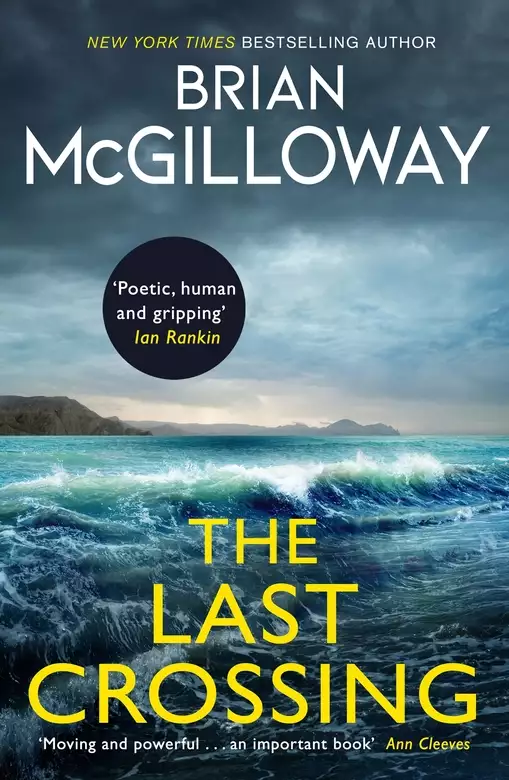
'Poetic, human and gripping... reminded me of Bernard MacLaverty's early work. Yes, it's that good' Ian Rankin
'Moving and powerful, this is an important book, which everyone should read' Ann Cleeves
'The Last Crossing is not only a riveting story about loss and guilt in a fractured society, it is also an important work. Beautifully written and lingers long in the memory' Steve Cavanagh
Tony, Hugh and Karen thought they'd seen the last of each other thirty years ago.
Half a lifetime has passed and memories have been buried. But when they are asked to reunite - to lay ghosts to rest for the good of the future - they all have their own reasons to agree.
As they take the ferry from Northern Ireland to Scotland the past is brought into terrible focus - some things are impossible to leave behind.
In The Last Crossing memory is unreliable, truth shifts and slips and the lingering legacy of the Troubles threatens the present once again.
Praise for Brian McGilloway:
'... McGilloway brings a forensic and compassionate eye to bear on the post-Troubles settlement in this thoughtful, moving, morally complex book' Irish Times
'McGilloway's grasp of characterisation is of the first rank, and more than compensates for the familiarity of the scenario here. The author continues to be one of Ireland's most accomplished crime writers' CrimeTime
'[A] superb book... thoughtful and insightful, wrenching and utterly compelling. It says something truly profound and universal about love, loyalty and revenge... If you want to understand Northern Ireland, or any society that has experienced conflict, put it on your list. And the writing is exquisite' Jane Casey
'Unearths individuals truths, unreliable memories and personal mythologies with a complex character-driven story that will leave you breathless until the final page' Gerard Brennan
'As heart-stopping and thrilling as it is exquisitely written and prescient' Claire Allan
'Another extraordinary novel from one of Ireland's crime fiction masters' Adrian McKinty
'A remarkably timely thriller' Irish World
Release date:
February 4, 2021
Publisher:
Little, Brown Book Group
Print pages:
90000
* BingeBooks earns revenue from qualifying purchases as an Amazon Associate as well as from other retail partners.
His face was glazed with tears, his mouth a grotesque O as first he pleaded for his life and, when it became clear that they would not listen to him, called for his mother. Stripped naked, he knelt in the grave they had already dug for him. The light of the torch Tony held caught the shiny skin of the scar on his lower abdomen where he’d had his appendix out, standing out against the lividity of the bruising he carried there, his phallus shrivelled amongst the dark of his pubis at the outer edges of the glare.
Tony had wanted to cover him up, give him his coat to offer him some dignity, but Hugh had refused. He was aware of Karen next to him, her breathing quick and shallow as she watched, the black plastic bag of Martin’s clothes, which they had stripped from him, twisted in her grip.
Martin held out his bound hands in supplication, looking from one face to the next. ‘It wasn’t me,’ he said. ‘I didn’t do it.’
‘You’re a liar,’ Hugh spat.
‘I’m not,’ Martin sobbed. ‘I swear on me mother, I’m not.’
‘And you knew what would happen.’
It was then that Martin broke down, his body wracked with sobs that turned to retching. He vomited onto himself, half choking on it, the bile and saliva hanging in a lace from his chin to his chest. He made no effort to wipe it away.
‘Fuck this,’ Hugh said, moving forward, raising his pistol.
‘Tell me mother—’
The shot reverberated through the trees, which came instantly alive, cacophonous, as a murder of crows took wing against the evening sky.
Martin twisted with the shot, his body thudding against the edge of the grave they had dug. Hugh moved across and, with his toe, pushed him down into the gaping space, before firing three more shots in quick succession, each one momentarily illuminating the still white body where it lay, the red wounds flowering as the blood unfurled with each shot.
‘Get those clothes burned,’ Hugh ordered, glancing at Karen. ‘You,’ he added, looking at Tony, ‘grab a spade and get shovelling.’
It took them twenty minutes to fill in the grave, Hugh and Tony quickly shifting into an alternating rhythm while, in the distance, through the uniform ranks of the spruce trees, they could see Karen, her face illuminated by the flickering flames, burning Martin’s clothes. The air, acrid with the smell of the fabric as it burnt, splintered with the crackle and hiss of the pine needles Karen had gathered up from the forest floor to kindle the blaze. When she was finished, they saw her dance on the embers, which sparked once more at her feet as she put the fire out and kicked a covering of leaves over the scorching.
In the distance, a low rumbling resolved itself into the roar of a plane taking off from Glasgow Airport and traversing the sky overhead, just above the clouds; the whine of its jet engines rising in pitch as the aircraft rose, building to a crescendo, before dissipating slowly into silence.
Tony wondered if any of those on board, glancing down, might see them about their business in the gloom. He felt his pulse throbbing in his ears, felt his own stomach twist and churn at the thought of what they had just done.
‘Are you sure—?’ he started, the first words either of them had spoken since taking up the shovels.
‘We never talk of this again,’ Hugh said. ‘We never come back here again.’
Tony motioned to protest, but Hugh raised the spade in front of him. ‘I’ll fucking cleave your head in two if you don’t stop. We did what we had to do. I’m no happier than you are about it, but he got what he deserved.’
As they gathered their stuff and left the clearing, Tony looked back once at the spot, the slight rise of the earth just visible, in the dying light of Hugh’s retreating torch beam, through the fork of an oak, twisted with ivy. It took them almost an hour to pick their way back to the car, the journey through the trees made in silence.
Only once, as they crossed a stream that ran down through the woodland, bridged by a fallen tree trunk, did Tony stop and reach out a hand for Karen to help her across. She took his hand in hers, squeezed it a little in reassurance, held it a second longer than necessary after she reached the other bank.
* * *
They drove back to Glasgow that evening and dropped Hugh at the train station.
‘I’ll be in touch,’ he said, as he left them. ‘Go home and forget about the whole bloody business.’
They watched him shuffle his way into the station, sticking a hand in his pocket and pawing out a few coins to pass to the young fella squatted at the station entrance, a paper coffee cup his begging bowl.
‘Where do you want me to leave you?’ Tony asked.
‘How about we get a bottle of something?’ Karen suggested. ‘There’s an offie across the street.’
She arrived back with a bottle of Southern Comfort and two litres of Diet Coke. They drove to Karen’s flat in Paisley. Once inside, they stripped off their clothes as Hugh had instructed and put them in a hot wash. They sat in front of the fire, wrapped in bed sheets, and drank half the Southern Comfort before Karen moved across and straddled Tony, her mouth sweet, her tongue cold in his mouth as she kissed him with an urgency, a hunger, which surprised him, even as she pulled the sheet off him and pushed him back onto the floor.
They made love there. Tony had the sense he was discovering her body anew in that moment, as if their proximity to death had somehow enflamed their desire to live, to breath, to feel. He tried to dispel from his mind the vision of Martin Kelly, kneeling in his grave, the thought that his body was cooling beneath the earth even as theirs blazed in a moment of climax.
They lay together, Tony’s head resting on her chest, his hand on her stomach. He could hear the rapid beating of her heart begin to slow, and felt his own breathing synchronise with its rhythm. He imagined himself happy, imagined them together like this, somewhere at home, a Donegal winter wind blowing outside.
That was what he would remember in years to come, when he was both alone and lonely. This last time together. The heat of her body, the scent of her perfume, of her skin, the gentle lift and fall of her breast beneath him with each breath, the saltiness in his mouth as he raised his own head and kissed her, the light of the flames dancing across her flesh.
‘Sins of the flesh,’ he muttered, as if trying out the phrase, his tongue struggling with the words. Such an archaic formulation, he thought: sins of the flesh. How else to describe it? Even alone now, did that still qualify as a sin of the flesh, when that flesh was his own?
He ran through the shopping list of his sins, a habit since childhood, as he waited for Father O’Brien to shunt back the wooden slide of the confessional box. He could hear the low murmurs of the conversation being conducted to the other side of the confessional, alternating between the modulated timbre of the priest’s deeper, softer tones and the hushed sibilant whisper of the lady who occupied the other box.
The confessional was dark and close, rich with the heady sweetness of the wood polish which he himself had used just the previous morning on the kneeling boards and frame when he’d done the weekly clean of the church.
He was surprised by the thud of the wooden slat sliding back into place; he’d not heard the muted rhythmic Act of Contrition from the other side.
‘Bless me, Father, for I have sinned,’ he began and, saw again, unbidden, Martin’s white body, the red flowering of his wounds, the narrowness of his grave, itself as dark as a confessional. He stopped.
‘Go on, Tony,’ the priest urged softly.
‘I have sinned,’ he repeated. ‘It’s been a month since my last confession. I’ve offended God by …’
The laundry list failed him now. Spoken unkindly of someone? Watched porn a few times? They seemed infantile somehow.
‘Are you OK?’
‘I’m, ah, I’m away for the day, tomorrow,’ he managed, his mouth suddenly dry, the walls of the confessional nearer to him than he’d realised, the edge of the kneeling board digging into his knee.
‘Very good,’ O’Brien said, a little quizzically. ‘Do you want to confess before you go?’
‘I was going to … I’m meeting a few friends from way back.’
He could see the silhouette of the priest through the mesh that separated them, his head nodding, bowed as he read from his breviary by the weak light that leaked through the curtains of the box.
‘Very good,’ the priest repeated. ‘I can get someone to cover the funeral on Thursday, if you like.’
‘No, it’s grand,’ Tony said. ‘I’ll be home tomorrow night. I’m on the last crossing back.’
‘Crossing? Are you headed to Scotland?’
Tony cursed silently, then realised the irony of doing so in his current situation.
‘Some old school friends?’ O’Brien guessed.
‘That’s it,’ Tony said. ‘I’ll be here for Thursday.’
‘It’ll do you good,’ O’Brien said, raising his head now. ‘What with everything over the past few months.’
Tony nodded.
‘Do you want to confess anything?’ O’Brien asked.
‘I’ve done … I’ve done things I’m not proud of,’ Tony said. ‘That’s as best I can put it.’
‘Loneliness can do that to a man,’ O’Brien began. ‘We’re social animals; we’re not made to be alone.’
Afterwards, he walked up to his wife’s grave. He’d visited it each day since her death. 283 days. The roses he’d brought for her birthday the previous week were wilted now, the stems soft, the heads hanging heavy, as if in prayer over her grave.
He hunkered at the edge, pulled an early weed from the soil above her, felt a sad satisfaction as he felt the roots tauten and give.
‘I’ll miss you tomorrow, Ann,’ he said. He stood, laid his hand on the cold marble of the headstone. ‘We’re heading back.’ He felt a tightening in his chest at the thought, and he placed his hand on the gravestone for support.
‘Love you, Ann,’ he concluded, once he’d caught his breath, his words barely a murmur. The stone beneath his hand was cold and unyielding and he felt shame at his thoughts, for they were not, he realised, of his wife.
He wondered how Karen had changed. Her hair had been long then, shoulder-length and brown. She’d be fifty-one now, maybe fifty-two. Did she think of him as he thought of her? Did she try to recreate, in her mind’s eye, his touch? His taste and smell? Did she feel, for a moment, the pressure of his head on her chest, his hand on her body? And did she wake at night, Martin’s final cries for his mother still audible in her ears, the smell of his burning clothes clinging to her hair?
And, more than that, he wondered if she turned to someone next to her in that bed and lied about what had disturbed her dreams. Or had she found someone to whom she could tell the truth? Or was her bed cold and wide and lonely, as his was now. As cold and lonely as Martin Kelly, where he lay beneath the earth.
The earth clattering across his brother’s coffin heralded a scream of agony from his father such as he had not heard before, nor since. The man, tall, solidly built, proud, seemed to crumple at the sound, as if the wail had taken something of substance with it as it left him. Tony gripped his arm, tried to hold him upright, while the Priest looked at him with a mixture of pity and embarrassment and his mother began sobbing once more into the clump of damp tissues she gripped.
To his rear, two of the group of men who had walked behind them, up through the cemetery in military formation, moved forward. ‘It’s all right, son,’ one of them said. ‘We’ve got him.’
His father recoiled at their touch, his hand scrabbling for Tony’s to help him stand again. The men, seeming to understand, stepped back, respectful, head bowed.
After the burial, the men, dressed in uniform of white open necked shirt and black trousers, spoke in soft earnest terms to his mother, passed his father with a nod and a grimace of shared loss, but offered their hands to Tony only to shake. The last one of the group to pass him, the one who had moved forward to help his father, cupped Tony’s shoulder in one hand as he shook the other, his grip firm and warm.
‘Sorry for your loss, son,’ he said. He was small, heavy set, brown haired, with a thick moustache. He spoke with a slight stutter, as if his breath caught with every few words.
‘Thank you,’ Tony said. ‘Thanks for your help there.’
‘Your father’s still raw,’ the man said. ‘Anything we can do to help, just let me know. Anything at all.’
Tony nodded, uncertain who ‘we’ or ‘he’ was. He’d been at university in Belfast for the past three years, had lost track of his parents’ neighbours and friends.
‘They’ll not get away with what they did to your Danny,’ the man said, his gaze level and unyielding.
Tony nodded, muttered agreement, not entirely sure what else he was meant to say. He did, at least, know who ‘they’ were.
His brother, Danny, two years his junior, had been walking home from watching a football match in the Brandywell. The evening was cold, so he’d had his Derry City scarf pulled up over his nose and mouth. He’d cut up through the alleyways and out onto Bligh’s Lane when an army Land Rover, racing away from a riot happening at the top of the lane, had careened down the roadway. A petrol bomb had caught the wire mesh on the windscreen and the dripping flames, and the smoke, had, it was reported afterwards, made it difficult for the driver to see. He’d mounted the kerb just as Danny appeared, as if from nowhere, he claimed, and the boy went under the wheels.
If Danny survived for long after the impact, they could not say, for the Land Rover had not stopped, for fear of an ambush. Whatever of that, the boy was dead by the time the people living in Nualamont Drive came out to see what had happened.
‘What did Mullan want?’ his father asked, later that evening. They were sitting in the kitchen, his father with an untouched mug of tea in front of him.
They’d invited all the funeral guests back to the local community centre for tea and sandwiches and hung round till the last of them departed.
Tony shrugged quizzically.
‘Sean Mullan,’ his father said, as if that clarified things. ‘He spoke to you at the grave,’ he added. ‘The fat guy with the moustache.’
Tony was surprised at the personal nature of his father’s comment. ‘He said if we needed help—’
‘Not from the likes of him,’ his dad snapped. ‘You didn’t agree to anything, did you?’
Tony considered whether murmuring agreement to the comment that those who had killed his brother should be held to account was something he should mention. In the end he simply shook his head. ‘I don’t even know who he is.’
‘Trouble’s who he is,’ his dad said. ‘Looking to jump on the back of Danny’s death.’
‘How?’
‘Mullan’s high up with that crowd of hoods. He’ll be claiming Danny’s death was political.’
‘It was political,’ Tony said. ‘The army ran him over.’
‘It was an accident,’ his father said, lifting a spoon and, with it, the film settling on the surface of his drink.
‘Accident my arse. They drove over him, like a dog.’
His father lifted his head, gazed at him, his eyes brimming and Tony regretted the insensitivity of the words. ‘The guy who did it was 19. Younger than you. First week on the job.’
‘Is that what they told you?’
The older man inhaled, sharply, then held the breath, as if reluctant to let it go for fear of what might happen.
‘And what did Mullan tell you? That they’d get them back?’
Tony kept his expression neutral. ‘Maybe someone should.’
His father nodded. ‘And what good would that do?’ Would it mean Danny would be back home with us?’
‘Someone should pay.’
‘Why? Will that balance things out, if there’s some other father sitt—’ He paused, his breath a suspiration, before resuming once more, ‘sitting stirring his cold fucking mug of tea the day he buries his boy. Will that make things better?’
Tony felt the urge to move to his father, to encircle him in his arms, but the distance between them seemed greater than ever. ‘It’ll not make them worse,’ he said, grudgingly.
‘Yes it will,’ the old man said, his expression drawn, as if time had accelerated through the day. He raised his chin, already trembling, as if to stymie the flow of tears, but to no avail.
Tony sat for a moment as his father sobbed, as if propinquity was its own support. Then, embarrassed by the rawness of the man’s tears, he moved into the living room.
After nine, father mother and son, sitting in the silence of their home, exhausted by the day’s events, heard the clatter of gunfire down the estate. The late evening news confirmed that a soldier had been shot on patrol.
At one in the morning, their front door was rammed open and six soldiers forced their way into the house. Tony was in his bed, sleeping only in his underwear.
They were in his room before he even had a chance to grab something to cover himself. Two of them dragged him down the stairs, ignoring his mother’s screams. His father was already being pulled down the stairs by the time they got Tony to release his grip on the bedpost; one of them raised his boot and ground the youth’s fingers against the wooden post until he could take it no more and it slipped from his grasp.
He was down the stairs in seconds and out onto the street, illuminated by the strobing of blue lights from the police Land Rovers which were parked at the end of the row, keeping back the straggle of protesters who’d already appeared from their houses.
The bench in the rear of the Land Rover was cold, the cushion padding long since torn away. He thought for a moment that some of the soldiers, whom he’d seen lifting his clothes off the seat beside his bed, would hand the garments into him, but the heavy doors swung shut and he sat in his pants, his father opposite in striped pyjamas, his mouth moving wordlessly.
‘Here son,’ Tony heard someone say. He turned to see the man next to him peel off his shirt and hand it to him.
‘Better half dressed than buck naked,’ Hugh Duggan said. ‘Smoke.’
Tony shook his head.
‘First time?’
‘Aye.’
‘They’ll try all sorts,’ Hugh said. ‘Whatever they do, say nothing. But don’t be surprised if they threaten to shoot your ma, or stitch up your da here. Fuck ’em. Tell ’em nothing. But they’re a shower of dirty bastards, so whatever dirty trick they pull, you be ready.’
‘Be ready for 11.30’, the text had said. In fact, the car pulled up at the bus stop five minutes early. The youth who opened the passenger door for Tony was in his early twenties at most, his hair thick and curled.
‘Tony Canning?’ he asked.
Tony nodded. He’d been instructed to bring an overnight bag with a change of clothes, lest they were delayed. The only one he’d been able to find that morning was a small, tartan travel bag he’d bought for Ann when first she went into the hospital. She only used it for a few days before it became clear her stay would necessitate more than two days change of underwear. Even with so little use, the bag had still smelt of the hospital when he’d opened it again.
As he’d packed it for his own journey that morning, he’d found a pen lying at the bottom of it, something he’d missed when he’d emptied it after her death. He’d brought it in with her Sudoku book, to keep her entertained. The book had been dumped unused. He’d held the pen between his finger and thumb, as if a talisman from his dead wife to remind him of her. He’d contemplated bringing it with him, pretended to forget it on the dressing table after he left the house and felt embarrassed at such a poor attempt at self-delusion.
He wanted to ask the youth where he could put the bag, but the youngster made no effort to open the boot for him, so he set it in the footwell and then sat, twisting slightly to one side.
‘Richard Barr,’ the driver offered, his hand held out. As Tony shook it, he noticed a sleeve tattoo of a Celtic design. Looking at Barr now, he saw the edge of a similar design hemming the neckline of his T-shirt and he wondered absently if it extended the whole way from his neck to his wrist.
The half hour drive from Derry to Dungiven passed in platitudes. Barr asked him the last time he’d been in Scotland. Tony had erroneously said, ‘Thirty years ago,’ then instantly corrected himself and added, ‘Apart from a trip to IKEA in Glasgow about ten years back.’
The comment developed into a discussion on the merits or otherwise of flat-packed furniture and an extended anecdote from Barr about a desk he bought for his student digs that eventually petered out without reaching either a punch line or point.
They trailed behind an L driver doing 40mph and Barr swerved lightly in and out behind her, one hand on the wheel, the other tapping out some unheard beat on his knee before he finally swerved out and sped past her on the chevrons at a right turn junction. Tony instinctively gripped the dashboard in front of him, even as he glanced in the wing mirror, half expecting to see the blue lights of a police car spark into life behind them. It seemed foolhardy, doing anything that might draw attention to them, considering what they were going to do. But then what were they going to do? Visit Scotland? Three old friends and their younger driver.
Barr seemed to note Tony’s discomfort in the periphery of his vision, for he straightened himself a little in. . .
We hope you are enjoying the book so far. To continue reading...

 Please log in to recommend or discuss...
