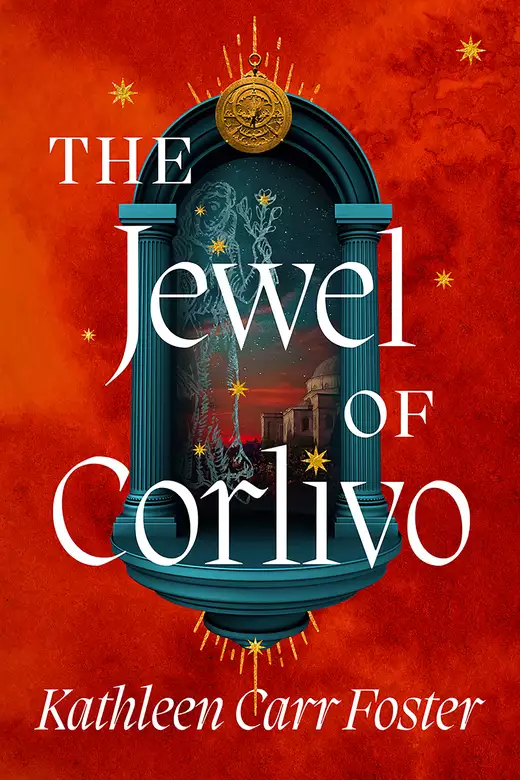
In a reimagined Byzantine empire, a runaway courtesan and her disgraced suitor are on the hunt for ancient treasure. But in Kathleen Carr Foster’s glittering debut, what they find will be far more troublesome . . .
Raised for the most luxurious pleasure house in mountain-ringed Corlivo, Anna has no illusions about her future. She’ll be a courtesan, as her mother was before she disappeared—and like her mother, gamble that her charms attract a patron rich enough to pay her debts.
But when a gruff explorer with connections at the capital notices Anna, it’s her sharp eye that draws him in. Sebastianus thinks Anna’s found a clue within the pages of an ancient book to the lost city of treasure he seeks, and she might well discover more.
Together they escape to the imperial court, where marvels are commonplace—and so is treachery. Anna’s courtesan training has hardly prepared her for the dangers of court life, let alone for delving into artifacts from the empire’s past. But when she uncovers a secret tied to her mother’s fate, Anna realizes more than her life is at stake. She holds the key to untold possibilities not only for herself, but for any of the women of Corlivo . . . if she can use it.
Release date:
October 27, 2026
Publisher:
Erewhon Books
Print pages:
384
* BingeBooks earns revenue from qualifying purchases as an Amazon Associate as well as from other retail partners.
I’M SO GRATEFUL THAT I MET MAGGIE COOPER, AND that what started out as a conversation about how to position this book when querying agents turned into a conversation about working together! Thank you for sharing your talent and expertise so generously, and for all your work to start this book on its journey out into the world.
Thank you to my brilliant editor, Viengsamai Fetters, who understood intuitively what I was trying to do with this book and who helped make it the best version of itself.
I’m indebted to the entire team at Erewhon who brought this book to life. Thank you to Michelle Addo-Chajet, Senior Communications Manager; Kelsy Thompson, Production Editor; Erin Roll, Copyeditor; Rayne Stone, Proofreader; Cassandra Farrin, Director of Erewhon and Special Editions; Diana Pho, Editorial Director; Shannon Gray-Winter, Publishing Projects Manager; and Kasie Griffitts, Sales Associate. Special thanks to Sarah Guan, for believing in the book enough to acquire it. Thank you also to the extended Kensington team who supported this book and made its publication possible.
Thank you to the friends and readers who provided invaluable feedback on early drafts: Jill Maio, Jessica Ullian, Caroline Woods, Joe Fazio, Shivani Shah, and Steven Dooner (who, among other advice, helped me understand the experience of theater in the early Byzantine world). Thanks also to Farley Urmston and Jordan Coriza, whose years of advice and encouragement have made me a better writer.
I’m beyond lucky for the lifelong friendship of a group of ride-or-die ladies: Pamela Browne Gerardi, Dawn Hayes, Delynn Speeleos, and Tracey Starin. Every depiction of the power of female friendship in this book is inspired by you. A double thank you to Delynn, whose feedback on an early draft led me to the idea of the astrolabe.
Thank you to my brother-and sister-in-law, Jeff Foster and Lisa Snyder, both early readers, who have been cheering me on through every twist and turn of this publishing journey (major milestones of which always seemed to happen when we were together somewhere!).
Thank you to my father, whose unconditional love and work ethic is the standard to which I hold myself.
Thank you to my dear sister, Christine, the strongest, bravest person I know, who read the very first draft and encouraged me to keep going.
Somehow I’ve managed to birth two daughters who are way, way cooler, smarter and more together than I’ve ever been. I’m so lucky to have you both. Thank you, Clare, for your whimsy, for your wise-beyond-your-years advice, and for giving me the occasional psychological tune-up. Thank you, Abby, for reading early drafts with a keen editorial eye and providing rock-solid advice and support throughout this process. You’ve been there every step of the way, and this is a better book because of you.
And most of all, thank you to Jim. You make every good thing possible. I love you. Home before you know it.
THIS BOOK, THOUGH IMAGINED, DRAWS INSPIRATION from the rich and fascinating history of the Byzantine Empire. Centuries after the western half of the Roman Empire had disintegrated under the weight of economic decline and external pressures, the eastern half continued to flourish. Early in that period, during the reign of the emperor Justinian and his wife, Theodora (527 to 565 CE), the city of Constantinople (modern-day Istanbul) was the crossroads of the world, a vibrant center of trade and culture bridging East and West. It was an intersection of old and new, with reverence for the philosophy and scholarship of the ancient world slowly giving way to the influence of Christianity. With the hindsight of more than a thousand years, we can see the Byzantine Empire as the connective tissue between the classical and medieval worlds.
With that background, a reader with even a casual knowledge of antiquity might spot close parallels between the fictional Jovinian and Calpurnia and the historical Justinian and Theodora. The Emperor and Empress lived in a palace in the imperial district of Constantinople, attended chariot races in the Hippodrome, and worshipped under the dome of the Hagia Sophia, which Justinian rebuilt on the site of an earlier church. They barely survived an uprising of factions in the city called the Nika riots. In their pursuit of an ideal republic, they instituted a number of unpopular social reforms. They forced the conversion of non-Christians to Christianity, outlawed other faiths, and instituted strict punishments for a variety of moral infractions.
The real-life Theodora was a complicated figure. A former actress (and likely sex worker), she was both an advocate for the rights of women and the architect of a reform effort that forced many women into a nunnery she established for penitent sex workers, even those who were unwilling to go1. Ultimately, Jovinian and Calpurnia’s fanaticism in this story is a way for me to write about how fanaticism, regardless of motivation, can seep into public life (even our contemporary public life), clouding our ability to recognize the humanity in one another.
True historians of the period will observe that I’ve taken many liberties with dress and language. Togas were no longer universally in fashion by 500 CE, but I think they are more fun than the tunics and chitons which people of that time seem to have worn. It would have been more accurate for me to base the fictional language of Kish on ancient Greek, not Latin, but that was less accessible to me as a writer, so here we are.
It’s easy to forget that although Justinian and Theodora’s reign seems long ago, the ancient Greek philosophers and scientists are even farther back in history, and by 500 CE were known only through the works they had left behind. Straba is a not-so-subtle re-imaging of Strabo, the ancient Greek geographer (born 64 BCE), and Semiarchus is inspired by the Greek mathematician and astronomer Hipparchus (c. 190–120 BCE), who laid the foundation for the early development of Western astronomy and may have invented the astrolabe. The orrery, too, is plucked from history. Those interested can learn about the Antikythera mechanism, an ancient device discovered off the coast of Greece in 1901.
The Mighty Arcadius is, of course, modeled on Alexander the Great, whose rapid conquest of nearly two million miles of land across Asia, Europe, and Africa was already legend by the time of Justinian. Alexander named many cities after himself, including Alexandria, at the edge of the Nile Delta on the Mediterranean Sea. The fate of his once-great library in that city is not definitively known. It may have burned to the ground or decayed slowly through neglect, but whatever its doom, it had vanished by Justinian’s reign. Who’s to say, though, that Alexander didn’t leave behind another hidden library? Perhaps it’s still out there, waiting to be found.
Because I’m not a historian, but a novelist, I’ve woven the creations of my imagination onto this rich background. What if, at that time in history, high in the Carpathian Mountains, there was a beautiful, glittering city devoted entirely to the pursuit of pleasure? Who would live there? Who would visit? What would it mean for such a place to have forgotten its own history? What would be lost? And what might be gained if it were to remember it again?
Like Anna, I believe that expanding our knowledge of the world plays a vital role in nudging us toward kindness and justice, and that understanding history is essential to knowing about ourselves. I’m always wary of any effort to suppress knowledge or turn away from the truths of the past, even those that are complicated, or that make us uncomfortable. The clues to the present are hidden there, and it’s our own loss if we miss them. I hope readers will be entertained by this journey into an imaginary time and place, and that they will see a piece of themselves somewhere in it.
Boston, Massachusetts.
2026
ON THE EVE OF THE SUMMER SOLSTICE, A WARM breeze blew the heavy scent of lilacs across the grand terrace at Casa Caligine, the greatest of all the pleasure houses of Corlivo. The air was thin there, high in the Kotol mountain range, and the stars were close, bright pinpricks in the inky sky. Golden light from the torches shone on the mossy flagstones. The place was packed with people: guests of the house, visitors from less exclusive pleasure houses farther down the mountain, serious bidders, the merely curious, servants holding platters of food and lingering near doorways. And all of them were eager to see the famous Demonstratio Tirae.
I hoped Kyra would be able to remember the choreography; she had drunk nearly a bottle of wine to calm her nerves. I understood the urge to dull the senses; I had gulped a hasty cup too, and I could already feel the warmth in my cheeks and nose. Even so, I was distracted by everything: the clamor of the crowd, the feeling that I was wading into a rushing river. Everyone else was in a boat, but I was just dipping my toes in the shallows. I fidgeted again with the gauzy white silk of my dress, identical to those worn by the five other tirae. I rubbed the inside of my wrist, raw from where a small blue crescent had been inked just under my skin: a letter C.
I tried to settle my nervous energy by scanning the crowd. That morning, a whisper had passed among us apprentices that two famous explorers were staying at Casa Caligine for the season. Ever since I was a child, I’d been fascinated by anything to do with adventures and faraway lands. Could I pick out the explorers based on their clothing?
Apparently not. All the men seemed to be dressed alike: dark togas and white linen trousers, the occasional colored sash or cloak. It was impossible to see anything distinct in a gathering of so many people. Although an endless war raged on the Empire’s eastern border, and new trouble had started on the northern roads, neither seemed to have kept the wealthy guests away from our mountain city. We were a two-week ride from the capital, and a world away from the lives of ordinary working people.
Suddenly, it was time. The six of us filed onto the platform set up at the end of the terrace. Kyra stumbled once but recovered. She held herself so rigidly that I knew she was compensating for the wine. But then the music began, and we were all swept up into the familiar steps of the dance. We linked arms, turned, pointed our toes gracefully. We picked up our thin rods with their ends wrapped in oil-soaked cloth and lit them, passing the flame from one to another. We spun them overhead, six whirls of fire against the dark night. As the melody rose and our bodies made shadows against the stone, we were untouchable, trained to perfection: beyond the reach of the curious, the judgmental, the eager. For one last moment, we were priceless.
And then it was over. We bowed and doused the flames, and the crowd roared with applause. The ancient ritual was finished for another year.
The matron walked slowly onto the stage, tall and elegant, with her white hair pinned into elaborate coils by jeweled combs.
She stretched out her hands in a gesture of welcome. “A marvelous display of our traditional demonstration! Honored guests, I am delighted to present the tirae of Casa Caligine, the freshest flowers of this great city. I hope you enjoy meeting them this evening. Please remember that unlike the other beautiful and accomplished women who reside here in our house, they are not yet available for your personal entertainment. If you are interested in placing a bid for the company of one of our tirae, please speak directly to me. Winning offers will be decided in one week’s time.”
We filed off behind her as the kithara players resumed their music. Conversation rose, and the guests began to mingle. Smoke from the torch oil hung in the air.
I grabbed Kyra’s arm. “I could use another cup of wine.”
She wiped beads of sweat from her shiny dark curls. “Me too. My mouth is dry as dust. I thought I was going to forget the steps.”
Hundreds of eyes seemed to follow us as we walked slowly through the crowd.
“Prettier than last year’s crop, I think.” A tall man in a deep red toga stared as he took a sweet from a passing waiter’s silver tray.
“I wouldn’t bid on any of them.” His companion squinted at us over a goblet of dark fruit wine. “I’d rather have the experienced ones. And have you seen the girls at Casa Aeris? Spectacular. Well worth the journey here.”
A stout man approached me; the engraved medals pinned to his blue sash clinked as he gave a little bow. “What a lovely creature you are.”
I curtsied with a smile. “Thank you, sir.”
He straightened a gold badge. “And you’ve just come from the training school?”
“Only a few weeks ago.”
“You must be looking forward to the coming months, finishing your apprenticeship and polishing your skills.” He grabbed my hand in his large, heavy one. “I can imagine helping you learn.”
I stepped back quickly, dismayed by the sour smell of wine on his breath. “Another time, perhaps.”
I felt his eyes on us as we hurried away. I shouldn’t have done that. We were supposed to mingle with the guests, but surely some of them would be easier company than that man.
Kyra’s hand was tight on my forearm. “By the Goddess, are they all going to be like that?”
“Hopefully not.” I glanced back over my shoulder. “Or maybe we’ll just get used to it.”
Kyra exhaled shakily and adjusted a jeweled hairpin.
“You’re not supposed to run away from them,” Valentina hissed from behind us.
Our mentor wore the makeup of a full courtesan: sparkling paint on her lips and an elaborate pattern of colorful swirls above her dark eyes. Her ginger hair was coiled high in braids, embellished here and there with gems, and her silver tunic clung to her slim frame.
The man beside her was tall, with narrow shoulders and a gloss of curly blond hair above a sharp nose and gray eyes. He leaned forward eagerly. “Won’t you introduce me to these pretty girls?”
She swept a hand in our direction. “These are the apprentices I’m supposed to mentor, if they would pay any attention to me at all. Anna and Kyra, inseparable friends. Girls, this is Clemens Fabius, Baro of Hierion.”
We curtsied deeply.
He gave a tight bow. “Your performance was delightful. Valentina, were you once as graceful as these little flowers?”
Her face hardened, but she smiled and swatted his arm with a wink. He laughed like a man who could imagine nothing more wonderful.
“I’m amazed,” he continued, “at how you ladies are able to spin those flaming poles without causing injury.”
Kyra laughed politely.
What was he talking about? We had burned one another in practice many times. I couldn’t help myself. “Sir, what makes you think that?”
He blinked in surprise and then laughed again, showing his straight, white teeth. “Delightful.”
Valentina’s eyes narrowed.
He extended his free elbow to me. “What a beautiful girl you are. Hair the color of honey. My dear, come with us to get some wine.”
Valentina gave his arm a squeeze. “My lord, if you will excuse us, I need a word with these two. I will meet you in just a moment.”
He bowed reluctantly and disappeared into the crowd.
Kyra watched his retreating figure. “He seems all right, Valentina.”
Valentina’s smile faded. Her eyes suddenly looked tired, despite the colorful shimmer around them. “He’s perfect. He’s a favorite of the Imperator, and he discovered a mountain of gold in a cave somewhere. I need a new patron, since Lord Marcus seems to have given me up. Of course, maybe that’s for the best. He wasn’t very generous.”
I strained to get another look at the man with the blond curls. “Is that man one of the famous explorers we heard about? Is the other here too?”
Valentina nodded. “They’re both here, but what does it matter to you? I’ve got my eye on Lord Fabius, and you’d do well to stay away from the other one.”
“I just expected an explorer to seem less insipid,” I said, watching the man bow his way through the crowd.
Valentina had been adjusting the draped waist of her dress, but at this she shot me a glance. “And who are you to have any expectations? Don’t make the mistake of thinking you can hold out for the man you like the best. A bid from any of them will do, but wealthy, generous, and dull is the ideal combination.”
“Anna won’t have patience for anyone dull.” Kyra squeezed my hand.
“Then she will have a needlessly difficult time.” Valentina stared into the crowd. “I’ll say this: The other explorer is certainly unusual. He is an Archidux, and the Imperator’s own nephew. Rich enough, but blind in one eye, of all things. And he limps.”
She nodded in the direction of a group on the opposite side of the terrace. “Over there, near the musicians, wearing a gray toga, like many of the others. See, with the burly arms and dark hair? He has a cane with a silver-and-ruby handle.”
The man who met her description was broad and imposing, with high cheekbones and a set jaw. He leaned lightly on a walking stick. I looked away quickly before he could notice me staring.
Kyra raised her dark eyebrows. “I suppose it doesn’t matter if you can see out of both eyes when you are the nephew of the Imperator.”
“The point is,” Valentina said, “look for someone who can help you clear your debts. Charm as many of them as you can. Not Lord Clemens, obviously. I need him.” She looked at me pointedly. “So, keep your quick tongue in check, Anna.”
“I need to sit down,” Kyra said.
“And before you get too curious, know that the Archidux is useless to you, because he never bids on tirae. That’s a blessing from the Goddess, since he’s rough and hard to entertain. Keep your distance.” She patted Kyra on the arm and moved off into the crowd.
We watched her glide gracefully away, drawing the eyes of all the men she passed.
Kyra’s face was ashen. “Do you think many of them are rough?” she whispered.
I had no idea how to answer her question. “You look tired. Come on. We can find a place to rest for a minute or two.”
Over the past few days, as the Demonstratio approached, Kyra had grown increasingly pale and drawn. I did my best to reassure her, but as I knew as little as she did about what the coming days would hold, my efforts had not done much to bring a sparkle back to her usually bright eyes.
We skirted the edge of the terrace, avoiding the clusters of people talking, laughing, staring. Left to myself, I would have ignored all of them and lingered at the wall. Below the terraces of Casa Caligine were the glowing lights of houses lining the cobbled streets of Corlivo—and farther down, the gates of the walled city. Beyond that, vast slopes and plains stretched to a thick forest. And past that? Parts of the Empire that I dreamed of visiting, but like all the girls raised for the elite pleasure houses of Corlivo, I had never even left the city.
“Oh, no,” I heard Kyra whisper.
I turned around to see the matron watching us with a frown.
“I think our rest is over.” I squeezed Kyra’s hand, and we plunged back into the crowd.
I COULDN’T REMEMBER a time in my life when Kyra hadn’t been by my side. In the absence of any blood relations, she was the nearest thing I had to a sister, but our natures were not alike. While I spent hours dreaming about possibilities far beyond the city walls, she was content with the day-to-day things that made up our lives: the feel of the sun on her face in summertime, warm bread fresh from the oven, a merry tune on the bells, the soft silk of a dress, a funny story. She loved coziness and familiarity. She was gentler and worried more.
We had been raised together in one of the many nurseries within the city walls. At the age of six we were sent to the Schola Morum, the famous training school, where we lived with all the other girls destined for a courtesan’s life. We told each other stories, whispering together in the dark about the grand lives we would lead when we were old enough to mingle with visitors from every corner of the Empire. Our lessons shaped us into charming companions; we learned how to dance gracefully, arrange lilies, sing, play the bells, make engaging conversation at dinner, and greet noblemen with the proper courtesy. We were made to believe that we were lucky to have been chosen for such an honor, and when our training ended, we prayed dutifully before the basalt statue of the great mountain Goddess. We gazed up in awe at her solemn features: unblinking eyes, carved waves of hair, arms hugging the contours of her curved body.
We had been taught that ours was a city of marvels, a place where honestiores, the Empire’s privileged, came to refresh themselves: to hear the musicians play, to see the theater, the acrobats, the beasts of the circus. It wasn’t until much later that we realized that we, and not any of these things, were the great commodity of Corlivo. We were what made the mountain city the wonder of the Empire.
AN HOUR LATER I was footsore from standing on the flagstones in my thin slippers. Kyra and I had long since gotten separated by the flow of people and conversation, her dark curls swallowed up by the crowd. My face hurt from smiling. All around me, courtesans flirted and the few apprentices made nervous conversation with potential bidders. Guests talked about all of us, about the similar demonstrations happening in other pleasure houses, and about events that seemed too far away to matter: unrest in the capital, legions of soldiers on the borders, the Imperator and his lowborn wife, and the strange religion the two of them were promoting everywhere. What did I know about these distant things? Standing beside a table with crystal pitchers of water, I breathed and savored my third cool cup. We were almost through it.
A figure in a navy-blue toga came toward me. To my surprise, it was a woman. Her dark hair was wound into a simple braid.
My face must have revealed my confusion, because the woman smiled. “Have you never seen a woman in a toga?”
I hastily swallowed the last of my water. “There’s a first time for everything.”
“Indeed, there is.” She touched my cheek with her soft hand. “As I’m learning, here in Corlivo, there’s something for everyone’s taste. I can hardly believe this place is real.”
I blushed and looked down at the moss growing in the cracks between the flagstones. There was a tapping sound, and the end of a black walking stick appeared in my field of vision.
“Comitissa Klaudia, are you flirting with this girl?” The Archidux’s voice was deep but coarse: less polished than I would have expected from the Imperator’s nephew.
“And why shouldn’t I?” she said with a touch of defiance.
“You should do whatever you like. But as I’ve told you, cousin, you’ll find the new girls disappointing.”
After the strain of the day, I felt a flash of frustration at being spoken of as though I weren’t even there. I kept my head lowered but said softly, “Your Grace, I’m a grown woman.”
“Oh, brava.” I could hear the amusement in the Comitissa’s voice. “Sebastianus, I wish more people put you in your place.”
“Look at me, tira.” The sound was like gravel scraping over stone.
I took in the ruby-handled walking stick, the linen trousers, the gray toga wound snug over his broad frame, his muscular shoulders and arms. He was more than a head taller than the Comitissa. His black hair was shaved underneath, but the top was long and tied back into a knot with a leather cord. His bronzed skin was faintly weathered, his jawline defined. One bright blue eye focused on me while the other was milky white, with no pupil visible at all. I forced myself to remain calm and hold his intense gaze.
“How old are you?” he asked.
“I am twenty, Your Grace.”
“Twenty and not afraid of you, apparently,” the Comitissa said, laughing.
“And you’re a woman at twenty, are you? Because you can do some parlor tricks with fire?”
I experienced a rare moment of not knowing what to say.
He looked out across the crowded terrace. “I think the charm of this place is fading for me.”
“By the gods, I think it’s marvelous,” she said. “Thank you for introducing me to it. It’s a good thing more people don’t know it’s here. The place would be overrun.”
“It doesn’t change very much from year to year.” His eye briefly flicked to my face.
“Perhaps it shouldn’t change,” she said. “It’s delightful the way it is.”
They no longer seemed to be paying attention to me. I took the opportunity to pick up my empty cup and dart away into the relative safety of the crowd. It was a relief to remember that this dismissive man didn’t bid on tirae.
SO MUCH WAS STRANGE ABOUT OUR NEW CIRCUMSTANCES: the rich food and ornate dresses, the presence of men, the tension of waiting for the bidding to begin, and my dawning awareness that none of us tirae were fully prepared for what would come after. It did not help that our days were long and empty. At the Schola Morum, every hour had been scheduled. Here at Casa Caligine, mornings and afternoons stretched out idly. Nothing seemed to happen until the sun began to set and we all prepared for an evening of entertaining. I had never experienced so much free time.
Since arriving a few weeks before, I had passed the hours in exploring the ancient stone building, from the drafty attics to the basement cavern where the laundry was done. As in any structure that had been added onto over centuries, there were nooks and staircases everywhere, passages behind the walls, closets that seemed not to have been opened for decades. While the other girls drank tea and gossiped over games of tabula, I ferreted into those hidden spaces, trying to satisfy the restless curiosity that always pulled at me.
Unlike the girls I had been raised with, daughters of courtesans who lived and worked in pleasure houses across the city of Corlivo, I did not know who my mother was. Each month, on visiting day, the other girls had filed down to the Schola Morum’s stark reception hall to greet the elegant, willowy women with their richly embroidered cloaks covering fine silk dresses, while I sat alone in the dormitory, wishing someone would come for me. From time to time, one of our teachers took pity on me and brought me on an outing to the market. I watched in awe any time one of the graceful courtesans from the great houses glided past the vendors’ stalls with her delicate chin raised haughtily. Any one of them could be my mother, I thought. But if one of them had been, she paid me no attention at all.
As a child, I had invented a hundred stories, each one more fanciful than the last: My mother had been captured by wild men who had taken her away to live on the vast northern plains; she had gon. . .
We hope you are enjoying the book so far. To continue reading...

 Please log in to recommend or discuss...
