- Book info
- Sample
- Media
- Author updates
- Lists
Synopsis
Three priceless treasures. Three extraordinary women. Three powerful legacies.
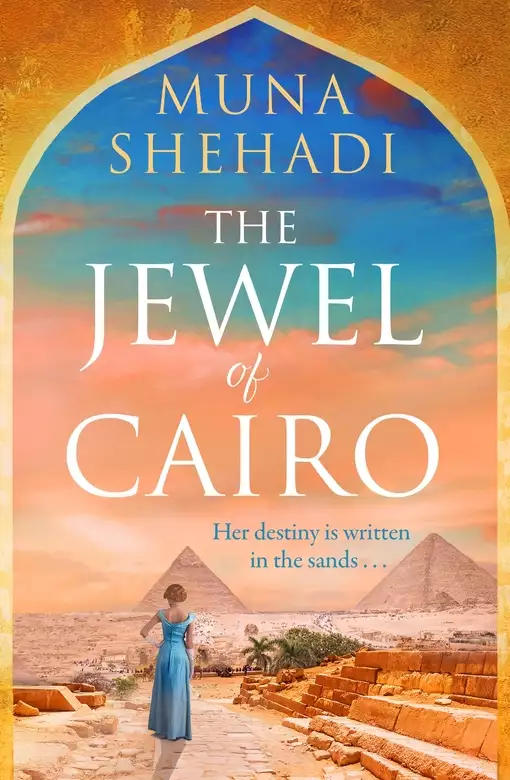
The Jewel of Cairo is the second in Muna Shehadi's spellbinding dual-time narrative series, with cross-generational appeal and captivating international settings perfect for fans of Lucinda Riley.
Cairo 1915. A wealthy Egyptian jeweler commissions a Fabergé egg as a wedding anniversary gift to his "queen," which opens like the petals of a lotus flower to reveal a miniature royal couple.
Cairo 1976. Lilianne parted ways with Connie and Helen in France and is recruited by the CIA to keep tabs on a charming jeweler who enjoys showing off his grandfather's Fabergé egg. But when trouble strikes, and a betrayal renders Cairo no longer safe, Liliane and an already broken Gilles must leave for the US- carrying a cargo far more precious than they could have known. Back on the the Connecticut coast, a marriage of convenience deepens into a singular kind of love - until devastating news forces Lilianne and Giles to make an impossible choice.
Southport, Connecticut present day. Decades later, Sophie has lost everything; her husband, her house, and her picture-perfect life. When her parents' old friend Helen visits with an exquisite antique doll, Sophie makes two accidental and shocking discoveries. Hidden inside the doll is a treasure so remarkable Sophie can't bear to part with it. And a slip from Helen reveals who Sophie's birth mother truly is. This is Sophie's chance to gain her life back - embarking on a journey to reunite with family and rediscover herself, she travels to Vermont. In Asphalia House, a home for recovering addicts, Sophie finds herself drawn to the strong and silent Owen, and discovers a family history beyond her imagination.
The next book in the series, The Temptations of Crete, will follow Connie's story after parting from Lilianne and Helen in 1975 Paris.
Readers adore the Women of Consequence trilogy:
⭐ ⭐ ⭐ ⭐ ⭐ 'Oh my! It is just exquisite . . . The author is a wonderful storyteller'
⭐ ⭐ ⭐ ⭐ ⭐ 'I couldn't put it down'
⭐ ⭐ ⭐ ⭐ ⭐ 'A rich tapestry of secrets, love, and self-discovery.'
⭐ ⭐ ⭐ ⭐ ⭐ 'It left me wanting to read more in this world and from Muna Shehadi'
Release date: December 18, 2025
Publisher: Headline
Print pages: 352
* BingeBooks earns revenue from qualifying purchases as an Amazon Associate as well as from other retail partners.
Reader buzz
 Please log in to recommend or discuss...
Author updates
The Jewel of Cairo
Muna Shehadi
In July of 1915, Ibrahim Sayed, the immensely wealthy Cairo jeweler, contacts the House of Fabergé in St Petersburg, Russia, to commission a jeweled egg, one of those most famously associated with tsars Alexander III and Nicholas II. It is to be a tenth-anniversary present for his Greek wife, Cora. He requests that the egg be designed by Alma Pihl, the only female ever to have created one of the Imperial eggs. Ibrahim would like this egg to fit into a piece he already owns, a model of Apollo’s chariot, commissioned from a young jeweler on the Greek island of Crete. The chariot’s base holds a secret compartment in which he hid his wife’s engagement ring when he proposed. He asks that the key to this hiding place be disguised in the egg’s interior.
Fabergé agrees to the commission, and Alma designs an egg incorporating Egyptian elements with a shape and decorations to complement those of the chariot. A twist of the jeweled and enameled falcon top causes the egg to open like the petals of a lotus flower, revealing a tiny king and queen wearing enamel robes and the traditional crowns of the pharaohs. The queen holds a bouquet of ruby roses, the king an ornate scepter, cleverly made from the key to the carriage’s hidden drawer.
When the egg arrives in Cairo in 1916, specially delivered by an emissary from the House of Fabergé, Ibrahim is delighted. On the anniversary day, he takes his wife out of the heat of Cairo to El Alamein on the Mediterranean shore for a feast he has arranged to be served in a private tent, flaps left open to catch the salty breeze. When the meal is nearly over, he retrieves the egg. For my queen, he says, bursting with excitement, and bows, handing over the little box. Cora chuckles and ruffles his hair affectionately, accusing him of flattery. When she opens the present, she is stunned and deeply touched by the egg’s beauty, then teasingly says she doesn’t deserve anything so extravagant and pretends to be cross with him. He can see she is enchanted, and that night they make love with more than their usual passion.
To the everlasting grief of his devoted wife, Ibrahim dies in 1934, at the age of fifty-three.
On her own deathbed decades later, Cora gives the egg and carriage to their son, Fadil, who has taken over the Sayed jewelry business with his wife, Leila. She also entrusts him with the secret of the hidden carriage compartment and its unique key.
To their sorrow, Fadil and Leila are able to conceive only one child, Sami, the light of his mother’s life, the despair of his father’s. Sami is charming, handsome, lazy, opportunistic and not above playing chameleon with his beliefs and values to get what he wants. Fadil often despairs about passing their shop on to a Sayed who doesn’t value the family business.
However, in 1951, when Sami is a teenager, a member of the Egyptian royal family, the beautiful Princess Fawzia, comes into the shop to commission a necklace. Sami is smitten, and Fadil grudgingly allows him to try his hand at designing. Sami comes up with a sketch of such grace and beauty that a proud Fadil awards him the commission, relieved that his son has finally become a true Sayed.
Tragically, in January of 1952, during the uprising against the British occupation and those who benefited from it, Fadil and Leila are killed trying to protect their shop from looters and arsonists. The exquisite diamond necklace, completed and awaiting delivery to Princess Fawzia, disappears, presumably stolen. At seventeen, Sami is forced to give up his life of pleasure and take over the business. He never learns the secret of the carriage.
Friday, April 9, 1976
Lilianne Maxwell strode briskly through the crowd in Cairo’s Tahrir Square. For the month she’d been in Egypt, she’d been escorted everywhere by colleagues who insisted foreign women should not go out alone. Breakfast, lunch and dinner, mornings, afternoons, evenings, all were fair game for the invitations that poured in, from her father’s friends in diplomatic or business circles, from higher-ups at the Cairo National Bank, from Egyptian government officials eager for American business involvement, even from the family across the hall in her apartment building.
Egyptian hospitality was legendary. But today, a glorious Friday afternoon with the city calling as loudly as her wanderlust, Lilianne had declined all invitations and succeeded in sneaking out, thrilled to be on her own.
The thrill hadn’t lasted long. Lilianne’s genes had stubbornly ignored her mother’s Egyptian blood in favor of her father’s Anglo-Saxon coloring – back in her mother’s bloodline, an Abdallah must have married a Jorgensson. Tall and blonde, she attracted male attention everywhere she went, even when conservatively dressed in the beige linen suit she’d worn to work, even wearing dark glasses to avoid eye contact. Obviously non-native, she was also an immediate target for people persistently trying to sell jewelry and souvenirs.
Through Cairo’s familiar chaos, she passed between the black stone lions guarding the entrance to the Qasr el Nil bridge. Car horns honked incessantly in the ubiquitous traffic as their drivers jockeyed and maneuvered for space, ignoring lanes, signs and signals in a series of constant near-misses that would terrify even a New York cab driver. A bus inched by, packed so full that the dozen or so men on its rear platform had to lean out to fit. As it passed, two more men ran to grab the offered hands that swung them up to find invisible footholds on board.
Ignoring the usual comments and come-ons from the predominantly male bus passengers, Lilianne continued on to the bridge, stopping halfway to gaze at the river, the lifeblood of the country. On arrival into Cairo, she had seen from her airplane window the Nile’s fertile valley, resembling a narrow green stem through brown desert, eventually blooming into the delta that emptied into the Mediterranean. Here on the ground, the river was wide and glorious, conveying sailboats and barges past the apartments, palaces and hotels crowding its banks.
Half of Lilianne belonged here. Her mother, a native Cairene, had fled the city’s tight embrace aged eighteen, for the relative freedom and openness of the US, a move that caused a complete break with her disapproving family. Somewhere in this crowded, remarkable sprawl lived strangers closely related by blood. Grandparents, uncles, cousins . . .
A man stopped next to her, complimenting her fair complexion in broken English. A small group of grinning teenagers blocked her escape route, proffering beads and statuary: ‘Special price for you, beautiful lady.’ Lilianne cut them off in fluent Arabic, pushed through and kept walking. Heartless, but there were so many needy and only one of her.
On the other side of the bridge lay Zamalek, an island dividing the Nile, home to embassies, stores, restaurants, gardens, sports fields and the Cairo Tower, a phallic upthrust decorated with lotus-flower lattice stonework, built in the 1950s by then-president Gamal Nasser as a symbol of Egyptian pride.
At the top, Lilianne was rewarded not only with a break from the harassment and crowds below, but with a breathtaking view of the city, bisected by the glittering river, sprawling toward the distant pyramids, its horizon spiked with minarets that five times a day sent out the adhan, or call to prayer. A fascinating mix of ancient, medieval and modern, fading into hazy eternity.
Her eyes drifted guiltily toward Shubra, where her mother, Dina Abdallah, had grown up. Lilianne hadn’t yet told the Abdallahs she was in town. Her mother had made it sound as if once Lilianne contacted them, not a moment of her time would be her own. Not only that, they’d disapprove of everything she was and everything she’d done, and would try
to change her.
Granted, Mom had a particular point of view, but since graduating from college, Lilianne had been fiercely independent, and the idea of becoming enmeshed in the sticky web of a family she barely knew did not appeal.
Yet now, looking out toward their neighborhood, she couldn’t help wondering about her grandparents, Zahra and Braheem, about Mom’s brothers, Khaled and Ramy, all of whom Lilianne had encountered only in black and white, reluctantly shared images from her mother’s photo album. Over the past month, there had been times Lilianne felt she could sense her relatives, like phantom limbs, reminding her of what belonged to her but was not present.
She should call. If only she weren’t so busy . . .
Back at street level, Lilianne strode through the Al Zohriya gardens, longing to slow down and savor the green spaces being enjoyed by Egyptian families escaping concrete and noise. But, like a shark, she needed to keep moving to avoid drowning in the sucking turbulence of men and peddlers.
Wearing her best ‘don’t-mess-with-me’ expression, she passed the grounds of the Zamalek Sporting Club and headed toward the elegant Omar Khayyam Hotel, one of the oldest in the city, a palace built in 1869 by the reputedly wastrel leader of Egypt, the khedive Isma’il Pasha. The building beckoned as a respite from the overstimulation of the city, a place where Lilianne could sip a drink and be deliciously ignored.
The Khayyam was a fantasy in stone at the Nile’s edge, a splendid mix of Arabic and European influences. Carved marble and latticed wood, hanging metal lanterns and crystal chandeliers, Oriental carpets and decorative ceilings, French Empire furniture and paintings, a style symptomatic of a country looking to define itself after decades of colonization.
Lilianne sank into a seat in the elegant bar room, breathing in the quiet, and ordered a Scotch and an International Herald Tribune. Along with the drink and paper, the waiter brought a dish of olives with a small bowl of labneh and the ubiquitous baladi bread, a thicker version of pita sold fresh daily at government-subsidized prices from donkey-drawn carts throughout the city’s neighborhoods.
As she sipped her Scotch, tearing off pieces of baladi to scoop up the addictive combination of briny olives and creamy, tangy labneh, she skimmed the headlines. Fire in a Malaysian shopping complex, NFL draft starting in the US, a sunken cargo ship off the coast of Greece.
A throat-clearing made her glance over. Two tables away, a man expensively dressed in a tan linen suit with a white shirt and paisley silk tie was immersed
in the sameissue of the Tribune she was reading. His thick hair was neatly combed, his skin a deep gold with the permanent five o’clock shadow of hair too dark to be invisible. Very handsome. Just as Lilianne was about to turn away, he met her gaze. She tensed, but he only smiled, nodded a greeting and went back to his reading.
Relieved, Lilianne finished the paper and her snack, paid her tab and wandered into the palm-tree-lined hotel courtyard, weighing the annoyance of further pestering if she ventured out again against the pleasures of discovering a new neighborhood.
As she stood undecided, the evening call to prayer – the Maghrib – filled the air, dominated by a nearby mosque, the sound overlapping with dozens of other prayer calls from mosques throughout the city, a mesmerizing cacophony that never failed to elicit in Lilianne an emotional response.
She leaned against a marble column, closed her eyes and let the hauntingly exotic tonality fill her. Allah is great. I testify that there is no god but Allah. I testify that Muhammad is the messenger of Allah. Come to prayer. Come to salvation. Allah is great. There is no god but Allah.
When the last echo faded, Lilianne roused herself and consulted her map, feeling, rather fancifully, as if the call had carried a message for her along with the faithful. She’d walk, even if she had to resort to combat.
‘May I be of some assistance?’ The words were pronounced in the perfectly enunciated English peculiar to foreign speakers.
Lilianne looked into the dark eyes of the man who’d been sitting near her in the bar. Had he followed her, or was this a coincidence?
‘Thank you.’ She smiled tightly. ‘I’d like to explore Zamalek, but I’m not sure of the best route.’
‘If you will permit, I’d be delighted to play guide and escort. Zamalek is safer than some of the city, but it can be difficult for women to walk alone in Cairo.’
‘So I’ve noticed.’
‘But you walk alone anyway.’ His eyes crinkled in a grin. He wore the air of someone who knew he was attractive, though he stood at a respectful distance and his eye contact had none of the appraising ‘how-do-I-get-in’ quality of a predator. Lilianne guessed he was ten years older than her, which would put him around forty. ‘Very brave.’
‘Brave or foolish, often the same thing.’
‘Forgive me for not introducing myself. I am Sami Sayed, third-generation owner of a jewelry shop on Brazil Street, here in Zamalek. We Sayeds are an old and
respected Cairo family. My mother taught me good manners and respect for women. Both are at your service.’ He clicked his heels and gave a slight bow, an old-fashioned gesture that charmed her.
Lilianne had been told about – and experienced – the extraordinary friendliness, hospitality and generosity of Egyptians toward friends and strangers alike. In New York City, a guy offering to show a woman around would be given a suspicious dismissal. The gesture here was more routine politeness. She folded her map, musing on the irony of having to be with someone in order to feel independent. ‘Thank you, Mr Sayed. You’re kind to offer.’
‘It will be my pleasure.’ He held out his hand. ‘You must call me Sami.’
‘Lilianne Maxwell.’ She liked his handshake, firm and brief. ‘You must call me Lilianne.’
‘Lovely to meet you, Lilianne.’ He extended his arm gracefully toward the street. ‘Et fadaleh.’
‘Thank you.’
‘Do you speak Arabic?’
‘Some.’ The lie came easily, her protective instinct at work. The less he knew about her the better. She’d studied Arabic since college, to honor the heritage her mother did her best to deny, and counted herself as decently fluent.
‘What brings you to Cairo, Lilianne?’
‘I’m here for work.’
‘What kind of work do you do?’
‘I’m a senior analyst for a US investment firm.’ Her father’s company, Maxwell Investments.
Sami’s eyebrows nearly shot off the top of his forehead. ‘Senior analyst! I’m impressed.’
If she were a man, he wouldn’t have blinked. ‘And you own a jewelry store.’
‘Yes, I own the store, and the store owns me. I grew up in an apartment above it, as did my parents and their parents. We Sayeds can’t stay away from the gems.’
A bitter note in his tone told her there was more he wasn’t saying, but she stayed silent, walking toward the Nile under the 26 July Corridor bridge, where they encountered an elaborate brick residence. Sami told her it had been the home of Aisha Fahmy, sister of Ali Fahmy, who’d built the palace and lived in it until his murder in 1923 by his wife, a former Parisian courtesan. Scandal! Next to it, a magnificent neo-Gothic mansion built early in the century by a Frenchman, currently housing the Venezuelan Embassy. ‘Many of the old palaces along the Nile are embassies now. They give our little island quite the panache.’
ending line of cars and hoping you didn’t get killed. Lilianne allowed his touch, but was pleased he released her when they reached safety on the opposite curb.
‘You’ve never left Cairo? For school or maybe jewel-shopping?’
‘I have gone in search of good stones and good deals, yes. But to live? If you asked my parents, they’d say you might as well ask Adam and Eve if they wanted to move from Eden.’ He winked. ‘I have great plans for someday, inshallah – God willing. I would like to travel more, not be so tied to the shop. For now, it’s a good life, an honorable life at a good moment for our country. Ah, you must try this.’
He’d stopped at a cart selling charcoal-roasted sweet potatoes and bought one after haggling officiously with the man over the price, which seemed more than reasonable to Lilianne.
Sami handed her the steaming potato, stuck with two forks so they could share. The orange flesh was smoky, tender and sweet. ‘You like this?’
‘I like this.’ She took a second bite to show her approval. ‘Where would you go if you left here?’
‘Ah, that’s easy. Paris first. City of light and love.’
Lilianne stopped eating, struck by a pang of homesickness. She’d just spent two of the best years of her life in Paris, for the last several months surrounded by three people she’d become closer to than any she could remember. Connie Pappas, colorful flower-child – still in Paris, but knowing her hummingbird nature, not for long. Helen Kenyon, shy, sheltered Midwesterner who’d blossomed during her all-too-short time in France. She and Lilianne had parted bitterly over the handsome, brilliant photojournalist Gilles Aubert, whom Helen had fallen madly in love with, and he with her. What should have been a happy ending was ruined by Helen’s cowardly decision to return to her farmer fiancé in Kansas. Connie had been philosophical. Lilianne had been furious. Watching Helen and Gilles together, the natural way they complemented each other, the joy they took in spending time together, had finally given Lilianne an inkling of what romantic love could be. Before that, the concept had seemed messy, complicated and unnecessary. ‘I lived there before I came to Cairo.’
‘I envy you.’ Sami patted his heart. ‘Such a beautiful place. So civilized. Everything Egypt should be but can’t quite manage.’
‘Why do you think that is?’
He shot her a look. ‘Egyptians.’
They wandered on. With Sami next to her, Lilianne was finally able to look around more comfortably. Zamalek, like so much of Cairo, was a mixture, old and modern, rich and poor. All around, reminders of the ancient city, intricately carved entrance doors, some half open to reveal stone courtyards, some with enormous decorative lanterns hanging ready to light the entryway. Now and then a stray cat – the pigeons of Cairo – would skulk across their path.
And everywhere food! Souped-up cafés for diplomat lunches next to carts selling fruit or counter kitchens selling chips, falafel and fried dough balls soaked in syrup. Men dominated the streets, in groups or singly, but there were women as well, in groups or with men, nearly all in jeans or other Western clothing. Among them, a healthy scattering of foreigners, probably embassy personnel as well as tourists from all over the world, walking the same city Egyptians had been walking since thousands of years before Christ. A humbling thought.
Everywhere they were greeted as if they were old friends. Men joked with Sami, welcomed Lilianne to Egypt, to Cairo, shopkeepers handed her samples of whatever they were making, invited her to taste more, asked her how she liked their country and city. The street felt like a community she’d become part of simply by being there. This was exactly what she’d been after when she’d naïvely left the office that afternoon – some sense of the city outside of the carefully curated outings she’d been taken on since she arrived.
In between Sami’s lessons on the history of Zamalek, first populated by royal palace workers, then gradually taken over and renovated by the wealthy, they ate food Sami insisted Lilianne try from what he assured her were the neighborhood’s top spots. Koshary, Egypt’s national dish, consisting of spiced rice, pasta and lentils doused with tomato sauce, topped with chickpeas and crisp fried onions, then laced with garlic vinegar for a superb mixture of tastes, temperatures and textures. Ta’ameya, Egyptian falafel, made with fava beans instead of chickpeas, tucked into baladi bread with tomato, pickles, cucumber, onions and parsley, under a blanket of creamy tahini sauce. Just as Lilianne’s stomach was about to burst, Sami insisted she try feteer meshaltet, an Egyptian layered pastry known for its delicate, flaky texture and rich, buttery taste.
All with Egyptian dinner time only a few hours away. Lilianne was doubly glad she’d claimed tonight for herself.
‘How do Egyptians keep from being overweight? I see people eating all day long.’
‘That’s easy. The rich stay thin to maintain their status, the
middle class stay thin to appear rich, and the poor don’t have enough to eat.’
Lilianne took the last bite of pastry her stomach could manage. ‘There has to be more than that.’
‘We have a healthy diet. Much more than Americans, who I think eat only hot dogs and French fries. You can see here and here, and there.’ He pointed to two stalls and a cart, each loaded with melons and strawberries, banana-cluster chains dangling from the ceiling, oranges, grapes, dates and a few other fruits Lilianne didn’t recognize. ‘We eat vegetables and fresh fruit. Ah, the fruit! Wait until summer and autumn, when there will be three times the variety.’
‘My mother jokes that in New York if you want to hear someone talk without stopping, ask an Arab cab driver where to get good grapes.’
‘Ah yes?’ Sami acknowledged the greeting of a man across the street. ‘And how does your mother know this?’
‘She’s Egyptian.’
He stopped walking, eyes even wider than they’d been when Lilianne announced she was an investment banker.
‘You are joking?’ He pointed to her hair. ‘Your father must be, what’s the word . . . all white everywhere?’
‘Albino? No.’
‘Why didn’t you tell me this before?’
‘Because “Hi, I’m Lilianne, I’m half Egyptian” is a strange way to introduce myself?’
‘Half Egyptian!’ He slapped his thigh. ‘Then we are brother and sister.’
She shrugged, smiling, glad she’d let him show her around. ‘Could be.’
A black car with tinted windows slowed and stopped next to them on the narrow street. The back window rolled down to reveal a middle-aged man, prevented from sitting upright by an enormous stomach. His pudgy, freckle-spotted hand emerged from the car, followed by a thin, raspy voice. ‘Sami Sayed.’
A character straight from an Egyptian Godfather movie.
Sami clasped the offered hand. ‘Abraam Al-Kalib, al salamu alaykum.’
‘Wa alaykum al salam. My friend has a necklace that needs repair. An old one, from her family.’
‘I am honored. Please have her come by the store whenever it’s convenient. For you and your friends I am always open.’ Sami gave his slight bow, and made
a move to withdraw his hand, but the man’s fleshy fingers must have tightened, because he gave up the effort.
The car behind them honked its displeasure at being blocked. Al-Kalib’s enormous chauffeur got out, folded his massive arms and glared at its driver. The honking stopped.
And cut! That’s a wrap. Good work, everyone!
‘How’s business, Sami?’ Al-Kalib’s eyes were shrewd and cold.
‘Very good, Alhamdulillah.’
‘Let’s hope it stays that way, eh?’
Lilianne took in a quick breath. She was not imagining the threat in those quiet words.
Fascinating.
Sami blanched. ‘Yes, yes, inshallah.’
The fingers released. The window rolled back up. The chauffeur unwrapped his arms from his manly chest, got into the car and moved on.
Lilianne glanced at Sami, who was straightening his cuff, looking mildly shaken. Was he in some kind of trouble? Mob trouble? Loan shark? Both? ‘Who was that?’
His full lips were pinched. ‘One of the most powerful men in Cairo.’
‘He doesn’t look like someone you’d want angry at you.’
‘Who does? We cross here.’ Sami casually stepped out in front of a car, which slowed without any sign of annoyance from the driver.
She followed his lead, both in crossing the street and dropping the subject of the man in the black car. ‘People must be regularly run over here.’
‘Not that regularly.’ Sami approached a storefront gleaming with gold, and opened the heavy wooden door with his family name lavishly scripted across the interior glass panel. ‘Ahlan wa sahlan, welcome to Sayed’s, jewelers to the common people, the middle class, the rich and the royal. Please come in.’
She walked in and nodded to a somber dark-skinned young man lolling behind the counter, who snapped to alarmed attention when he caught sight of her escort.
‘Thank you for taking over while I was out, Youssef,’ Sami said in Arabic. ‘You may go back and finish your work.’
Youssef nodded and disappeared into the back of the shop.
‘Your assistant?’
yes aren’t what they were when I was twenty. Neither is my patience.’
‘Your shop is beautiful.’ She wasn’t flattering him. This was a far cry from the tourist stuff sold downtown, where shelves were crammed with gilt busts of King Tutankhamun and Queen Hatshepsut, gold bracelets hanging edge to edge, and dense mats of necklaces. The jewelry in Sami’s store showed clear loyalty to Egypt, with a predominance of gold, the vibrant blue of lapis lazuli, green emeralds and opalescent pearls in the traditional symbols – ankhs, scarabs, lotus flowers, falcons and snakes. But these pieces had been brought into more modern times, graceful lines that only hinted at the original shapes, or asymmetrical takes on the ancient forms. A set of bracelets with unusual curves that formed a series of overlapping circles on the wearer’s arm. A necklace dangling a lapis lazuli scarab whose gold legs extended and blended into a sinuous golden frame. A pin of multi-hued turquoise lotus flowers that tangled with each other in a glittery bouquet.
‘Thank you. Many of the pieces are my own work.’
‘I’m impressed.’
Sami leaned closer, conspiratorially, though they were alone in the shop. Lilianne was struck again by his clean-shaven good looks: deep-set, nearly black eyes with long lashes under neat brows, a fine high forehead and cheekbones, and a long, sharp-bridged nose. His aftershave was delicate and subtle, his clothes a perfect fit. A very attractive man.
True to her nature, she felt nothing. No interest, no chemistry, no sexual curiosity. Nothing. A shameful and tragic flaw she’d confessed only to one person, which had turned out to be one too many.
‘I once designed a necklace for a princess of Egypt. Fawzia, daughter of King Fuad and Queen Nazli. The finest piece I ever created.’ His eyes gleamed with pride. ‘I was sixteen and fell madly in love with her the second she walked into our shop. I begged my father to allow me to submit a design. He indulged me by letting me try, but had no intention of choosing my work. I slaved for weeks. A lacework pattern of diamonds in the shape of the Egyptian collar necklace historically worn by royalty, scaled down for her beautiful neck. My father couldn’t believe what I’d done, and I couldn’t believe he chose it for Fawzia. The proudest moment of my life.’
‘She must have loved it.’
‘No, this is the tragedy.’ He stepped back, his fine features clouding. ‘She never saw it. The work had just been finished, then came the riots in 1952 against foreigners in Egypt and against our profligate king. The city was a disaster, our shop burned. Our safe, in the back of the store, was intact, but the necklace was gone. My father must have hidden it elsewhere, or tried to, but both he and my mother were killed in the violence, along with many others, and the necklace never resurfaced.’
‘I’m sorry.’ She was struck both by the senseless loss of the story and by the dry way Sami recited the words, as if he’d said them so many times they no longer held meaning.
‘I haven’t forgotten the sounds of those riots, the smell of the fires. The panic at age seventeen when my parents didn’t come home and didn’t come home . . . What was I to do? How was I to live? It was a terrible day. My parents were dead and I’d let down my princess. Poor boy!’
His mocking tone further surprised her. ‘That is a terrible day. How did—’
‘Life goes on, Alhamdulillah, thanks to God.’ His eyes came abruptly back to life. ‘One day I’ll show you what I’m working on upstairs.’
‘In your design studio?’
‘The shop studio is in the back room there.’ He gestured toward the door Youssef had disappeared through. ‘Upstairs is my personal studio, in my apartment.’
‘Ah.’ Lilianne bent her head over a glass case to avoid commenting further. Where she came from, inviting a woman up to your apartment to see your jewels . . . She’d heard that one before.
Her eyes came to rest on a bracelet whose thick gold band parted to embrace a scarab holding two tiny diamonds between its front legs, its head blue from lapis, its body a deep red. On either side, two lotus flowers inlaid with turquoise bloomed from tiny lapis-striped vases.
Lilianne was not that keen on jewelry, rarely saw anything that appealed, but the little beetle had caught her fancy.
‘What do you see?’
She pointed. ‘That one.’
‘Ah! A lady of discerning taste. That’s one of my designs. You must try it.’ Sami took a ring of keys out of his pocket, unlocked the case and handed her the bracelet.
Lilianne slipped it on. The metal was cool, the colors glowed against her skin, fairer than Sami’s, but with the same olive tint.
‘In our history, the scarab was associated with the sun god Khepri, a symbol of daily rebirth. The god was believed to roll the sun across the sky. Which is
how these little beetles became important. You know what the scarab is also called?’
‘No, what?’ Lilianne looked up from the bracelet to find Sami’s eyes glinting with amusement.
‘Dung beetle. They roll their eggs into balls of dung, which they also eat in large quantities. So you see what we Egyptians hold sacred.’
Lilianne laughed, the feeling strange until she realized it had been a while since she’d done so out of more than politeness. ‘I think it might go deeper than that.’
‘Yes. I don’t remember details.’ His smile was sheepish and endearing. ‘The symbol has thousands of years of precedent in Egypt, so I can’t claim to have designed it, only added my own interpretation.’
‘It’s beautiful.’
He inclined his head. ‘I’m honored. And I would be even more honored if you’d let me take you for a real Egyptian dinner tonight. Not the tourist places.’
‘Dinner?!’ Lilianne put a hand to her stomach. ‘I ate enough on our walk here to last me until breakfast.’
‘Ah, no.’ He lifted a warning finger. ‘While you’re here, you must learn to eat like an Egyptian.’
Lilianne slid the bracelet off and laid it on the counter, weighing how to phrase her rejection. ‘I’m afraid I have dinner plans. And you’ve already been so generous with your time.’
‘It’s been nothing but a pleasure.’ He went behind the counter and rummaged in a drawer, coming up with a business card he handed to her. ‘You’re here for a while, though, yes?’
‘Until I hear otherwise.’ She examined his card, black and white script with a diamond nestled in the Y of his last name, pleased he wasn’t pushing harder for her company.
‘Come, I will find you a cab.’ He walked outside with her toward the river and flagged a taxi within a few minutes. ‘Where to?’
‘Maadi.’
The driver nodded. Sami slipped him some money and said, in Arabic, ‘Treat her like your own daughter or I will hear about it.’
‘Thank you, Sami.’ Lilianne offered her hand, pretending she hadn’t understood his warning to the driver. ‘For the escort, the food and showing me your shop. Ma’a el salama.’
‘Goodbye.’ He shook her hand with a big smile, his black eyes warm. ‘Ashofak bokra, inshallah. See you tomorrow.’
gnored almost as often as traffic rules, the phrase meant more along the lines of ‘hope to see you sometime’.
There was more to translate here than just Arabic.
After a traffic-clogged ride back to her spacious furnished apartment, provided by Maxwell Investments, Lilianne changed into jeans and a sweater, then poured herself a glass of water and went out onto her balcony overlooking the evocatively named Street 85, east of Mostafa Kamel Square. She was feeling oddly empty and restless. Curious, since she’d so been looking forward to her precious first night free of social obligation.
Her phone rang. She jumped up, telling herself it was undoubtedly a business call. But wouldn’t it be wonderful if it was Connie calling from Paris with news that Gilles was safe, or even better, a call from Gilles himself? He’d been so gutted by Helen’s rejection that despite Connie and Lilianne’s pleadings, he’d requested a transfer to cover the raging civil war in Lebanon, practically a suicide wish. Lilianne had heard from him every few days over her first couple of weeks in Cairo, but nothing since. She told herself he was just busy, but the worry persisted.
Hearing his deep voice would go a long way toward lightening her mood tonight.
‘Hello?’ She crossed her fingers, waiting for the response.
‘Lilianne Maxwell?’
Lilianne wrinkled her nose. Not familiar. ‘Yes.’
‘John Baker, US State Department. We met at the embassy last week.’
Uhh . . . Her mind clicked through a mental Rolodex of recent contacts.
‘Yes, I remember.’ Vaguely. Dark suit, short hair . . . That described half the people in the building. If she was right, John Baker was average height with handsome features, rigidly parted hair, perfect teeth, a brutal handshake and vaguely musty breath. A political officer, she thought. Not someone she’d been thrilled to meet, or someone she was thrilled to have interrupt her evening. ‘How are you?’
‘I’m doing fine, how about yourself?’
Herself was annoyed. ‘What can I do for you?’
‘Wondering if you’d have a minute to meet Monday morning?’
‘Let me check.’ Interesting. What would his division want with her? She dragged her day planner out of her briefcase, then flipped the pages until she landed on April 12. ‘Ten o’clock?’
‘That would be fine. I’ll have you on the list for entry.’
‘Okay . . .’ She turned, pulling the phone cord with her. ‘Anything you can hint at? My family all right?’
‘I’m sure they’re fine.’ He chuckled drily. ‘Can’t talk more now. See you Monday.’
Lilianne hung up the phone and stood frowning. ‘Can’t talk more now’ could mean classified. Was he CIA?
During her master’s program at Harvard, Lilianne had been recruited by the CIA, and participated in training at Camp Peary in Virginia, aka ‘the farm’. She’d excelled, and at first thought she’d found a way to define her career. Then two things had happened. One, her father had had a mild heart attack, and had to cut back his duties at Maxwell Investments while he recovered, and two, Lilianne had begun to suspect she was too much of a loner to be all-in on teamwork, and she wasn’t willing to be so thoroughly controlled in her career, told where to live, what to wear, whom she could be friends with. She also couldn’t see any women at the top, which was where she wanted to be.
Maybe John Baker knew something about her investigation into Maxwell Investments’ proposed partnership with the Cairo National Bank, though she had yet to find any red flags. She could think of nothing else that made logical sense.
But as she returned to the balcony to resume trying to enjoy her solitude in the cooling evening, the voice of intuition Lilianne had learned to trust over the years told her the Monday meeting would signal a turning point in her stay. ...
We hope you are enjoying the book so far. To continue reading...