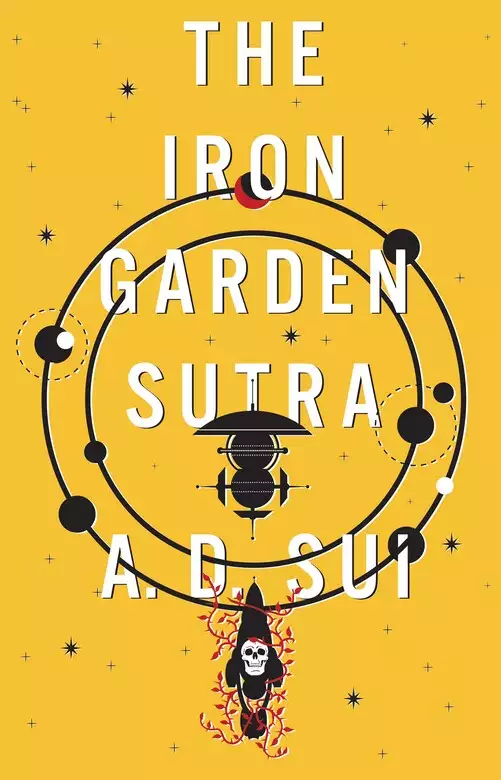
Klara and the Sun meets S. A. Barnes’s Dead Silence with a touch of Becky Chambers’ A Psalm for the Wild-Built in Nebula Award-winning author A.D. Sui’s darkly philosophical murder mystery, as a death monk and a team of researchers trapped onboard a spaceship of the dead encounter something beyond human understanding…
Vessel Iris has devoted himself to the Starlit Order, performing funeral rites for the dead across the galaxy, guiding souls back into the Infinite Light. Despite the meaning he finds in his work and the comfort of AI companionship, his relationships with the living leave him longing for deeper connection.
The spaceship Counsel of Nicaea has been lost for more than a thousand years, its passengers reduced to dust and bone. A relic of Earth’s dying past, its sudden appearance has attracted a team of academics eager to investigate its archeological history. And Iris has been assigned to bring peace to the crew’s long departed souls.
Carpeted in moss and intertwined with vines, Nicaea is more forest than ship. Iris’s religious rituals are met with bemusement by the scientists—and outright hostility by engineer Yan Fukui.
But the plant life isn’t the only sentience to have survived in the past millennia. Something onboard is stalking the explorers one by one. And Iris with his AI enhancement may be their only hope for survival. . .
IN OUTER SPACE NO ONE CAN HEAR YOUR PRAYERS
Release date:
February 24, 2026
Publisher:
Erewhon Books
Print pages:
384
* BingeBooks earns revenue from qualifying purchases as an Amazon Associate as well as from other retail partners.
The Infinite Light does not love nor does it care. It has no capacity for kindness or cruelty. The Infinite Light observes life with the curiosity of a child tearing off the legs of an insect. It watches its successes and failures with nothing but detached amusement. Do not forget, do not make me repeat myself. The Infinite Light does not love.
From the unabridged diaries of Vessel Iris, Volume Ten
You like dead people.
At these words, Iris returned to himself, back to the airy, sunlit room, to the peach-tinged marble floors scrubbed to a mirror-like finish, to the single stick of incense burning in front of him, to the tranquil temple morning before it erupted in its usual commotion.
“I like meeting people. They just often happen to be dead when I get there,” he said in a tone he’d use when instructing a novice. “And have you forgotten that jolting a monk from their meditation is an ill omen?”
A superstitious tale, the same voice, so much like his own but stripped of any human intonation, replied.
Iris could shut off the voice if he was inclined to, but he had grown quite accustomed to VIFAI’s chattering over the past two decades. At their introduction, when Iris had first welcomed the AI companion to share in the space of his mind, he had asked for its name. It had refused to give one at first, stating it was nothing more than “Iris’s friendly AI” and that its records indicated that monks never insisted their AIs name themselves. But the acronym stuck. Over the years it evolved to “Vessel Iris’s Friendly AI” and the now VIFAI had inadvertently named itself despite its reluctance to do so.
Iris was about ready to slip back into the calming waves of his sunrise meditation when an alarm flashed across his field of vision. He had half a mind to dismiss it, but the message flashed red and ignited with the crest of the Starlit Order. A quick scan revealed the notice had bounced from Doshua Station to the Primary Temple first before landing in Iris’s ocular projector. This had to be important. Inner peace and enlightenment would have to wait. Iris sat back on his heels and made a silent apology to the very thing that was both nothing and no one, and yet was everything and everyone at once. With a micromovement of his eyes, he opened the message. Counsel of Nicaea, arri—
Are you going?
This time Iris did gently shoo VIFAI to a distant corner of his mind. A time-out for while he read. He would apologise when he learned more about his assignment.
Generation ships, like the one suddenly orbiting Doshua Station, had all but disappeared. The last one crossed the galaxy arm not three hundred years prior and docked at P’Ilani before its passengers, seventh-generation descendants from First Earth, hit the dirt and gleefully destroyed all of P’Ilani’s native fauna. Yet here was the Nicaea, unexpected, uninvited, and, according to the message, assigned to Iris himself.
Doshua was a two-day trip, but Iris could easily leave at a moment’s notice. A Vessel’s belongings were few, and he was already wearing most of them. Finding a shuttle was a simple task with Inon Station hanging in low orbit, only an elevator ride away. Currency was also of no concern. Under the unspoken social contract the Starlit Order had formed with the rest of known space, it was improper for Vessels to handle currency, more improper still for someone to demand it of him. In exchange for this preferential treatment, Vessels performed a multitude of services for the countless citizens scattered across the galaxy.
For centuries, gate travel had been relatively safe. For just as long, space travel in general had been relatively safe. But relativity and wishful thinking did little to protect a ship’s hull when it split from impact or to shield a crew from a sudden burst of stellar radiation. Death still frequented orbits and travel routes. It was the vocation of the Vessels to guide those lost in space to the Infinite Light, to read final rites, to prepare the bodies for transport and burial of choice, and to comfort those left behind. Iris had attended many such deaths and ushered many travelers back to the One Beginning. It was a peaceful job, away from the core of civilization, away from the pull of a planet and the unbearable routine of temple life.
Iris had been planet-side for nearly six months now and had committed—again—every crumbling step and every clay tile of the Northern Temple to memory. He had recited every line of scripture at both sunrise and sunset prayers. He had bowed, and prayed, and meditated, and memorised every leaf on every tree in the main garden, and was slowly, and most assuredly, going mad with boredom. He could skirt the idea all he liked, but the friendly voice in his mind knew the answer before Iris ever thought of it himself.
You’ve already decided, VIFAI chimed, noting the decisive fluctuation of Iris’s thoughts. Iris couldn’t help but smile in return. No part of him could ever be concealed from the AI companion—not that he would ever want that. No sense pretending he had ever entertained staying put. Yet Iris wholeheartedly believed the decision had been made long before he ever opened the message, that it was as the Infinite Light had intended. He couldn’t fathom why the Light had intended for a generation ship to appear from the Doshua Gate when it did, but it wasn’t his place to question. Machinations far greater than his life were playing in the universe. The directive had been placed before his eyes, and it was his duty to carry it out. He would miss the temple, like he always did, but not for a long while, and by then a new adventure would be sure to dim the homesickness.
Smoothing out his white robe and trousers, Iris rose. The warm, cream marble beneath his bare feet flushed peach against the rays of the rising sun. A stifling day it would be when the sun hit its zenith, but he would be long gone before midday. A ribbon of saffron smoke wove towards the domed ceiling from the single stick of incense, keeping time of Iris’s sitting. He bowed deeply to excuse himself.
No time to waste.
There were too many things for him to carry in just the pockets of his robes, so Iris placed each item carefully inside a cracking, leather duffel bag. The bag had been a gift from a wealthy Yutam widow who had bestowed her deceased wife’s belonging to Iris. The language barrier had been too much for him to decline the gift, and no matter how hard he attempted to firmly thrust it back into the woman’s hands, she had persisted. Nevertheless, he was proud of the bag and lamented rarely being able to use it.
One change of robes.
One pair of replacement mala beads.
One shaving kit.
One tattered, pocket-sized diary with the front cover missing.
The bag remained largely empty.
You need a smaller bag, VIFAI said. Or more stuff.
A Vessel needs few possessions, Iris recited and zipped up the duffel. He was doing a moderately successful job of containing his blossoming excitement; if only he could suppress it long enough to board a shuttle, away from the nosy eyes and ears of his peers. Another couple of hours at most, and he would be free to shake off the veneer of aloofness so common to monks who spent prolonged tenures between temple walls.
Someone’s here, VIFAI said, two seconds too late.
A lithe shadow greeted Iris from the doorless entrance.
“Vessel Iris,” Vessel Bacai said, her voice gentle as the turning of the sand dunes, “you’re leaving us so soon?”
Not soon enough. Iris bowed, low enough to satisfy Bacai’s unmentioned ego. She was his senior, not in years, but in status. She would never say it out loud, but she would walk ahead of him and talk over him given the opportunity and give every possible indication that it was him who was to learn from her. Bacai was, after all, enlightened. Her words, not his. She had recited all the right mantras and had all the right dreams. She had the whitest robes and the most benevolent of smiles. Where Bacai embodied the sutras, Iris only knew them by name. Rumours had it that the walls of her room were carved with notches, one for every soul she had ushered to the One Beginning, and that Vessel Bacai was running out of space.
“I’m afraid my time has been cut short,” Iris said, intending to keep the conversation curt. “A message came through just moments ago. I have been summoned to usher the souls from a generation ship. It looks like I’ll be away for quite some time.”
On the surface, Bacai remained perfectly serene, tan skin unlined. But her eyes darted from side to side ever so slightly. She was checking her own messages, possibly asking her AI companion to flag any reports of generation ships in the news feeds. “Don’t you find it strange, Vessel Iris, that the Primary Temple asked for you? Someone of—” She didn’t finish.
Someone of your unimportant and unimpressive standing, Iris finished internally.
Someone’s jealous, VIFAI said, and Iris begged it to be silent.
Gently, gently, it was all to be handled gently. Politeness and respect were to be held above all else, especially at the temple, where every clay wall had ears of its own and mouths eager to spread the recent temple gossip. Nothing but universal love for everything and everyone, including Vessel Bacai, whose arrogant big toe now pushed its way past the threshold and took residence in Iris’s room.
“Would you like me to suggest you go, Vessel Bacai, in my stead?” Iris asked, voice tranquil, his face unreadable. It was a daring move. She could easily supersede him and attend to the ship herself, but that would mean he had done her a favor, and Bacai resented owing anything to anyone. So, just as anticipated, she gave a chilling smile and let Iris have a small bow.
“Not at all,” Bacai said, lips stretching along pearly teeth. “I hope you enjoy yourself very much.”
Wouldn’t you like that. Every Vessel had their own subtle ways of practicing vanity. Some more obviously than others. Iris was grateful that unlike Bacai’s jewel-adorned strand of white mala beads, he had the sense to keep his sandalwood. They were the very same beads he had been given at age six when he was welcomed into the Order, and they were soft and warm, wound around his left wrist as he scurried across the terraces, bag tucked under his arm.
“Do return swiftly, Vessel Iris,” Bacai called after him, her voice a birdsong against the rising suns. “We will all miss you terribly.”
Sweet lies, nothing more.
If he moved fast enough, he would miss most of the Vessels, the Beacons, and the novices as they moved from sunrise prayer to breakfast. Faster even, and he would miss Mother Nova as she emerged from the main garden after collecting the morning’s fruit. Their brief exchanges were mostly neutral and sometimes even pleasant. But recently their conversations had grown strained, weighed down by the gravity of things unsaid. It was simpler to avoid her altogether—cowardly, Iris admitted to himself, but simpler. Check the shuttle schedules, he told VIFAI, and find the ones that express the highest pro-Vessel sentiment, particularly by the captains. The AI buzzed affirmatively and got to work.
Iris flattened himself against a wall and squeezed by a group of elderly monks who were creating an elaborate mandala symbolically representative of the known universe using vibrant sands of reds and yellows. Swirls of colour dusted from tiny, bronzed funnels as the monks gently brushed short metal rods along their lengths, a couple grains of sand at a time. Iris didn’t have the care nor the patience for such artistry. Receiving a disapproving look, he hurried along, never lingering long enough to collect a reprimand. The mandala was to be destroyed as soon as it was completed, to signify the impermanence of even the most beautiful things. What harm was to be done if Iris were to hasten its end? The monks would disagree.
No time to ponder. Iris was already outside the main building, bare feet stepping quickly on the warm dirt of the courtyard. Several calico cats leapt from their napping spots in the sun to dodge his approach, scurrying atop the staircase and perching along the terrace. Just a few more hurried steps and he would be right at the gates, and once he was past the threshold, no one would bother stopping him.
“Blessed sunrise, Vessel Iris.”
Iris dug his heels into the ground. Hurry and find me a shuttle, please, he thought at VIFAI before turning around.
Mother Nova greeted him with a slight bow of the head and a broad smile. A wicker basket filled to the brim with peaches rested on her equally broad hip. “Running off so fast, you will rush the clouds away.”
Iris dropped his duffel bag to the dirt and bowed deeply, eyes glued to the orange dust speckled across the hem of his white trousers. “Blessed sunrise, Mother Nova. I have received a message from the Primary Temple that my services are needed at the—”
“Yes, yes, of course, at Doshua.” Without warning, Mother Nova’s hand was on his shoulder, and Iris nearly crumbled under its weight. “All messages go through me, child. So that I can find the right Vessel to send along.”
“Bacai—”
“Vessel Bacai will receive the assignment that suits her better,” Mother Nova said, squeezing Iris’s shoulder. “Everything is as the Light has intended it. Don’t overthink it, you’ll give yourself a headache. Go on then before the sun is too high in the sky. I hope you’ve packed for a long trip.”
Iris lingered a moment. Of all the ships in all the quadrants of the galaxy, Mother Nova had bestowed the honor of a generation ship upon him. Earlier that year, not six months prior, she had tried to talk him out of going aboard a small passenger ship heading back from Kirai Five, and that was far less impressive. He was almost upset he didn’t have to fight Bacai for this assignment. Almost. It was, after all, in Mother Nova’s words, as the Light intended it. Who was he to argue?
“Blessed day,” Iris said, breaking free from the weight of Mother Nova’s hand. He was again able to stand upright, to breathe evenly. He reminded himself that he was thrilled to go, thrilled to serve, to fulfill his purpose as a Vessel, that whatever tensions ate at him would melt away once he passed the threshold.
“Blessed indeed,” Mother Nova said with a warm smile. She walked back towards the temple with the wicker basket still at her hip. Watching her back sway with the rhythm of her steps, Iris thought how she had remained seemingly unchanged since he first walked through the gates nearly twenty years past. How little he had known about her, about her private aspirations and passions, not even her real name. She was as much a fixture of the temple as the terraces and gardens were. Permanent as the mountains looming over the horizon. Both welcoming and impartial as the rolling thunderstorms that came only in the summer nights. How Iris both dreaded and cherished the soft, ashy vowels of her speech. How all these idiosyncrasies fit into one that was the Mother Nova, he didn’t know. It wasn’t his place to know, wasn’t his place to question or understand.
I found us three shuttle options from the station, VIFAI spoke up, no louder than a whisper. Iris sensed it loitering, reluctant to interrupt his thoughts.
With a decisive square of his shoulders, Iris picked up his duffel bag and crossed the threshold of the temple gates.
“Notify the one with the least chatty captain, please.”
I pray and I mediate and still it’s no use. Why did you give me these thoughts that I cannot purge myself of? Why did you bestow this evil upon me? If I am a mere reflection of you, O, Light, then you must be just as cruel and vile as I am.
From the unabridged diaries of Vessel Iris, Volume Three
The Counsel of Nicaea’s hull dominated the view from Doshua Station. The generation ship glided lazily along the length of the peripheral corridor, passing from one meteorite-proof glass segment to the next, panels shimmering like obsidian snake-skin. From Iris’s vantage point, it looked as though it was the station that orbited the ship and not the other way around. An illusion made all the more tempting by the colossal size of the vessel. Craning his neck as far as it would go, he failed to see where the hull ended and space began. Only when he found stretches of darkness devoid of all starlight did he know he was looking at the Nicaea. Can you pull some stats on the ship? Iris asked VIFAI as he strode leisurely down the corridor. And anything else you can pull from the feed on generation ships. I’d like to be prepared.
Once, these periphery corridors had been crowded with commuters, eager to gaze upon the vastness of space for the first time. But just like with everything, people quickly grew bored with the sight of stars and distant galaxies. And now Iris was alone, interrupted only by the occasional service staff watching media on their break. As a Vessel, he had the clearances to speak with the Doshua AI directly, but then his own, less powerful one would be jealous that its services were neglected. Here, away from the crowds and the perpetual hum of the station, Iris had the luxury of sparing the few extra minutes. He allowed VIFAI to work at its own pace and for himself to study the spaceship in blissful silence.
Centuries before Iris was born, First Earth generation ships left their cradle in search of habitable worlds. Pressured by rapidly collapsing ecosystems, those with the means looked to other planets for a second chance, leaving the majority of the population behind. Archaeological records indicated each generation ship had been largely homogenous in religious makeup, suggested by preserved artifacts and digital records. Fueled by relentless faith, the colonists had scattered across the cosmos in search of their own, personal, Edens. It was an easy exercise not to pass judgment on those who ran. If the world was burning around him and escape was right there, Iris would have done the same.
But fate had had a different ending in mind and the simultaneous development of gate travel rendered the same ships obsolete before a single one ever reached its destination. There was no precise way to locate them, contact them, or to recover them mid-flight, so they were declared lost to the cosmos and committed to history books. Over the past hundreds of years, several had popped up in distant corners of the galaxy. They made their slow approach in silence, manned by nothing more than crumbling skeletons and ancient navigational systems. Every once in a while, the steady gravitational pull of a planet would be enough to place them in orbit until they were safely disposed of or dissected, their carcasses dragged off to various research institutes.
The Nicaea had already proven special. It was the first generation ship to exit gate space independently and the first to plant itself in stable orbit near a station, an object far too small to produce its own gravitational pull. Iris nursed a timid hope that aboard, he would find many oddities, treasures from First Earth, and remnants of cultures long lost to the gravity wells of time. Strange folklore and superstition, honed over years of complete isolation, usually adorned the corridors and living quarters of generation ships. He quietly yearned for a space that someone had lived in, that someone had made a home.
The Northern Temple had been “home” for many years, yet his room, now vacant, could easily be occupied by a novice, as it had by him. No one would notice the difference because there would be none. The same sleeping mat would be rolled out by the wall, the same glow sphere would cast shadows when night came. Not a single remnant of Iris would be in that space, no memory of him, a space forever borrowed and never his own.
With a faint vibration at Iris’s temple, VIFAI presented its compiled findings on the Nicaea across his field of vision. Station AI would have completed the task in under a second; it had taken VIFAI over two minutes. Still, Iris sensed a faint, yet noticeable flare of pride from his companion, and he wouldn’t dare extinguish that fragile emotion.
The Counsel of Nicaea had been in flight for more than a thousand years. By a sheer miracle, it had avoided destruction by a meteor strike in its travels. The ship originally left First Earth with a little over a thousand people, although it was impossible to predict what the numbers would resemble when Iris went aboard. But a thousand souls! Generation ships never housed any surviving passengers, save for the one orbiting P’Ilani, and station AI had confirmed this with its preliminary scans moments after the Nicaea emerged from gate space. But it would still take Iris weeks, if not months, to find and lay to rest over one thousand people.
One bare foot placed carefully ahead of the other, Iris made his way to the shuttle gates as he skimmed over the files and annotations VIFAI had produced. Once there, he would board a single-person, unmanned craft, smaller than his room at the Northern Temple. The shuttle would deliver him to one of the operational airlocks on the Nicaea, so the exciting part of his assignment could begin. This part of his journey had been automated for his convenience: Iris had no piloting skills, nor any inclination to develop them, convinced that his neuroses would make him jumpy at the controls.
The shuttle doors were programmed to open after completing a retinal scan, the data for which had been uploaded before Iris ever set foot on the station. Once aboard the Nicaea, he could bask in glorious solitude. Maybe a station security official would accompany him once or twice, as they tended to do, until they grew bored with a Vessel’s routine and resigned to let Iris come and go as he pleased.
Long before he ever reached Doshua, Iris had decided he would spend all of his available time on the Nicaea, avoiding the forty-minute commute from the station to the ship. He was hoping some of the hydroponic systems had survived, and he would be able to make his own food. If not, he could always fast. It wouldn’t be his first nor his last. Any fast up to a week was doable, but if he continued working on the Nicaea for weeks on end, he would have to return to the station to replenish his provisions, as arduous a task as it would be. Nothing quite like an automated shuttle to make you feel at ease, Iris thought cheerfully as the shuttle doors shut silently behind him.
The chances of an automated shuttle breaking down are very low, but never zero, VIFAI said with a playful tickle, an electrical nudge of laughter at Iris’s brain stem.
Taking a seat at the piloting console—purely ceremonial as he would have no ability to steer the shuttle—Iris unwound the mala from his wrist and ran the strand between his fingers. With each count, he uttered a mantra to accompany the bead.
“I am free from hatred and from anger. I am free from desire and craving. I am the empty Vessel of the cosmos, the mouthpiece of the Light.” The shuttle began to vibrate and hum as it initiated the launch sequence. Space travel was relatively safe. Yet, being intimately aware of just how many people perished every year in its relative safety, Iris was inclined to err on the side of caution.
“Speak through me and only in virtue will I repeat your words. Speak through me so that I may be the balm for those needing relief. Command my body to move in your image, and I will be the guide to those lost and seeking you.” Iris’s top lip twitched in a small smirk. Those words did not belong to him. They were reserved for the Beacons, whose sole responsibility was to travel and teach the word of the Starlit. He had picked up the verses while scrubbing the gaps between the hallway tiles and eavesdropping on the Beacons’ prayer. He had a foul habit of doing that.
A faint sandalwood aroma wafted through the cramped shuttle cabin as Iris ran the beads through his fingers. “My friend, rejoice, for there is no you, and there is no me. The Light is your flesh as it is starlight. The Light is these words as it is the blood in your veins. Rejoice that in the touch of a lover you know the touch of the Divine. Rejoice that in your last breath you learn what it is to be the cosmos.” Iris opened his eyes, not realizing he had closed them. This was his favourite one, the five verses reserved only for the Vessels. Five verses that he would say over every single passenger he found aboard the Nicaea as he returned them to the One Beginning. These five verses were his and his alone.
Outside the palm-sized observation window, the station fell away, quickly replaced by the growing hull of the Nicaea, dark and imposing. Growing closer, the imperfections and hundreds of patches along the once-smooth exterior were hard to ignore. Meteorites, blown apart by the canons, had rained debris along the tight paneling, scratching deep gashes as they passed. Over and over, for a thousand years. The Nicaea had taken beating after beating without reprieve.
What a wreck, VIFAI said.
She was strong enough to get this far.
It doesn’t take much to follow inertia, VIFAI chimed up as the shuttle came to a stop with a last burst from the stabilizers. Now came the important part: The shuttle would “knock” and the ship would “answer” before any doors opened or any docking took place. Even old ships, without an AI construct navigating their journeys, could perform a function this simple.
Well, this isn’t good.
Problem?
This ship is so old it has no general operating system or AI pilot running it. Not that I can find. Doshua should have told me about this. Station is getting forgetful in its old age. I won’t get any information about what we can expect to find inside. I’m effectively blind and mute.
Without a general operating system running a ship or a ship AI presiding over it, VIFAI had no one to ask questions and no one to give it answers. It lacked the configuration to speak to all the various parts of the ship or open doors, shut off lights, or really do much of anything of value. Yet, when the shuttle “knocked,” blindly following protocol, the ship welcomed it inside and presented the closest airlock for docking. The lights were clearly on, even when no one could possibly be home. Still following protocol and without questioning the peculiarity of what had just transpired, the shuttle fired its stabilizing thrusters and moved to dock.
Odd.
Maybe you missed it, Iris suggested cautiously, ignoring the rising hairs along his neck.
A ship this size, me missing its AI would be like you missing a temple while standing at its gates, VIFAI bit back.
A foolish remark, Iris admitted. He picked up his duffel bag from the floor and walked over to the airlock. The instant the doors parted, a current of warm, humid air filled the modest airlock to the brim. A cacophony of earthy smells from otherworldly florals and other abundant alien flora flooded Iris’s senses with their sweet musk. The heavy silks of Vessel robes, made to withstand dry heat were instantly soaked with fresh sweat and condensation and clinging to his back and thighs. “Feels like home,” he said with a small chuckle as he wiped his forehead.
A dark, moss-lined corridor greeted him just beyond the airlock doors. Moss covered every surface, running up the walls and weaving a patchwork of green around the flickering light panels. In some spots, it bled a deep blue, so heavy it was nearly black. Fat droplets of condensation settled along most horizontal spots, clear and bulbous. Iris wriggled his toes against the soft, squishy ground with every step.
Down the corridor, the carpet of moss gave way to an array of vines. Their lithe bodies had pried open the doors, pulling the two halves apart. Large, yellow blossoms ran along their length, reaching through cracks in the composite of ceiling panels. Breaking the first rule of walking barefoot through generation ships, Iris reached out and placed his palm flat against one of the vines. A pulse played beneath his fingers with the steady rhythm of an unseen heart. Peculiar, Iris told VIFAI. Make a recording of this, please.
Above him, the vines converged in an organic trellis, punctuated with more heavy, yellow blossoms. When Iris removed his hand from the vine, the flower closest to him furled its three petals inwards and released a fragrant puff before retreating into the vine at once. Ignoring the second rule of walking barefoot through generation ships, Iris inhaled the sweet perfume the flower had left for him.
That could most definitely be poison, VIFAI said.
And I am inoculated against most poisons. And if I am not inoculated against this one, then it is the will of the Light that I perish here, Iris replied, sardonically. Relax a little. He brushed aside the vine from across the doorway and ducked underneath it with one fluid motion.
Most generation ships were designed to strike a balance between lasting utility and marginal comfort, as both were vital for human survival. There was nothing comforting about a lifelong entrapment in a glorified can with only a modest hull to shield the inhabitants from all the brutality of outer space, so when quarters couldn’t be expanded horizontally, architects built up. Most communal spaces boasted high ceilings and were equipped with lighting that shifted to mimic the rising and setting sun. Where possible, corridors that went on for kilometres weaved between open spaces and living quarters, forming vast networks. Iris had read that the most sophisticated of these ships boasted holographic ceilings cap
We hope you are enjoying the book so far. To continue reading...

 Please log in to recommend or discuss...
