
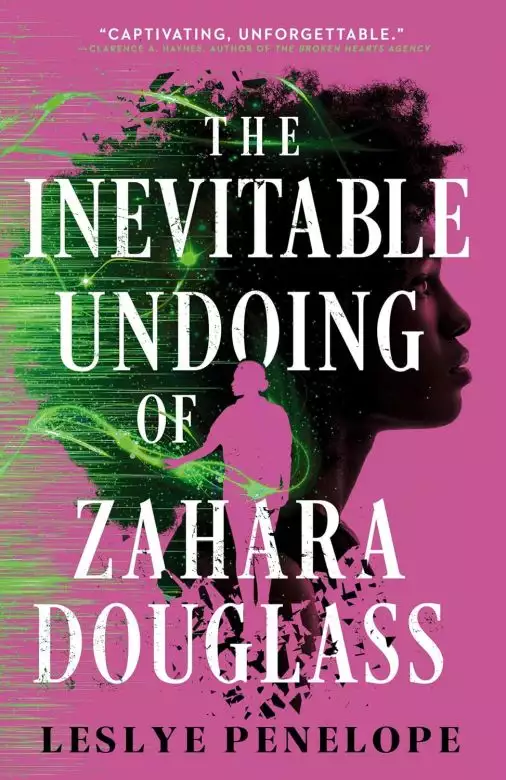
The Inevitable Undoing of Zahara Douglass
- eBook
- Paperback
- Audiobook
- Book info
- Sample
- Media
- Author updates
- Lists
Synopsis
For five years, Zahara Douglass has been haunted by her sister’s impossible disappearance. Now, in December 1999, with the world on the brink of chaos, Zahara sets out to find her sister no matter the cost in this twisty and compelling modern fantasy from Leslye Penelope.
In April 1994, Zahara watched her twin sister, Annica, get hustled into a stranger’s car and disappear—only to return to a world where no one remembers Annica ever existed. Not her mother. Not the police. No one.
Now, as the world braces for the looming Y2K crisis, Zahara finds evidence that proves her sister was real. Determined to uncover the truth, she hires a private investigator and begins digging into her family’s shadowed past. When the investigation leads to two charismatic men who once served with her father in Vietnam, Zahara realizes she and her sister may be pawns in a dangerous power struggle with unthinkable consequences.
To find her sister, Zahara must face the truth about her family, her memories, and the power lurking within her. But the sisters’ reunion comes at a price—one that could unravel reality and bring about the end of the world.
Release date: August 11, 2026
Publisher: Orbit
Print pages: 384
* BingeBooks earns revenue from qualifying purchases as an Amazon Associate as well as from other retail partners.
Reader buzz
 Please log in to recommend or discuss...
Author updates
The Inevitable Undoing of Zahara Douglass
Leslye Penelope
Goose bumps rippled up her arm in the chill of the examination room. Her gaze followed a brown streak of water damage from the ceiling down the beige wall as her fingers plucked at a hangnail on her thumb.
“Zahara? I need you to tell me why you’re here.”
She tore her attention from the unsightly stain to focus on the doctor. With his pockmarked face, drooping eyes, and fleshy jowls, he reminded her of a bulldog. He tapped the paperwork on the clipboard in his hand. His right ring finger bore a large class ring, the stone blood-red.
Zahara hadn’t bothered with a class ring, but Annica had—a blue moonstone at the center, the June birthstone they both liked best. It had always been too big for her skinny finger.
“My mother thinks I’m a danger to myself,” Zahara said, voice monotone.
Mom’s cries echoed in her mind, the last words she’d sobbed, repeating like a broken record. “I don’t know what else to do, baby. You’re scaring me.”
She couldn’t remember the last time she’d seen her mother cry.
“And you think your mother has no reason to be concerned?”
Zahara blew out a breath. Shifted in her seat. Tugged at the tiny bit of skin hanging from her cuticle. “She’s just not listening to me.”
The dog-faced doctor blinked. “Listening to you when you say that you have a twin sister who disappeared. Is that right?”
“Yes.” She crossed her arms, bracing herself.
“But you don’t have a twin sister. You’re an only child. Do you see why claiming otherwise has created cause for worry?” He didn’t wait for her to respond. “And your actions—”
“I was never going to harm myself.” She squeezed her fists tight, hoping her hands would go numb.
“According to your mother, you haven’t eaten, you haven’t slept, you’re skipping school, and you’ve been wandering the streets day and night, searching for this sister of yours.”
Zahara slumped in her chair. The room’s single window looked out onto a sunlit courtyard. Bright flowers bloomed, orbited by giant, heavy bumblebees. It was probably supposed to be cheery.
An enormous spider had woven a web in a corner of the window—on the outside, thank God. It was there now, the many segments of its articulated legs moving slowly, winding up a fly that had gotten caught in its trap. She commiserated with the fly. Then again, the spider was probably hungry. Everything in this world had to eat.
The doctor said her name again, but Zahara ignored him.
Zahara’s scream ripped through the kitchen.
“Oh my God, Z, what is wrong with you?” her sister snapped, not looking up from the computer in the kitchen nook.
“Spider,” she breathed, pointing to where the giant bug was crawling across the kitchen counter. Right behind the bowl of oatmeal she had just set down. Her limbs seized and her eyelids refused to shut. If she blinked, she might miss its path and then it could be anywhere. No, she would stay right here staring at it so at least she’d know if it tried to get closer to her. Or crawled in her ear to lay eggs or something. Spiders laid eggs, right?
The chair scraped as Annica stood and marched over. “And you say I’m the drama queen,” she muttered, grabbing an envelope from a stack of mail and waving it menacingly at the creature.
“Don’t kill it!” Zahara shrieked. The envelope her sister had snatched bore red lettering stamped across the top. OVERDUE. The PG&E bill.
Annica rolled her eyes. “What do you want me to do, release it into the wild?”
“I don’t know. Maybe. It doesn’t have to die. I just don’t want it in here. With us. Where we live.”
Her sister shot her a sunny smile, but suspicion made Zahara narrow her eyes.
“So do you want to take it outside?” Annica asked sweetly, tilting her head.
“Eww. No. I don’t want to be near it.” She cringed and backed away a step.
Bam! Annica slammed the envelope down, sending the tiny beast to arachnid heaven. Zahara jumped and shivered as her sister wiped away the remains with a paper towel before throwing both into the trash. Then she returned to the computer, falling into the chair ungracefully.
Zahara bit back the question forming on her lips. Are you okay? she wanted to ask, but then Nica would snap something like They wouldn’t have let me out of the hospital if I wasn’t okay, right? and she didn’t feel like starting a thing this morning.
She looked at the trash can and considered fishing out the electric bill, spider guts and all—she needed to pay it (well, part of it) when she got her check on Friday—but figured she would just call and find the amount due then. Annica had left the stack of mail askew, so she patted it back into place, all the edges lining up neatly. If only it were so easy to put their lives back in order.
Her oatmeal sat there cooling, but she wasn’t hungry anymore. Her stomach still fluttered from the close encounter with the creepy crawly beast of many legs. She shook herself and spun around. “Hey, can I use the computer for like five minutes to check my email?”
Annica glanced over. “Sure. I need to start getting ready anyway.” With a few taps, she closed all her windows and opened the mail program before standing again and stretching with a yawn.
“Thanks.” Zahara replaced her in the chair and logged in to her email account. Two messages greeted her, double the number she was expecting. The presence of the first one, though she’d known it would be there, still caused a heavy weight of disappointment to drag at her shoulders.
The sender was [email protected], and inside the email was sure to be the end of a certain road. A dream she’d had to defer. She needed to open it, had sat down with that very intention, but maybe now didn’t need to be the time. It would still be there tomorrow. And the next day.
She figured the email would probably still be in her inbox in twenty years, maybe until the end of time, or until the email server thing got unplugged or something. She’d have to ask Nica about it.
Deciding that no matter what was inside, it could wait at least for a few minutes, she considered the second message. The sender was listed as a perplexing [email protected]. The subject line, “Concerned,” made her frown. Her cursor hovered over the message when the front door opened and closed again.
“Nica?”
Sounds of the shower came from Mom’s first-floor bedroom, and no one else was in the house. But Annica wouldn’t have left for school without her. It was too early anyway. Zahara peered around the corner into the empty living room. Through the front window, she saw her sister hurrying down the sidewalk with her backpack on.
“What the hell?” The wrongness of it had her springing from her chair and racing to open the door. “Nica! Where are you going?”
Her sister, headed in the opposite direction of their high school, didn’t turn around; instead, she quickened her pace.
Zahara stepped onto the front porch and cupped her hands around her mouth. “Annica!” she yelled. Her sister just picked up speed.
In the yard next door, Mrs. Yee stood in her housecoat watering her freesias. The older woman was hard of hearing, but she looked over and waved. Zahara waved back distractedly, watching her sister’s progress. The feeling that something horrible was about to happen was a vast black hole opening up inside her.
Zahara began to run.
She didn’t even stop to put on her sneakers, she just darted out the door, across the porch, down the steps, and onto the sidewalk.
Annica had started a sort of limping jog and was already half a block ahead. She shouldn’t be jogging. Hell, she still had residue from the tape used to keep the IV needle in place stuck to her bony hand. And the more Zahara shouted, the more her sister ignored her.
Zahara quickened her pace when she noticed the car idling on the corner. A figure in a dark hoodie was hunched over the steering wheel of the nondescript dark gray hatchback. Annica hitched her bag higher on her lean shoulder and moved even faster.
Zahara had not just gotten out of the hospital. In fact, she’d never been hospitalized. What’s more, she had spent the past five years training her body into a machine, so why was she still so far away when Annica reached the car? When her sister opened the passenger door. Fell into the seat.
Annica looked up and met Zahara’s eye. The expression on her face was grim. Determined. Resigned.
“Annica! Wait!” She was only steps away.
Her sister merely blinked. Parted her chapped lips and spoke something too soft to hear. But Zahara thought she could read the word on her lips.
Goodbye.
The car started moving before the passenger door was fully closed. Zahara slapped the roof with her hand as it slid away.
None of this made any sense, so Zahara gave chase. She ran until her feet bled. The morning air, sharp as a scythe, carved through her lungs. The asphalt of the street, ragged-edged and uneven, butchered her bare soles. And still she ran on.
The brake lights of the car winked on when it pulled to a stop at a traffic light two blocks down. Zahara put on a burst of speed. She could catch them. She would.
The pain was nothing to her. It barely even registered. The last time she’d broken down crying at the agony in her legs or the blood pooled in her pointe shoes was years ago, after Madame Claudine forced her to endure endless dizzying rounds of pirouettes and jetés, demanding perfection from each turn or leap.
The light turned green. The hatchback took off. Not peeling away in a cloud of smoke and burned rubber but easing forward with the flow of traffic. Not at all intimidated by the lone barefoot teenager racing down the middle of the street behind it.
Nearly there… So close, but then farther and farther as the car making off with her sister shot forward. Put on its turn signal. Disappeared around the corner.
Zahara ran until the pain finally did register. Until each step was a battle. Until hope was just a tiny speck in the distance. Until she collapsed at the edge of an empty intersection alone, breaths heaving, side in stitches, tears and blood mingling on the ground.
Annica was gone.
She limped over to the pay phone next to the laundromat on the corner. Shaking fingers pressed the three digits. If only she’d been faster…
“911, what is your emergency?”
Her first try at answering was stymied by her inability to breathe, so she sucked air into her lungs as slowly as she could, then blew it out again. “My sister, she was just kidnapped. I—I saw it.”
“Okay, ma’am, what is your location?”
Zahara looked up at the street signs, barely recognizing where she was. Were they asking about where she was now? She decided her home address was more relevant and rattled it off. The operator asked a series of rapid-fire questions, which Zahara did her best to answer. “She’ll be seventeen in June… African American.”
“A navy T-shirt and blue jeans. Black backpack. White sneakers. Dark brown hair in shoulder-length cornrows.”
“I didn’t get a good look. They were wearing a dark hoodie with their head covered.”
“Not sure.”
“It was a gray hatchback. Not too old.”
“No, I didn’t see the license plate.” Zahara cursed herself. Why didn’t she pay attention to the license plate?
“No, I didn’t see a weapon either. It was like—” Her voice broke as her throat strangled her words. He’d been waiting for her sister. Annica knew he would be there. She got in willingly. But if Zahara told that to the emergency people, they wouldn’t take her seriously.
Deep sobs rushed up from within her, and she struggled to answer the rest of the questions. The dispatcher was patient, and her unemotional voice helped somewhat.
“Okay. Yes. I’ll go home and wait for the officers to arrive. Thank you so much.”
Someone had carved some kind of unreadable graffiti into the plastic of the phone receiver. After she hung up, she realized the jagged texture had bit into her palms. Shivers racked her body. It was as if her very bones were coated with ice crystals. And her feet… Her feet were a mess.
She hobbled the six blocks home, the pain of her body warring with the pain in her heart. What had just happened? Did Annica have a secret boyfriend? Were they running away together? Why wouldn’t she have told Zahara? They told each other everything.
As she toddled along, her darting gaze tracked her surroundings, hoping that Annica would just turn up. She might walk out from behind a tree or from the alley, and this horrible nightmare would end.
Zahara nearly bumped into Mrs. Yee on the sidewalk in her faded floral housecoat, ragged slippers on her feet. Her round face was familiar and Zahara wished she could fall into the woman’s arms and let loose the sobs that she was barely holding back. But their neighbor wasn’t the touchy-feely kind, and although she had lived next door all Zahara’s life, they weren’t close.
Mrs. Yee was holding something in her hand, waving it around. Zahara blinked, bringing her into focus.
“I got this,” the woman said too loudly, shaking the paper again before pressing it into Zahara’s hands. RON HERMAN, YOUR REAL ESTATE CONNECTION! the words on the flyer shouted. The realtor’s smiling face was wholly unnatural. Did the woman think that she would want to buy a house sometime soon?
At her confused frown, Mrs. Yee gently plucked the paper from her hands and flipped it over. On the back was a series of handwritten letters and numbers that swam in Zahara’s blurred vision.
“License plate,” she said, pointing. “I got the license plate. My ears may be no good, but my eyes…” She grinned, motioning to her dark eyes fanned with wrinkles, then gave the thumbs-up sign.
The tears Zahara had been holding back burst out of her in a torrent. The empty pit in her middle refilled itself in a rush with something like hope. She couldn’t hold herself back from pulling the woman in for a hug.
Mrs. Yee’s shoulders were rigid, her posture tense, but eventually she softened and finally patted Zahara on the back. “It will be all right soon. You’ll find her.” Her tone was unusually soothing.
Zahara hiccuped and pulled away, her lungs not knowing exactly what they wanted to do. Gratitude filled her, nearly pulling her down to her knees. Then dizziness swamped her and nausea made her press her lips tight together and hold her hand against her belly.
She closed her eyes, breathing deeply. When she opened them again, Mrs. Yee’s orange tabby, Hokey, stood in his usual place in the front window, arching his back in a protracted stretch. Zahara blinked, and there were two Hokeys, both stretching and then settling back down together.
Zahara shut her eyes again, overwhelmed by wooziness. Pain crackled across her skin, making her cry out. It felt like she’d stuck a fork in an electrical socket, or maybe even been struck by lightning. The scent of something spicy hit her nose, then quickly dissipated. Fortunately, the feeling only lasted for a second or two.
Eyes open once more and watering now from the intensity of the brief pain, she straightened, swallowing down the bile that had risen. When she looked over at her neighbor’s house, the cats in the window were gone. Both of them. Mrs. Yee was gone, too.
Well, that was… rude. Unless Zahara had been standing there longer than she’d thought… She shook her head to clear it and walked gingerly into her house, clutching the flyer in bloodless fingers.
“Mom!” she screamed, tracking blood across the floor until she reached the phone in the kitchen and dialed 911 again.
“Hello? I just called 911 a few minutes ago to report a kidnapping, and I have new information. Um, okay, sure.” As she was put on hold, her gaze skated around the kitchen.
“Mom!” she called again, then froze. The almond-colored refrigerator that had been gasping and wheezing for the past few months was gone. In its place stood a sleek black model, complete with a fancy water and ice dispenser in the door. The countertops, which had been made of butcher block her entire life were now a snazzy black granite.
Zahara turned slowly to the little nook, which had, not more than fifteen minutes ago, held a computer. Now the tower, monitor, and keyboard were all gone. Instead, a stack of recipe books stood in their place.
“Ma’am,” the voice on the phone came back. “You say you called to report a kidnapping? When was this?”
“A f-few minutes ago.”
“We haven’t had any reports of kidnappings come in today, ma’am. Are you certain you called in to this district?”
She peered into the living room, and the phone slipped out of her hand to clatter on the tile. The furniture. What the hell happened to the furniture?
Footsteps on the staircase had her spinning around. “Zahara, why are you screaming like a banshee?”
She faced her mother, and her jaw dropped open. Cassandra Douglass was dressed stylishly in a business suit with heels. Her hair, which last night had been in box braids, was neatly relaxed and curled in big frothy loops that haloed around her head. Red lipstick contrasted prettily against the dark of her skin.
Seeing the expression on her daughter’s face, she stopped short. “What’s wrong, baby girl?”
Zahara just blinked. A designer handbag was in her mother’s grip, and if she wasn’t mistaken, those were designer shoes on her feet as well. Zahara spun and walked into the living room without saying another word.
“Z?” Her mother’s footsteps clacked across the kitchen. Zahara heard her pick up the phone receiver and replace it. The words “Are you… bleeding?” vaguely hit her consciousness, but most of her focus was on the room before her.
The walls were painted a calm peachy color instead of the light blue they’d always been. Family photos on the credenza were in different frames. She turned in a circle. It was like she’d never been here before. The walls and the rooms were the same size and shape. The house was the one she’d grown up in, but everything inside it was completely different.
“Zahara, you’re scaring me,” her mother said, coming to her and pulling her into her arms. “Where have you been and why are you bleeding?” An unfamiliar perfume wafted from her pores. It was thick, a little cloying, probably expensive—like the rest of her now.
“What in the hell is happening?” Zahara whispered.
As her mother held her in a familiar embrace amid all the other unfamiliarity, Zahara clutched her. “Annica was kidnapped,” she said through clenched teeth. Her breathing labored; she barely got the words out.
Her mother pulled back and peered into her eyes, concern etched there. “Oh, sweetheart, that’s horrible! Who is Annica? One of your friends from school?”
Zahara took a shaky step back, pulling out of her mother’s grip. “What?”
Cassandra tilted her head, her concern growing by the second. Zahara’s lips quivered, her heart stuttered; the nausea returned, twice as strong as before. A photo on the credenza caught her eye. Where Annica’s school photos had once sat, other pictures now replaced them. Zahara’s baby photos were there, as were the photos from her parents’ wedding. But where every one of her childhood photos had included her twin, more often than not in an identical outfit, now Zahara was in them alone.
She backed away into the hall, leaving her mother calling after her, and raced up the steps to their bedroom. Gone were the two twin beds. One queen-sized bed filled the room. Annica’s dresser and desk were also gone. Her books and papers and computer parts nowhere to be found. Zahara wrenched open the closet door to find unfamiliar clothes hanging there—all in her size. Many designer names among the tags.
She slammed the closet door shut and fell to her knees, sobbing. Her mother was there, that unfamiliar perfume assaulting Zahara’s nostrils. A warm hand rubbed her back, trying to comfort her, but there was no comfort to be had here.
Wake up, wake up, wake up, wake up! She pinched the inside of her arm, hoping against hope that this was all a horrible nightmare.
“Ohhh, sweetheart,” her mother cooed, pulling her into another embrace. “What’s happening? Talk to me, baby girl.”
Even that name caused the sobs to grow deeper. Annica was the baby girl. That was what their father had started calling her as the firstborn. But somehow, in some way, it had never happened. She never existed.
“You really don’t know who Annica is?” she asked her mother.
Cassandra’s brow crinkled in confusion—legitimate, sincere confusion. The baby that she had carried for nine months, given birth to, breastfed, and stayed in the hospital with countless times—there was no recognition in her gaze whatsoever. She shook her head. “I love that name, though,” she said. “I always thought it would be nice.”
“The best friend from the Pippi Longstocking books,” Zahara said with a sniff. She knew the origin of the name. Had heard about it her whole life.
Cassandra smiled, stroking her daughter’s cheek. “I didn’t know that you knew anyone with that name. Kidnapped? I can’t even imagine…”
Zahara thought that she might cry forever. There was an endless well of despair inside her. She closed her eyes and recalled her twin sister’s face—the face she’d just seen, looking at her sadly, whispering…
Goodbye.
The spider had abandoned its meal and loped out of sight, maybe in search of dessert, leaving behind the no-longer-struggling, cocooned fly. The insect had given up all hope.
Hope.
Zahara snorted and regarded the doctor again. He appeared patient, but she was sure it was just an act. A bulging vein in his forehead looked a bit dangerous.
When her sister first left, Zahara had tried to pretend, but the wrongness of the new life was too much to bear. Her mother’s lightness and joy were too big a contrast to the serious, dour woman she’d known all her life. Mom now had hobbies, friends, and even went out on dates. And there was so much extra money.
They apparently ate out in restaurants, ordered carryout, and tipped well. There were photos from international vacations that Zahara had no recollection of. She even had a car—her own car—apparently gifted to her on her sixteenth birthday. Friends, girls she had previously only known via passing them in the halls or as bodies filling seats in classrooms, called and left messages for her, worried because she’d missed some party or planned trip to the mall.
In this world, Zahara was still dancing. Madame Claudine had called, too, after that first day, wondering if she was dead because that was the only acceptable reason for missing rehearsal.
And for a few days, at least, still reeling and confused, Zahara had tried. Had gone through the motions: attending school, apologizing to these new friends, attending dance class. She had really tried.
But the guilt was ravenous and it fed on her constantly. Her memories were so vivid, so real. And so she’d spent day after day, night after night searching, telling anyone who would listen about her twin sister.
The doctor blew out a slow breath, tapping his finger on the clipboard again. “I’m recommending you for a 5150 hold, Zahara, so that we can evaluate you and ensure that you are not, in fact, a danger to yourself or anyone else.”
She couldn’t say she was surprised. Was her memory a liar? Has she actually lost her mind? Could they fix her here?
Once she was officially admitted, a nurse led her to a room where she had to strip out of her clothes and put on a pair of scrubs with an elastic band—no strings—and slip-on shoes. The scrubs were the color of dried blood. Then she was taken to the unit where she would be held for the next three days.
A group of kids were watching Sailor Moon on a television bolted to the wall. A couple of tables were scattered around, where other kids were drawing. A white girl with matted blond hair played solitaire with a crumpled deck of cards. No one looked up when Zahara entered.
The next seventy-two hours unfolded with a mix of tedium and fear. She had a single room, but the door had to be kept open at all times. Nurses were always checking her blood pressure and heart rate. The food was barely edible, but if she didn’t eat, she heard from one of her fellow inmates—a petite Asian girl with a shaved head—they could tack on extra time.
She lost the hair tie that had been holding her ponytail. She was pretty sure one of the other girls had stolen it and she couldn’t get another one. The only combs allowed barely went through her thick hair.
At odd intervals throughout the night, one of the girls screamed like she was being murdered. The bed was lumpy. The selection of books in the rec room was anemic. And the TV was controlled by Carol, a six-foot-tall black girl who was apparently the first female football player at her high school. She only wanted to watch cartoons, so that’s what they watched.
Group therapy was a tour through a variety of mental illnesses Zahara hadn’t even been aware of. Afterward, many of the girls would sit around comparing their suicide attempts. It took less than twenty-four hours for Zahara to realize there was nothing and no one here who could help her.
“What are you in for?” asked a red-haired white girl with two braids somehow curving outward from her head.
“Delusions. Apparently, I invented a twin sister.”
The girl nodded sagely, as if this was no surprise to her. “My first hold,” she said, “I met this chick who ran away to live with her dead grandmother. They found her in an abandoned building that she honestly thought was her grandmother’s house. Our minds are strange and wondrous places.”
The next time Zahara met with the droopy-eyed psychiatrist, she told him with a straight face that she knew she didn’t have a sister. She’d made the whole thing up. The stress of her upcoming audition with the National Ballet Theatre had gotten to her. But she was okay now. She knew the truth from the lies.
As her discharge papers were processed, she sent a silent message to her twin. I don’t know if you were real, Annica. I think so, but I’m just not sure anymore. If you were, I hope you can forgive me.
A sound like the manic warbling of a robotic bird cuts through the all-too-familiar melody of Tchaikovsky’s “Waltz of the Flowers.” Zahara is in the middle of a series of whipping fouetté turns when it hits, and she stumbles.
A cell phone.
Somewhere in the first few rows.
Its high-pitched dissonance is at odds with the orchestra’s faultless tones. The phone’s distinct melody is also well known but grating.
The first chair flute, a ghostly pale young man with a shock of unruly orange hair, copies the ring tone subtly, then re-joins the rest of the woodwinds without missing any additional notes. A smattering of laughter breaks out in the crowd as the conductor bulges his eyes and purses his lips. Perhaps the young ginger will not be first chair for long.
Zahara wobbles her way out of the turns and into the leaps that take her to the edge of the stage, a delighted smile never leaving her face. Breaking character would turn the disaster of her mistake into a catastrophe.
She holds the final arabesque, briefly becoming a statue carved from marble. Then she exits stage left and, once out of sight of those seated in the first row, bends over, gripping the curtain and gasping for breath. When was the last time she lost her feet? The horror of it washes over her with a powerful undertow.
“Everybody’s a comedian,” Ekaterina mutters, coming up next to her, wearing the red-and-gold Spanish Dancer costume. “And what the hell is wrong with people? Didn’t they hear the announcement at the top of the show to turn their phones off ? Zahara, you all right?”
She stands, her vision swimming, grip still tight on the black fabric of the curtain. “Fine.” Gritted teeth bite out the single word. Normally, she would stay to watch the “Grand Pas de Deux,” imagine the day that she would be dancing in the coveted principal role of the Sugar Plum Fairy. But, not wanting any more pity, and feeling a growing sense of shame for her mistake, she retreats farther into the backstage area, seeking to lick her wounds in private before the curtain call.
A gaggle of small children in angel costumes flitter in her peripheral vision, trying their best to stay out of the way of the other dancers, but failing. They should really be back in the dressing room until the end of this number, but that’s not Zahara’s responsibility. She turns the corner to the stairwell, where she finds a lone girl lit only by the orange-red glow of the EXIT sign. She’s a little angel, too, separated from the rest of her flock, wire and gauze wings tilting crookedly on her back. But this child isn’t gaping with wonder at the professional dancers scurrying around. She’s crying.
She’s only about seven or eight, scrubbing at her cheeks with the palms of her hands and sniffling wetly. Zahara could slip past her. The girl would likely not even notice. She doesn’t recognize the child, but there are far too many kids in this performance—different groups each night—for her to have really gotten to know any of them. They’re bused in from dance schools around the county, an unending parade of tiny ballet students tottering around on unsteady legs. Zahara had been one of them once. So, though children are, in general
We hope you are enjoying the book so far. To continue reading...
