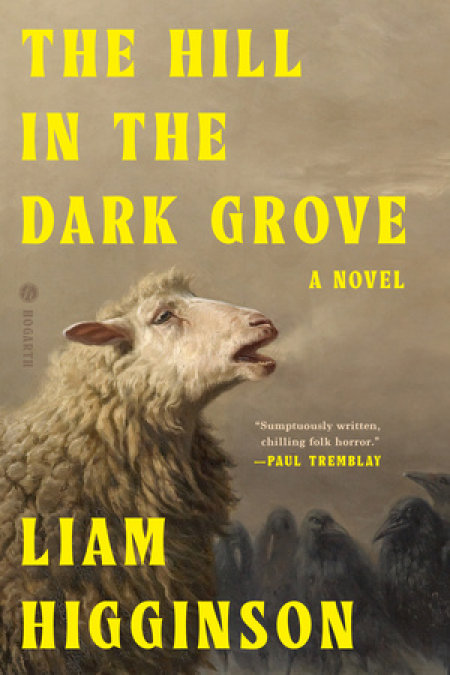
In this gripping debut, steeped in Welsh folklore, a husband and wife living in the beautiful but isolated mountains of Snowdonia stumble upon a buried Neolithic ruin—awakening a mysterious, ancient presence with its own dark designs.
“A sumptuously written, chilling folk horror novel.”—Paul Tremblay, New York Times bestselling author of Horror Movie and A Head Full of Ghosts
One of Publishers Weekly’s Most Anticipated Books of the Year
Carwyn and his wife, Rhian, have lived a quiet life as sheep farmers in the remote Welsh mountains for decades, tending to ancestral land that has been in Carwyn’s family for generations. But recent years have taken their toll: local friends lost one by one to old age or rising prices; the accumulation of debts; new English tourists, more every year, disrespecting the land—littering, camping on private property, needing to be rescued when they misjudge the elements.
When Carwyn finds a strange stone head in a disused corner of the farm, he realizes the artifact is just one piece of something much larger—something unfathomably old. Despite Rhian’s protests, Carwyn becomes obsessed with unearthing the structure, and soon neglects the daily work of the farm to keep digging. Meanwhile, the sheep fall sick more easily than any season before, and a tragic accident on market day threatens to leave an increasingly isolated Rhian without a way to satisfy their ever-more-insistent creditors. Through it all, Carwyn becomes convinced that uncovering the site and determining its original purpose will be the key to solving everything. But there was a reason his ancestors kept the past buried, and in disturbing the earth, he has called forth a power greater and more terrible than he could have imagined.
Enthralling and atmospheric, Liam Higginson’s The Hill in the Dark Grove expertly weaves together myth, psychological suspense, and supernatural horror, heralding a sparkling new literary talent.
Release date:
August 11, 2026
Publisher:
Hogarth
Print pages:
304
* BingeBooks earns revenue from qualifying purchases as an Amazon Associate as well as from other retail partners.
1917: The funeral procession made its way by lamplight up out of the valley. Four figures in a makeshift hearse drawn by a mule, the horses having all been long since requisitioned for the war. A one-armed man frightful with scars hunched at the reins, his uniform still caked with clinging Flanders mud, and at his side a slack-jawed youth, likewise attired, whose haunted eyes seemed to behold a private carnival of horrors. They would not be going back. In the wagon bed, two women come directly from the lambing: the elder in a gingham pinny; the younger dressed in hasty mourning, sitting upright with bedraggled dignity as the cart jolted up the rutted lane.
She held the dead boy on her lap in an old dynamite box from the quarry. What scraps of him his pals had been able to pick out of the muck. And mingled with the burnt-caramel odor from the residue of nitroglycerine, and their own accustomed smells of lanolin and sweat, and the night air still carrying the scent of melting snow from off the mountains, there were the vulgar top notes of decay. A trickle of dark liquid spilled onto her dress. The journey from the trenches had been long.
The mound, the men had told her. This was his dying wish, and as little as they understood (or told themselves that they did not), they’d promised they would honor it. In his last days of ranting and shell-shocked delirium before the final mercy of the German mortar, he had raved obsessively about the mound in the dark grove.
A steep and rock-strewn field opened before them, and here they left the wagon at a tumbledown stone wall, taking only the lantern and their rolls of picks and shovels and their grisly cargo. The way led out across the slope toward the silhouettes of trees against the crisp night sky. Somewhere to the west, the young woman fancied she could hear the hum of the Marconi station at Waunfawr. An owl called shrilly from the wood. They made their way through an old iron gate into the trees, where the scarred man kept the lamp trained rigidly ahead, and the dark pressed in around them, a colossal, watchful presence. The youth twitched as he walked. The older woman was intoning the Gweddi’r Arglwydd under her breath, although the prayer felt strangely unconvincing so far from a chapel pew.
The mound was in a clearing where the woods gave way to scree. Not one of them had ever set foot in this place before, yet in the lamplight it aroused a deep familiarity. They laid the boy’s remains to rest with Easter daffodils. No words were spoken, save the old woman’s muttered prayer. They’d come prepared for grueling work, for on the mountainside the soil was hard and unforgiving, but the digging passed with unexpected ease, like turning fresh-tilled earth. And none of them would ever speak the thought aloud, but all would feel a shudder every time the memory returned to them. It seemed almost as though the stony ground had opened to receive him.
The stream turned up peculiar things with each spring thaw. It was a ribbon of the purest meltwater babbling down a rocky channel from the snow-bound peaks where, just a month before, so many of the year’s lambs had been lost to the last winter storm. Unimaginable that this placid brook had fallen to earth as that howling blizzard. Still brilliantly cold, though. Narrow enough a hare could leap across it even at its widest point, and so shallow hawks and buzzards stood in it to bathe. It wandered down across the mountainside: through crags and tussocks on the highest slopes, down upland meadows where it fell in little cataracts between black stones, to run at last along the lower boundary of the Gwynnant farm.
Carwyn had been coming here since he was just a boy, when his old taid had shown him how to pick the perfect stones to mend a wall after the ravages of winter. He had an unerring eye for it. For judging where each piece might slot, so that gravity alone might hold them there a hundred years or more, and there seemed a lesson greater than the practical imparted by his sparing words. A purpose and a place for everything, if one could only see it. How wise and venerable a man his grandfather appeared to him back then—a country patriarch from an unbroken line of wry and humble folk, who left no trace to mark their stewardship of the land. A Taliesin or a Merlin of the modern day, hunkering among the reeds and rushes at the stream-bank, and he would sift through the water’s curious offerings like a panner out for gold.
Sometimes there would be chipped and battered hammerstones—fist-sized cobbles smoothed to roundness by the sea that did not belong in an inland mountain stream and might have once lain on the beach at Criccieth or Penmaenmawr. Seashells, too, perhaps from those same coastlines, with holes pierced through to string them on a thread. There were vicious, shiny fragments of knapped flint, still sharp enough to cut with, and less often the whole implements they’d made. Arrowheads both crude and beautiful; chert axes that could still hew wood; the tip of what he thought had been a spear. And bones. There were small bones in great profusion, mostly from fresh victims of the prey-birds, but among them ones immeasurably older, brown with age and bearing marks of butchery or ritual. Two needles made from ribs of hares, and once a fishing hook of similar design. They grew less frequent with the years, but the mountain sent its cryptic treasures every spring as if it wished for him to find them, though if there was a message it was one that he had not yet learned to read.
But most remarkable of all the findings was a figurine of clay. It had been picked out of the stream by Carwyn’s great-grand-uncle, and by all accounts it caused a row at farm shows and at chapel and the local pubs whenever he could be cajoled to show it. The thing was smaller than his thumb, an ugly little object, moss-stained and cracked and missing pieces that might give a clue to what it might depict. It had a head, faceless and bluntly pointed like a crow’s beak, and a slouching, armless body with just the nubbins left of legs, and that was all that he could say with any certainty. It might, for all he knew, have been a toy made for a child to occupy them on a rainy afternoon, but it had an eerie artistry about it. No matter how many people looked at it over the years, it seemed none could agree exactly what it was.
To his wife Rhian, it looked like a buxom pregnant woman—a mother goddess or fertility idol in the vein of the Venus of Willendorf. She didn’t like to have it in the house because she found its presence sinister. Its sheer antiquity unsettled her; brought thoughts of how one’s own small trinkets might be viewed by strangers eons hence. Old Brynmor Jenkins from up Pen-y-Pass would tap it with his pipe and swear it was a tupping ram, while Dai Bad-English at the Llanrwst farmers’ auction saw in it a raven with the body of a toad. He’d shown it once to Mrs. Prodgers down the village shop, who said it looked quite like a bull, but she had thought the figurine a foul, ungodly thing and told him not to bring it back. The headteacher, Ianto Pepper, from Beddgelert school—the nearest thing to an expert in those parts—was of the firm view it should go to a museum. And could they not see it clearly was a water deity with a fish’s head? Carwyn had attempted, twice, to take it for donation. Had even gone as far as the Amgueddfa Cymru down in Cardiff, but both times he had found himself unwilling to part with it just yet. Try as he might, he could not see the things the others did. To him it remained resolutely unidentifiable.
He kept it with the stream’s small treasures in a biscuit tin out in his workshop: a grand name for a tin-roofed former pigsty in the courtyard of the farm, crammed floor to ceiling with all manner of broken things he’d one day mend, and junk with purpose yet to be determined. The sheep came first and left scant time for other tasks. But sometimes, at the end of a long day, when the red sun rested on the treetops down the valley, he would sit out in his fraying armchair with the tin set in his lap, and unwrap the objects from their cotton nests to ponder them. He was not a student of history. The odd-shaped stones were alien to him as letters in an unknown alphabet, but he felt, in some way, their significance. They seemed to him a proof of his belonging to the land—of the Welsh as the last true indigenous inhabitants of Britain. If Wales had been around a day, then the invaders were an eye-blink. Before Edward and his English came, before the Normans and the Vikings came, before the Roman legions came, before even the Beaker folk came with their pottery and their bronze, there had been people like him living in these mountains for a hundred thousand years.
We hope you are enjoying the book so far. To continue reading...

 Please log in to recommend or discuss...
