
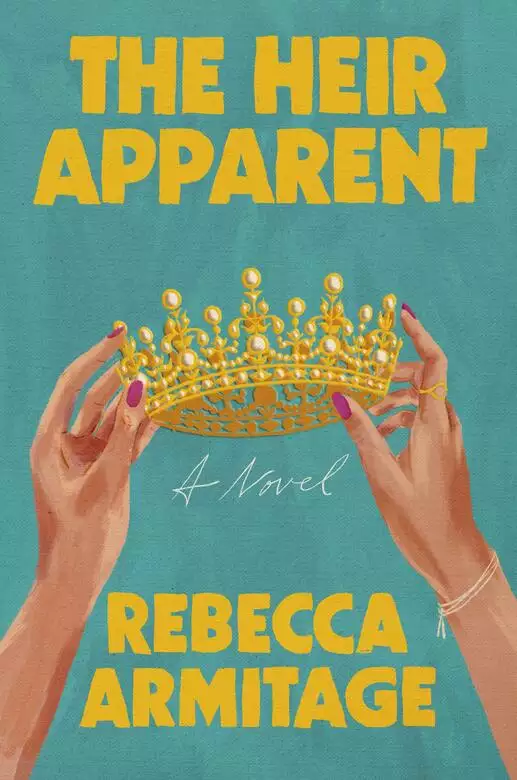
The Heir Apparent
- eBook
- Paperback
- Audiobook
- Hardcover
- Book info
- Sample
- Media
- Author updates
- Lists
Synopsis
An irresistible modern fairy tale about a British princess who must decide between her duty to her family—or to her own heart
It’s New Year’s Day in Tasmania and the life Lexi Villiers has carefully built is working out nicely: she’s in the second year of her medical residency, she lives on a beautiful farm with her two best friends Finn and Jack, and she’s about to finally become more-than-friendly with Jack—when a helicopter abruptly lands. Out steps her grandmother’s right-hand-man, with the tragic news that her father and older brother have been killed in a skiing accident. Lexi’s grandmother happens to be the Queen of England, and in addition to the shock and grief, Lexi must now accept the reality that she is suddenly next in line for the throne—a role she has publicly disavowed.
Returning to London as the heir apparent Princess Alexandrina, Lexi is greeted by a skeptical public not ready to forgive her defection, a grieving sister-in-law harboring an explosive secret, and a scheming uncle determined to claim the throne himself. Her recent life—and Jack—grow ever more distant as she feels the tug of tradition, of love for her grandmother, and of obligation. When her grandmother grants her one year to decide, Lexi must choose her own destiny: will it be determined by an accident of birth, or by love?
Release date: December 2, 2025
Publisher: Grand Central Publishing
Print pages: 336
* BingeBooks earns revenue from qualifying purchases as an Amazon Associate as well as from other retail partners.
Reader buzz
 Please log in to recommend or discuss...
Author updates
The Heir Apparent
Rebecca Armitage
I was about to kiss my best friend when the helicopter came.
It was New Year’s Day, and for the third year in a row, Jack and I woke before the sun. I’d rolled up the rainfly on my tent during the night so I could look at the eruption of stars overhead. Now I saw only the first bloom of dawn. When I crawled outside, Jack’s own tent was already unzipped, and he was sitting by the embers, rumpled and sleepy and smiling at me.
“Coffee?” he whispered.
Finn was still asleep in his dew-beaded tent, so we left him there and walked the sandy path from the campsite. There’s nothing like morning in the Australian bush—it’s magical. Those great beautiful gums were silhouetted against a pale sky. The first birds started their call. Wombats ambled around us, unafraid, as we walked towards the water tank.
This tradition of ours was a bit of an accident. The first time, the three of us had been at a New Year’s Eve party at a bar in Japan when we drunkenly agreed to a snowboard instructor’s invitation for a dawn run down the mountain. The next morning, when the alarm went off in our room at the ryokan, Jack had flinched under his giant doona, and our hangovers walloped us over the back of our skulls.
It would have been so easy for the two of us to roll over and go back to sleep, but Finn was staying at a place down the road with his sisters. He’d be standing at the ski lift waiting for us, looking fresh and miraculously sober, and he’d have been beyond pissed if we didn’t show. So we had silently pushed back our blankets and put on our damp ski gear and trudged out into the inky snowfields to find him. It wasn’t until the three of us reached the summit and the sun burst above the mountains that Jack and I looked at each other and smiled, our hangovers gone, the new day like a fresh sheet of paper. We’d agreed to watch the sun rise together every New Year’s Day for the rest of our lives. Probably a strange vow for two friends, if anyone had bothered to ask. We certainly hadn’t.
Last year I had been on call, and we’d watched the sun ascend over Hobart while we sat together on the roof of the hospital. This time, we were camping, a curious anticipation humming between us.
“We could probably still catch the sunrise if we head down to the beach now,” Jack said.
I left the bottle by the tap and we walked through the long grass in silence. When my boot got caught under a log, I steadied myself on Jack’s down-covered wrist, my hand sliding into his. I left it there. Such a curious feeling, holding your best friend’s hand, like edging your toes over a great precipice, or draining a champagne flute quickly.
Jack and I had been circling each other for weeks. A month earlier, soon after I’d broken up with Ben, he’d tickled me in the kitchen until I was breathless and hysterical and trying to pretend I didn’t enjoy feeling him pressed against me while I grabbed his strong forearms.
So I didn’t object when he squeezed my hand as we stood on the rocks above the beach, the sky blushing pink before us. Sunlight travelled through particles in the air, refracting and scattering in the atmosphere. It was simple science at work, but as the sun torched the sky it was hard not to believe it was just for us.
Now would be the time for Jack to ruin the moment, to say, “Pretty spectacular, ay?” or maybe, “Okay, I need that coffee.” This time he was silent as he wrapped an arm around my waist and pulled me close. He smelled of campfire and down feathers.
I barely heard the distant drone of the chopper as he looked at me. He brushed a leaf from my hair, and I stared at his lovely full lips, his dark eyes. But the droning got louder, and the grass around us began to ripple, then whip against our legs.
We turned towards the roaring helicopter as it descended on a sloping field. I hardly recognised Stewart when he emerged, crouching beneath the blades as if he weren’t five foot five. When I realised it was him, I knew that someone had died. His mouth was set, his shoulders were hunched and his fists were clenched, just as they had been twelve years before when he’d hopped off the Italian coastguard boat and said my mother was still out there somewhere.
This time, they’d sent Stewart all the way to Australia. And not just to Sydney. He’d taken a plane to Hobart and found Jack’s mum, who must have told him we were camping out east on Maria Island. Then he’d chartered a chopper at dawn to track me down.
Stewart had been the last one to give up on me. Even when Louis’s texts dwindled from once a month to once a quarter and then to nothing, Stewart would still dutifully check in on me. His suggestions would arrive by Signal—Unfortunate, this story about you putting a coffee cup in the recycling. It’s best to assume the tabloids are always watching. But I hadn’t heard from him in three years.
Now he was wheezing from the effort of crossing the field, though he remembered his protocol and managed a crisp bow.
“Is it the Queen?” I asked.
He was in a dark suit and tie. They all kept a black outfit for the day it finally happened. I wondered whose idea it had been, this journey to the ends of the Earth to find me. Probably Stewart suggested it and Papa outright rejected it. “She can open up the bloody newspaper like everyone else,” he probably said.
And then Stewart would have tactfully remarked that the newspapers might be most sympathetic to a father who did everything in his power to find his wayward daughter and break this terrible news to her.
But there was a strange look on Stewart’s face as he stood before Jack and me, his breath shaky and deep. I realised, with alarm, that he was scared.
“I’m sorry, Your Royal Highness,” he breathed. “I’m so sorry, no. It’s not the Queen at all.”
It had been at least a decade since I’d flown private.
The family tried to avoid it where possible. At first, it was because seeing us climb the little steps to a private jet reminded our subjects that we were like very expensive house cats: lazy, ungrateful and, perhaps, ultimately useless. Then it was because the younger members of the family kept preaching about climate change before hopping on a rich friend’s Cessna to pump six thousand kilograms of carbon dioxide through the skies on the way to Mustique.
But my father had died in the snow.
My brother Louis was holding on for now, but it didn’t look good.
No one had bothered to tell me what was going on with Kris, our oldest friend in the world, but I heard whispers of “brain death.”
And so the Queen had accepted an offer from a telco billionaire to fly me back to England on his Dassault Falcon. There were six people on the plane I didn’t recognise, but they were all young and dressed in black suits. Junior aides, I assumed, from Papa’s office.
The moment I sat down, an aide slid into the seat beside me and took my hand. I thought perhaps she was trying to console me, but she produced a bottle of acetone and started rubbing off my dark nail polish. Even after all these years, it was still a thrill to pick out a shade with a ridiculous name like Barbaric Burgundy or Poison Ivy at the salon. Even more intoxicating was to watch it chip at the edges and do nothing about it for weeks on end. Now I was watching my month-old Courgette Coquette nails disappear.
“Thank you,” I said.
“Of course, Your Royal Highness,” she whispered. She looked around and then, when she was satisfied no one could hear us, she leaned forward. “I know it’s ridiculous, this rule about dark nail polish. It’s not very modern. If it were up to me, you’d wear what you wanted.”
I had got on the jet in Patagonia fleece and hiking boots, but I knew I’d come down the steps looking like the last eleven years had never happened. I wondered if she’d start sewing in extensions next, to boost my curls to their pre-Australian levels. They couldn’t get me back under fifty kilos in fourteen hours, though, I was pretty sure.
Stewart took the seat in front of me and began texting. It was odd to see him on an iPhone. The last time we were close, I was still trying to convince him to play Snake on his Nokia. He had been Granny’s private secretary for thirty years, but he seemed to have had a hand in all of our lives.
“Is there any more news about Louis?” I asked him.
He looked up from his phone and back down at the screen. “No, ma’am. I’m sorry. They’ll radio up to the pilot if they hear anything.”
We both knew we wouldn’t discuss what had happened back at the house. After the chopper landed in Hobart, Stewart had taken me to the vineyard to pack a bag. I sat under the grape-leaf arbour while he ransacked my room. But then came a strange feeling, one I’d had before, like a black wave cresting and breaking over my head. The edges of my vision began to dissolve and I remembered, in quick succession, the feeling of Mum’s fingers braiding my hair; the time I fell off my horse and Papa ran across the wide, green lawns of the Scottish estate with something like fear in his eyes; and how, if a window fogged up, Louis and I drew a star each with our fingertips, one for him and one for me. Even after we’d stopped speaking, I still found myself smudging two stars on frosted glass on winter nights, wondering, as they clouded over, if he ever thought about me anymore.
By the time Stewart had come out of the cottage to ask where I kept my passport, I was doubled over in my chair. It was like hot claws had taken hold of my lungs, and I flinched when he put a hand on my shoulder.
“Breathe, ma’am,” he murmured. “Just breathe.”
Palace aides are forbidden from touching members of the family. But Stewart had always been around when I was growing up, always giving me sweets and helping me onto my horse, and I adored him. He had constantly implored me to stop hugging him, but we both knew I held all the power and if I wanted to wrap my little arms around his knees and squeeze, I would. It was nice to feel his touch again. It was almost enough to stop the walls of my mind caving in.
“Here, ma’am,” he said, his hand still on my shoulder. “This will calm you.”
I looked up and he was holding the bottle of amber liquid. I hadn’t seen it since the week Mum died, all those photographers in boats bobbing in the waves just beyond the villa’s dock. Back then, Stewart had drawn the blinds as I sat trembling on the edge of the bed, and then he came towards me as he pulled liquid into the dropper. It was meant to taste like blackcurrants, but it had burned my throat, and I wanted to say I didn’t like it. But then the cold rush was back. It was as if the floor opened below me and I was falling, falling through black nothingness.
I took the bottle from Stewart’s hands and tossed it as hard as I could. It landed somewhere among the pinot vines, and I imagined Jack finding it days or weeks later, wondering how a bottle of diazepam elixir had ended up on his property.
“Don’t touch me again, Stewart,” I gasped, my chest heaving.
I was almost myself again by the time the jet took off from Hobart Airport. Stewart put his phone down and settled his elbows on his knees, his trouser legs riding up so I could see his compression socks. He was getting old.
“You should prepare yourself, ma’am. They were under the snow for more than twenty minutes. Prince Louis had a small air pocket, which is how he was able to survive being buried, but it’s not… it was probably not enough,” he said.
We need 3.3 millilitres of oxygen for every 100 grams of brain tissue. I remembered writing that equation down again and again before exam time: 3.3 ml per 100 g. I’d made a rhyme of it: three-point-three per one hundred g, three-point-three per one hundred g. If that number drops, the body redirects blood flow to the brain to try to save it. After five minutes in an oxygen-deprived state, brain cells start to die. That’s when the permanent damage sets in, and it accelerates until the brain just stops.
My brother’s brain.
“He was in extreme cold, though,” I heard myself say. “It happens sometimes—a child falls in an icy lake and the temperature sort of flash-freezes the brain cells, and they come back with all function intact.”
Stewart looked down, and the bespectacled girl with the nail polish remover held my hand tenderly.
“I’ve read about it,” I told them.
“Yes, ma’am,” Stewart said. “We pray for Prince Louis. But I do not want you to get your hopes up.”
An unspoken “this time” hung in the air between us. I felt tears simmer in my eyes. Louis was the only one who’d hugged me after Mum died, even though he was furious with me. I didn’t know then it would be one of the last times a family member took me in their arms and held me.
Unbidden, another memory: The four of us on a ski trip to Courchevel. Louis and I wore matching red jackets. Mum looked resplendent in a white Fendi snowsuit, her chic mirrored goggles hiding her tear-stained eyes. I’d heard our parents arguing again in their suite that morning. The slamming of doors, Mum’s quiet sobs. The photographers were assembled a respectful distance away on a snowbank as she helped us with our poles and jackets. When Papa kneeled in front of me and tightened my already fastened buckles, the whirr of the camera shutters sounded like crickets all around us. He looked up at me and grinned.
“There you are, mignonette,” he said with the stagy brightness of a man who’d been fighting with his wife all morning and was holding it together for both the kids and the world’s press.
The photograph of that moment was often run alongside stories about our deteriorating relationship. That was when things were good, the tabloids claimed. Often they’d include a picture from the day Louis and I were born, Mum looking young and overwhelmed with a baby in each arm, Papa beaming and relieved to be discharged of his duty. The photo from Mum’s funeral was always there too, showing me and Louis, aged seventeen and completely blown apart. I didn’t really remember anything from that day—the picture was the only proof I had that I was even there.
When my nails were clean, I excused myself and walked to the bathroom, where I could check my phone. I’d been clear-headed enough while we packed my suitcase for London to stick the phone in the waistband of my leggings when Stewart wasn’t looking. Fifty-seven text messages had arrived in the space of twenty minutes. Seven missed calls from those old-fashioned enough to try to phone someone who’d just endured a family tragedy that already had its own Wikipedia page. Most were from Uncle James. If I’d picked up, he would have begged me not to get on this plane.
I tapped on the little nesting dolls of news alerts on the screen so I could start from the beginning.
BREAKING: Prince Frederick injured in ski accident in Switzerland, palace says.
BREAKING: Prince Frederick, son Prince Louis and Duchess Amira’s brother Krishiv Shankar injured skiing in Zermatt, Switzerland. Follow our live blog for updates.
BREAKING: Heir to the throne Prince Frederick dead at 63 after avalanche, confirms Queen. Prince Louis in “critical condition.”
BREAKING: Prince Louis reportedly critical and brother-in-law Krishiv Shankar “brain dead” after Prince Frederick’s death in ski accident.
WATCH LIVE NOW: UK PM Jenny Walsh addresses nation after darkest day in British monarchy’s history. Follow our updates.
BREAKING: No sign of Princess Alexandrina after ski tragedy kills her father and leaves brother critical.
I whisked the remaining news alerts away and took a shaky breath. My text messages were all condolences and exclamation points and question marks.
Text me when you land okay? Call if you’re up to it, I don’t care what time it is, Jack had written just before we took off from Hobart.
Stewart hadn’t allowed him or Finn onto the chopper, insisting he only had space for me. As the chopper darted away, I watched the two of them standing there, growing smaller. I suppose they ended the trip then, packing up the tents and taking the ferry home. I imagined them sitting in our cosy living room with the news on the TV—sleeping bags and boots on every surface, where they’d stay for weeks on end without me to insist they be dealt with immediately.
The mess would still be there when I returned, perhaps in a month. Six weeks tops. Finn would smirk and say, “Sorry, dolly,” as I slipped back into my old skin and pretended to worry about the proper care and storage of expensive camping gear. Jack would be leaning against the doorjamb, smiling at me. Papa would still be dead, but Louis would be awake by then, his snap-frozen brain cells thoroughly thawed. The rightful heir spared, his aides would shoo me back to Australia in no time, I was sure of it.
The jet punched through the clouds over the island and into the light above. I looked down the list of missed calls and texts. I spotted a message from Amira, the first she’d sent me in three years.
Lexi, please come home now. I need you.
Louis and I were the first twins born in the line for more than three hundred years.
In 1660, King Charles II fell in love with our ancestor, Barbara Villiers, who was tall and luscious, with a tumble of dark hair and insouciant hips. She was from a noble but impoverished family and already married. So the king made Barbara his royal mistress and instead made a politically advantageous match in Catherine, a Portuguese Infanta who spoke little English and couldn’t seem to bear him a child.
Barbara might have remained a footnote in history, but three years later an outbreak of smallpox tore through Whitehall. First, Barbara’s husband died. Then, Queen Catherine was overcome. The next day, Charles married his mistress, and Barbara was England’s “uncrowned queen” no more. Within months, she was pregnant with twins, and the woman once deemed a royal whore was transformed into a vessel for the heir and spare.
Only one twin survived childbirth. There was something wrong with the girl, who was born very small and grey. Her brother, William, must have been feeding off her strength, because he arrived teeming with health, all dimpled knees and bread dough cheeks.
In delivering a healthy male, Barbara had catapulted herself into that most vaunted of all positions: the mother of a future king. But fate wasn’t done with her yet. A few years later, when smallpox returned to London, Charles succumbed to the disease, making three-year-old William the new king. Barbara, who had spent years consolidating her power in court, became Queen Regent, ruling until her son was old enough to accede the throne.
The England we know was shaped by Barbara’s small, pale hands. A Scottish rebellion against her rule was brutally put down, and she retired the title of Prince of Wales forever, instead making her son, and all future male heirs, the Prince of Scotland. Charles’s House of Stuart never technically ended, but we Villiers crept inside it like ivy, twisting around support beams and window frames until we flourished over the roof. It is her name we keep as our own. And all of it was possible because of her twins—the girl who died, and the boy who didn’t.
Three centuries later, Louis and I were both expected to survive the perils of birth, and we promised to take the monarchy into interesting new territory. The question of which twin would rule had already been settled: the first child delivered was the heir. Unless she was a girl followed by a living boy, in which case she slid down the line of succession at the first sighting of his tiny regal penis.
The TV anchors of 1993 breakfast television giddily speculated about the constitutional implications of my mother’s pregnancy. What if Princess Isla required a caesarean, and an obstetrician found two boys in her belly? He alone held the fate of the British monarchy in his hands. From the gaping wound that contained two babies curled together like fish, he would reach inside and pluck out a future king. There were also those who argued that the last twin out was the first implanted, and therefore the kingdom’s rightful monarch.
The palace sensed a looming constitutional crisis. And so, when my mother’s labour entered its twentieth hour and the doctor said it was time to consider a caesarean, the Queen was consulted over the phone. She made her ruling. Isla would have to work these babies out of herself naturally. Intervention would only take place if our lives were under threat. The life of Isla, then twenty years old and one of the most famous women in the world, was never discussed.
At the time, she was still desperate to do everything perfectly, and thirty-seven minutes after her mother-in-law refused to end her misery, Isla gave birth to a healthy baby boy. I followed two minutes later—pallid, silent and female.
As Papa clutched his heir, I was whisked to another room where I was surrounded by a dozen doctors and nurses wielding nasal cannulas and nitric oxide. My mother moaned in pain and fear until finally, either an eternity or sixty seconds later, I unleashed an almighty wail. She had done it. She had birthed an heir and a spare in one afternoon. I imagine every royal woman experiences that moment of deliverance the same way, whether it is 1664 or 1993. That intake of breath as the doctor or the midwife peers over the child. Will the baby thrive? Is it a boy? Am I finally, finally safe?
By the nineties, princesses had earned a certain cultural cachet. The tabloids wanted designer gowns, shiny hair and bad boyfriends. Then they wanted an Abbey wedding to a nice man who was the harbinger of ruddy-faced babies and postpartum weight-loss stories.
Louis was the future of the family; I was a decorative accent.
Six hours after she delivered us, Mum was helped out of bed, her black curls brushed until they shone. A blousy seafoam maternity dress was pulled over her head—this was years before she started to rebel with the men’s blazers, Calvin Klein minimalism and oversized sweatshirts that haunt trend cycles to this day. She’s the reason every woman in the world wears sneakers with dresses. Sometimes I’ll be walking through town and a girl will pass me in old Levi’s, a man’s shirt and a baseball cap pulled over her hair. The post-divorce Isla aesthetic, they called it.
But on this day in 1993, she stood on the steps of the hospital in what was effectively a big green tent, the fabric so thin and pale she must have been terrified that one sneeze would destroy this antiseptic vision of postpartum perfection. Papa was beside her in his ubiquitous Savile Row, thirty-three years old, but looking far more nervous than his young wife.
The palace aides had choreographed the photo op perfectly. Isla would emerge with both of us in her arms, the teen bride transformed into a regal mother. After a moment, Papa would take the boy from her, and they would pose with one baby each. But in the glare of the camera flashes, he forgot his cue and did nothing but stand there. Mum, wobbly and in pain, gritted her teeth and held on to five kilos of sleeping babies while the world watched. Eventually, an aide opened the door to the hospital and ushered them back inside, taking the babies from her pale, spindly arms before she sank back into the wheelchair awaiting her.
They say four thousand people flocked to the palace to wait for the announcement of our names. An easel was placed at the gates:
Prince Louis Arthur Albert Lawrence, born 28 December 1993 at 2:02 p.m.
Princess Alexandrina Anne Barbara Mary born 28 December 1993 at 2:04 p.m.
Twenty-nine years later, another easel was placed outside the gates:
Prince Louis died peacefully at Visp Medical Centre this afternoon. His wife, Amira, Duchess of Somerset, was by his side. She will return to London tonight, where she will stay with the Queen. Princess Alexandrina is expected to arrive in London tomorrow.
Amira, after receiving permission from Granny, had agreed to turn off Louis’s life support while I was somewhere over the Timor Sea. She had done the same for her brother, Kris, ten minutes earlier.
Later, the Daily Post reported that a Swiss doctor had phoned me on the plane to run through their clinical evaluation of Louis’s chances of recovery. We’d conversed in French, apparently, and I’d tearfully agreed that it was time to remove life support. It was my idea that his organs should be harvested first. I couldn’t work out who had leaked this falsehood to the Post—probably Granny’s people, to cast her in a warmer light. Or perhaps it was Stewart, trying to help me save face.
Because in reality, they didn’t radio the pilot as they’d promised, but waited to tell me when we landed for a fuel stop in Singapore.
“Oh,” I said to Stewart when he broke the news. I was so unsteady that the young female aide who’d cleaned my nails was now gripping my arm for fear I might collapse onto the tarmac. “Can I speak to Louis now?”
Stewart and the girl exchanged a look.
“No, ma’am,” Stewart said slowly. “As I just told you, Prince Louis died two hours ago.”
I shook my head. When we were babies, Louis and I could only sleep if we were swaddled together in the same cot. As toddlers, we chattered in the secret language we’d invented. He brought me a glow-worm in a jar; he gave me a piggyback when I cut my foot on an oyster shell. Louis and I were two little stars drawn on the glass, and I couldn’t believe he was disappearing into the fog without me.
“No,” I said again. “I’m sure there’s been a mistake. If you could just let me talk to him—”
Suddenly my knees buckled, and the girl holding me up almost toppled over as she tried to catch me. Orphaned and alone, there was nothing to do but allow Stewart to help me back onto the plane that would return me to my family. But even as I flew closer to London, advancing further up the line of succession, I was still a pariah in the House of Villiers.
Granny was a 23-year-old newlywed on her first international tour when she became queen. At some point, while she was dancing with dignitaries at an embassy party in Barbados, her father died in his sleep and the crown slipped invisibly to her head. The following day, she landed at RAF Northolt and her ladies-in-waiting realised they hadn’t packed mourning attire. The new queen sat on the plane for forty-five minutes while a black dress was procured from Watford Castle. It’s one of the most famous photos of her: Eleanor’s bow-shaped mouth set in a grimace, her delicate hand holding the railing as she descended the steps towards the neat row of men who would schedule every minute of the rest of her life.
Five decades later, Stewart was determined not to make the same mistake. The girl who did my nails flicked through a rack of black clothing, pulling out Erdem dresses and Reiss blazers, glancing at me appraisingly and popping them back.
“She can’t look too styled,” she whispered to Stewart as I stared out the window, lush green farmland giving way to sprawling suburbs. “It needs to look like it came from her own closet. But also… you know.”
My wardrobe no longer included British designers, A-line hems or headbands. The only thing I’d really kept from my old life was Mum’s waxed Barbour jacket. I rarely wore it, fearing I would disturb her last remaining essence still lurking in the fabric. When I did wear it, the Daily Post would inevitably run a photo of me alongside an old picture of Mum from the eighties, looking gorgeous and windswept on the moors.
“Just keep it simple and appropriate,” Stewart whispered. “And nothing too flashy.”
We landed hard on the empty runway and I gripped my seat. It was the first time I’d been in England in three years. That last disastrous trip, I’d left two days early, booking a flight back to Australia on the train to Heathrow. It took me twenty-eight hours, including a nine-hour layover in Seoul, to get home. I wore sunglasses and a hoodie and dozed on airport carpets and no one gave me a second look.
Out the window, I saw the row of men in suits walking across the tarmac to meet the plane. It took a moment to realise one of the men was, in fact, a woman, dressed in a black pantsuit.
Stewart cleared his throat. “Ma’am, just to reiterate the plan: there are no photographers and we’ve strung tarps against the fence to safeguard your privacy. Once you’re in the car, we’ll take you to the palace so you can be with the Queen.”
In the end, they dressed me in an Alexander McQueen skirt suit.
“Black looks good on you. You’re a true winter,” the young female aide said as she rolled up the blazer’s sleeves.
She had the mousy look of most female palace aides. They were all white; they were all rich. With her featureless blonde face, she could have been pure aristocracy. Her family must have been somewhere further down the food chain, but high enough that a £21,000 palace salary covered her tab at the Twenty Two hotel while she lived off a generous trust.
“Thank you,” I responded uneasily. “What’s your name again?”
She might have told me already, or I might have waited sixteen hours to ask—I couldn’t recall.
“Mary,” she said with a flush. “Mary Williams.”
“Right, yes, sorry. That’s my middle name.”
“Yes, ma’am,” she said warmly. Again, she glanced around us. “I’m a big admirer of yours.”
I looked at her, confused. No one ever said that. I was the one who had walked away. But before I had a cha
We hope you are enjoying the book so far. To continue reading...
