The sea doesn't forget. It knows all of this has happened before. And will happen again...
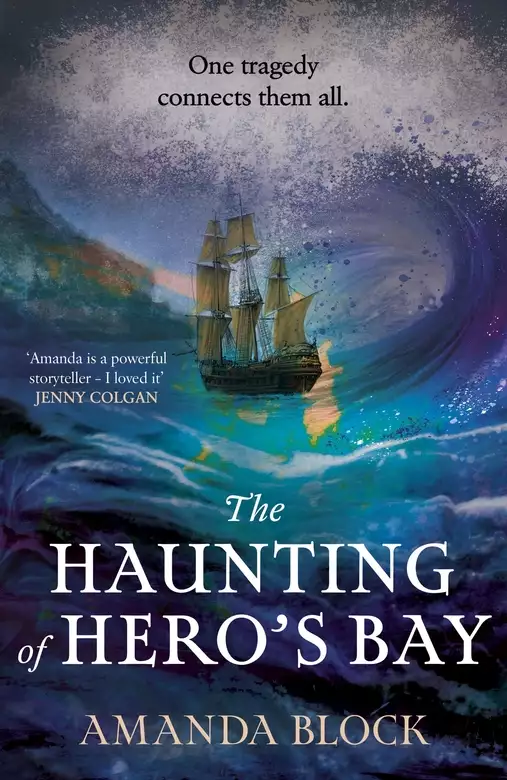
1840 As a vast ship loses its way in the night-time mist, shattering against the cliffs of Crescombe, North Devon, a daring young artist dives into the murky sea. But it's not for heroism he is risking all: something - or someone - is drawing him into those dark, perilous waters . . .
By dawn, only his legacy will survive.
Now When Finley arrives in Crescombe for the summer, he suspects he's not alone in his attic bedroom. Before long, he is uncovering secrets the remote seaside town has kept for almost two centuries: about ghosts and curses, about a ruthless old smuggling family, and about the young women whose bodies have washed up along the town's rocky shoreline, just below his porthole window.
Yet the more Finley learns, the further he's bonded to those who have gone before him - and the closer he comes to meeting the same watery end . . .
But this is not just a story about death. It's about love. It's about fate. And how, ultimately, the past can pull you under . . .
Praise for The Lost Storyteller 'A powerful novel about . . . how stories connect us all' Jenny Colgan 'A warm, immersive read that weaves folklore through a story of self-discovery' Kate Sawyer 'A moving story and vivid characters. But it also has that special indefinable something. One of my books of the year' Tracy Rees
Release date:
October 9, 2025
Publisher:
Hodder & Stoughton
Print pages:
400
* BingeBooks earns revenue from qualifying purchases as an Amazon Associate as well as from other retail partners.
It’s just before dawn, and a photographer has puffed his way up the cliff path, hoping to capture the first glimpse of sunlight as it bleeds into the bay. He sets up his tripod in the dewy grass a few feet from the precipice, then can’t resist shuffling past it to peer over the edge.
At first, in the grey-blue gloom, his mind still woolly from sleep, he can’t work out what he’s seeing. Something is snagged on the rocks below; a knot of driftwood, perhaps, or a clump of flotsam. Even as the photographer’s eyes adjust, and understanding begins to writhe in his empty stomach, for a few more seconds he tries to convince himself it’s something else down there: a seal; a mannequin; a mermaid.
Later, after two local constables have arrived, secretly thrilled by their unexpected summons, there is some debate over how to get to her. She is caught at the most easterly point of the bay, wedged between the rocks, though the hem of her nightdress is fluttering in the water, giving the impression she’s still breathing. By both land and sea, the route to her is treacherous. But they don’t deliberate for too long – they can’t risk her being carried out into open water or, worse, any tourists stumbling across this scene – and, in the end, a pair of grizzled fishermen manage to navigate the rocky shoreline and drag her into their boat like a prize catch.
Later still, the constables are replaced by their superiors, who try to piece together what has happened. She was staying at the nearby hotel, they discover, where no one seems to remember her in any detail; why she was there, or when she was last seen, or even much about what she looked like. If it weren’t for her name and address in the hotel register, her order for the breakfast she never ate tacked to the board behind the desk, she might not have been there at all. The only part of her that seems to have stuck in people’s minds are her glasses. Lenses like jam jars, explains the receptionist, cupping her hands to demonstrate.
They don’t find the glasses. It’s one of a few inconvenient loose threads, though the police forge ahead with their enquiries. Foul play is ruled out – she doesn’t seem to have made enough of an impression on anyone for that – and if she slipped from the cliff path by accident, why was she out there after dark, and in only a flimsy nightdress? No, suicide seems most likely, especially when the family in the room below report that they heard strange noises: scratching, banging, crying. The whys and wherefores seem to matter a little less after that; she obviously wasn’t quite right in the head.
The hotel’s manager, an agitated man at the best of times, frets it will be bad for business, a guest dying like that. But it’s almost the end of summer. The other guests quickly disperse and, soon enough, most of the staff too – back to college, or university, or other brighter opportunities in bigger towns. The story goes with them, of course, but fades and shrinks as it travels, until it’s just a half-remembered anecdote the manager needn’t worry about. Not yet, anyway.
She lingers in the locals’ memories a little longer. Her death might be a tragedy, a further blight on an already stormy and disappointing sort of summer, but, for some, it is not a shock. For there are those who have always distrusted that stretch of coast, that side of town. They know the tales about that place – most of them, at least – because they were told them by their grannies, who were told them by their own grannies before that.
Ultimately, though, it’s the sea that remembers her the longest. It takes its time to wash her away; untangle the strands of her hair caught in seaweed, scrub the spots of her blood from the rocks. It holds on to her glasses, which sank to the depths when she fell, bumping them around the seabed until they are cracked and cloudy. There is no hurry to erase her – no point, even. The sea doesn’t forget. Ever-present, it knows all of this has happened before.
And will happen again.
1
Crescombe
‘You’ll know all about that painting, then.’
Finley barely heard the taxi driver’s pronouncement, because he was fairly sure he was about to die. Since the station, they’d barrelled down country lanes, narrowly avoiding collisions with other vehicles, alarmed-looking ramblers and, at one point, several sheep. As he gripped the rucksack on his lap, Finley pictured the taxi overturning in a ditch or perhaps simply plunging into the sea – though the thought of Mollie weeping regretfully over his picture on the news was not wholly unwelcome.
‘Hero’s Bay,’ continued the driver, undeterred by Finley’s silence. ‘By that artist who drowned: George, Lord Delmore.’ He attempted an affected tone, but in his broad West Country accent the name was mostly Rs. ‘You’ll know about him and all.’
‘Erm, yeah,’ Finley said, because it seemed to be more of a statement than a question. Besides, what else was there to know, beyond the drowning? Like Van Gogh’s ear, Delmore’s death was as famous as his paintings.
A pineapple-shaped air freshener was dangling from the rear-view mirror and watching it judder was almost as nauseating as its tropical stench. As the car lurched around a hairpin bend, Finley longed for a proper view of the sea. He kept catching sight of it between the trees, glinting in the early-evening light. If it would only stay put at the horizon, perhaps staring at it would curb some of his queasiness (or did that only work at sea?).
‘Don’t rate the painting myself,’ the driver said a few minutes later, hurtling past a stop sign. ‘It’s a bit dark, a bit blotchy. Can’t even tell it’s Crescombe.’
‘No,’ agreed Finley, who wouldn’t have been able to identify any image of Crescombe.
The sea glimmered again. It was toying with him, peekaboo-ing between branches. Ordinarily, Finley thought the sea too vast, too dangerous, but today – presumably because he was hot, and the water so close – its pull was undeniable. He imagined lying at the shoreline, sand shifting beneath his back as he was gently rocked by a cooling tide . . .
The taxi vaulted over a hidden dip. As Finley bounced in his seat, half the contents of his open rucksack – which he’d been hugging to himself like a lifebuoy – went tumbling to the floor, including several books and his just-in-case juice. Leaning down to collect them, a clump of dark hair fell into his eyes and his stomach gave a dangerous tremor.
‘Here we are.’ The driver took both hands off the steering wheel to gesture ahead.
Re-emerging from his knees, Finley found they were zooming towards a group of hikers gathered at the side of the road and, in their midst, a white sign that read:
Crescombe
(‘Hero’s Bay’)
The hikers, who were all women, were clutching at the sign like it was a friend – while their real friend was wobbling on the rungs of a nearby gate, her phone aloft, trying to fit everyone into a photo. In spite of their walking clothes and rucksacks, something about this group put Finley in mind of bridesmaids posing around their bride. Or maybe he just had weddings on the brain.
‘Popular spot for photos, that,’ remarked the taxi driver. ‘They’d be better off taking it up at Westcliff, though, where he painted it. S’pose they’ll go there later. S’pose you will too.’
Finley once again noted the statement, the certainty.
‘You weren’t wanting a picture yourself?’ the driver continued.
‘Oh – no, thanks,’ said Finley, assuming this to be an empty offer, considering the sign and its bridal party were now specks beyond the rear windscreen.
Even so, he winced to imagine that photo; how clammy and awkward he’d look – and how overdressed, because it had been far chillier in Edinburgh that morning, and now he was too worried he’d sweated through his T-shirt to remove his jumper.
What would be the point of a picture, anyway? He never posted on social media, and it wasn’t as though he had anyone to send it to, aside from his mum. Most of his closest friends – the ones from university – had now drifted exclusively into Mollie’s orbit. In any case, the whole point of coming to Crescombe was to keep a low profile, so it seemed counterproductive to advertise his presence when, by and large, he just wanted people to forget about him. Assuming they hadn’t already.
‘It doesn’t get the same attention as places like Woolacombe or Clovelly,’ mused the taxi driver. ‘If it wasn’t for the painting, nobody would come here. But there’s something about Crescombe, you’ll see.’
This comment, which sounded slightly muffled due to the popping in Finley’s ears, was intriguing enough to rouse him from self-pity. They had begun a sharp descent and, having emerged from their wooded surroundings, he now had a clear view of the bay below, where little houses and boats fringed an arc of yellow beach. At either end, the coastline curved, so its eastern and western points curled back towards its body, like the claws of a crab.
Beyond was all sea. It leaked between Crescombe’s pincers, spilling out towards the sky. Perhaps it had been that talk of Delmore, and drowning, but it all looked far less welcoming than in Finley’s imaginings of this moment: the water was greyer, rougher; even at this distance he could see it frothing against the shore.
He had been right before: the sea was too vast, too dangerous. But there was no turning back now. He was expected, and he’d come a long way to be here – or rather, to be anywhere but there. Better, then, to submerge himself in it all – the unfamiliar surroundings, the solitude, even this terrible taxi ride – and let the next month wash over him until he was ready to resurface.
Upon seeing Crockers Nest, Finley’s first thought was that it looked lonely. Jutting from the end of a natural ledge that snaked around the middle of the cliff, the guesthouse felt far removed from the vibrant seafront that had just flashed by. Undoubtedly, it was the last building in Crescombe – though in the evening gloom, the tall stone structure hardly seemed like a building at all, more an extension of the jagged cliff face at its back.
Still, anything felt more inviting than getting back in that taxi, so Finley shouldered his rucksack and began to drag his suitcase along a precipitous driveway. Tucked into the guesthouse’s weathered stonework, he found a teal front door that smelled freshly painted, and was just reaching for its whale-tail knocker when a family of four emerged from the other side. Eagerly, they eyed his taxi, but before Finley could warn them about the driver, another figure wafted over the threshold, her floaty multicoloured dress and stream of chatter putting him in mind of a talkative tropical fish.
‘ . . . Oh look, there’s a taxi here already, that’s a bit of luck! You take this one, then, my loves, and I’ll cancel the—’ She broke off as she spotted Finley. ‘Oh, here he is!’
‘Hi, Lorraine.’
He hadn’t seen her for years, but she looked much the same as she did in the framed photograph at his parents’ house, where she and his mum were perched on a pub wall with pints: her shoulder-length hair was still fluffy and blonde, her make-up still a little overdone, and she had retained that twinkle in her smiling eyes.
Waggling an admonishing finger at him, she announced, ‘The last time I saw you, young man, you were piddling in a paddling pool!’
‘So, quite a long time ago!’ Finley spluttered, lest the assembled onlookers – who now included the taxi driver – thought him some twenty-eight-year-old pervert who lurked around kids’ gardens.
Lorraine merely laughed. ‘Come here – give your godmother a squeeze . . .’
She opened her arms so wide she might’ve meant to squeeze the whole driveway. Reluctantly, Finley allowed himself to be scooped into a tight embrace, acutely aware of how sweaty he was in his jumper, and that people were watching, and that he hardly even knew this woman . . .
Eventually, she released him, waved off her other guests, then took his arm and led him into Crockers Nest, breathlessly enquiring about everything from his journey to his family, before informing him that his accent was ever so nice – an impressive observation, Finley felt, considering he’d hardly said anything at all.
The guesthouse’s entrance hall was brighter and more modern than he had anticipated, largely due to a new-looking skylight that illuminated its whitewashed walls and a mint-coloured carpet still as fuzzy as a show home’s. Still, it contained nods to the building’s history and proximity to the sea, such as the artful arrangements of shells and pebbles on the mantlepieces, and the reception desk whose top seemed to be propped up by three old and slightly pungent barrels.
‘Now, your room’s right at the top . . .’
At this, Finley expected them to head up the main staircase, but instead Lorraine beckoned him through a side door, where they emerged at the foot of a much narrower, spiralling set of steps. Clearly, this was part of the original building, and Finley experienced a little thrill as they began to ascend: it felt like they were exploring an old lighthouse.
‘I was sorry to hear about your bookshop closing, love,’ Lorraine called over her shoulder.
‘Oh,’ said Finley, immediately downcast again, ‘thanks. Though it wasn’t really my—’
‘And about . . . Mollie, was it?’ Lorraine looked around, forcing them both to stop. ‘Your mum told me that and all. What a little cow.’
Finley presumed this last remark referred to Mollie, rather than his mum, and felt a deeply ingrained need to defend her: ‘She’s fine – it’s all fine.’ Though as he stared down at the handle of his suitcase, his despondency deepened. ‘It was ages ago now . . .’
‘Doesn’t matter,’ said Lorraine firmly. ‘Doesn’t mean it won’t still hurt. Took me years to get over The Dickhead. Years.’
The Dickhead, Finley assumed, was Lorraine’s ex-husband, an accountant who’d had an affair with his secretary – which suggested to Finley a lack of originality as well as moral fibre. In response to this infidelity, Lorraine had extracted vast sums from him in the divorce (‘Not so good with money now, is he?’ Finley’s dad had chuckled) with which, just under a year ago, she’d moved to North Devon and bought the then dilapidated Crockers Nest.
‘I understand, is what I’m saying,’ she went on. ‘And if you ever need to talk, I’m right here.’ She jabbed a pink fingernail towards the step on which she’d stopped.
‘Thanks,’ muttered Finley, both embarrassed and a little clearer as to why she’d agreed to have him to stay for the summer. ‘And thanks for all of this, for putting me up . . .’
Lorraine smiled and, to his relief, continued to climb the stairs, her brightly coloured dress rippling around her ankles. ‘I’ll be expecting you to pull your weight!’ she trilled. ‘I’ve plenty of jobs for you!’
‘Of course,’ said Finley, who had hoped for this: he wanted all the distractions this place had to offer.
‘It’s only admin, really,’ admitted Lorraine. ‘Although—’ She stopped and spun around again. ‘You’re a historian, aren’t you, Finley?’
‘A classicist,’ he said, before clarifying, ‘I mean, I studied Classics at uni.’
‘History, Classics . . .’ Lorraine gave a sweep of her hand to denote same thing. ‘Because I’ve been thinking, I could maybe use you for my little research project. I’ve been looking into the history of this place, you see, and especially into the Crockers themselves. They were smugglers, you know.’
‘Really?’ said Finley, recalling those barrels at reception, his interest piqued once more.
A few moments later, both a little out of breath, they reached the top of the spiralling stairs, where there was a lone arched door that wouldn’t have looked out of place in a chapel. Producing a key dangling from a crocheted seagull, Lorraine explained, ‘Now, the handle gets a bit sticky sometimes, so you might need to give it a rattle.’ She duly demonstrated, then nudged open the door, saying, ‘Here we are: home sweet—Oh, for God’s sake!’
A cold blast rushed over the threshold. It ruffled Finley’s hair and snuck beneath his jumper, irresistibly reminding him of books he had read about the discovery of ancient tombs, and the hiss of stale, trapped air escaping for the first time in centuries.
Lorraine, meanwhile, had dived into the room and thrown her weight against the round window on the far wall, which had blown open. ‘Bloody thing,’ she panted, pushing against the wind, ‘always coming loose . . .’
While she resecured the latch, Finley stooped to pick up the local leaflets that the breeze had scattered across the floor and took in his new surroundings. It was a small, square room, its walls comprising either wooden panels or wooden cupboards. In addition to the window – which he now saw was fashioned like a large porthole – this gave the impression he had just walked into a ship’s cabin.
‘Here, come and look at the view,’ said Lorraine. ‘It’s the best in the house – the best in Crescombe.’
Unlike the local taxi driver, who had barely bothered with the town’s second syllable, Lorraine drew it out until it rhymed with tomb. Obediently, Finley joined her at the window, and suddenly the floor felt unsteady, as though he really were on a ship. After all those stairs, he had guessed they were high up – and he had already seen how precariously Crockers Nest was perched on the cliff ledge. Nevertheless, it was still a shock to peer beyond the round window’s flimsy-looking safety bars; to see that there was very little between himself and the water.
‘We’re right at the eastern tip of the bay here,’ explained Lorraine, oblivious to his discomfort. ‘That’s the beach, of course’ – she tapped at the glass – ‘and the main bit of town behind it. And up there, that’s Westcliff, where Delmore painted Hero’s Bay.’
Still feeling apathetic towards Crescombe’s most famous export, Finley forced his gaze towards the long stretch of sand to his left, then up towards the darkening mass of land on the other side of the water.
‘It’s all a crescent, see?’ continued Lorraine, tracing the shape on the window. ‘They think that’s why it’s called Crescombe.’
Finley tried to make an interested noise, but had returned to staring at the encroaching sea below, mesmerised by the way its foam marbled after it had lashed against the rocks.
Lorraine, perhaps sensing his attention was elsewhere, asked, ‘Are you hungry, love? I could heat you up some spag bol or something?’
‘Oh, I’m okay, thanks,’ said Finley, taking a step back from the window and almost tripping over his suitcase. ‘I ate before, at the station,’ he added, untruthfully.
‘You sure?’
Lorraine looked surprised, even disappointed. There was a small pause, which was probably only noticeable because she was so talkative, but made Finley wonder whether she, like he, was weighing up what they were to one another. Now, was he principally her godson, guest or employee?
‘Well, all the info you’ll need about Crockers Nest and the town and whatnot is in the folder,’ she continued, a touch more business-like than before. ‘And let me know if you have any issues. We’ve just had this room done up and you’re the first to stay here – my guinea pig, if you like.’
Finley, who hadn’t known this, wondered what – if any – issues she was anticipating. Before he could ask, however, Lorraine had returned to the door, where she knocked at the neighbouring wooden panel saying, ‘It’s like a cave under here, the walls are that much of a mess. Must’ve been where the servants lived or something. I guess we’ll find out, won’t we?’
‘Sorry?’
The twinkle returned to her eyes as she ducked out of the door. ‘In our research . . .’
Finley waited until her footsteps on the stairs had faded, then tapped his phone to the sensor on his arm. He’d done a lot of snacking on the train, so was surprised to find his blood sugar wasn’t too bad. After a brief search, he located a kitchenette inside what was essentially another cupboard, and with a heavy feeling he couldn’t entirely attribute to tiredness or even heartache, he unloaded his insulin into the fridge. Between a pint of milk and what looked like a local ale, he then slotted his just-in-case juice; he would need more supplies tomorrow.
On closing the fridge door, Finley became aware of a faint floral smell, as if Lorraine had spritzed around some room fragrance before his arrival. Still, this was all a vast improvement on the last place he’d lived – a dingy flat off Leith Walk that had smelled of damp and his housemate’s weed – so Finley strove to ignore the niggling feeling that coming here hadn’t been his most rational decision, and began to unpack.
He got as far as laying out all the books he had brought – most of them vestiges of The Book Bothy’s closing-down sale – before flopping back onto the striped covers of the single bed and reaching for his phone. More out of habit than any genuine interest, Finley began to scroll through various updates from people he wouldn’t exactly call friends, until – with a jolt that rivalled what he’d felt on seeing that vertiginous view – he spotted a familiar profile and the words HEN DO!!!
Don’t, Finley thought, even as he tapped on the first picture. Don’t do it to yourself.
The party must have been organised by Mollie’s screechy schoolfriends, because everyone was decked out in matching pink sashes and those stupid bobbing headbands. Still, Mollie looked happy enough – more than happy, Finley realised, an invisible weight pressing at his chest, emptying his lungs, as he drank in the sight of her freckles, her dimples, her shiny red hair . . .
In one picture, he spotted Fiona, which was another unpleasant surprise. His sister might have known Mollie just as long as he had, but her presence there felt highly disloyal. Still, Finley gleaned some satisfaction from the tight-lipped expression on Fiona’s bony face – almost certainly a reaction to the penis-shaped straw poking out of her drink.
Eventually, Finley dropped the phone onto the bedcovers and stared up at the low wood-panelled ceiling (really, this room was almost reminiscent of a sauna), trying to distract himself from the images of Mollie and her friends still imprinted on his vision. He considered sneaking out to find some chips – maybe eating them on the beach, where he could make a start on one of his books. After all, coming to Crescombe was his chance to get back to things like reading; to get back to himself.
He must have fallen asleep, though, because the next thing he knew it was dark, and he was cold. Groggily, he pushed himself up, and it took him a moment to remember where he was. The porthole window had blown open again. He groped for the switch on the bedside lamp – it was darker here than it would be in Edinburgh right now – and then stumbled across the room, the cold air stinging his bleary eyes.
This time, he braced himself for the view when he peered beyond the spindly safety bars, and whereas before the sea had been advancing upon the cliff shelf, now the invasion seemed complete. Logically, Finley knew that there must still be something of the ledge left beyond the footprint of the guesthouse, yet at this hour – and with the tide as high as it was – Crockers Nest appeared entirely surrounded by dense, dark water.
Hastily, Finley pushed the window shut with a clunk, then examined the stiff latch for a moment, marvelling at how strong the wind must have been to dislodge it. But when he looked back at the window, his heart lurched: on the other side of the glass, a pale face was looming out of the night, staring straight at him.
With a grunt of shock, Finley staggered backwards, before his sleep-addled mind made sense of what he was really seeing: his own reflection, peering back at him from the dark glass.
Heart hammering, he forced his focus beyond his anxious face, towards the distant lights of Crescombe, but continued to feel strange: clammy, and a little lightheaded, as if he’d been climbing a misty mountainside. Presumably it was only tiredness or his blood sugar, because in reality he had never felt closer to sea level; he could still hear the water’s endless churning. The sound followed him back to bed, where he lay awake for a long time, listening to the sea’s deep, rhythmic breaths until, eventually, they merged with his own.
2
The Drowned Painter
Finley awoke early, roused by the keening of seagulls and that steady pulse of the sea, which was quieter now, as though the beast that had spent the night thrashing against the rocks was now at slumber. The view from his room was also less unsettling this morning; the low sun was beaming straight into the bay, and Crescombe Beach was glittering at the collar of the land like a gold necklace. Experimentally, Finley prodded at the weighty latch of the large porthole window and, when it didn’t budge, wondered whether he might have dreamed it blowing open.
Regardless, he felt brighter by the time he emerged through the teal front door of Crockers Nest, especially after pausing to glance back at the guesthouse. He identified his room, far above, by its round window – and the fact that it protruded from the top of the building like a princess’s turret. It was, as he had suspected, the highest point of Crockers Nest, though it didn’t look quite as perilous as it had felt last night, and he was reassured that it seemed firmly embedded in the cliff face behind.
He turned to stare out at the open expanse of the Bristol Channel, breathing in the fresh, briny air, and was just pondering where he might find breakfast this early when something caught his eye: carved into the rock beyond his feet were lumpy steps, zig-zagging right down to the water. The sea was a sculptor, Finley knew, but they looked too deliberate to be natural, and he wondered whether he was looking down on a fisherman’s shortcut – or perhaps, he thought, recalling Lorraine’s words about the Crocker family, this route had once been used by smugglers.
It was this intriguing idea that drew Finley down the uneven footholds, his fingertips digging into the rough stone at his side, for there was nothing in the way of a handrail. At one point, the rest of the rocky slope even seemed to fall away, and Finley was suddenly left sidling next to a sheer drop into the water. Gasping, he managed to scramble onwards, though only because, twenty metres or so below, the milky green water looked still and calm, almost inviting . . .
At the base of the steps, Finley discovered a small beach. Judging by its wet sand, it had been entirely underwater only hours ago, which made it feel secret, almost enchanted – as did the fact that perched between the humps of a rock just off its shore was a mermaid.
But no, of course she wasn’t; she was just a girl – a woman – sitting there in a black swimming costume. She had her back to him, and was gathering up her long, tangled hair, which must have been dark blonde when dry, but now, dripping in the low sunlight, had an almost greenish hue. As she began scrunching it into a heap on the top of her head, Finley backed away – he didn’t want her to think he was spying – but the crunch of tiny shells beneath his trainers made her pause, her hands still in her hair.
‘There’s no need to leave because of me.’
Unlike her words, her tone was not encouraging. So much so that Finley wondered whether he’d stumbled across a private beach – though if it was private, surely it belonged to Crockers Nest?
‘Sorry,’ he said, to be on the safe side. ‘I didn’t realise—I’m staying at the guesthouse.’
As she twisted to look at him, her hair fell back over her shoulders in soggy tendrils, like frayed rope. She was pale and lean, with a narrow face and wide-set eyes, which did not entirely dispel Finley’s suspicion that he had disturbed some mythical water spirit – an encounter, he knew, that was unlikely to end well for him.
After a few moments passed in which she simply stared at him, he felt obliged to fill the silence: ‘I only just arrived last night.’
‘Yes,’ she said, her gaze drifting down towards his trainers, which were already sandy and sodden.
In turn, he looked at her, suddenly noting she had nothing with her; no bag, no dry clothes, not even a pair of flip-flops.
‘Did you swim here?’ he asked.
‘Yes.’
‘From where?’
She gestured vaguely over the water, which could have meant the small harbour opposite, or the western tip of Crescombe, or perhaps the middle of the Atlantic. The sea rippled gently beneath her arm, like a silken sleeve, but Finley could still picture how it had seethed in the dark the previous night.
‘Is it safe?’ he asked doubtfully.
Her brow furrowed. ‘It’s the sea.’
‘Right, yeah,’ he said, feeling foolish. ‘I just meant— I heard the weather’s really changeable here.’
She neither confirmed nor denied this, instead asking, ‘Are you going to be here a lot?’ She glanced at the cliff behind him. ‘No one ever comes down those steps.’
Finley wasn’t sure how to respond: did she or didn’t she mind him being here? Given her gene
We hope you are enjoying the book so far. To continue reading...

 Please log in to recommend or discuss...
