
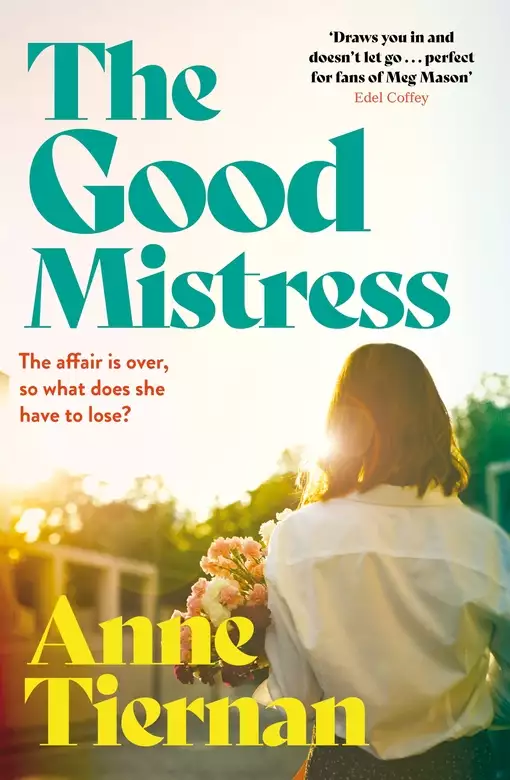
The Good Mistress
- eBook
- Paperback
- Audiobook
- Book info
- Sample
- Media
- Author updates
- Lists
Synopsis
The new novel from international bestseller Anne Tiernan, with her trademark wit, sharp observation, charming warmth and devastating honesty when it comes to mid-life.
Juliet never planned to be the other woman, but Rory was the only man she'd ever loved. She was sure he'd leave his frustratingly perfect wife - until he went and ghosted her, literally.
Maeve is a bestselling novelist, and yet between her exasperating husband, teenage sons and ailing mother, success feels hollow. When she dallies in a surprising infidelity of her own, her carefully constructed life begins to unravel.
Erica was the perfect wife, but Rory knew things about her that no-one else can ever know. And now she's left with a question she doesn't want the answer to: had she lost Rory long before he died?
As three women's lives collide, they must reconcile the realities of love, betrayal and the limits of forgiveness - because what does it truly mean to be 'good', anyway?
'Tender, raw and moving . . . I was drawn in from the first page' Sinéad Moriarty
'Draws you in and doesn't let go . . . perfect for fans of Meg Mason' Edel Coffey
Release date: April 29, 2025
Publisher: Hachette New Zealand
Print pages: 400
* BingeBooks earns revenue from qualifying purchases as an Amazon Associate as well as from other retail partners.
Reader buzz
 Please log in to recommend or discuss...
Author updates
The Good Mistress
Anne Tiernan
His way was to dazzle and disappear, a celestial body dipping away below the horizon. And now he’s ghosted her in the most literal way possible. It’s almost funny. Well, he’d think so anyway.
After a pause for a hymn, the woman beside her resumes sniffing. Earlier, during the eulogy, her weeping peaked, and Juliet had leaned in to ask how she knew him. ‘I didn’t,’ she said. ‘But the poor family, what a shock. God be good to them.’ And she blessed herself in such a sorrowful manner that Juliet turned away in disgust. She’d forgotten how funerals are community events here, not just by invitation, like some drab wedding. How dare you, she thought, snivelling like you loved him too. At least, she hopes this was merely a thought; the sleeping pills she downed on the plane with a glass of wine failed to knock her out and have instead placed her into a sort of disassociated fugue. She also hopes this woman’s tears aren’t contagious because if she starts to cry now she’ll never stop. Like when you go to the toilet for the first time on a night out. Breaking the seal, they used to call it.
She tries to remember the last time she was in a church, a proper one like this, with light struggling through stained glass, the heady perfume of incense and arse-numbing pews. Everywhere she looks, there are artefacts of pain: tortured sons, grieving mothers, treacherous friends. There’d be no mistaking this church for a community centre as you might do in Auckland; some Episcopalian place that teaches tolerance. (Tolerance! The nuns would be appalled.) From a distance, it’s been easy to be repelled by Catholicism, but here, immersed again, the ritual pulls at her seductively. Death feels so ordinary that she finds a strange comfort in it. Maybe this has been the point all along. To make the suffering more bearable.
The priest at the pulpit in his ornate robes is ancient and gnarled, just as he should be. You need someone who looks only a generation away from the Famine. (Almost twenty years gone, and Juliet can still only see this capitalised. There it sits in her head alongside the Church and the Troubles, a sort of holy trinity of misery.) He has a face you could imagine side-eyeing you through the fly screen of the confessional box, demanding a decade of the rosary for your impure thoughts. Impure: it makes them sound murky when they couldn’t be more explicit. Juliet could pray on skinned knees for a thousand years and still not do enough penance for the volume of filthy thoughts she’s had about Rory.
Bless me, Father, for I have etc.
And adored every minute of it …
There are symbolic offerings on the table beside the coffin – a guitar and a golf club maybe? Something, anyway, that doesn’t align with her knowledge of him and reinforces her sense of exclusion. She is meaningless amongst this crowd. (You’re my entire universe, Jules. He’d said that. She’d heard him.) What gift would she bring in the offertory procession? A naked selfie? She imagines it, perched on the coffin, like a sassy Mary – Magdalene obviously, not Virgin – sinful but subservient. Actually, she could just prostrate herself naked on the coffin, offer up her whole being, as she had done, over and over.
The woman beside her joins in with the priest suddenly, whispering fiercely, Blessed is the fruit of thy womb, Jesus. Why only this line? It was a lonely walk into the clinic in Liverpool all those years ago, Rory both present and absent then too. The old people with their gabardine coats and their placards, kneeling outside, chanted this, like a Satanic incantation, increasing the volume as she made her way, weak-legged, to the door. The cruel piousness of them.
She leans in and whispers back, ‘But are we not blessed too? The bearers of the fruit?’ The woman looks alarmed and turns away.
Juliet’s own almost eighteen-year-old womb fruit (citrus maybe, definitely with an edge), Ruby, is at her mother’s house, sleeping off the gruelling flight, while Juliet’s mother, Denise, is sleeping off the effects of another gruelling round of chemo. Juliet was surprised that Ruby wanted to come with her back ‘home’ – funny how she uses this word still, she supposes she’ll always feel cleaved in two, like a swallow’s tail. Ruby’s on her gap year, but instead of cutting loose (Juliet’s interpretation of it) she’s using the time to work and save for university. It’s unnecessary given Tāne, her father, has always been generous with his maintenance. (He can afford to be magnanimous because he’s loaded, but more importantly, he’s now ecstatically married to someone whose most appealing quality is that she’s not Juliet.) But that’s Ruby, intent on doing the honourable thing at the expense of pleasure. A sort of reversed mirror image of Juliet’s own life philosophy in fact. Juliet neglected to inform her own work she’s here. Simply gave a spare key to her neighbour in the building in Takapuna where she and Ruby share an apartment (at her daughter’s insistence, so he could water the plants) and here they are. She suspects she’ll find missed calls and texts on her phone from Peter, the owner of the interiors shop she works in. She also suspects after three years he’ll be relieved to finally have a bona fide excuse to fire her. She was hired as ‘creative consultant’ to help customers with decor, but it soon became apparent that while she may have the artistic aptitude, she doesn’t have the appetite to advise North Shore housewives in their distressed Golden Goose trainers on how to achieve their Heritage Luxe design aspirations. So, she sits at the till now and simply takes their money. If they want to spend three hundred dollars on one noxious candle and a plastic bottle of hand soap, then fine. Juliet is resigned to the collusion.
If she leans, she can make out the back of Erica’s chic blonde head in the front pew. The grieving widow. Why is it that widows get their own special title? Not bereaved children, or parents. Or lovers. And widower just a derivative, lacking the same pathos. Once upon a time, they used to say relict, like you were the leftovers. Juliet shudders. The woman beside her sighs and tries to nudge her back into her own space but she holds firm. It strikes her now that there is no male equivalent for a mistress. She supposes it’s because women need to be put in some kind of box, categorised by their relationships to men. So, there’s another thing she and Erica share.
She watches Erica intently, sees no revealing shake of her shoulders, no raising of a hand to dab away tears. Rory called Erica cold once and it thrilled Juliet. She was always trying to provoke a negative comment about her and then prove herself to be the opposite. Though it was rare this happened, he was so reticent about his marriage. (‘But am I better than her?’ she’d push when they were making love. He’d never answer of course.) If there was a suggestion that Erica was uptight, Juliet would be loose; moody and she’d be sunshine itself; frigid and she’d be insatiable – not that she had to try with that. With Rory inside her, it was the only time in her life she felt full. But she would give anything now to switch places with Erica. To be her. To wallow in the warm centre of the grief. Not out here in the cold, the pain pushed down, mutating like some cancerous tumour invisible to the human eye.
Someone in front shifts and blocks her view so Juliet swivels and scans the crowd for familiar faces. The woman beside her mutters.
‘Oh, go and keen over the coffin like they used to do,’ Juliet says.
‘What the hell is wrong with you?’
‘Where do I start?’
She looks for her old friend Maeve but is relieved in a way when she doesn’t see her. They’ve not spoken since Maeve’s low-key wedding to Cillian. Was it a wedding? A commitment ceremony maybe – very Maeve. Instead of a religious reading, that passage from Captain Corelli’s Mandolin on the nature of love that was all the rage back then. Fourteen years ago now. Juliet flew home from Auckland to be Maeve’s … what? Not bridesmaid. Maid of Dishonour maybe? The night before the wedding, Colum, Cillian’s brother, propositioned Juliet while they were all in the pub, despite his heavily pregnant wife being nearby. Juliet declined, and not politely. During his speech the next day Colum congratulated Maeve for choosing a bridesmaid that wouldn’t outshine her. When it came to her speech, Juliet stood and encouraged everyone present to raise a glass to Colum, the charitable best man, who despite not thinking her attractive nonetheless was willing to allow his cock in her mouth the night before. Much drama ensued. The owner of the restaurant in Dublin they were in – who turned out to be a devout Opus Dei member who considered even smear tests and yoga as evil – threatened to kick the entire wedding party out. Juliet, naturally, got all the blame. ‘Why do you always have to create such a scene, Juliet?’ Maeve, pregnant then with her younger son, and more sympathetic to her gestating sister-in-law than her walking nightmare of a friend, was livid.
Apart from the fact she’s now a well-known writer, she has little insight into Maeve’s life, which would have been unthinkable when they were young and so enmeshed in one another. Would spend the day together and still phone when they got home, Juliet lying on her belly on the thin, worn carpet of the hallway, running her fingers along the woodchipped walls, the coiled flex stretched as far as possible so that her parents in the sitting room couldn’t hear. Things loosened between them once they left school, Maeve in Trinity and later working in publishing, Juliet in Dublin too but inhabiting a different world. She took a series of low-paid jobs in retail and hospitality for over ten years, a way of punishing herself after sabotaging her chance at getting a place in NCAD to study art. Not feeling any attachment to her career made life easier. Or so she told herself. And though they kept up a pretence of friendship, there was a gulf between their lives even before Juliet left for New Zealand with Tāne when she was thirty. Being plunged into motherhood brought them closer again for a time but of course Juliet, as is her way, had to go and ruin that too.
On the back wall of the altar is the Pietà, and this lifeless body of Jesus in his mother’s arms makes her think of Dan, the other member of their little gang, and his funeral here too, over thirty years ago. She, Rory and Maeve, bewildered. Seventeen and stunned that death could happen – no, that it could happen to one of them. The grief was too big, too adult-shaped, for them. Grief or guilt, though, the lines were blurred.
At the end of the mass as people line up to offer condolences to the family, the choir sings ‘Be Not Afraid’. She’d forgotten these lovely songs, the soundtrack to every Irish funeral. She pinches the skin between her thumb and forefinger now to stem the tears. She won’t join the queue. She won’t say Sorry for your loss because she can’t imagine one greater than her own.
But then, she’s always been accused of selfishness. Rory said it too, when they fought the last time she saw him in San Francisco airport. He was leaving early after a phone call from home, the details of which he refused to share. He always enjoyed that sort of opaqueness. Juliet followed him there, begging him to stay. She can still feel their final embrace, the musky smell off him, the ripe tang of their sex. He was in such a hurry to get home he hadn’t showered. She clung to him tightly as though she might physically prevent him from leaving or, failing that, could imprint his body on her own.
She gets on her knees, puts her head in her hands, banishes that image and recalls instead the diner, Mason’s, next to their hotel near Union Square where they ate breakfast. He was like a child ordering his eggs, changing his choice every day for the thrill of saying over easy or sunny side up like they did on American shows. They sat side by side in the booth, unable to keep their hands off each other.
That’s it, it’s all she gets. Fragments. Discarded scenes she rescues from the cutting-room floor that she replays, knows by heart. Erica has the rest. The slick Oscar-winning movie version.
The coffin is being wheeled down the aisle on a trolley. No pallbearers, detached now even in death. She’s on the edge of the row and has an urge to reach out her hand and trail her fingers along the side as it goes past. He was ticklish; she would brush her hands along his torso, and he would convulse in a childlike agony. The woman beside her gasps and Juliet realises she’s actually done it, she’s touched the coffin. But Erica doesn’t notice, or ignores it, all Death Becomes Her, walking erect and dry-eyed. The seventeen-year-old son, Charlie, looks so like Rory, something catches and flips in her heart.
——
Outside, Juliet stands apart against the shaded, damp wall of the church, watching as Erica and Charlie touch the coffin before it’s slid into the hearse. People crowd around hugging them, and once age recedes from their features she recognises many of them as old neighbours or faces from businesses in the town. Like an inappropriate joke, the sun appears from behind a cloud and light bounces off the gilded details of the coffin. She pulls out her phone to see who texted earlier. Even now, with his casket only a few feet away, a tremor of hope runs through her. Like this is all a mistake.
It’s from Shauna, the gallery owner who holds life-drawing classes that Juliet occasionally models for. She’s been doing this modelling for a few years now. Posing naked in front of strangers feels like an authentic foil to the interiors shop, maybe a closer approximation to who she could have been if she hadn’t fucked everything up. But still with that slight masochistic edge, being the muse rather than the artist. Apparently, Juliet was supposed to turn up for a class today. Three missed calls from her too. She knows Shauna is ringing out of concern rather than annoyance. Almost worse in a way. She puts the phone back in her pocket without replying.
‘Grand day for it all the same,’ says an old man in a flat cap, and Juliet winces. She moves away from him as though his indifference might contaminate her, and as she does she feels a familiar stickiness between her legs and the dull background cramp in her stomach makes sense now. Her period, how strange. How strange that the sun leers down and her employer thinks she should inform her of her plans and old men want to talk about the weather and her bodily functions carry on as normal.
As though He is not dead.
There’s crying but it seems as though it has nothing to do with her. All of this seems as though it has nothing to do with her. Like she’s stumbled upon a service for a stranger and can’t leave without appearing rude. If it wasn’t for Charlie sitting to her left and looking to her for reassurance, she might try to run. She tries to gulp down some air because for days now, since it happened, she’s felt like she can’t pull enough breath into her lungs. And despite the yawning proportions of this old church, the perfumed air is so loaded, it’s an extra strain.
It’s crushing, having the crowd behind, like something pinning the back of her neck so that it’s an effort to keep her head raised. Strangers, many of them, or business acquaintances. Or neighbours that she could ask to bring in her bins but none that would pop in for a cup of tea. The scrutiny makes her conscious of every movement. Her father used to hunt; she heard him once telling her mother about a deer he stalked, how it froze in front of him, one foreleg raised, eyes locked on his. He couldn’t shoot it, he said, it felt unsporting. So she tries to stay as still as possible.
And somehow, she and Charlie are outside now, the service over, and people gather round and shake her hand. She’s glad of the sunshine so that she can put on her shades. There’s something too intimate about looking directly into their concerned, watery eyes when all she would like to do is be alone, crawl into the back of the hearse and bury herself under the wreaths. Peep out like the Cabbage Patch doll her mother hid in the flower bed for her to find on the morning of her ninth birthday.
Why is she thinking of this now? She’s been fixating on the oddest things as though her attention is skewed and narrowed. Solving Wordle each morning as if her life depended on it. Maybe it did. She got her period this morning, her body as well as her mind subverting expectations. There had been times, with all those losses, when seeing this blood filled her with a kind of terror, because she understood then that the world was not the predictable place she’d known as a child, life was not the smooth journey her doting parents made her believe. But today when she saw the blood, on the day it was due, the punctuality filled her with a different kind of astonishment. That her body could behave this way, be so glib.
If only her parents were here now. But they’d both died – with the most thoughtful of timing – in the last few years, the inheritance digging Erica and Rory out of the Covid-ravaged pit in which their event promotions business was floundering. They’d be gracious, attentive, taking care of it all, like those parties they used to throw. Little Erica would sit on the stairs, hidden she hoped, content to watch from a distance, her childhood stammer making her shy, or maybe the shyness making her stammer. A few days ago (was it really?) when she reluctantly rang the undertaker – who sounded like he was expecting her, who called her Erica in an intimate way even though she introduced herself as Mrs O’Sullivan – to make arrangements, she said she’d prefer something private. Her mother died during lockdown and the restrictions on funeral size were the only blessing. That’s the kind of wedding she’d wanted as well, would have happily eloped in fact, but Rory talked her out of that, persuaded her to wait until they could afford to throw the most lavish ceremony possible. Just as the undertaker talked her out of a small funeral. Not in any way that could be called bullying. It was more that he was so completely sure of himself, in that slick way only men can be. The more he spoke, the more she felt colonised by a terrible blankness. But actually, he was so deft she leaned into this void, let him have his way because it was a relief to have someone else make the decisions. Because that’s something you don’t think about. How suddenly, after more than thirty years, it’s all down to you. She was so young when they’d got together, it was easy for her life to become absorbed into his. That happens with women sometimes, men not so much, she thinks. And Rory was that kind of person. Sort of all-consuming. Or maybe it’s truer to say that it’s because she was a particular kind of person – a weak one. She was happy to do it, though. It felt easy and natural to attach herself to his momentum because, unlike her, he held such ambition for himself, seemed so sure of where he was headed. Or at least, that he was headed somewhere. After college, she’d worked for a few years – without much conviction – in a bank on Ballyboyne’s main square, a job her father had organised, while Rory managed a pub nearby. But since Charlie, she’s stayed at home, a very silent partner in their business, a cheerleader for his dreams.
She notices a woman in a long black dress, leaning, with one leg bent behind, foot pressed against the church wall. Erica is struck by the languid pose, the easy possession of her own body. Her head is down and she’s tapping at her phone in a bored way. The woman straightens, puts her phone in her pocket and looks around. Erica sees now she’s older than her posture and figure suggested and she recognises her as Juliet, a childhood friend of Rory’s. It’s been a long time but she has the kind of striking features you never forget. When Erica first met Rory, both aged seventeen, at the tennis courts near his childhood home, where she had a summer job coaching younger kids, Juliet was part of the little gang he hung around with. He grew apart from them once Erica was on the scene. He liked to keep things in separate boxes. Juliet always struck her as kind of flippant, the type of person who didn’t seem to take life too seriously. Maybe if you looked like that it was easy to be unconcerned. Erica is surprised to see her here; she lives abroad, Australia, she thinks. Juliet starts to walk away and Erica is seized by a desire to follow her, beg her to take her wherever she’s going, let her ordinary preoccupations become her own. But she won’t, of course, she’ll do what’s expected of her, as she’s always done. As though he is not dead.
In the carpark across the road from the church, Juliet panics because she can’t remember what vehicle she hired at the airport. Or if she did hire anything. Maybe she’s dreaming. Maybe she’s still in New Zealand. Maybe, in fact, it’s she who’s dead, a thought that is not unattractive at this moment. As she’s staring, bewildered, she feels a light touch on her arm from behind. She turns to see Maeve, but a kind of bad artist’s impression of her. Like a composite of a suspect the police might issue. Maeve’s once vibrant red hair has faded to a silvery strawberry blonde and her sharp features are slightly time blunted.
‘Juliet! Jesus, God, it’s been so long. I can’t believe you came all the way over.’
There’s a moment of hesitation before they hug. Maeve feels as twitchy as ever against her and pulls away first.
‘I was coming anyway.’ The lies roll off the tongue easily now. ‘Denise isn’t well. And I brought Ruby with me so we could all spend some time together.’
Maeve reaches out and pats her, then withdraws her hand. Her movements have always been nervy and quick. That one’s always up to high doh, Denise used to say.
‘I heard. Breast cancer, isn’t it? Poor Denise.’
‘Yeah. It’s spread a fair bit. She says she always knew it’d be her boobs that would get her in the end.’
They share a sad, knowing smile that cuts through some of the estrangement of the last few years. When they were kids, Denise had a cleavage that rendered boys shifty-eyed. Not Rory, though, who could maintain a steady gaze but with a hint of a smile playing on his mouth as though he was in on the joke.
‘How long are you here for?’
This is always one of the first questions she’s asked. People seem to need to know she’ll leave again. ‘Almost four weeks.’
Maeve nods, as though reassured, then wraps her arms around herself and shivers. ‘I can’t believe Rory’s gone. I only saw him a while ago. You’d never have known.’ She gives a quick shake of her head as though annoyed at herself. ‘That was a stupid thing to say. As if you can sense a heart attack lurking. What I mean is, he looked so healthy. You know, Erica told me his Apple watch kept indicating his heartbeat was irregular, but he decided that meant his watch was broken. Stubborn to the last. Cillian would have been straight on to the cardiologist. Sometimes I think he only believes things about his body if his Fitbit tells him.’
Maeve’s words tumble out like she’s been storing them up. She still sounds like she’s arguing with herself.
‘Why were you meeting him?’ Juliet tries to keep her tone neutral. It’s what she always imagines, that everyone back here is socialising, having a great time in her absence.
‘What?’ Maeve looks confused, as though away on some other thought tangent completely. ‘Oh Rory, you mean. Um … just picking up Jamie from the house. Charlie had people over for his birthday. They’re in the same year in school.’ She frowns, then looks away, adds absently, ‘Charlie has the same birthday as Dan, you know.’
‘You moved back here from Dublin? I didn’t realise.’
‘Yeah, I know. Mad, isn’t it? Four years ago. Cillian quit the bank so it was partly financial. And Mam’s got dementia so we look after her. God, and I couldn’t wait to get out of Ballyboyne when we were kids.’
Juliet makes a sympathetic face. ‘What did you talk about?’
‘Me and Rory?’ Maeve waves her hand dismissively. ‘God, nothing really. He was always awkward when Erica was around. Like he was ashamed of his old friends or life or something. We weren’t close anymore anyway.’
‘Maybe it’s her he was ashamed of.’
Maeve raises her eyebrows in a sceptical way that irritates Juliet. ‘Hardly.’
Juliet makes a non-committal sound. Of course not. She was the perfect elegant accessory for Rory, pretty and wholesome, an antidote to his own mother. Grew up in a big Georgian house a few miles away from the town in a parish near the Hill of Tara. Her father a judge or something equally mythical. Too good for the local convents, so sent to a posh school thirty miles away in Dublin instead. Only ventured near Ballyboyne to play tennis. She used to remind Juliet of the small, perfectly formed twirling figure in her childhood jewellery box. You half expected ‘Greensleeves’ to play whenever she appeared.
‘When was the last time you saw him?’
Juliet pretends to think, as though the exact moment of it – his expression, words, clothes, the specific sandalwood and sex smell of him – is not etched on her memory. Despite not having picked up a brush in years she could paint it, reproduce the scene in detail. Couple Fighting in Airport Terminal, March 2022. Artist – Juliet Quinn.
‘Years ago. Eh … 2018, I think. I came home to vote in the abortion referendum and bumped into him then.’ This is both true and not. They did run into each other then – for the first time since she’d left Ireland fifteen years before – and rekindled their affair.
‘Really? Amazing you did that. You know, when the marriage referendum was passed, I was so sad Dan wasn’t here to see it. Imagine! He wouldn’t have believed it. I hardly believe it sometimes. Thinking of back then. God, two men couldn’t love one another but a man could rape his wife? It’s no wonder we’re all basket cases.’ She sighs and turns her head back towards the church. ‘Look, the hearse is moving off. Shall we drive together to the graveyard? We’ve years to catch up on.’ She doesn’t wait for an answer, just strides away.
Juliet hadn’t intended on going to the burial. Rory had told her the night of Dan’s funeral that he wanted to be cremated. He said he couldn’t bear the thought of being underground, it was the dull thud of that first shovel of dirt on wood that did it. The sound would haunt him forever, though they both knew it was more than this that would haunt him. But she’s hungry to hear more of him, maybe even find something of herself, so she follows Maeve to the car.
——
As they nudge through the town, Maeve tunes the radio in to some easy-listening station that deals in nostalgia.
‘My music tastes have stayed firmly rooted in the twentieth century. When I got my Spotify summary for the year I was disappointed, though unsurprised, to see my listening type was The Replayer.’ She makes air quotes around this. ‘A euphemism I’m sure for ancient and boring. I don’t know how or when it happens. Getting old. Being fearful of new stuff.’
‘I don’t know how it happens that we’re burying old friends now.’
‘Yes, burying old friends,’ Maeve echoes, rubbing the side of her face. ‘Is this it now? We’ve graduated from weddings and christenings to funerals? Surely the. . .
We hope you are enjoying the book so far. To continue reading...
