
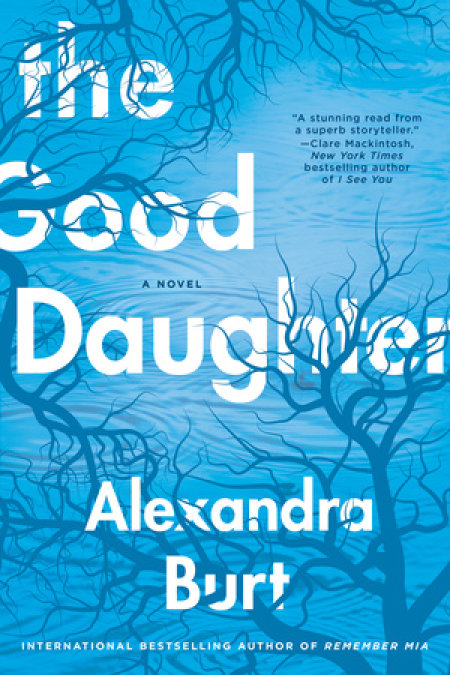
The Good Daughter
- eBook
- Paperback
- Audiobook
- Book info
- Sample
- Media
- Author updates
- Lists
Synopsis
‘A stunning read from a superb storyteller.’ Clare Mackintosh
From the #1 ebook and Sunday Times bestseller, comes the tale of a young woman in search of her past, and the mother who will do anything to keep it hidden…
What if you were the worst crime your mother ever committed?
Dahlia Waller’s childhood memories consist of stuffy cars, seedy motels, and a rootless existence traveling the country with her eccentric mother. Now grown, she desperately wants to distance herself from that life. Yet one thing is stopping her from moving forward: she has questions.
In order to understand her past, Dahlia must go back. Back to her mother in the stifling town of Aurora, Texas. Back into the past of a woman on the brink of madness. But after she discovers three grave-like mounds on a neighbouring farm, she’ll learn that in her mother’s world of secrets, not all questions are meant to be answered…
The Good Daughter is a compelling take on a genre that shows no sign of slowing down. The perfect read for fans of Gillian Flynn and Paula Hawkins.
Release date: February 7, 2017
Publisher: Berkley
Print pages: 400
* BingeBooks earns revenue from qualifying purchases as an Amazon Associate as well as from other retail partners.
Reader buzz
 Please log in to recommend or discuss...
Author updates
The Good Daughter
Alexandra Burt
Copyright © 2017 Alexandra Burt
PROLOGUE
They stopped once for the night, in Albuquerque. The name of the city intrigued the girl so she looked it up in the encyclopedia she carried with her. It was her most prized possession.
Albuhkirkee . . . she silently repeated the word until it lost all meaning. The girl caught herself drifting off into some paranoid daydream, not knowing what time it was and where they were going. They had never driven this far for so long, never had to pump gas so many times.
Weary with the burden of her heavy eyelids, she was drunk with sleep by the time her mother stopped at a hotel. Rodeside Inn, the sign read. All she’d remember later were the weeds that grew through the cracks of the concrete parking lot.
The next morning, her mother bought donuts at a drive-through and they got back on the road. The girl went to sleep but when she woke up and looked out the window, the scenery hadn’t changed at all. After days on the road, she felt as if she was leaking electricity. The hours stretched and she wished her mother hadn’t thrown her bag in the trunk of the Lincoln—she longed for her American Girl magazine and the jelly-bean flavored Chapstick.
She opened a bag of Red Vines, sucked on them and then gently rubbed them over her lips until they turned crimson.
Running her fingers across the cracked spine of her encyclopedia—the first pages were missing and she’d never know what words came before accordion; a box-shaped bellows-driven musical instrument, colloquially referred to as a squeezebox—she concentrated on the sound of the pages rustling like old parchment as she flipped through the tattered book.
Her mother called her Pet. The girl didn’t like the name, especially when her mother introduced her. This is pet, she’d say with a smile. She’s very shy. Then her mother moved on quickly, as if she had told too much already.
Pet, the encyclopedia said, a domestic or tamed animal kept for companionship. Treated with care and affection.
The girl opened the encyclopedia to a random page. She remembered when it was new, how the pages and the spine had not yielded as readily, and she wondered if the pages would eventually shed. She attempted to focus on a word but the movement of the car made her nauseous. Eventually she just left the book cracked open in her lap.
“My feet are cold. Can I get a pair of socks from the trunk?” she asked somewhere after the New Mexico/Texas border.
“Not now,” her mother said and checked her watch.
The girl fell asleep again and later awoke to the slamming of the car door. She rubbed her eyes and her surroundings came into focus; red brick walls, a large sign that read Midpoint Café, her mother standing by a pay phone only a few feet away, rummaging through her purse for change. It was noon and the girl felt ravenous staring at a display poster of fries and milkshakes in the café window.
“I’m hungry,” she called out to her mother.
“It has to be quick, we have to be somewhere,” the mother said and the girl slid on her sandals in a hurry.
In the gloom of the dingy cafe, their knees touched under the narrow table. The mother opened up a newspaper left behind in the booth and scanned the headlines.
The girl had so many questions: why are we rushing; who did you call; where are we going; why did we drive all the way from California to Texas—she had the whole conversation planned out, knew exactly what to ask: short, direct questions that left no room for vague and elusive answers. The place was loud and crowded and the diners competed with one another to be heard, creating an overall atmosphere of raucousness. In the background, a baby cried and a waitress dropped a plate.
They ordered lunch—French fries and a strawberry shake for the girl, coffee and a Reuben sandwich, no sauerkraut, for the mother—and while they waited for their order to arrive, the mother excused herself. “I have to make another call, I’ll be right back.”
She ate and watched the diners and minutes later, her mother returned. She had seemingly perked up, now appeared bubbly, almost as if in a state of anticipation, and her eyes moved quickly. “Let’s play a game,” she said and opened the paper. “Tell me a number between one and twenty-two.”
The girl loved numbers. Numerology, belief in divine, mystical or other special relationship between a number and a coinciding event. The number 7 was her favorite one. 7 meant she was a seeker, a thinker, always trying to understand underlying hidden truths.
“Seven,” the girl said and silently recited random facts; seven ancient wonders of the world, seven days of the week, seven colors of the rainbow.
They ate silently, the girl devouring the fries, then taking her time with the milkshake, studying the people around her while her mother skimmed page seven of the newspaper. She wondered how naming a number of a page was a game to begin with, but her mother seldom answered questions posed to her, and so she didn’t ask.
The mother paid the check and the waitress counted out the change.
Just as the girl attempted to decipher the headline the mother had been studying, she called out to her. “Hurry up, Pet.”
The girl did as she was told.
Later, the mother rolled down the window and the girl watched her check her face in the rearview mirror. When a siren sounded, the mother licked her lips, fluffed her hair and pulled into a dirt patch where three wooden posts formed an entrance with a cow skull nailed to its very top. An officer appeared next to the car.
“Your taillight’s out,” he said and scanned the car’s interior.
The police officer was lean with closely cropped hair and skin the color of nutmeg. The mother got out of the car, pulled her red scarf tighter around her head. Her hair fluttered in the wind, her clothes clung to her body, and her arms were tightly wrapped around her.
The girl noticed a boy in the back of the police cruiser. “What did he do?” she called out to the officer.
“He didn’t do anything. That’s my son Roberto,” he said, “he’s just riding along.”
The next time the girl turned around, her mother and the officer stood in the shade of a large oak tree. Her mother’s voice trailed toward the car like pearls rubbing gently against each other. The officer leaned back and laughed at something her mother said.
Later, the mother drove to a motel where the girl fell into a deep sleep. The next morning, after free coffee from the dingy lounge and day-old donuts, they emerged from the Aurora Police Precinct with paperwork in their hands. When the girl read the paperwork, it stated Memphis Waller and her daughter Dahlia Waller had been robbed by the side of the road, including the mother’s wallet and identification.
Dahlia; flower, symbolic meaning of a commitment and a bond that lasts forever.
The girl did not ask questions. She was glad to finally have a proper name and no one, not even her mother, would refer to her as Pet ever again.
Later, she would remember that the sky was overcast and turning darker by the minute.
PART I
What is this madness blazing in your hearts?
Achilles
Chapter 1
Dahlia
It all started with the crickets.
My mother sweeps them off the porch but to no avail: they seem to multiply exponentially—they’re taking over, she says melodramatically—and she sprays lemon-scented Raid in every nook and crevice until the fragrance of artificial citrus descends upon her Texas bungalow and becomes part of our lives like the unsightly boxes in her room she hasn’t managed to unpack in decades.
April and May bring more rain which in turn brings more crickets. By June, the porch is covered in shadowy forms climbing up the wooden posts, reaching the horizontal rail just to fall off the precipice and pool under the porch. Come July, my mother is convinced that a rogue crowd of crickets will work their way up the brick walls and discover small pockmarks and cracks along the exterior. Eventually they will invade the house, she says.
I explain that last year there were the frogs, and the year before there were the crane flies, and before that—I can’t remember but I make something up—there were the potato bugs. “Next year it’ll be something else. Just relax,” I say but she won’t have any of it.
“I just can’t stand those crickets,” she says, getting more irate with every swipe of the broom.
“Let me go for my run. I’ll think of something when I get back,” I say, feeling myself getting impatient.
Over the past months, I have become a master in avoiding fights with her, yet the better I’ve become, the more she insists on the drama. The world always revolves around her, she sees no point of view other than her own, no explanations occur to her but the ones that make sense to her and her alone.
I step off the porch and stretch my calves yet my mother is determined to discuss the crickets.
“I hate the sound they make,” she says and follows me into the street.
“What sound?” I ask. If I wait any longer it’ll be too hot for a run.
“It’s like an old hardwood floor when the flooring nails rub together and they squeak,” she says and holds her hand behind her ear as if she is attempting to direct sound waves into it. “You don’t understand, Dahlia…” she pauses as if something important just occurred to her. “They crunch when you step on them. At least no one can come in undetected,” she adds as if her logic has a special shape that fits a special key which in turn fits a special lock.
“I’ll call an exterminator,” I say and jog off before she can say anything else.
I regret having come back to Aurora.
Months ago I stood in front of her door and I realized the house hadn’t changed at all—the same crooked solar lights from fifteen years ago stuck in the cracked soil like elfin street lights. The same drab curtains covered the windows; the paint was still chipped; the door chime hadn’t been fixed. I knocked and my mother opened the door and as we embraced, I felt a hesitation, but I was used to that. She still looked impeccable—wore a dress, had done her makeup, and there wasn’t a gray hair to be seen—yet she seemed grim and dark and rarely was she without a cigarette between her manicured nails. And now she obsessed about crickets.
Leaving my mother’s subdivision behind, I make my way down a rural road towards the woods. It’s July and the sun that was orange an hour ago is about to turn into a yellow inferno. Another hour and everything will cook.
About two miles into the run, I realize I haven’t stretched nearly enough. I feel a slight stinging behind my left knee, an old injury that has been flaring up lately. When I reach the top of the hill leading into the woods, I stop. Hands on my hips, I attempt to catch my breath. The heat bites into me and the sun eats my skin and eyes. I ignore the pesky insects swarming around me, barely wipe away the salty beads trickling down my neck. I scan an unfamiliar tree line to my right—haven’t I paid close enough attention or have the columns of rain that have swept North Texas for the past few months somehow changed the vegetation?—and I long for shade to stretch my leg.
Squeezing between the trees, I step into the woods and the temperature drops twenty degrees. The scorching sun loses its grip and the air turns dank and muggy. The beauty of the woods takes me by surprise; it’s not just a collection of trees but there are paths leading toward what looks like ancient tree cities, some still standing, and others have turned into mere skeletons. The springy ground is an array of leaves and chunks of rotted wood, the dark wet earth soothes my feet after the unforgiving asphalt.
I follow deer tracks and brambles claw themselves to the mesh fabric of my Reeboks. With my palms I lean against a gnarly Texas oak, stretching my calves. The bark is sharp, leaving painful imprints on my hands. The burn in my leg ceases and as I bend over and pull brambles off my shoes, I catch a glimpse of a crescent indentation in the ground as if someone burrowed the tip of a boot into the soil. Next to it, a speck of red, a shade somewhere between scarlet and crimson. I can’t make sense of it as if my mind is trying to fit a square block into a round hole.
I step closer and my brain catches up; the colorful speck is a fingernail, a half-moon rimmed with dirt, resting among the tree scraps. A pale hand with nails a shade a teenager would wear, one with a silly name like Cajun Shrimp. The hand is motionless, just lies there, bare and helpless, a peculiar intruder disturbing the methodical layers of the forest’s skin.
I scan the ground. There’s a pale silver bauble—a coin maybe, larger than a dime but smaller than a nickel. The sun hits it just right and throws a sparkle my way. There’s a luster to it, radiant and sparkling, illuminated as if it wants to be observed. I believe the hand and the sunlit glint among the browns and greens of the woods to be a figment of my oxygen-deprived runner’s brain.
I bow down to get a closer look. Eyes peek from within the ground. They are surrounded by a spongy layer of pine needles.
Still the square block doesn’t fit into the round hole. Broken and cloudy, the eyes stare beyond the cathedral high pillars. The lids seem to quiver ever so slightly.
And then the hand moves.
Run.
My body obeys. Ten steps and I lose my footing and stumble, hit the ground, left shoulder first. I roll down a hill and sharp branches nip at my skin, I tumble farther and farther, a steady and painful descent that I’m unable to stop. I come to a halt and I feel a sharp pain hit me right between my eyes. Then my world goes dark.
When I come to, everything is quiet but for the thumping sound of my heart. I swallow water. I’m drowning. My head throbs but I manage to push my body off the ground. I’m in a creek, face down. The vision of the hand has carved itself into my brain. I must be mistaken, I tell myself.
I catch my breath and return to the very spot. I kneel down and a burning sensation moves up my arm, to my face, then to my neck. There is an anticipation, a nervous kind of energy tingling through me, as if electrical sparks are travelling all the way to my toes. A scent hits my nostrils, an olfactory hint of something… unpleasant… out of place within the otherwise fresh forest. The scent is sickly sweet, a mere hint one moment, then a good stench. Something is dripping onto my lap—warm moisture spreads onto my bare thighs—and I realize my nose is bleeding profusely. My shaking hands are covered in blood.
A buried body, I think, as if I have finally solved a riddle I’ve been pondering for a while. My mind tumbles, spills into itself. My sense of smell is heightened and the soil and decomposing leaves make the atmosphere thick. I feel a sense of paranoia, I imagine someone watching me, no, I don’t imagine, I know there’s someone watching me.
I scan the trees around me. I know what I am; prey. A small sob works its way up and out of my throat.
There’s no visual clue just knowledge and intuition and my eyes find a narrow path with knotted roots. Run, I repeat, and again my body obeys.
I reach the road and wave down a truck filled with men in overalls. There’s a large ladder covered in paint splatters extending beyond the truck bed. I scream and point at the tree line and they rush in that direction.
One man stays behind and says words in Spanish I don’t understand.
I feel as if I have travelled through a time machine: I remember the clinic well—Metroplex, a three-story building, aged and tacky, from the industrial carpet to the disassembled pay phones left deserted on linen fabric covered walls.
I recall the emergency room; every strep throat, every fever that wouldn’t go away, every sprained ankle, every cut that required stitches resulted in arguments with nurses and administration. My mother refused to sign paperwork, wouldn’t give them any information but our names.
There’s this rage inside of me that I feel toward my mother and I wish my memory was a sieve, yet it maintains a detailed account of her transgressions, all fresh, all defined, neat and organized. They sit in waiting and many have come back to me lately, so many memories have returned yet not a single one of them pleasant. Lately, all it takes is an image, a smell, a faint recall, and the dam of restraint breaks. It sloshes over everything Unforgiving in its clarity.
They say—I’ve done the research—humans are hardwired to retain negative memories as a matter of survival.
Survival; the act of surviving, especially under adverse or unusual circumstances.
El Paso, Texas, 1987
I roll down the car window to allow the night to seep in. I hear trucks idle. I listen to the drone of the engines; observe them maneuver in and out of the parking lot. They hiss and scream, sometimes their engines fall silent. Men emerge and climb from the cabs.
It’s their house on wheels, my mother tells me.
My house is the backseat of my mother’s car. From there I watch the constant movements of trucks and men. I arrange my pillows and blankets just right. I have learned how to tuck myself in . I am to remain underneath, hidden.
It’s just a game, my mother says. So no one knows you are here.
I listen to their radio until it jitters, and then there is nothing left but silence. Underneath the many layers, I hear my mother talk to the truckers.
One man said I saw a black dog, so I pulled over.
I’m afraid of the black dog. I watch the road sometimes, expect him to stand in the middle, drooling, barring his fangs.
I spread out my crayons over the seat. When I run out of paper, I flip through my drawings until I find one that’s blank on the back.
We wash up in a sink in a nearby building. The floor is cold and my bare feet leave dirty wet trails all over the white tiles. I wiggle and struggle to get away from the cold that makes my skin turn into tiny bumps.
Is the black dog coming for me, I ask my mother.
She just laughs.
The dog’s not real, it’s when you drive too long and you see things. It’s time to pull over and sleep. That’s all.
I know the feeling of seeing things. I will keep an eye out for the black dog anyway. To make sure.
Mom leaves and when she returns, she smells of food. She hands me a donut, and I eat in the car. I get powdered sugar all over everything but mom doesn’t seem to mind.
Those days don’t feel real. It’s almost as if I travel while I sleep. When I wake up, I’m in a different place but still in the car.
I love the car. All my toys are in the car.
Chapter 2
Dahlia
The ER waiting room is quiet but for the hypnotic tick of an old plastic clock hanging on the wall. A whiff of latex and disinfectant hangs in the air.
Bobby’s uniform is tidy, his blue button down shirt and navy colored slacks are pressed immaculately. His hair is short, his face freshly shaven. A lifetime ago Bobby and I went to high school together, but he stuck around and I left Aurora days after graduation. We haven’t spoken since I’ve been back in town.
“I can’t believe this,” I say and struggle to line up the events. My clothes are wet, so is my hair.
Bobby smiles at me. “You’ve been back in town for what… a few months, and I see you’re still the same old trouble maker.”
For a split second I’m a teenager again, remembering how we’d roam through town, wandering around in abandoned buildings, acquiring cuts and bruises and sprained ankles along the way. “Seems that way, doesn’t it?” I finally say.
“You waved at me the other day, at the gas station. I was going to follow you and pull you over.”
I feel some sort of way about his words, following me, pulling me over. That’s how we met a long time ago; his father pulled my mother over by the side of the road. Bobby sat in the backseat of his father’s cruiser, I was in the backseat of my mother’s car, and we stared at one another.
I ignored Bobby at the gas station because of the way I’d left fifteen years ago. That and the fact that my life is nothing to be proud of. I have been dreading having to make small talk with him, catch up, swap stories about our lives.
“How long has it been?” Bobby asks. “Just about fifteen years?” he says as if he’s kept track of time.
I do the math. I arrived in Aurora just shy of thirteen, I did one year in middle school, then went to high school. In high school, I had saved every dollar I made; I bagged groceries, worked at the car wash, even put away my allowance. There wasn’t any money for college, and I didn’t have any motivation or big dreams short of getting out of town—but Bobby was going through something then. His mother had cancer, had been well for years but then it returned. There seemed to have been something else; he was preoccupied with things I knew nothing about, things he was reluctant to share. I left Aurora at eighteen. Fifteen years exactly.
The last time we spoke was the night I left.
“If you think about it, why not go to Colorado, or California? If we’re going to leave, might as well go far,” I had said but he had remained quiet. We had talked about leaving Aurora for years, leaving Texas altogether, we had imagined it many times.
“You want to hear what I think?” he finally asked.
I sensed sarcasm. He started talking about having a different perspective and maybe I should be thankful for what I have instead of griping about what I didn’t. That night, he made his way through a six-pack in no time and by the time he was on the last beer, he didn’t make a whole lot of sense. He went on and on about choices some people have that others don’t. Had we not talked about leaving Aurora since tenth grade, had we not imagined what life could be like somewhere else?—but suddenly there was no more I vent and you listen. He was judgmental and mean and not what I needed that night. We parted ways then, he was drunk and I was angry.
At home, I saw my mother hadn’t lifted a finger to fill out the paperwork I needed to apply for financial aid. I threw my clothes and a few books in a duffle bag, waited for the sun to come up. When I heard my mother rummage around in the kitchen, I went downstairs.
“You still haven’t filled out the forms,” it came out sharply, just as I intended. All my life there had been paperwork, missing and incomplete forms. “Are we still doing this? We still don’t have the right paperwork?” I asked. There were the missing papers when I was a kid—what I now know to be shot records and residency documentation— and school was the mother of all wounds. She would never let me leave, wanted to attach an eternal tether to me, making sure I’d never be more than she was.
We argued. I told her I’d leave. She said she’d pay for a community college close by. I told her I wanted to go out of state. We argued some more. Eventually she turned silent and ignored me.
I left that night. I drove down the highway leaving Aurora behind me. I had about five-hundred dollars, a fifteen year old car, and my high school diploma—a pretty meek start for a life on my own. I left fighting with my mother, and I had never said goodbye to Bobby.
I felt panic rise up. The streets felt alien to me, yet I drove on until I reached Amarillo. The city was depressing with nothing but dust and yellow grass, far away from everywhere and close to nowhere. I found work the very next day and a place to stay. Wanted signs at motels were plenty along the two major highways running through town and my mother had taught me well: the right motel and the right owner, and you can offer free work for a week in exchange for a room. One week’s worth of work for the room each month, cash for the next three weeks of work. I knew that many employers didn’t mind turning a blind eye to the fact that I insisted on getting paid under the table.
I got a second job at a nearby motel and after a year of saving every penny, I felt confident I was in a good place. One day, on my way to my second job, a tapping and slapping sound under the hood made me pull over. The car, by then sixteen years old, was no longer fixable. The next day I went to apply for a car loan, a used older model Subaru—though still better than what I had—but I needed my social security number.
“I’m sorry we can’t process the application,” the car salesman said. “Do you have your card on you?”
“I think I lost it,” I lied.
He scrambled through the papers. “You might want go to the social security administration office downtown.”
“How about I pay you cash for the car?” I hated to use every penny I had saved up but I needed transportation. I haggled some, paid for the car. I never went to the local social security office. It was just like it had always been, the old and familiar hurdle that was paperwork.
I worked more jobs to save more money and eventually moved out of the motel. I knew better than to try to rent an apartment but I waited for a sublet to come available—there’d be no credit checks, no paperwork, and no contracts to fill out. I lived in a three-bedroom apartment with two other women, a flight attendant and a pharmacy student from Ecuador.
I thought about starting my own residential cleaning business, but I knew the business license would never happen. Again, there’d be paperwork. There were better jobs I qualified for over the years—cruise ships taking off from Galveston—but I needed a passport. I kept my head down, never forming lasting friendships or getting seriously involved with anyone. Fifteen years passed and I saw myself going nowhere but down a lonely, dead end road of minimum wage jobs and double shifts.
I thought about returning to Aurora but those moments passed. I thought about my childhood and those thoughts lingered. My early years remained sketchy at best; I couldn’t name my favorite childhood food, stuffed animal, board game, friend, place, or person. Glimpses emerged yet none of them could be verified; there was no attic stuffed with trunks and boxes holding dolls and toys and old bicycles. When my mother and I did move, we started completely from scratch, no phone calls to left-behind friends, no letters, no Christmas cards. Everything was fin
We hope you are enjoying the book so far. To continue reading...
