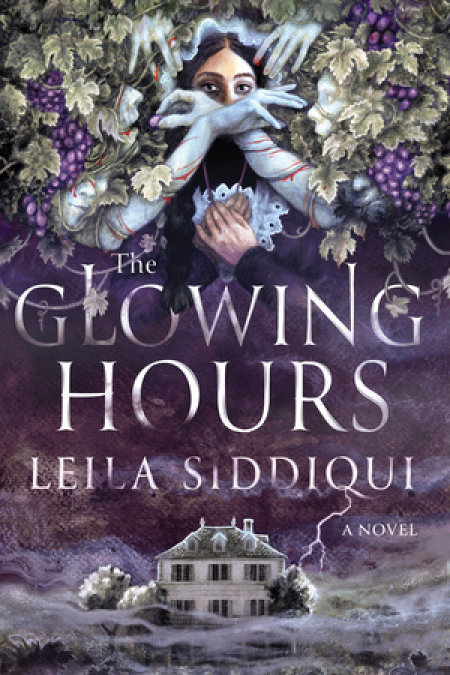
A mind-bending, revisionist gothic horror story about the fabled summer Mary Shelley began work on Frankenstein, as told by her Indian housemaid, Mehrunissa “Mehr” Begum. For fans of Silvia Moreno-Garcia, Isabel Cañas, and Kathe Koja.
“Strange how one can find they are an interruption in another person’s story . . .”
Summer 1816: London is a hostile place for the newly disembarked Mehrunissa Begum, who’s come to deliver her brother’s letter of inheritance before returning to her comfortable life in Lucknow, India. Only, she can’t find her brother anywhere and has no money for the return trip. With nowhere else to go, Mehr finds refuge in a boardinghouse for Indian maids. If she can’t find her brother, she reasons, she will get a job and start saving.
Mehr is soon hired at the English estate of Mary and Percy Shelley, young artists of burgeoning fame who are on the run from secrets of their own. Mary is brooding and quiet, but takes a curious liking to her new maid, asking her to accompany the Shelleys and her stepsister, Claire—as well as the eccentric Lord Byron and his physician, John Polidori—to Lake Geneva for the summer.
Almost immediately, Mehr notices strange, ghostly events at the villa. The walls breathe, portraits shift, and phantoms appear like unbidden guests who refuse to leave. The weather is fierce and foreboding, showing no signs of softening its relentless pall. And as Mary Shelley begins work on what will become her earth-shattering literary phenomenon, Mehr finds herself trapped in the villa as the rest of its inhabitants descend into madness.
Release date:
February 3, 2026
Publisher:
Hell's Hundred
Print pages:
336
* BingeBooks earns revenue from qualifying purchases as an Amazon Associate as well as from other retail partners.
It had taken Jane years to find her. She’d followed the river of gossip from London to Coventry, all those whisperings about an exotic and wealthy foreigner who, decades ago, had turned heads in London society for just a brief few weeks before mysteriously vanishing. A lifelong spinster, so it was told, who’d spent her life caring for her brother’s children, and, when they had grown, was taken in by an adoring niece to look after her grandnieces and nephews. Jane sat in the drawing room, waiting for her to appear.
The floor creaked behind Jane, and Mehrunissa Begum Hammersmith walked in, a thick gray-streaked braid swung over a shoulder, a matronly high-necked black dress on. She was graceful and soft as she made her way across the room, sat in a chair opposite Jane, and folded her hands in her lap.
“I am delighted to make your acquaintance, Mrs. Shelley,” Miss Hammersmith said.
Jane doubted it. The woman neither smiled nor frowned; she had an unreadable expression on her face. A thick knot formed in Jane’s chest. She could see, now, why her mother-in-law had been so taken by such a dignified creature. Slowly, Jane exhaled the breath she’d been keeping in and gathered the bundle of papers in her lap.
“I have begun the task of working on my mother-in-law’s memorials,” Jane said calmly. “Both hers and her husband’s.”
“Tragic, how he died,” Miss Hammersmith said. “I read about it in the papers. So young, Percy. Lord Byron too. And . . .”
The woman before Jane appeared to lose her composure. But she took a moment, and a softness returned to her face. “And another man who was employed by him,” she continued. “A young doctor.”
Jane nodded. “You spent that summer with the most notorious man to ever have written a word in the English language. Have you ever wanted to—”
“No.” Miss Hammersmith shook her head. She smoothed her black dress against the tops of her thighs. “I prefer to forget that summer, Mrs. Shelley. It was as if I were never there.”
Miss Hammersmith stared hard at Jane, who realized this was not a request but a command. She would never speak of her time with the Shelleys. Jane had been gripping hard to the bundle. She let go, placed her hands on top of the pile, then cleared her throat. It was a while before the words materialized in her mind.
“As you may have heard,” Jane said, “Mrs. Shelley died a number of years ago. We were very intimate. She was like a mother to me.” She let out a deep sigh. She knew she hadn’t fully recovered from the loss, perhaps never would. “A few years after her death, I found the journals she had written with her husband.” She shifted in her seat, Miss Hammersmith watching her every movement. “And while I have tasked myself with putting together her biography, there are some things I . . .”
She found she’d been tapping her foot against the floor. She stopped, then finally stood and approached Miss Hammersmith. Jane held out the bundle of papers to her and, when she didn’t reach for it, laid it delicately in her lap.
“Pages from her journals, Miss Hammersmith. From that summer. She paints a very vivid picture of you. Of what happened to all of you in that villa. I cannot, in good conscience, include any of this in her memorials. I ought to have thrown it all into the hearth, to have destroyed it before my husband could see it.”
Tears sprang to her eyes, and she quickly wiped them away. “In my affection for my mother-in-law, I want you to have them. You can treasure these pages or you can burn them. They are yours to do with as you wish.”
“What about her sister Claire?”
“Miss Clairmont wants nothing to do with us.”
“Then what makes you think I should have them?” Miss Hammersmith asked.
“I do not know. I suppose she would not have minded that I shared with you.”
Jane sat back down and watched as Miss Hammersmith undid the twine around the bundle. When she’d found the journals, she and her husband had begun to read them together. She was consumed by this window into the youth of a woman she’d worshipped. As the events of Mary Shelley’s life took on a sad turn—of dashed hopes, death, depression—she hid them away from her husband, took on the sole project of consolidating it all into a biography of her beloved mother-in-law. But there were some lines, some passages, that she found herself scratching out completely. She was shocked at her own rashness and had to step away from the journals for a time. Young Mary had seemed bitter, hapless, and at times even irritating. It was not the woman she’d come to love as her own mother.
But she was still working through her grief and eventually returned to the task. As she read on, she arrived at the summer of 1816. Then it wasn’t just lines or passages she found herself blotting out but entire pages. She would rip them out, hide them from her husband in various parts of the house: shoved into desk drawers and within pages of other books, some even sprinkled in the garden. It took Jane weeks, months, to decide what to do with them. And even then, there were moments from them she wished she could tell her husband about. But it would be her secret to bear.
She had a duty to her mother-in-law, who was one of the greatest women writers of the past century. Jane would ensure her legacy stayed that way. There were times she felt possessive of her brilliant mother-in-law. Mary had lost her husband at such a young age. Jane’s own husband, Percy Florence, was Mary’s only surviving child. Yet Mary’s delicate vulnerability had made Jane want her all to herself. To care for her, love her as a daughter might have. But the journal spoke of unbelievable things. Of obsession, prurience, madness, grotesque hallucinations . . . Jane shuddered to think about it.
Miss Hammersmith slid one page behind the other. She stopped to read, then glanced away, perhaps overcome with her own memories of that summer.
“You’ve read these pages?” Miss Hammersmith asked.
Jane nodded. “It was quite a summer.” She leaned forward, hesitated for a moment before asking, “Is it all true?”
Miss Hammersmith moved the bundle to a side table. “I believe she had a brilliant mind, though often troubled. She was far too young to have gone through what she did.”
Jane let out a breath. So it was true. Her mother-in-law had had a touch of madness that summer. It was no wonder, considering all she’d been through in her young life, that she had produced such a frightening tale. Perhaps the incendiary pages had just been a way to inspire her writing.
“After I heard about Mr. Shelley’s death, I dreamt about her often,” Miss Hammersmith said. “That she was freed of that man, the burden of his genius.”
“She never married again,” Jane said.
“Or perhaps could not.” Miss Hammersmith stared at a point on the rug. “Her devotion to him was like a religion. She entwined her full self in that man. I will never understand it.”
Jane felt the seconds tick by on the clock as she mustered the courage to ask her next question.
“Have you read Frankenstein?” she said at last. “You were one of very few to witness her inspiration.”
Miss Hammersmith had on a faraway smile, one that reminded Jane of her mother-in-law.
“I don’t have the courage to read her work,” she said. “Any of it. Is it not curious, that all three of the men we spent our summer with died only a few years after? And yet we women, cursed with life instead?”
Miss Hammersmith laid her hand on top of the bundle. “Thank you for the gift.”
Then she stood, moved swiftly across the room and into the hall. By the time Jane got there, Miss Hammersmith had the door held open for her.
Jane pulled a copy of Frankenstein from her pocketbook. It was one of a multitude she owned, multiple editions she couldn’t bear to part with. But this one would do. She opened the book and, since she’d previously underlined the passages, was able to find the page quickly.
“Safie is a young Arabian woman,” she said to Miss Hammersmith. “Beguiling, enchanting. She has an ‘angelic beauty,’ ‘shining raven black hair’ that was ‘curiously braided.’”
Miss Hammersmith held the door wider. “Mrs. Shelley—”
“And the way she sings. ‘Her voice flowed in a rich cadence, swelling or dying away, like a nightingale in the woods.’”
It brought tears to her eyes to read out this passage. She found the same was true for Miss Hammersmith.
“In her journals, she wrote about hearing you sing in the vineyard. This Safie, she makes quite an impression on the monstrous creature,” Jane said softly, pushing the book into her hands.
She stepped out onto the concrete stairs and turned back to Miss Hammersmith. The older woman stared at the book in her trembling hands. She turned it over and over, touched the cover, her fingers brushing against a deformed caricature of Victor Frankenstein’s creature. Then, without a word, Miss Hammersmith handed the book back to Jane and swiftly shut the door.
We hope you are enjoying the book so far. To continue reading...

 Please log in to recommend or discuss...
