
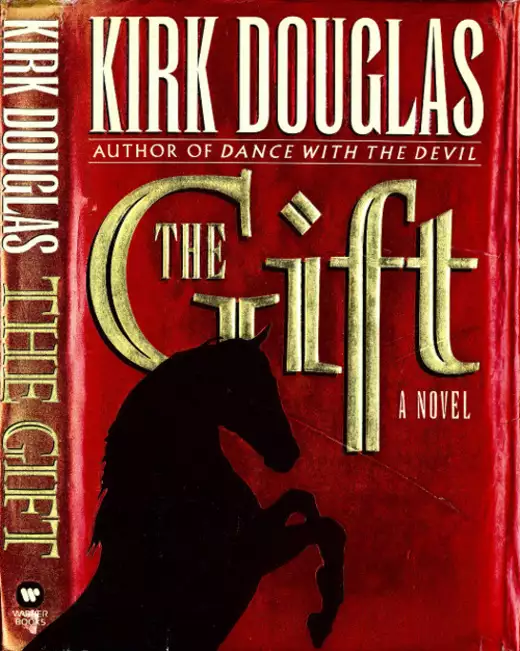
The Gift
- eBook
- Paperback
- Audiobook
- Hardcover
- Book info
- Sample
- Media
- Author updates
- Lists
Synopsis
Softhearted, emotionally fragile Patricia Dennison— orphaned heiress to the Stoneham fortune— divides her life between trips to a Swiss sanatorium, where she is ensconced in the suicide ward, and the farm where she pensions off broken-down horses, cultivates a lush rose garden, and moons after a handsome, seemingly heroic doctor. Enter arrogant Miguel Cardiga, a Portuguese bullfighter whose career is sidelined by a rogue bull's deadly horns. Son of a famed equestrian, Miguel schools Patricia in dressage and love. Meantime, trustees at the Stoneham Group plot to declare Patricia incompetent and engineer a series of accidents designed to drive her over the edge.
Release date: November 29, 2009
Publisher: Grand Central Publishing
Print pages: 288
* BingeBooks earns revenue from qualifying purchases as an Amazon Associate as well as from other retail partners.
Reader buzz
 Please log in to recommend or discuss...
Author updates
The Gift
Kirk Douglas
muscular thigh.
“Isabel! What are you doing here?”
She glanced furtively down the corridor, where early spectators were beginning to stream into the arena, eager to get good
seats for the final bullfight of the season, and pulled him into her hiding place.
“I want you,” she gasped, her mouth hungrily seeking his, while her hand reached down, trying to coax an erection.
“For God’s sake, control yourself! Your husband is here.”
“Don’t worry, Luis is too busy picking out a bull for you.” Her hand held on to his shirtsleeve. “Tonight?”
“Yes.” He freed his arm. “I’m late—I have to get ready now.”
“The usual place!” She blew him an indiscreet kiss.
For a moment Miguel’s eyes followed her silhouette—she was seductive even now as she hurried down the corridor. But it bothered
him that she was getting so reckless. She took more risks than a bullfighter—if her husband found out, he’d kill them both.
Maybe he shouldn’t meet her tonight… but he knew he would.
Taking a shortcut to his dressing room to avoid eager fans, Miguel climbed a scaffold spanning the open space above the bullpens.
Carefully, he navigated the rickety boards.
Beneath him, the bulls were turning and twisting in the close confines of their pens, the relentless sound of their scuffling
hooves punctuated by loud thuds as they furiously rammed their horns into the cement enclosures. He could feel the pent-up
fury of these huge beasts, their one aim to batter down the walls confining them, to kill everything in their path.
In less than an hour, one of them would thunder into the arena and focus his rage on him in a contest that pitted the brute
force of the bull against the grace and skill of horse and rider. Miguel’s actions would be strictly governed by ancient rules
of chivalry; this was how his Portuguese countrymen—who revered tradition above all else and scorned the Spaniards’ preference
for gore—would judge his performance. If he accidentally killed the bull, he would be heavily fined.
In the corner, near the pens, Miguel spotted the stout figure of Isabel’s husband, one of Iberia’s leading bull breeders,
gesturing animatedly to his assistant. It was Luis Veloso’s bull that Miguel would fight this afternoon. The assistant took
up a long stick and, together with several keepers, separated one of the mammoth beasts from the others. The bull bellowed
angrily as the men prodded him into a narrow chute.
All was ready.
A half hour later, Miguel gave himself one last look in the mirror. The gold filigree embroidery glittered against the midnight
blue of his satin coat; tailored at the waist and flaring out above his knees, it fit his lean muscular body perfectly. His
white britches were spotless, his black leather riding boots polished to a shine.
He narrowed his brown eyes. The olive-skinned face that stared back at him from under an unruly shock of black curly hair
had the haughty expression of a man in charge of his destiny.
“You obviously like what you see,” mocked his friend Emilio Fonseca as he sprawled in an overstuffed armchair, his long legs
lazily draped over the side, a cigarette dangling from his fingers.
“I do,” Miguel said softly, mocking back.
Emilio yawned, stretching his arms over his slicked-back hair, which hugged his head like a skullcap.
They could hear the rumble of the herd of oxen that always escorted the bull from the ring at the conclusion of a bullfight.
Miguel felt his nerves tightening into coils of steel. He was up next.
Emilio sat up. “Ahh, I hear the patter of little feet.”
Miguel laughed. He appreciated the effort his friend made to relax him before he entered the arena.
He opened the dressing room door and, with Emilio following, walked slowly down the darkened hallway into an Arabian Nights
setting—pointed archways, crescent moons, wrought-iron scrolls and arabesques, Moorish touches that made this red brick structure
the most unusual bullring in the world.
Nothing betrayed the apprehension that knotted itself inside of him—the fear that he might fail this time, bring disgrace
to the famous Cardiga name. Of course, his father, who hated bullfighting, thought he had disgraced it already. Do sons of
great men ever measure up?
In the alcove at the end of the hall, the groom was holding his horse, its mane braided with satin ribbons to match his coat.
Miguel donned his three-cornered plumed hat and eased into the elaborately tooled antique saddle. Today, he was using the
Palomino, named Talar—“a slice of gold“—for good luck. Talar pranced nervously on the brick floor, his hooves ominously keeping
time with Miguel’s heartbeat. The horse was ready to explode, the tension vibrating within him like a live electrical current.
“Fortuna, my friend,” Emilio said, slapping the horse’s rump.
Miguel turned Talar toward the slivers of bright light filtering through the cracks in the heavy gates of the arena. He could
hear the rustling murmurs of anticipation on the other side. Accounts of his success in the provinces had spread to Lisbon:
he was billed as a rising star. Now, he was ready to enter the ranks of the best. He knew it. Today, he would make his mark
at last. Today, he would
become more famous than Paulo Cardiga—and as a bullfighter, not a riding master. He was twenty-five, and he refused to spend
any more of his life in his father’s shadow.
Trumpets blared and the gates parted slowly. Suddenly, all fear left him. Now instinct took over.
Miguel put the horse into a graceful passage—a prance in slow motion, the horse levitating above the ground after each step before descending like a ballerina to repeat
the pattern. The epitome of haute école. It was just like Miguel to make his entry with the most difficult movement. The crowd
rose to its feet, some nine thousand people shouting their appreciation—“Miguelinho! Miguelinho!“ Clearly, they had filled the arena to capacity today, not just for his bullfight, but for his horsemanship. As the son of
the greatest riding master of all time, he expected comparison to his father. He knew he didn’t disappoint.
Mount and rider melded into one as they danced to the music, the horse delicately crossing his ankles, floating diagonally
across the arena. Bravos reverberated in the bleachers as Talar cantered backward, a movement his father had made famous.
Miguel’s only reaction to the repeated ovations was a slight bow in the direction of the VIP box below one of the four minarets
that jutted out against the blue sky. From the box, Isabel’s hungry eyes followed his every move. But her husband wore a grimace
on his face. “I hope he gets it in the balls,” Veloso muttered through clenched teeth to his assistant.
The trumpets stopped and a hush fell over the arena.
Miguel and Talar stood as motionless as a statue, waiting for the bull pen to open.
For a moment, all that could be seen was a tunnel into blackness. Then a roar erupted, and the bull thundered into the ring.
His hind legs sent up a spume of dust as he slid to a stop in the sand. His huge black head, horns wrapped in leather to protect
the horse somewhat, moved from side to side, sizing up the situation. Finally, his eyes focused on Miguel.
Now the horse and rider came to life. They approached the bull slowly, leisurely, contemptuously. “Ehe! Ehe!” Miguel shouted, taunting the bull, waving a small flag that ended in a steel dart. The farpa had to pierce the bull’s hump in exactly the right place, and
in accordance with the most stringent rules, to numb the nerve endings of the neck.
The animal charged—a half ton of fury barreling across the arena. Miguel pushed Talar forward, letting the bull come alongside;
then, just when it looked like the horns might connect, he planted the farpa with flawless precision, the horse swerving easily out of harm’s way.
The crowd erupted. It was a close call, and they liked the exciting opening to this bout. It usually took a while to draw
out the full power of a bull, but this one was ready.
The horse and rider seemed perfectly at ease as they spun in a graceful pirouette, ready to flirt with the bull for a second
pass. This time, the bull attacked head-on. Miguel swerved Talar to the right, aiming his dart, but the bull, undeterred,
swerved in the same direction. Miguel pulled Talar so violently to the left, he had to struggle to recover his balance.
Fortunately, momentum carried the bull past them. But, as the bull slid to a stop in a cloud of dust, Miguel suddenly felt
a knot of fear in his gut. This animal had a strategy of his own. He had figured out how to cut off the horse and rider. It
was as if he had played this game before.
The inteligente officiating at the bullfight gave a signal and two men rushed in on foot to draw the bull away with capes. But Miguel waved
them off.
His sweaty palms gripped the reins as he sent the horse into a flat-out gallop, getting ready for another pass. Momentarily
confused, the bull hunched up in rage, eyes on his adversary, hooves pawing the ground. He lowered his head, horns poised.
Then he charged, sending dirt flying in all directions, again stampeding straight on.
Miguel tried to veer to the left, repeating the earlier maneuver. But it was too late. The bull anticipated his move and was
faster. The horns made contact, momentarily lifting the horse and rider up in the air before all three crashed to the ground.
The stunned crowd rose to its feet, screaming.
Miguel lay still, the yellow sand soaking up the blood streaming from his shattered left leg. But he felt no pain. In his
mind, he saw that Talar, like Pegasus, had sprouted wings and was rising high above the arena. The screams of the crowd became
fainter and
fainter as they flew higher and higher, past the towering minarets toward the bright blue sky.
PATRICIA DENNISON smoothed the pale blue coverlet for the tenth time, and sat down on the neatly made bed beside her suitcases. She folded
her hands in her lap and forced herself to keep still.
She felt like a child left behind on the last day of camp, waiting for her daddy to come and take her home. But she was nineteen,
an adult; she wasn’t supposed to feel so insecure and vulnerable any more. Well, at least her attitude to this place had changed—when
she first came here after her mother’s suicide, she thought of the sanitorium as a prison; now she thought of it as a camp.
The waiting was excruciating, but she had herself to blame—why had she packed, not knowing exactly when her father would arrive?
Now there was nothing to do but wait. Maybe she should unpack her books and read—that would take up some time. Instead, she
got up to look out the window again.
In all her uncertainty about life, she clung to one absolute truth—her daddy loved her and he wanted to be with her as much
as she wanted to be with him. They would have a home again, like they did when she was little, when Mommy and Daddy were still
together. It all went to pieces when Mommy took her to New York to live with her grandfather in the Stoneham mansion. J. L.—he
never let her call him Grandpa—would get so angry every time she said she wanted to visit her father in California. After
a while she stopped asking; it did no good anyway.
But they would make up for lost time now.
She stared out the window in a trance, trying to conjure up a figure coming down the walk. But there was no one. The grounds
were devoid of people; no one was strolling even. Only the thin branches of the willow trees moved restlessly in the breeze,
the dance of their wispy arms reflected in the water of the pond.
With her long fingers she traced the window bars which were
bolted to the inside of the frame. This was the suicidal ward, after all. The glass had a yellowish tint, a special coating
as precaution against breakage, and for good reason. When she first came here she would have crashed through the glass and
carved herself up. She would have done anything to end the despair, the relentless pain of grief.
She remembered when Dr. Solomon said her therapy had progressed far enough that she could have a mirror. He brought it to
her room and hung it himself. She looked into it and a face that was not her own stared back. It was a pale face, framed by
short blond hair, as fragile looking as bone china, with the bottomless gray eyes of a hunted animal. It was her mother’s
face.
“Smile,” Dr. Solomon had said. She watched the lips, barely pink, quiver a little and then curl up to reveal a row of white
teeth.
“So, you have an overbite, huh?” he teased her.
She laughed and suddenly the happy face in the mirror belonged to her again.
Poor Mommy—she had been sad for so long. Only in death did she seem at peace. Patricia remembered standing over the casket,
pumped up full of tranquilizers, looking at her mother lying there—beautiful and serene, surrounded by white roses, her favorite
flowers. Then the sweet scent was crushed by the smell of a man’s cologne—overpowering, heavy, insidious. Her grandfather
placed his arm around her shoulder and the odor almost made her gag.
Her next recollection was waking up in this room, in the Lausanne sanitorium, and looking up into large, compassionate eyes
magnified by thick glasses. Then she made out a thicket of ruffled strawberry blond hair and a scraggly beard of the same
color.
“I’m Dr. Solomon,” a soft voice said. “Don’t be afraid… You’re safe here.”
During the next six months, Patricia came to identify that voice with warmth and wisdom. He didn’t grill her about her childhood
or her dreams; instead, he brought her inspirational books to read about heroic people who found special meaning to their
lives. Then they discussed what she had read.
She decided she would read something now—reading always made her feel better; it was a good way to pass the time. She
unzipped her suitcase and found the little book she was looking for tucked next to her riding boots—The Mystical Nature of a Horse, by Paulo Cardiga.
Tomorrow, she would be meeting the famed Portuguese riding master. She loved horses and riding, and so her father was taking
her on a vacation to Portugal where he had arranged lessons at the Cardiga riding school. Actually, he had wanted her to come
to Portugal last year, when he was directing a movie in Lisbon and Tróia, but J. L. objected.
It wasn’t too late, Daddy had said, when he called her from Italy yesterday. His last words to her before he hung up kept
ringing in her mind: “Patricia—it’s never too late. I just learned that myself. There is so much we have to talk about. I
must tell you something very important.” There was a tremor in his voice when he said that. What did he mean?
She sighed. She would find out soon enough.
She opened the little book and started reading. Absorbed, she forgot her anxiety. When she next checked her watch, she realized
that an hour had passed. She calculated the time. It was more than twenty-four hours ago that her father had called from Trieste,
saying he was on his way to Zurich. The airline connections were poor and there were always delays in Italy, she knew that,
but this long? Shouldn’t he be here already?
She stood up again and looked out the window. And now she saw him. He was coming up the walk, next to the rumpled figure of
Dr. Solomon.
As he came closer, Patricia felt a scream rising in her chest, moving into her throat, but she couldn’t open her lips to let
it out. The old feeling of uncontrollable panic Dr. Solomon had taught her to banish was choking her again. It wasn’t her
father coming up the walk—it was J. L.
He had spoiled too many of their vacations. But not this time. Daddy wouldn’t let it happen. He had promised.
J. L., tall and stiff, with steel gray hair and piercing blue eyes—a granite statue, Mommy had called him—entered the room
without knocking, followed by a clearly agitated Dr. Solomon. “Patricia… you’re coming with me,” J. L. commanded, approaching
her. The smell of his cologne was instantly overpowering.
She backed away and sat down on the bed, clutching the handle of her suitcase.
“Mr. Stoneham,” Dr. Solomon was saying, “this is not the way to handle this crisis. Now more than ever Patricia needs to stay
here and—”
“I’m sure you think so.” J. L. snorted. “Judging by your fees, you’d like to keep her here forever.”
The odor of his cologne was making Patricia dizzy. She took a deep breath and clenched her teeth. “I’m not going anywhere
with you.” Her voice quavered as she spoke the words. “I’m waiting for Daddy.”
“Your father is not coming,” J. L. said sharply.
“Mr. Stoneham—please—” Dr. Solomon’s soft voice was now full of indignation.
Patricia couldn’t stop her body from trembling as she looked directly into J. L.’s piercing eyes. “I don’t believe you. You’ll
never separate us again.”
J. L. leaned over her. “Now you listen to me—”
His face was inches away. She was gagging from the stench. She turned her head and pushed against him with both hands. “Leave
me alone.”
“You’ll obey me—remember, I pay the bills.”
“I don’t want your filthy money…” Her quavering voice grew firm and clear. “I hate it. I hate you!”
He slapped her.
She stared at him in horror as Dr. Solomon grabbed his arm. “Mr. Stoneham—I must insist on handling this. You are making a
serious mistake.”
“No!” Stoneham shot back. “She has to hear this, and she might as well hear it from me.” Then he lowered his voice. “Patricia—your
father is dead.”
She sprang from the bed, staring wild-eyed. “It isn’t true!” She was yelling now. “You lie! Get out!”
Stoneham stood watching her impassively. “Make yourself useful, Doctor—tell the girl.”
Dr. Solomon sat down on the bed and tried to pull her down beside him. But she continued to stand mutely. “Listen to me, Patricia,”
he said gently. “It is true…”
Patricia’s eyes were wide with uncomprehending terror. “Daddy… dead?” she whispered.
Then she turned back to J. L. and in a hollow voice that seemed to be coming from the deepest recesses of her body said, “So
now everybody is dead… why are you still alive?”
She didn’t know what happened next. She was suddenly transported very far away, too far to hear. Dr. Solomon, J. L., and all
the things in the room became tiny and colorless—like a fuzzy newspaper photograph. Then, all went black and her feet gave
way under her. She felt she was falling into a huge dark chamber—a small broken doll twisting and turning in the horrifying
darkness.
When she came to, she was alone, lying in bed, under the pale blue coverlet. The suitcases had been put away and the mirror
was gone from the wall.
Much later she found out that J. L. had flown back to New York that very day. Aboard his private jet he had suffered his second
heart attack—this one fatal.
She was his sole heir. He left all his billions to her as if he wanted to get even.
PATRICIA DENNISON’S long slender fingers nervously fidgeted with the place cards. She had set two tables often; now she had to arrange the main
table of twenty.
She glanced at her watch—she had to hurry or she’d be late for the meeting with her board of trustees. Quickly, she moved
along the table until she came to the head—“Dr. Thomas Keegan,” the guest of honor, would sit here, below the painting of
her grandfather. She looked up into J. L.’s steely eyes and shuddered slightly.
He’d had the same stern look the last time she saw him alive—when he came to get her at the sanitorium in Lausanne. And now
he stared at her from his portrait, reminding her of the burden he had forced her to carry.
J. L. Stoneham—whose sole reason for living was the accumulation of money—would never have approved of Tom, a young surgeon
who lived in stark poverty in war-torn Lebanon, caring for people the world had forsaken. But there were so many things she
had done after his death of which he wouldn’t approve. For one thing, his will specified that she continue to live in this
Park Avenue mansion; even in death, he was trying to run her life. Only a loophole allowed her to turn the house into a museum,
where anyone with an hour to spare could come to view the priceless works of art displayed on the walls of a billionaire’s
dwelling.
But today, the main dining room, often used for important social and diplomatic events, was closed off to the public. A large
staff was working feverishly in the kitchen preparing for the fund-raising dinner Patricia was hosting. She had never done
it before, and was anxious to make it a success—for Tom.
The young doctor had first captured her heart six months ago when she read a Newsweek article about him. Although she rarely left her farm in upstate New York, she decided to attend one of his lectures. Tall,
blond, and boyishly sincere, he reminded her of a modern-day Albert Schweitzer, whose inspirational books she had read in
the sanitorium. Tom spoke with an almost feverish intensity, at times looking straight at her: “In the mere act of caring
for another human being lies wisdom and inner peace. If you do not care about others, you know only a life of conflict and
torment. But once you start to care, you have found the road to peace and your life will become a victory over conflict.”
Those words touched something deep within her. And that day she became Tom’s champion, channeling all the money she could
pry from the trustees to his hospital in Beirut. In return, he became her source of strength, showing her that she was not
necessarily chained to the curse of her grandfather’s money.
She had completely alienated herself from people, living like a recluse on her farm. leaving the trustees to run the Stoneham
empire. Now, with Tom’s help, she could give away to the poor and disadvantaged more of the money her grandfather had heaped
on her.
A loud cough startled her. She had been so absorbed in her thoughts she hadn’t heard the caterer come in. “What is it, Francis?”
“I said, Miss D.—do these meet with your approval?” He held up two crystal pitchers brimming with white roses.
“Oh yes—you’ve done a beautiful job of arranging them.”
Francis beamed. “These roses are exquisite. I’ve never seen white roses with just a hint of pink blush at the center.”
“They’re called ‘Sheer Bliss’—I grow them myself on my farm.”
“Do you really, Miss D.? How wonderful!”
The caterer returned to the kitchen, and she finished with the place cards, putting herself directly opposite Tom at the other
end of the table with her back to the portrait of her mother. On this happy occasion it would be too haunting a reminder of
the past. It hurt her to look at it.
Mother had never wanted to pose for that portrait, but J. L. had insisted—and he always got his way. The artist had done an
incredible job—on both likenesses. He had painted J. L. like a stone statue, completely without expression—except for the
eyes, which seemed to bore through Patricia l. . .
We hope you are enjoying the book so far. To continue reading...
