
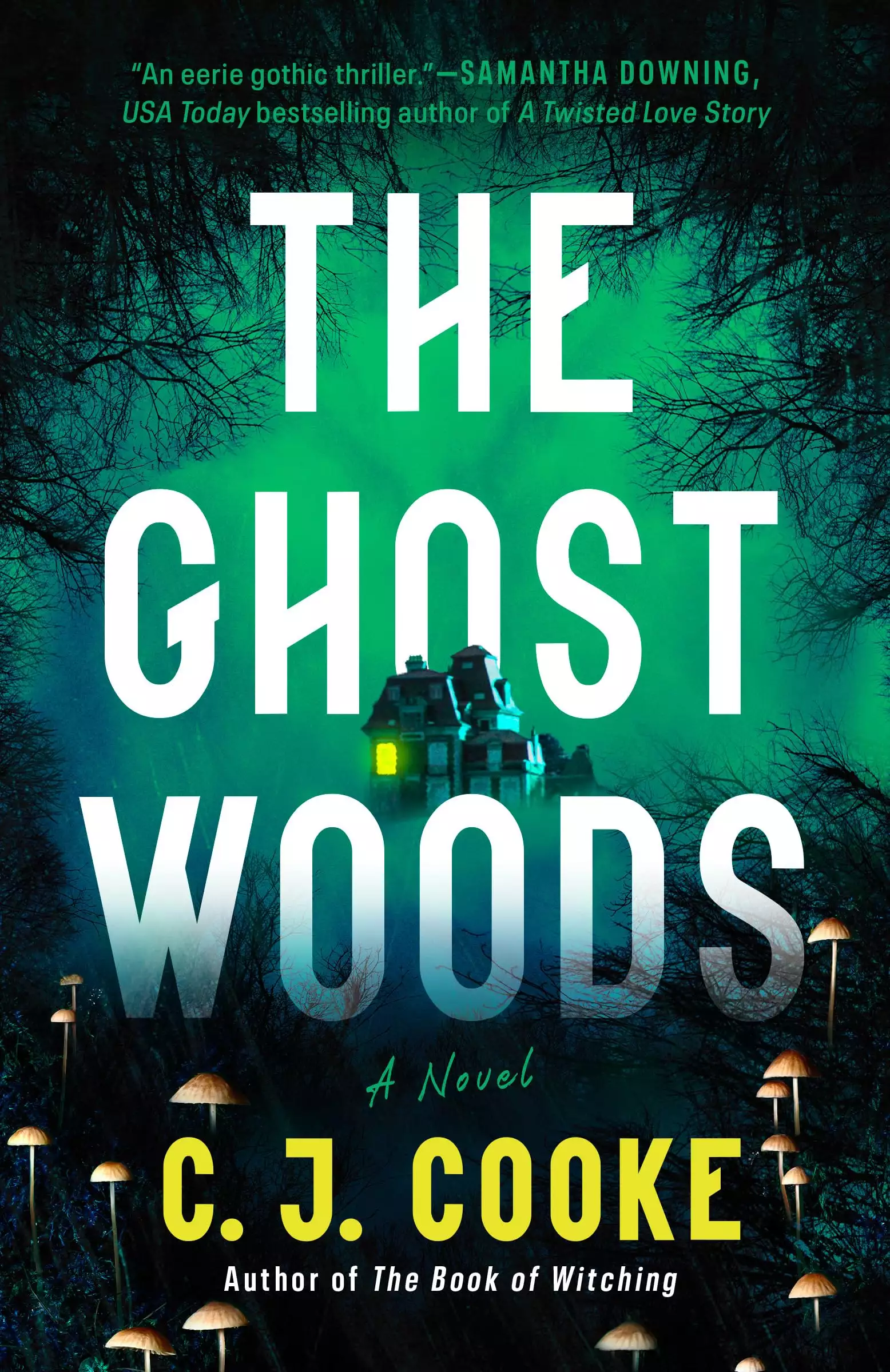
The Ghost Woods
- eBook
- Paperback
- Audiobook
- Hardcover
- Book info
- Sample
- Media
- Author updates
- Lists
Synopsis
In the midst of the woods stands a house called Lichen Hall. This place is shrouded in folklore—old stories of ghosts, of witches, of a child who is not quite a child.
Now the woods are creeping closer, and something has been unleashed.
Pearl Gorham arrives in 1965, one of a string of young women sent to Lichen Hall to give birth. And she soon suspects the proprietors are hiding something. Then she meets the mysterious mother and young boy who live on the grounds—and together they begin to unpack the secrets of this place. As the truth comes to the surface and the darkness moves in, Pearl must rethink everything she knew—and risk what she holds most dear.
Release date: April 29, 2025
Publisher: Berkley
Print pages: 384
* BingeBooks earns revenue from qualifying purchases as an Amazon Associate as well as from other retail partners.
Reader buzz
 Please log in to recommend or discuss...
Author updates
The Ghost Woods
C.J. Cooke
In a minute or two the Caterpillar […] crawled away into the grass, merely remarking as it went, ‘One side will make you grow taller, and the other side will make you grow shorter.’
‘One side of WHAT? The other side of WHAT?’ thought Alice to herself.
‘Of the mushroom,’ said the Caterpillar.
Lewis Carroll, Alice’s Adventures in Wonderland (1865)
He wha tills the fairies’ green
Nah luck again shal hae;
And he wha spills the fairies’ ring
Betide him want and wae.
Traditional Scottish Rhyme
‘You’re going to kill me,’ he says with a whimper. ‘You want me to burn in the fire.’
His words land like blows. I look over his sweet face, at his soft brown eyes that hold no guile. Why would he say such a thing?
‘Do you know why?’ I whisper. The words are hard to say.
‘Because of what I am.’
I reach out and take his hand in mine. ‘I would never, ever hurt you,’ I say gently.
A shadow falls across his face.
‘But you will.’
Just five years old, filled with such terrible knowledge.
My son.
It is said the daughter of the richest hall in the Scottish Borders liked to read in the ancient wood nearby, where the trees were so old their trunks had whitened and their branches were gnarled and crooked.
One day, the girl fell asleep on the forest floor, and as she slept, she dreamt she was visited by a malign and hideous creature, old as time and twisted as a vine, dripping in thick black slime. This was the witch, Nicnevin, Scotland’s Hecate, in one of her many forms.
When the girl woke, she raced home and dared not visit the forest for many months.
Nine moons later the girl delivered a baby, despite swearing she had lain with no man. The doctor who attended took one look at the child and fled. While the child had a cherubic human face, long fibrous roots extended from its fingers, toes, and navel, its ears were budding twigs, and the crown of its head was what appeared to be the spongy cap of a mushroom.
The parents would not allow such a creature to live, and it is said that Nicnevin cast a spell on each of them, possessing their minds until they hated each other, or took their own lives out of confusion and misery. The family was forever cursed for their cruel act.
But the witch would not let the hall go to waste. The hall, Nicnevin decided, would be reclaimed as her kingdom, a palace of rot and ruin.
Hence the name, Lichen Hall.
‘The History of Lichen Hall’, footnote xi, The Magical World of Fungi, A.E. Llewellyn (1937)
Dundee, Scotland, May 1959
I have a ghost in my knee. There’s a small pocket just behind the kneecap and she’s hiding in there, all tucked up in the soft mattress of cartilage. She’s very small and terrified, so I’m sitting with that leg slightly straightened so I don’t disturb her. I’ve not said a word about this to anyone. They’d think I’m mad.
‘Mabel? Are you listening?’
Ma’s eyes are wide, as if she’s trying to wake herself up, but her hands tell a different story. She’s holding on to the strap of her handbag, knuckles white, as though we’re on a fair-ground ride.
‘Did you hear what Dr McCann just said?’
I nod, but I didn’t hear, not really. I’m always doing this – sliding off into a daydream. I look over the file on the desk beside us. I can see my name. Mabel Anne Haggith. Date of birth 12 March 1942, ninety-eight pounds, five foot two. Dr McCann peers down his spectacles, his fat red fingers laced together like a sea creature. The air in the room pulses with the sense that I’ve done something wrong.
‘When was the date of your last menstrual period, Miss Haggith?’ he asks.
‘I’m not sure.’ Embarrassment hits me like a slap. Nobody has ever asked me that before. It’s a private thing.
‘Do try and recall,’ he says wearily. Ma nudges me as though I’m being rude.
‘My … my monthlies have always been irregular,’ I stammer.
‘I only need to know about one menses, Miss Haggith.’ Mr McCann sighs. ‘The last one.’
‘Just before Christmas,’ I say, remembering how the ground seemed to tilt that morning in the bakery when I was putting in the first batch of mince pies. A strong twist in my groin, and I knew what was happening. Unlike now.
Dr McCann scribbles something down before flipping through the calendar on his desk. More scribbling, and muttering. The ghost in my knee gives a cough.
‘Five months,’ Dr McCann announces suddenly. ‘Which suggests a due date around the end of September.’ He licks his finger and thumb and plucks a leaflet from a pile on his desk. ‘Here,’ he says, passing it to Ma. ‘I expect you’ll wish to make enquiries as soon as you can.’
Ma takes the leaflet with a sob. The ghost is restless, unable to sleep now. I rub my kneecap furiously until Ma pulls my hand away, irritated.
‘Who was it?’ she snaps, her eyes flashing. ‘Was it that awful boy, Jack?’
‘Jack?’ I say, frowning. ‘I don’t understand. What’s wrong with me? Am I dying?’
‘Dying?’ Dr McCann starts to laugh. ‘Come on, Mabel. You’re seventeen. You’re not a child.’
‘… would have thought you’d keep your legs crossed,’ Ma hisses, angry tears wobbling in her eyes. ‘And that dirty, disgusting boy. I knew it would come to this. I knew it.’
It’s only when I see the title of the leaflet that it dawns on me, a slow realization like creeping fingers along my neck. St Luke’s mother and baby home. The front of the leaflet bears a picture of a woman sitting in bed, a man and woman beside her. They’re all smiling, and she’s handing a baby to them. A subheading reads, Adoption is the best option for unwed mothers.
They think I’m expecting a baby. That’s what this is.
‘I’m not having a
baby,’ I protest loudly, and I almost go to tell them about the ghosts that sometimes sleep in my lungs or hide in my gums, and that maybe there’s a ghost in my womb and they’ve mistaken it for a baby. But instead, I say, ‘I’m a virgin,’ which causes Dr McCann to splutter into a laugh. But it’s true – I am a virgin. I’ve never had sex, not even the type you do with your hands.
Dr McCann looks at Ma, whose face is tight, lips pursed. A fact I heard once drifts into my mind – the average person tells one or two lies a day, but is lied to up to two hundred times a day. I know I’ve told the truth. So is Dr McCann lying?
My stepdad Richard is waiting for us in the car when we go outside. ‘Everything OK?’ he asks Ma, and she presses her face into his chest as though we’ve just fled a war.
He narrows his eyes and looks from her to me. ‘What did you do?’ he says.
I keep my knee straight for the ghost, but she’s moved. I can feel her in my tummy now, dancing.
‘It’s that Jack,’ Ma whispers, stricken. ‘He’s got Mabel in trouble.’
Jack’s my friend from two doors down. We’ve been seeing each other, but we’ve never gone further than kissing. ‘It’s not Jack!’ I say, afraid that she’s going to pin blame on him when he’s innocent.
‘Mother of God,’ she hisses, crossing herself. ‘There’s a squadron of potential fathers.’
Richard stares at me, his face darkening. My heart flutters in my chest. I don’t know what I’ve done wrong.
We pull off for home. Our house is a four-storey terrace on Rotten Row. There are nine bedrooms, seven of which are usually occupied by strangers. We’ve lived there my whole life, but it’s only been a guest house since Da died ten years ago. It’s how Ma met Richard. He came to stay six years ago and never left.
We stop outside Mr McGregor’s butcher’s shop. Richard winds down the window and the smell wafting from the shop door is like an open crypt. I scramble for the door handle, certain I’m about to be sick.
Adoption is the best option for unwed mothers.
‘You can go for the mince, Mabel,’ Ma says, handing me some coins. ‘A quarter pound and not half an ounce more, do you hear? On you go.’
I press the lapel of my coat to my nose and walk into the butcher’s. An inch of sawdust carpets the floor, plucked chickens are strung up by their necks, and a row of dead pigs hang upside down along the back wall.
Mr McGregor’s son Rory is working today. He’s a little older than me, and he’s deaf. When Rory’s working, they use a notepad and a pencil for the customers to write down what they want. Sometimes Rory writes back little messages, like ‘nice day for a BBQ!’ or ‘you’re looking well today, Mrs Haggith!’
What was I to order again? A dead chicken? When I reach the top of the queue, Rory has been replaced by an older man I’ve never seen before. He must work for Mr McGregor because he’s wearing a bloodstained
striped apron and he’s wiping his hands on a towel and staring at me. He has a tattoo on the side of his face. A spider’s web.
‘What’ll it be?’ he says. ‘Got a great deal on pork sausages today. A pound for ten pence.’
I’m still too deep in my body to speak to him. I pick up the notepad and pencil.
Chicken, was it?
I take a fresh page on the notepad and write, but the words don’t make sense. They say:
There’s a man in the car with a knife to my ma’s neck. He’ll kill her if you don’t give me everything in the till.
I hand the note to the man with the spider’s web tattoo. He looks up at me with a look of wild confusion, and suddenly I’m relieved because he’s every bit as green about the gills as I feel after what happened in Dr McCann’s office. Why did I write that? One of the ghosts must have written it. I can feel one of them lengthening along the bone of my index finger, fidgeting.
The shop is empty. The man glances again at Richard’s car parked outside, and whatever he sees must convince him because he makes a quick dash for the till and starts stuffing handfuls of money into a plastic bag. He hands it to me with a grim nod, the bag full of coins and notes swinging in the foul stench of the dead things. I find my arm lifting, my fingers unfolding from my palm, the bag jangling in my hand, my feet turning and cutting a fresh path through the sawdust. And then I’m outside, and I get into the car and hold on to the bag of money. I’m not sure what’s going on.
‘Pass me the mince,’ Ma says, snapping her fingers at me. ‘And the receipt. He better not have overcharged you. Always adding on a few more ounces than I asked for, that McGregor.’
I hand her the bag. She opens it and stares down at the cash. There’s a moment of complete silence, when all the ghosts inside me are still and Ma’s too bewildered to say anything at all. But it doesn’t last. She turns sharply and stares at me in alarm.
‘Mabel?’ she says.
Scottish Borders, Scotland, September 1965
1
This place is in the middle of goddam bloody nowhere. It’s getting dark, and I swear my bladder is going to explode if I don’t pee in the next two minutes.
‘Do you think we could pull over?’ I ask Mr Peterson. He’s the Church of England’s Moral Welfare Officer.
‘Oh no, is it that time?’ he says, tearing his eyes from the road to glance at me with horror. ‘Do we need to find you a hospital?’
‘What? No!’ I say. ‘I’m not in labour. I just need to empty my bladder.’
The car wobbles slightly as Mr Peterson decides what to do with this information. He flicks the indicator – a pointless act, given that we’re the only car for miles – and slams the brakes on, pulling to the side of the road in a cloud of gravel dust.
I burst out of the car and scramble through the bushes at the roadside, arranging my heavily pregnant body before squatting down with relief. It’s only when I’m finished that I realize I’m ankle-deep in a bog, and my attempts to yank my feet free of the sucking mud flicks up enough of it to ruin the expensive dress my mother bought for me to impress the Whitlocks. Fat chance they’ll be anything but disgusted now.
‘Oh dear. Did you have a fall?’ Mr Peterson asks when I return to the car. I had to reach into the bog to retrieve one of my shoes, so am now sleeved and socked in black slime. He produces a handkerchief from his breast pocket, and I use it to scrub off the worst of it, but the smell makes me gag.
‘Let’s go, shall we?’ I say.
‘Right.’ He clears his throat and turns the radio on before heading back to the road. The Beatles’ ‘I Want To Hold Your Hand’ comes on, and he moves a hand from the wheel to change the station.
‘Oh, can you not?’ I say. ‘I love the Beatles.’
He’s miffed, but leaves the radio as it is.
‘I went to see them, you know,’ I tell him. ‘Last April. When they came to Edinburgh.’
‘Did they?’ he says, and I laugh. As if anyone on the planet didn’t know this.
‘I signed the original petition to get them to come to Scotland.’
‘You must be quite the fan,’ he says.
I tell him how Lucy, Sebastian, and I camped out for two nights on Bread Street to get tickets. It was freezing cold, a long row of sleeping bags huddled together on the pavements, but I never laughed so much in my life. And then, the night of the concert, the sight of the four of them on the small stage of the ABC Cinema, all in grey suits. When they played ‘I Want To Hold Your Hand’, you could barely hear them for the hysteria. Everyone around us immediately burst into tears, even Sebastian. It feels like a hundred years ago that we did that.
‘I’m more of a Glen Miller man myself,’ Mr Peterson says, and he gives into the urge to flip the station to the eight o’clock BBC News.
I wonder how often he makes this trip, driving knocked-up girls to mother and baby homes – although the place we’re headed to isn’t a mother and baby home, per se. It’s a residential home. Lichen Hall, a sprawling sixteenth-century manor house owned by the Whitlock family, who lovingly take in girls like me on occasion to spare them the indignity of entering an institution. I’m grateful for this, really I am. But I’m so anxious I’ve broken out in hives. Lichen Hall is situated on the Scottish Borders, half an hour from the little fishing village of St Abbs – or, like I said, in the middle of goddam nowhere. What am I going to do all day? I should
have asked if they have a record player, or, at the very least, a television. I’m used to being busy, up at five to start my shift at the hospital, then straight out to dinner or a nightclub with friends.
‘I don’t suppose you know if this place has a television?’ I ask Mr Peterson.
‘I’m afraid I don’t.’
‘They’ll have a phone, won’t they? I’ll be able to ring my family?’
‘You didn’t find that out before you agreed to stay?’
Truth be told, I was too ashamed to do anything other than resign myself to whatever fate my parents planned out for me. Pregnant and unmarried at twenty-two. I’m such a disappointment.
‘It’s not too late to apply for a place at an institutional mother and baby home,’ he says, hearing the fear in my silence. ‘They’ve changed, you know. Not as Dickensian as they used to be.’
I don’t believe this for a moment. I visited a mother and baby home last month. It was one of the smaller ones, in a terraced house on Corstorphine Road, run by the Salvation Army. The atmosphere inside chilled me. The matron was charming, but the walls were cold and bare, and from the pale, fearful expressions of the girls there I suspected she ruled the place with an iron fist.
‘Mum says she knows the owners of Lichen Hall,’ I tell him. ‘She says they’re my kind of people. Mr Whitlock’s retired. He was a scientist. A pioneering microbiologist, if I’m correct.’
‘A microbiologist? And they own a mansion?’
‘He held professorships at Edinburgh University and Yale. Mrs Whitlock’s father bought Lichen Hall, back in the day. I’m sure they’ll have a telephone.’ I say this more for myself than for Mr Peterson. ‘And anyway, how would it look if I cancelled so late in the day?’
He arches an eyebrow. ‘Your mother is a friend of the Whitlocks?’
‘Well, friends of friends.’ I try to read his look. ‘Why? And don’t even think about telling me the place is haunted. My brother’s already tried that one.’
Charlie kindly cooked up an elaborate tale last night and decided to regale me with it while I was packing. Something about a fairy queen who took issue with the original owners after they killed a fairy baby. According to my brother, she haunts the place and curses everyone who steps inside it. Such a bastard, is Charlie. He knew full well how anxious I was about coming.
We take a right turn and park outside tall black gates, two gold ‘W’s pronged at the top. This must be it, though it’s quite a concealed entrance for what I imagine to be a large estate, just a wee nook on the bend
of the road clutched by trees.
Mr Peterson turns off the car engine and pulls a folded piece of paper from his jacket pocket. ‘Instructions for the key,’ he says. I watch as he steps out and roots around for a while in the dim light, bending over a bush and then heading back to the gates with what I assume to be the discovered key. He opens the gates and returns to the car to drive us through.
‘I think you were about to tell me Lichen Hall is cursed,’ I say. ‘Or that the Whitlocks are murderers.’
‘I’m not at liberty to say …’
‘Oh, for God’s sake, spit it out,’ I laugh. ‘You can’t build me up like that and then clam up.’
‘It’s just a rumour,’ he says, braking too hard at a bend and throwing us both forward in our seats.
‘What’s just a rumour?’
He scratches the bald spot on the crown of his head. ‘Well, it was a while ago now. ’57 or ’58, I can’t remember when … An awful car accident just past Berwick. Smoke for miles. Neither of the Whitlocks was involved, but their son was.’
‘My God,’ I say. ‘Their son?’
‘Their only son, only child. Rumour goes that once word of the crash reached the Whitlocks, they went straight to the morgue and insisted the body be given over to them.’
I wait for him to tell me he’s joking, but he doesn’t. ‘That’s … unusual.’
‘Well, that’s not the worst of it. About a week later, their son – his name escapes me – was spotted in the village, right as rain, apparently. No sign of injury.’
I digest that for a moment, then shake it off. Lichen Hall is one of the largest properties in the Scottish Borders. It sounds like they’ve been the victims of vicious gossip.
‘That’s all I know,’ Mr Peterson says, very serious.
‘I’ll bear it in mind.’
I won’t let him talk me out of this. I’m not going anywhere near an institution, thank you.
The drive to Lichen Hall is a single lane tarmacked road with a wall on one side and tall trees on the other, and I crane my head to spot the house at the end of it. Oh God, there it is, lit up by the car’s headlights. Four pointy turrets and dark stone walls laced with red ivy. It looks like Dracula’s holiday home.
We drive to the main entrance, marked by pillars, broad stone steps, and a forbidding front door. Mr Peterson suddenly looks nervous.
‘I’ll leave your bags by the steps,’ he says, cutting the engine. He jumps out of the car, and I follow, watching him as he hefts the bags out of the boot and dumps them on the ground.
‘Can you at least help me carry them inside?’ I ask, annoyed at how carelessly he drops my belongings on to the wet cobblestones. He’s already heading back to the front of the car, and I assume he’s getting some paperwork, some last detail before handing me over to my hosts.
But then the engine sounds, and with a squeal of tyres he’s driving off, the back end of the car fishtailing as he disappears down the driveway.
It starts to rain. I look around, too dumbfounded by Mr Peterson’s hasty departure to be annoyed about it. The storm doors are shut, no one around. I decide to abandon my luggage and waddle to the side of the house where, to my relief, I see a woman in a doorway, throwing what looks like breadcrumbs across the courtyard. A dozen crows are gathered around, fighting for the food.
‘Hello?’ I say. ‘I’m Pearl, Pearl Gorham. I think you’re expecting me?’
‘Oh, hello!’ the woman says, stepping forward with an outstretched hand. She must be Mrs Whitlock. She has cropped brown hair flecked with silver, hooded grey eyes, crooked teeth. She’s dressed in dark trousers and a turtleneck. Her skin is pocked with acne scars, and she has broad, capable hands with short clean nails.
‘Yes, we were expecting you,’ she says. ‘Where’s your driver?’ She’s Scottish, but has very little accent, as though she’s lived most of her life in London, or had elocution lessons.
‘He had another appointment,’ I say hastily.
She calls back inside the house. ‘Aretta? Rahmi? Come and help Miss Gorham with her bags.’
Two girls emerge from the darkness and I direct them to the spot where I left my suitcases. They’re both about my age. Aretta is tall and lean, brown-skinned, with high cheekbones and full lips. She’s impressively strong, as she plucks up the heaviest bag as though it’s a box of feathers. Rahmi is small, feline eyes the colour of ochre, long black hair tied up in a loose bun. She has a nose piercing and a no-shit-taking stare. At first, I assume they’re here under the same conditions as me, but neither of them is visibly pregnant. Perhaps they’re maids.
The rain starts to pelt down, so we gather up the bags hastily – though Mrs Whitlock tells me not to help, given that I’m eight months pregnant – and race inside.
I find myself in an old-fashioned kitchen with chequerboard tiles, mahogany cabinets, a vast, marble-topped kitchen island, and an impossibly high ceiling sliced by wooden beams, the kind a trapeze artist might make good use of.
She looks me up and down. ‘Did you have a fall?’
I remember the caked mud on my dress and hands. I look a mess. ‘Ah, sorry. No, not a fall. We had to make a pit stop earlier …’
‘Let’s get you cleaned up.’
She leads me briskly along a long hallway towards a set of stairs. I hate stairs, since about two months ago. Stairs and the third trimester are not a good combination. But I try to keep up.
‘I’m afraid the east wing is closed off,’ Mrs Whitlock says, a few steps ahead of me. ‘My husband and I aren’t up to that kind of work. Not anymore.’ She trails off. ‘Anyway, there’s enough of the house left to accommodate us all comfortably. We have hot water, but only in the mornings, so you’ll do well to rise early. Rahmi prepares breakfast at seven, lunch at twelve and dinner at five.’
‘Why is it closed off?’ I ask.
She cocks her head. ‘I’m afraid I don’t follow.’
‘You said the east wing was closed off. And that you and your husband weren’t able to …’
‘Ah, I see. Shall I give you a tour?’
I nod, brightening. ‘Yes please.’
Her eyes fall on the dried mud streaked across my hands and legs. ‘You don’t want to wash and change first? I can show you after …’
‘Now is perfect,’ I say, not wanting to explain that fear is oozing out of my every pore, and that the only way I’ll be able to sleep tonight is if I familiarize myself with these new surroundings as quickly as possible. I’m a creature who thrives on familiarity.
She gives a little impressed tip of her head. ‘Follow me,’ she says.
At the end of the corridor, the stairs continue up another floor, and I notice a stairlift bolted to the wall. It looks like a new addition.
Mrs Whitlock leads me to the left, which fans out into a huge room, ballroom-sized, with a row of stained-glass windows sending rainbows all over the thick carpet. ‘This is my husband’s Micrarium,’ she says, and I nod as though I know what a bloody Micrarium is. ‘When we first moved here, he bought a metal detector to scope out the grounds for old coins.’
‘Old coins?’
She looks surprised. ‘Oh, I thought you’d have heard about the grounds of the hall. Yes, quite the site we have here – the old wood about a quarter of a mile east is part of the ancient Caledonian forest. You’ll notice the trees have very pale trunks, very ghostly. We call them the ghost woods. My father dug up a horse harness the week after he and my mother moved here. From the Bronze Age, it turns out. Three thousand years old.’
‘Wow,’ I say. ‘That’s incredible.’
‘Well, yes. We’ve not found anything quite as significant since. A handful of Jacobite bullets, a redcoat button. Lots of bones, some of which turned out to be human.’ A grimace. ‘Lots of battles on our grounds, it seems. My husband is more interested in nature than history, anyway.’
‘Nature is history, isn’t it?’
‘Quite. ...
We hope you are enjoying the book so far. To continue reading...
