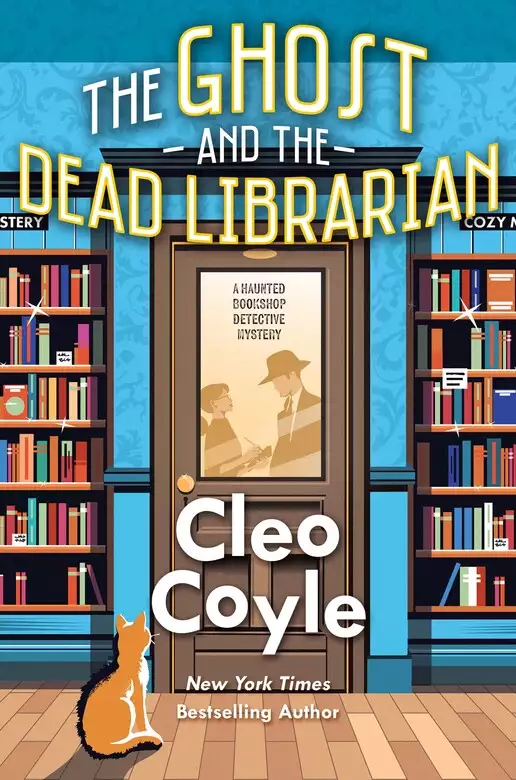
In an utterly charming new paranormal cozy mystery series from New York Times bestselling author Cleo Coyle, a smalltown Rhode Island bookshop owner investigates the death of an eccentric librarian with the help of a wisecracking, 1940s gumshoe ghost.
As a young widow, Penelope moved back to her quaint Rhode Island town to give her young son a safer home and her aunt’s dying bookshop new life. Using her late husband’s insurance money, Pen polished the store into a local treasure. But her updates did more than attract new customers. They roused a dead private eye from his big sleep.
With Pen’s affection for hardboiled detective stories, it’s no surprise she’s developed a fondness for the wisecracking yet oddly likeable spirit. Sure, Jack’s cold spots are exasperating, along with his proclivity for putting noir fiction in the cozy section. But murder was Jack’s business in life, and his PI skills come in awfully handy when the body of an eccentric librarian is found amid the bookshop’s mystery aisles.
For years, Dory jokingly called herself “The Dead Librarian” because of her hobby of collecting local obituaries. Now, in death, she’s discovered holding her own eerily pre-written obit. Was it a suicide note? Jack and Pen say no and their certainty takes them from a ghost town’s ancient cemetery to a prominent family’s Newport estate. Then an intriguing stranger comes to town. Nikki Burnside takes a keen interest in Dory’s death and makes Pen a shocking offer, one that may change her life—and Jack’s afterlife. But unless Jack can help Pen prove who “checked out” the librarian, a ruthless killer may close the book on her.
Release date:
September 29, 2026
Publisher:
Kensington Books
Print pages:
384
* BingeBooks earns revenue from qualifying purchases as an Amazon Associate as well as from other retail partners.
I’m licensed as a private detective … The police don’t like me. The crooks don’t like me … My ethics are my own … and I’ll shoot it out with any gun in the city—any time, any place.
—Carroll John Daly, The Snarl of the Beast, 1927(cited as the first hard-boiled private detective novel)
New York City
June 5, 1947
Jack Shepard dropped his fedora on the worn green counter and his powerful body onto a padded stool.
After a string of long days and sleepless nights, he dreamed of hard shots and soft shoulders, but his complaining stomach demanded a hot meal. And since his dusty pantry held little more than stale pretzels, cigarettes, and beer, he’d made his way here. The Third Avenue Lunchroom wasn’t the Ritz, but it was familiar, and to a man who made his living navigating unfriendly alleys, the least bit of familiar felt like home.
He threw a wink at the waitress.
“What’s good today, Millie?”
“Depends.”
“On what?”
“On what you’re gonna spend. I like a good tip.”
“Here’s one for you.” Jack tapped the racing form in his suit pocket. “Zippy the Pip in the fifth at Belmont.”
“A girl can’t pay the rent with that kind of tip!”
“Sure, she can. With five to one odds, you’ll win a double sawbuck if your pony shows.”
“And if he don’t?”
Jack shrugged his acre of shoulders. “Tell you what, if your blue plate’s warm and your java’s hot, you’ll get your tip in cold hard cash.”
“Well then, big fella, I’ll get your coffee.”
As Millie stepped away, Jack turned his squeaky seat to case the joint. He never sat long with his back to a room he hadn’t eyeballed.
The place was nothing special, one of those greasy spoons that had been around since before pre-sliced bread became the basis of civilization. The uptown crowd would cringe at the very idea of sitting at its rickety wooden tables and worn leather booths, but Jack never did like the smart set. Too many closets with skeletons, plenty of which he had been hired to find or bury—figuratively speaking. He was a private eye, not muscle for hire.
On the other hand, he wasn’t above bending a law or two. As long as he got his twenty clams per diem, he was up for the job. And lately those jobs kept him hopping faster than that mechanical rabbit hoodwinking greyhounds around a dog track.
The typical noontime crowd was here: secretaries, store clerks, and switchboard operators, along with a few cabbies, subway guards, and newshounds, though the latter usually drank their lunch with their own kind at the hotel bar up the street.
Only one thing struck him today as looking wrong. The cookie sitting alone at a corner table quietly crying.
Dressed in a tailored red suit with a matching cap and smooth victory roll to her shiny chestnut hair, Daphne was one of those smart-looking shopgirls from Fifth Avenue. Like the rest of her type who frequented this no-frills eatery, she was expected to look like she belonged on Fifth, even though she couldn’t afford a meal there; and since her brother worked here, she stopped by nearly every day to see him.
They were good kids, barely out of their teens with a sad song he’d heard many times before. When their father died in the war, they lost their farm in Rhode Island and moved down to the city with their mother to find work. Then she died and they were on their own.
When Millie returned with his strong black cup, he tipped his head toward the crying girl.
“What’s with the waterworks in the corner? Someone bother that kid?”
Millie frowned. “You might say that.”
“And what do you say?”
She leaned close. “Just before you arrived, coppers were here—two of them. They questioned her.”
“The uniform kind or detectives in suits?”
“Suits. They asked her about her brother, Jimmy.”
“Jimmy the busboy?”
Millie nodded. “They grilled me, too. Wanted to know where the kid was. I said he was at his other job. Lawn and garden care for the Long Island types. I asked them why they wanted to know, but they wouldn’t tell me.”
She rested her arms on her padded hips and shook her head sadly.
“I don’t know what they said to Jimmy’s sister, but after they left, she started bawling.”
Jack rubbed his iron jaw. “When’s the kid due to punch the clock?”
“Any minute. Jimmy works the afternoon shift.” She looked worried. “You think he’s in some kind of trouble?”
“Jimmy? Naw. That kid is an Eagle Scout. Two jobs plus charity work coaching baseball at an orphanage.” Jack waved his hand. “They probably want him as a witness for some crime. They’ll get his statement and that will be that.”
A few minutes later Jack was tucking into his meatloaf and smashed potatoes when Jimmy swept through the kitchen door in his apron, ready to collect plates and wipe tables. He spotted Jack, and his peach-skinned face lit up.
“Hiya, Mr. Shepard!”
Jack waved him over, which was nothing new, since they chatted every time Jack came for a meal. Jimmy was smart and funny, always had a joke about the latest headlines, the Yankee lineup, or the bangtails on Jack’s racing form. But mostly the kid liked hearing about Jack’s cases, even though tales of tracking Cheating Charlies and recovering stolen industrial equipment were a lot less exciting than the crazy yarns they published in those dime detective magazines the kid read.
“I like the idea of doing good for people,” he once told Jack. “And finding justice for ’em is about the best good you can do. That’s why I’d like to become a detective or policeman someday or maybe a lawyer, like Clarence Darrow or Perry Mason …”
“What’s the matter, Mr. Shepard?” Jimmy asked. “You look like you ate a dark cloud—and in this joint I’ll bet they’d serve it with ketchup and a straw.”
“Are you in some kind of trouble, son?”
“Me? No. Why would you ask that?”
Jack didn’t have a chance to tell him. The detectives in suits were back with a couple of uniforms in tow, and they didn’t waste any time. They surrounded Jimmy and cuffed him. The boy was in shock as they dragged him toward the door.
Daphne jumped up and threw herself in front of the cops.
“Stop! Leave my brother alone!”
Jack knew her protests wouldn’t matter. Nothing a dame shouted, or a gumshoe argued, would have slowed those hard-faced cops down. This arrest was serious and deliberate.
Under Jack’s stern but silent gaze, one of the uniforms firmly moved Daphne aside.
Out on the sidewalk, the spectacle drew a crowd. The cops pushed through and drove away with a stunned and frightened Jimmy handcuffed in the back.
As Millie put her big, soft arms around Jimmy’s sister, mothering the tearful girl, she met Jack’s gaze with a confused and desperate look. It was a look he’d seen many times in his business, one that told him she didn’t know what to do.
When Daphne finally wiped her eyes, she saw the gawkers had disappeared and traffic had resumed up and down Third Avenue. The mechanical rabbits had returned to the rails of their routines. But Jack Shepard stayed. His tower of a body refused to move an inch from the cracked concrete.
“What are they charging him with?” Jack asked.
“Murder,” Daphne whimpered.
Jack’s fists clenched. That stouthearted kid would never take a life, which meant one of two things—sloppy police-work, or somebody put a frame on the boy.
“Mr. Shepard, I have to help my brother,” Daphne said, eyes welling again, “but I don’t know how.”
“That’s all right, doll, because I do.”
My Bookshop Ghost
Midnight, I dare say … The time when the graves give up their dead, and ghosts walk.
—Dashiell Hammett, The Dain Curse, 1929(first serialized in Black Mask magazine, circa 1928)
Quindicott, Rhode Island
Present Day
I sat up in bed, eyes wide open.
“Jack?” I whispered into the dark. “Are you there?”
As thunder rumbled in the distance, a gruff voice grumbled through my head.
Yeah, baby, I’m here.
A moment ago, I was in a greasy spoon on New York’s bustling Third Avenue, watching the famous private detective, Jack Shepard, take on a new case. Suddenly I was jerked out of the bright, raucous past and waking up in the shadowy silence of my own bedroom.
“Your story ended with an innocent kid carted off to jail. What happened next?”
Plenty. But I can’t steer your dreams if you ain’t conked out. You ready to re-hit your sack, honey?
“No,” I told the ghost. “My mouth is full of cotton. I need a drink.”
“Now you’re talkin’. Gin? Scotch?”
“Water.”
I threw off the covers and immediately started shivering.
My window curtains were billowing on a chilly autumn gust that sent the damp smell of dying leaves circling the room. With a groan, I pulled a thick terry robe over my thin, cotton nightgown, shoved on my glasses, and freed my copper hair from its messy ponytail, hoping for extra warmth around my ears.
Even without my cracked window, the ghost tended to drop temperatures a few degrees, and his dreams weren’t just dreams. They were vivid memories of his own time, and he never shared them lightly. There was always some point—though I couldn’t see this one, and I told him so as I shut the window and headed for the kitchen.
Don’t get your panties in a twist. You came to before I got to the point …
That’s what the ghost told me on the night I’d found the dead librarian. He wasn’t impressed with how I’d handled things afterward, and he told me so, but I couldn’t fault him for that.
Despite selling mysteries for a living, I wasn’t so hot at solving them. Jack didn’t mind. He seemed to like coaching me. And I let him. After all, he’d had far more experience with homicide than I, and not just because he was a victim of it.
Before heading off to fight the Nazis in Europe, Jack had been a cop in New York City. After returning from the war, instead of rejoining the NYPD, he opened his own private investigation business—until 1949, when he was gunned down in my family’s Rhode Island bookshop while pursuing a lead in a case.
I, Penelope Thornton-McClure, single mom, widow, and now co-owner (with my aunt Sadie) of our family’s book business, was far from a professional PI. Sure, I was a longtime fan of the Black Mask school of detective fiction (thanks to the noir-loving reading habits of my late father); but a few years ago, when the Rhode Island Staties were eyeing me as a person of interest in a murder investigation, I’d needed more than a fictional detective, and I got one.
It was during that highly stressful time in my life that Jack’s voice broke through, surprising us both. The ghost had tried to speak with many other living souls over the years, but they never heard him—or never needed to.
Now, I was the only breathing creature who could hear the ghost of Jack Shepard, besides Bookmark, our orange marmalade tabby; though, as far as I knew, the cat never talked back.
Ever since then, Jack’s spirit had buoyed me across numerous rocky stretches; though, as a sounding board, Jack and his hard-boiled ideas weren’t always sound. For one thing, I refused to “pack a heater” in my purse. Brass knuckles were not an option for my son Spencer in dealing with an elementary school bully. And when it came to crime, I never relied exclusively on my PI spirit.
Earlier this evening, after I discovered the librarian’s corpse, I tearfully notified the authorities, like any sane citizen. But while our local police force was still deciding whether her death involved foul play, the ghost in my head was pronouncing it murder.
Was he right? Or was it just wishful thinking on his part?
As a big-city private eye, Jack never expected to be stuck in a small town like Quindicott for the rest of his afterlife. An unsolved murder gave Jack’s spirit something to do besides twiddle his nonexistent thumbs, manifest cold spots, and haunt my bookshop customers.
But while a potential homicide always livened up the dead guy, I had doubts about what exactly happened. I told Jack as much as I filled a glass with cold water from the kitchen sink.
Listen, doll, Jack replied, if you’re standing on shaky ground, then you need to look harder.
“At what?”
The ground! Ever heard the saying “God is in the details”? Well, so’s the devil. Detective work is all about details. Do it wrong and angels weep. Do it right, and you might save some poor soul from the worst kind of hell. Success or failure lies in how you build your case. So, let’s go over yours. From the top …
I took a deep breath and did as Jack asked. After settling in at the kitchen table, I drank away my cotton mouth. Then I began to recount the evening’s fateful events from the start.
An Honored Guest
It was Friday night, and the place was packed for Dory McKenna’s book launch party.
By attendance alone, our event was already an enormous success. Our aisles were choked with happy shoppers, browsing for purchases as they waited for the start of Dory’s author talk and book signing.
While I chatted with our customers, helping them with selections and steering them toward releases by favorite authors, my aunt Sadie and our twenty-something staffer, Bonnie Franzetti, rang them up.
On a typical day, Sadie, Bonnie, and I were able to run our shop with ease. My young son, Spencer, often helped after school and with special events, but he was off camping overnight, and this evening we needed more hands on deck. So, I asked an old friend to act as security.
Seymour Tarnish wasn’t an obvious bouncer type, given his paunchy build and knobby knees, but as a mail carrier for the U.S. Postal Service, he was used to dealing with all manner of humanity, and with his big personality (and even bigger mouth), Seymour could always keep rowdy crowds in line.
As a voracious reader (and passionate collector of vintage pulp novels and comic books), Seymour was also a good customer, and he’d mastered enough trivia to make him a Jeopardy! champ. That victory had earned him quasi-celebrity status in our little town, though generally people considered him an odd bird, given his decision to spend his game show winnings on an ice cream truck. Good Humor, however, was not his usual disposition.
“Make a hole! Make a hole!” Seymour bellowed, somewhere near our front door. “Out of the way, people! Tonight’s main attraction is coming through!”
The crowd began to part. Not as dramatically as the Red Sea, but close. I knew this had less to do with Seymour and more about the respect and affection everyone had for our town’s retired head librarian. Warm applause swept the store the moment she appeared.
Dory McKenna smiled and nodded. Though petite, she gave off electric energy. Her sharp blue eyes flashed with bright enthusiasm as she greeted everyone she knew—and she knew practically everyone, given her former occupation. But it was her lifelong passion that led to this evening.
When Dory was just a young staffer at the Quindicott Library, she began creating a database of obituaries for the region. Soon, she was the one writing all the obits for our town paper. She even jokingly referred to herself as “The Dead Librarian.”
With tonight’s book launch, all those years of dedicated dead work were about to pay off. Utilizing two centuries of collected obituaries as well as family Bible entries, church and municipal records, and primary source interviews, Dory had assembled a unique history of our region through the lives of prominent (and not so prominent) citizens.
Her book, Directory of the Dead, was an instant “must read” for our area, as evidenced by the incredible turnout. Everyone was excited to learn what Dory had discovered about their ancestors (and their neighbors’ ancestors).
My aunt Sadie was thrilled, too. She had known Dory forever and helped her prepare for the evening by shopping with her for an elegant maroon pantsuit with matching heels. Colleen, our town’s beautician, had trimmed and rinsed Dory’s salt-and-pepper nest into a sleek, silver pageboy and even did her makeup.
As Dory moved through the store to our adjacent event space, I could tell the crowd was impressed with her transformation. Gone were the flannel shirts, bulky sweaters, and loose denims she’d adopted since retiring.
Suddenly the newly fashionable Dory was stopped by an attractive middle-aged man in a navy blazer with golden blond hair, a closely trimmed beard, and a toothy smile.
“Ms. McKenna, may I have a word? I’d like to ask—”
“The Q and A is after the talk, buddy,” Seymour said, waving him off as he escorted Dory forward.
Our shining literary star and her de facto bodyguard quickly made it through the dense crowd with me following in their wake. Finally, we reached Sadie’s version of a velvet rope. Seymour untied the purple ribbon and admitted Dory and me to our events space. Then he quickly tied it up again before the crowd could push through.
“Keep your pants on, people! There’s still ten minutes to showtime.” He tapped his watch. “Go back to your shopping, and I’ll clue you in!”
The three of us were now alone in the quiet peace of our newly renovated event space. Bonnie and I had spent the morning lining up the folding chairs in two sections of seventy-five each, with an aisle in between. Looking around now, I was concerned whether there were enough seats to accommodate everyone.
While Seymour escorted Dory to the podium in front of the room, I adjusted the interior lighting.
“I admire your skills at crowd control, Seymour,” Dory said.
“You’re a celebrity now, Ms. McKenna, so you’ve got to be careful.”
“Careful of what?”
“Men, for starters.” Seymour crossed his arms. “I know more than a few widowers on my mail route who’d latch on to you like a freshwater leech.”
For once, I gotta agree with the postman, Jack announced in my head. The sound of a spinster rubbing two nickels together is always a dinner bell for gigolos.
Really, Jack, I replied in the privacy of my own thoughts. I doubt there are many gigolos within earshot.
I don’t know, Penny, that bearded blond chowderhead sure looked the part.
Dory chuckled. “Seymour, you’re just as outspoken as you were when you were a teenager, and I always enjoyed your imagination.”
“Right back at’cha, Ms. McKenna. Those annual Halloween story-thons of yours were the best. All the kids loved how you got into it. Like the year you chased me with that wooden stake.”
“What did you expect? You came dressed as Dracula. I came as Professor Van Helsing. You read Bram Stoker, didn’t you?”
“On your advice. An excellent yarn.”
“Well, then. You should have known that chase was inevitable!”
What a pair of screwballs, Jack quipped. Dressing up as characters in a book.
“Hey, Pen,” Seymour called. “Who did you come as that year?”
“Um, I don’t recall,” I lied.
“I do,” Dory said. “I always remember clever literary costumes, and Penelope came as Dashiell Hammett’s famous detective Sam Spade.”
Jack snorted. Wishful thinking?
Seymour jerked his thumb. “That’s what Pen figured. But nobody else got it. Everyone thought she came as Katharine Hepburn.”
I could hear Jack laughing.
Ignoring the ghost, I faced Dory. “You always did put on a great show at those story-thons, Ms. McKenna. My son Spencer would have loved them.”
“Just like me and the other kids,” Seymour said. “We ate up those creepy tales you told about our town. The one about Michaelmas Pond was the freakiest.”
Seymour gave a mock shiver, and I gave a real one.
“All those dead bodies,” I said. “That was a scary story.”
“It’s not a story,” Dory said. “The history of this region is far grimmer than you can imagine.”
This dame’s got a real after-dark attitude, Jack said. I think I like her.
Dory checked her watch. “Shall we get started?”
“First we make sure the microphone is working,” Seymour said, flipping it on. “‘Check, check!’ We’re good. Then Pen is going to cut the ribbon and unleash the unwashed horde. When everybody is settled, I’ll shut them up, introduce Pen—”
“And I’ll introduce you,” I said. “Help yourself now to some coffee, tea, or a water bottle on the back table. After your talk, we’ll give you a break to freshen up. Then we’ll have the signing, and Linda and Milner Logan from Cooper Family Bakery will serve one of their special cakes for the wrap-up party. We’ll have drinks, too.”
Good stiff drinks, I hope, Jack said.
Punch, I told the ghost, which is what I’ll do to you in your next dream if you spook our audience. So, behave!
Aw, give it a rest. It’s Friday night. If it were up to me, we’d be on the town at a suds club or gin palace, not in some backwoods bookshop listening to a scribbler gas on—
I know, Jack. I’ve heard it before. Many times—
If I weren’t dead already, I’d be bored to death.
A few minutes later, the ghost ran out of complaints, Dory was seated behind the podium, sipping a bottle of water, and I cut the purple ribbon. As the crowd poured in, I secured Dory’s handbag behind our checkout counter and returned to find the event space completely filled to standing room only.
It was quite a turnout and a diverse one, too.
Descendants of the wealthy old families from Larchmont Hill were rubbing elbows with our fellow shopkeepers here on Cranberry Street. I recognized many locals who’d been born and raised in the lands around this old bookshop: from teachers, nurses, and delivery drivers, to plumbers, housecleaners, and homemakers. All of us had gathered to hear about our shared past.
The editor of the local paper had come to cover the event personally. The town physician and members of the city council were on hand as well.
As far as the citizens of Quindicott—and our less affluent sister town of Millstone—were concerned, Dory McKenna had written the most important book ever published.
My aunt Sadie was beaming with pride as she entered the crowded room and gave me a thumbs-up. I took a deep breath, adjusted my glasses, and stepped up to the microphone.
“Good evening, everyone! It is my great pleasure to introduce our town’s former head librarian, an unmatched expert in our region’s history, an avocation that inspired her newly published work, Directory of the Dead. Let’s give a big, warm welcome to our guest of honor, Quindicott’s very own ‘Dead Librarian,’ Dory McKenna!”
An Unhappy Customer
Enthusiastic applause erupted when Dory finished her talk. She spoke for a solid hour, telling tales of our region and its people. The audience was just as enthralled as Seymour and I had been as kids when she held her annual Halloween story-thons years ago.
Her Q & A session went on for another hour until finally I stepped up to escort her to our back room where she could give her voice a break and use the restroom before her book signing.
About half the audience came only to hear Dory speak and buy her book. But there were still plenty of people who wanted to have their purchase autographed.
Sadie skillfully coaxed the waiting crowd back into our store where they continued to browse, chat, and shop for more books before Dory’s signing session. While Bonnie resumed her work on the register, Seymour and I quickly folded and stacked most of the chairs in the events space, moving others against the wall for the wrap-up party.
As we finished, Seymour set up the autograph table, and I noticed a basket of books someone in the audience had picked out but did not purchase. I decided to return the books to their shelves on my way to fetch Dory for her book signing.
I was in a quiet alcove at the rear of our store, reshelving T. S. Eliot’s Old Possum’s Book of Practical Cats, when I felt a gentle hand touch my arm. I turned to find our guest of honor.
“Excuse me, Penelope, do you have a moment?”
“Of course, Ms. McKenna! You gave a wonderful talk. And you answered so ma. . .
We hope you are enjoying the book so far. To continue reading...

 Please log in to recommend or discuss...
