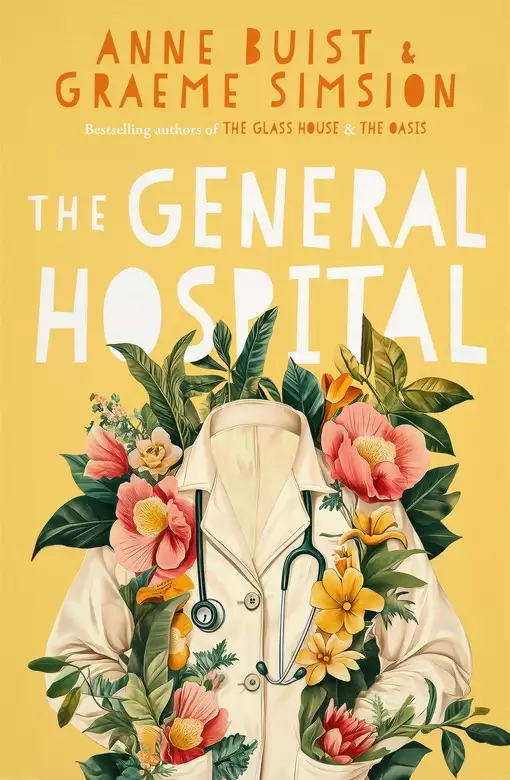
A profound and engrossing medical drama by bestsellers Anne Buist and Graeme Simsion
Trainee psychiatrist Doctor Hannah Wright is back where she worked as an intern: the general hospital. This time, instead of dealing with patients' broken bodies, she's tackling their mental health issues, with a roving commission to cover the medical, surgical and obstetric wards. All the while learning that mental and physical health are inextricably linked.
Christina is planning to sue her obstetrician - Hannah's ex-boyfriend - for mental distress during labour. Junjie's Olympic dream has been shattered by injury. Is he at risk of taking his own life? Max's bipolar medication might keep him level-headed, but it is destroying his kidneys. And Ishani claims that setting herself on fire was an accident, but her story doesn't stack up.
When she's not on call, Hannah finds herself navigating an unexpected friendship and the promising early days of a new relationship with fellow trainee Alex, before her grandmother reveals an explosive family secret.
Filled with realism, heart and humour, esteemed Australian psychiatrist Anne Buist and internationally bestselling author Graeme Simsion (The Rosie Project) bring us into the world of physical and mental health in this unique novel.
Praise for The Glass House and The Oasis:
'Contains all the comforting trappings of a fast-paced medical procedural' SYDNEY MORNING HERALD
'Reminiscent of Eleanor Oliphant is Completely Fine and Simsion's The Rosie Project' BOOKS + PUBLISHING
'A masterfully told, character-driven novel that will have you laughing and crying in equal measures'THE AUSTRALIAN
'An inside eye on the experience of young doctors . . . [with] a compassionate lightness of touch'THE AGE
'A unique novel that's so timely' DAILY TELEGRAPH
'Deeply empathetic' THE AUSTRALIAN WOMEN'S WEEKLY
Publisher:
Hachette Australia
Print pages:
352
* BingeBooks earns revenue from qualifying purchases as an Amazon Associate as well as from other retail partners.
Nova Mandala is standing on the threshold of a new life. Looking great and feeling better – figure-hugging dark red dress; long brown hair with red highlights that shine in the morning sun; fitter inside and out than she’s ever been thanks to diet, exercise and the power of positive thinking. Positive thinking: if you can believe in it, set your mind to it, you can have it.
Today’s wedding would not have happened without the work she’d done with the bride to help her visualise the life she wanted. But as the sun rose over the sea and the couple exchanged vows on the sand, her mind had drifted, and landed at the inevitable place, with the question she would have asked a client in the same position: If not now, when?
She feels guilty. She’s the one who’s changed – for the better. She’s making something of her life. Guilt belongs to the past. Her future is the image she sees every day at the gym – a woman standing on a mountain peak. But Nick isn’t the person she’s going to climb that mountain with.
He’s returning, barefoot, from a walk along the beach with the baby; both children are getting scratchy from the early start. He’s already reminded her that he didn’t want to bring them. There’s a half-empty champagne glass in his spare hand.
‘I’ll drive,’ she says.
‘Why?’
Maybe, just maybe, instead of projecting this constant negative energy, he could say something empathetic – something that might make her reconsider. What if he knew what was coming? We’d all behave differently if we knew what was coming.
But right now they have to get a grumpy five-year-old and a crying baby to the car and wrangle them into their car seat and capsule.
She focuses on her tomorrow. When everything will be different.
First day of my new rotation, and I’m late. I’m standing outside the converted house where I worked two years ago as an intern, doing the rotation that would inspire me to specialise in psychiatry, and the building is full of construction workers. Not being treated for mental health issues – doing construction.
There’s a note stuck to the door with surgical tape: Hannah: CL now in Tower B. Bring coffee. Jon
I pull out my phone – same message.
Jon Homann is one of my fellow second-year trainees; we’ll be working together for the next six months. Moving us to one of the towers that house the Menzies Hospital’s medical, surgical and obstetric wards makes sense, because CL – consultation-liaison – psychiatry is about working with the staff in those wards to deal with their patients’ mental health issues: coming to terms with a tough prognosis; the physical illness that has psychiatric symptoms; the depression that didn’t disappear to make way for the cirrhosis of the liver. We’re the roving troubleshooters of mental health.
I run the half kilometre to my new home, wishing I’d worn trainers instead of Doc Martens. Or checked where I was working before assuming that nothing had changed at a place where things change all the time.
—
The foyer of Tower B is more hotel than hospital, a contrast to the main psychiatric wards across the road where the ambience is somewhere between nursing home and rough-neighbourhood high school. Now, at least in terms of accommodation, I’m on the same level as the ‘real’ doctors. I walk to the lifts, check the directory, and press the down button.
I’m looking at my reflection in the mirrored lift door – face flushed, fringe plastered over forehead and glasses – when I see a familiar figure behind me: short auburn hair, diamond studs and green scrubs. Kate Rigby. She works in the Emergency Department, where she’s a senior registrar, close to qualifying as a consultant. And not my biggest fan. She’s too busy with her phone to notice me.
The down arrow flashes. I get in, press B2, and Kate, still texting, follows. She doesn’t look up until we start descending. ED is up on the first floor, level with the back entrance where the ambulances arrive.
She eyeballs me for a few moments. ‘Didn’t realise there were people working below ground.’ Then, in an obvious dig at the clumsiness that ended my brief ambition of working in emergency medicine, ‘But just three floors up to ED if you hurt yourself.’
‘And just three floors down to psych if you’re not coping.’
Probably shouldn’t have said that.
—
The new Consultation-Liaison office is in the basement, an undecorated open space that looks like an underground railway station. All that’s missing is a busker. Or air-raid sirens. There are five smaller rooms along one side. I check one out: empty shelves, no furniture, just one electrical socket. The two computers we’ll share are on a large modular table in the main area. And there’s a mustiness, a slight sweetness in the air. I’m a doctor – I know the smell of death.
CL staff are scattered around the table and the open space on mismatched office chairs, looking at computers and phones. Four senior registrars – fourth - and fifth-year trainees – I’ve met before, plus a couple of nurses in scrubs, an occupational therapist and a social worker. We’re a multidisciplinary team, except that the psychologists are separate. There was some problem with them reporting to a psychiatrist, or possibly Professor Gordon specifically. When a ward needs help, they have to decide whether to call us or the psychologists and, like the general public, they don’t always know who does what.
Jon emerges from one of the other rooms. He’s back from two weeks with his family in Darwin. He’s had a fade – hair shaved around his neck and ears, tapering to an unruly mop on top – and is in a short-sleeved shirt and baggy pants. There’s a coffee in his hand. Lucky, because I didn’t have time.
For the year I’ve known him, Jon’s been a bit of a fish out of water – not totally comfortable in Melbourne, or his job, or his own skin. But I’m not getting that today. Before he left for Darwin, it seemed there was something starting with my flatmate. Maybe that’s part of it.
With him is Sally, a nurse I met during my previous stint in Consultation-Liaison. She’s late thirties, long brown ponytail, a CL veteran. It looks like she and Jon have been doing the same as me – checking the place out.
‘Hannah Wright, late on her first day,’ says Sally, laughing. ‘Lucky for you, Prof’s postponed the kick-off meeting till tomorrow. Some management drama. So, gather round newbies,’ she says, indicating all of the doctors and the social worker, ‘and I’ll tell you what you need to know. And the first thing you need to know is, don’t order anything for lunch that’s not already prepared. Because by the time it’s ready, you’ll have been called.’
I knew it was going to be frantic. What I want to know is which wards we’re assigned to. I’m going to have to wait – that’s Prof’s call.
‘We cover each other anyway,’ says Sally. ‘If Prof was here, he’d say, “because we’re a team”.’
‘And since Prof isn’t here ?’ says Jon.
‘It’s because we’re understaffed.’
Which leads into how the clinicians in the various wards find us when they need us. There were complaints that CL registrars were hard to reach – possibly because they were doing other things. Admin’s response each time was to add another way of contacting us. There are now five methods, all ending up on our phones.
‘If it’s marked urgent then you need to respond within fifteen minutes. They can telephone as well, so don’t ignore calls.’
We all scramble to check our phones. Nothing. Of course – we haven’t been allocated our wards yet.
Sally laughs. ‘Till tomorrow, I’m the dispatcher.’
She gives me two routine reviews of patients with schizophrenia who are being treated for physical problems, two reviews of medication, and an unspecified request from Neurology with the fifteen-minute flag, received ten minutes ago. Your time starts now.
I duck into one of the small rooms, and see that it’s been fitted out as a kitchenette, or at least the beginnings of one, with kettle, mugs, instant coffee and teabags, though no sink or fridge. I call Neuro and they tell me they’ve got a patient who’s not coping with the bad news that he’s got a brain tumour. He’s apparently sufficiently distressed that the neurologists want some help ‘settling him down’. Can’t see how it qualifies as urgent. And it sounds like a job for a psychologist, except for the ‘settling down’ part – I’m guessing they’re thinking medication.
As I head out, Jon is still talking to Sally.
‘We got the basement because they forgot about us when they specced the building, right?’
‘That too,’ says Sally. ‘But this was Medical Records – paper records. The case for digitising them was based on the savings from freeing up our old building.’
‘By moving us here,’ says Jon.
‘At least it wasn’t the morgue,’ I say.
‘That,’ says Sally, ‘is one level above us.’
—
I head to Neurology and get a briefing from the registrar. The patient’s name is Gareth, forty-eight, systems architect – meaning, I guess, something to do with computers. He’s got a brain tumour and they’re organising a biopsy. The help they want is a mental-state assessment that will allow them to give him some sedation. I guessed right.
Physically, Neuro is like all the medical wards: white walls; two - and four-bed rooms off the circular corridor; staff station and storage in the centre.
Neurology is the flip side of the psychiatry coin: we both claim the content of the skull but make a division between mind and brain. The ailments with a clear location in the brain or spinal cord – degenerative neurological conditions, epilepsy, brain cancer – go to the neurologists and neurosurgeons. We get the rest, including ‘not coping with bad news’, at least until the researchers discover a physical cause.
Gareth is in a four-bed room, sitting in a chair – hospital-issue gown, physique in line with a sedentary job, scowl on his face, laptop propped in front of him.
He glances up. ‘If you’re here to do something about the tumour, talk. If not, piss off.’
He’s stopped typing, so I stay where I am, between him and the bed, letting him sit with his words and his attitude for a while.
He starts typing again, so I answer. ‘Any other reason you think I’d be here?’
‘The junior said she was going to get someone to help me deal with the bad news. I guess that’s you. Right?’
‘She thought you might like to discuss the situation with someone.’
‘What are you?’
‘My name is Dr Hannah Wright, and I’m with the psych team.’
‘Fuck. Don’t you have people with mental illness to see?’
I could call out his rudeness and disrespect here, but working in mental health, you have to decide which fights to pick. On day one, I’ll give a pass to a guy who’s just been told he has a brain tumour, which may itself be affecting his behaviour.
So I just say, ‘I imagine you were pretty shocked by the diagnosis.’
‘Listen,’ he says. ‘I’m not in shock, I’m not grieving, I’m not in fucking denial. The opposite. I wanted to know what was going on, what they can do about it, what the odds are. I don’t need a shrink. I need a neurologist, a neurosurgeon – whoever can do what has to be done, who talks straight and knows what they’re doing. Is that denial?’
‘How about you tell me what you understand about your illness.’
Gareth rolls his eyes. ‘I’ve got a brain tumour. There are a few things it could be, including a secondary cancer. Could be a glioblastoma, in which case they may be able to take the pressure off for a bit, but I’ll probably be fucked. If it’s something else, they still may not want to operate because they might kill me or cause brain damage.’
‘Sounds like straight talk to me.’
‘You weren’t the one who had to prise it out of them. What they won’t give me are the odds of what it might be and the risk of operating. My fucking life is on the line and it’s all “let’s wait and see” and “you’re in good hands”.’
‘Maybe they have a point. It should be clearer once they’ve done the biopsy.’
‘They’re going to have my head open. Maybe they’ll have a chance to get it there and then, and they’ll need my instructions – in advance, obviously. Which I can’t give them unless I know the risks. But they don’t want my fucking input. They know best. Arrogant shits.’
I try not to smile. I can empathise with his frustration, but also with his doctors: time-poor and not wanting to alarm him with scenarios that may not eventuate. Or deal with his abuse.
I point to the laptop. ‘If you want to know the probabilities, in a general way …’
‘Fuck me, you’re going to tell me to google it.’ He pauses, then passes me the laptop. ‘Well, get on with it.’
I sit in the spare chair and find an article from Duke University: How Likely Am I to Survive a Brain Tumor? Clear and relatively positive, with a section headed Trust the Experts. I give the computer to him and sit while he reads.
The colour drains from his face. I suspect he hadn’t realised how accurate ‘probably fucked’ was as a prognosis for a glioblastoma. The shock seems to have drained his anger, too, but it hasn’t improved his language.
‘Fuuuuuck.’
‘Like I said, wait till you’ve got the biopsy results.’
He’s quiet for a few moments. Then, evenly, ‘If it’s a meningioma, I want them to pull it out. Take the fucking risk. My body, my choice.’
‘I’ll pass that on.’ I smile. ‘And be nice to them. Or they might decide the tumour is making you agitated and decide to calm you down.’ I mime using a syringe.
‘Pricks,’ he says, but manages something resembling a smile at his wordplay.
On the way out, I give the registrar the message about removing the tumour if possible. Her expression says, We’ll make that decision.
I add that he’s more settled. ‘No need for sedation.’
She seems disappointed.
—
I spend the rest of the day assessing patients, writing drug charts, and showing interns how to do a better referral (use one method only and don’t flag it as urgent unless it’s really, like, urgent). It’s a buzz: on the move through the different wards, plenty happening, a sense of being needed, and a lot of dealing with one-size-fits-all protocols that don’t take mental health conditions into account. I know way more than when I was doing this as an intern.
I hardly spend any time in the basement, which is good, because I’d be needing vitamin D supplements by the end of the rotation.
As I’m packing up to go home, I get a phone call.
‘Hannah?’
I recognise the voice but can’t place it.
‘I need you in ED. Three floors up.’ It’s Kate Rigby.
‘I’m not on call.’
‘I don’t care. You’re CL, aren’t you?’
‘As of today, but –’
‘This can’t be done by the idiot who’s on call.’
‘Who are you talking about?’
‘Doesn’t matter. You know what you said in the lift this morning? Well … just get up here.’
She hangs up. I check who’s rostered as the on-call psych registrar for tonight – it’s Carey, another second-year trainee, nonbinary and proudly autistic, currently doing a rotation in Extended Care. Their direct style of communication might clash with Kate’s by being too similar. I grab my bag and take the lift to ED.
The smell hits me as I walk in – a mix of charcoal, petrol and burnt flesh. I’m back on the front line of physical medicine. Motor-car accidents, cardiac arrests, foreign objects in body cavities. And major burns.
Kate Rigby is reading a chart as she tucks a wrap over a patient being wheeled in. The consultant at the head of the gurney is giving urgent instructions in a low voice to her and three nurses.
As they pass, I realise that the patient is the burns victim. About my age, late twenties, probably South Asian. Long black hair, deep brown eyes darting wildly, breath ragged. Except for a small area below one eye, her face is untouched. And I’m certain I’ve seen her somewhere before – a medical administrator, I think, with a habit of making fun of doctors. In my mind, I can see her mocking smile and hear her Indian lilt, but I can’t place her.
Kate sees me and nods. Surely this isn’t the patient she wants me to see?
I step back, and a couple of minutes later, Kate emerges and leads me to the central staff station. A few clinicians are sitting at computers and others are moving back and forth from the cubicles around us. I catch glimpses of patients behind curtains, and family members looking out, signalling for attention.
Kate takes the last chair and I prop myself on a bench.
‘I need you to talk to an accident victim.’ Her clipped tone has a trace of an English accent. Matter-of-fact as always, but she’s not meeting my eyes. Something is off.
‘The young woman with burns?’
Kate shakes her head. ‘Spinal, high thoracic or above. Doesn’t appear to be any significant head trauma. MCA.’
Motor-car accident. Possible neck injury. The victim may have lost, in a second, the capacity to walk, feed themselves, even breathe for themselves, as well as bowel, bladder and sexual function.
Kate answers the unstated question. ‘Don’t know how much she’ll regain.’
‘You’re not comfortable telling her that?’ Informing patients about their diagnosis, shattering as it may be, is not part of the CL job. We pick up the pieces later.
‘It’s never comfortable, but I’ve told her. Said we’re treating the swelling around the spine and it’s too early to comment on function.’
‘So … how can I help?’
Kate looks around, up, down, everywhere but me. ‘It was a head - on,’ she finally says, voice uncharacteristically soft. ‘She wants to know how her children are.’
My stomach drops. I can see what’s coming.
‘I’ve told heaps of patients they’ve lost a husband. A sister. A mother or father,’ says Kate, her gaze steady on the ceiling. ‘We lost Nova’s husband half an hour ago. I’ve told her. But …’ She’s blinking back tears and clearly furious at herself. ‘The five-year-old girl was dead at the scene.’ A long pause, then she adds, ‘I have a five-year-old daughter.’
‘Shit.’
Kate manages a wry laugh. ‘Yeah. If it helps, the infant in the capsule survived. At this stage. Unconscious, having an MRI.’
Ironically, Carey – the on-call ‘idiot’ – is one of the best people Kate could have called. Before switching to psychiatry, they were a paediatric registrar. They worried that their autism might get in the way of compassionately delivering bad news to parents, so studied the task with their customary intensity. They learned so well that other doctors asked them to do it on their behalf, figuring, with what Carey would call neurotypical lack of empathy, that an autistic person wouldn’t find it so emotionally difficult. They’ve taught me a lot – protocols, checklists, principles. Be clear and kind.
‘I’ll do it with you,’ I say.
‘I can’t do kids.’
‘No, you just haven’t yet.’ She won’t thank me for this now but … ‘It’s called identification. Part of being human.’
‘That’d come as a surprise to some of the people I work with. That I’m human.’
I give her time to think about it while I compose a text to Alex, my colleague of twelve months and boyfriend of one, to tell him I might be late to dinner. Kate looks like she’s formulating an argument. But when I hit send, she nods.
—
Nova Mandala is in one of the rooms in ED used for critical patients. It’s compact, lined with machines. She’s attached to several of them. Fluid drips into her arm and a nurse stands silently adjusting it. A heart monitor shows a rapid regular rhythm.
She’s mid-thirties, lithe build with salon-tanned arms, long brown hair with ragged ends – looks like she’s dyed it to death. Why do I notice that? She’s lying still, head bandaged and neck in a brace, one eye swollen shut with a false eyelash wedged into the slit. The other eye – with only her natural eyelashes – is watching the nurse.
‘Please,’ she says to the nurse. ‘My … children … okay?’ I can tell it’s not the first time she’s asked.
I feel Kate tense beside me and I grip her arm.
‘You have to wait for the doctor,’ the nurse says. She looks up and sees us. ‘Here’s Dr Rigby now.’
‘And I’m Dr Wright,’ I say, stepping to the side of the bed where Nova will be able to see me.
‘She’ – she looks at Kate – ‘said they’d been taken to the Children’s.’ Nova’s voice is trembling but full of hope.
She appears sedated, but the need to know about her children is pushing through. I do a quick screen: she knows where she is and what day it is. It’s likely she’ll take in what I say – if she’s ready to hear it. But she’s asked.
I pull a chair up to the bed. Kate stands to one side, a pace back. I want to hold Nova’s hand, but she might not be able to feel it and I need her to focus on her children rather than her injuries. ‘What are your children’s names?’
‘Amelia and Archie,’ she whispers. ‘Amelia is five and Archie is only five months.’
‘It was a bad head-on collision,’ I say. ‘I’m really sorry but –’
‘No!’ A tear is coursing down her face and her voice cracks with emotion.
‘Archie is alive, but we don’t yet know the extent of his injuries. But … they were unable to save your husband and your older child, Nova. I’m so sorry.’
I watch as the life Nova knew disappears. If she were able to move, I imagine her body would be folded in two, heaving with grief. Instead her anguish is contained in the weeping of one eye and the taut skin of her mouth as she lets out a long slow and seemingly unending howl. I don’t need a five-year-old daughter to feel her pain; mine is in the sense of uselessness that overwhelms me.
Empathise but don’t sympathise to excess. Easy to say. In my first two years as a doctor, I never quite got on top of it, and in the psych work I’ve done so far, there’s been time and support to manage the confronting cases. But right now I have a job to do and my emotions are no use to Nova or Kate.
I look up at Kate and mime breathe as she wipes her eyes, visibly angry with herself.
‘No-one can know how you feel,’ I say to Nova. ‘We get that no words will help except’ – I look to Kate – ‘to show that you’re not alone.’
Kate bites her lip and takes a breath. ‘If there’s anyone we can talk to or anything we can do, just ask,’ she says. Then leaves us alone.
I sit with Nova for the next two hours, watch the nurse bathe her eye and remove the make-up, feeling that she’s taking whatever was left of the old Nova with it. I leave her only to text Alex that I won’t make dinner and to brief Carey when they come past. I suggest they talk to Kate.
‘Amelia was starting school,’ Nova says suddenly, with startling clarity, as if this was the most critical thing to deal with. ‘On Wednesday. What will I do with her school uniform?’
She must have a picture in her mind of her daughter in the uniform she will never wear, perhaps of her saying goodbye at the school gate as she proudly crossed the threshold from preschooler to primary-schooler. Just one moment but standing for everything that’s been lost. Amelia will never go to school, grow up, have a child of her own. I feel a surge of anger, at I’m not sure who.
‘Archie is only five months old,’ Nova says a few minutes later. ‘I’m their mother. I was meant to protect them.’
I ring the Children’s Hospital to get an update.
‘Not looking good, I’m afraid. He hasn’t regained consciousness.’
—
I accompany Nova as she’s transferred upstairs to the spinal ward, then head home. It’s only fifteen minutes’ walk to my apartment, one of four in what was once a gracious Edwardian home, but it’s 9.30 pm by the time I get back from my first day in Consultation-Liaison. The TV isn’t on, so I figure my flatmate, Jess, is out. She’s in training as a paramedic and is doing a stint out on the road.
I make myself a toasted sandwich and call Alex. ‘Sorry about tonight. Tough one. But a chance to bond with my archenemy. I might need a few friends on the ground this term.’
‘All good. I went to the JazzLab.’
‘How was day one in Child and Adolescent?’
‘Fine. Listen, I know it’s late, but do you want to come over?’
I do. I could use a hug from someone who understands. And I think there’s something left in the emotional tank.
As I pass Jess’s room, I hear a noise. No answer when I knock, so I gently open the door. Jess is curled up in a faded onesie, panda ears poking up over a mess of red hair. She’s sobbing.
‘Jess? What’s wrong?’ I sit on the bed and cradle her while I wait for her to answer. Which takes about five minutes.
She finally manages, ‘Car accident,’ then gasps for air. Her hair is in her mouth as I pass her some tissues to deal with the snot.
‘Okay, you’re getting up and I’m making you a hot chocolate. Then you can tell me, very slowly, okay?’
‘I don’t want hot chocolate. I want ice cream.’
Two car accidents in one day. At least two lives ended, one changed forever. And two health workers traumatised. Goes with the territory.
But Jess isn’t Kate. Kate has been dealing with the tough stuff for at least six years. Jess has mostly been doing patient pickups and drop-offs. Before that she was a hairdresser.
‘It was a head-o. . .
We hope you are enjoying the book so far. To continue reading...

 Please log in to recommend or discuss...
