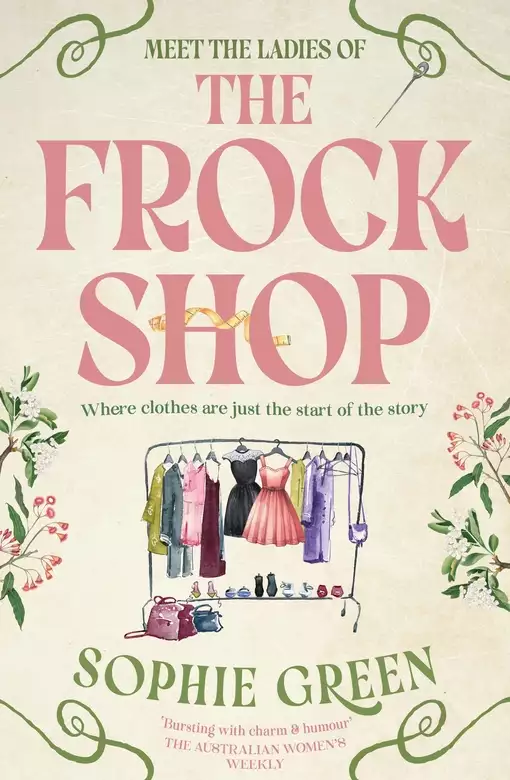
Australian bestseller Sophie Green returns with a sparkling story about the beauty of the second-hand, the power of second chances, and becoming who you were always meant to be (with a little help from your friends).
On Sydney's lower north shore, in the harbourside suburb of Mosman, there is a charity frock shop. For decades, it has clothed the women of this suburb, through good times and bad, for richer, for poorer.
Local resident Daphne has always worked at the frock shop. And she knows better than most how clothes are used by women as talismans, as armour, as beauty. Clothes are essential parts of women's stories, and those stories are now part of Daphne's life.
Daphne has her own stories, too. Some involve her old friend Adelaide, who still bears the devastating secret that caused her to flee Australia in her youth. Some involve a new friend, Christina, who has been forced to leave her glamorous Los Angeles life to rebuild in her childhood city. Then there is Margot, living a life that is far from what she had dreamed it would be, and Lucy, desperate for escape and the promise of tomorrow.
Not only does the frock shop give them purpose, but the clothes will help them become the women they were destined to be, because it is never too late for a transformation.
Praise for Sophie's novels:
'A heartwarming, feel-good novel bursting with charm, humour and seaside sunshine'THE AUSTRALIAN WOMEN'S WEEKLY
'Cosy, uplifting and entertaining, this is the perfect escape read' WOMAN'S DAY
'Delightful'BETTER HOMES AND GARDENS
'A warm treat of a novel' WEEKEND AUSTRALIAN
'Reading a Sophie Green book is the greatest escape'WHO MAGAZINE
Release date:
July 28, 2026
Publisher:
Hachette Australia
Print pages:
432
* BingeBooks earns revenue from qualifying purchases as an Amazon Associate as well as from other retail partners.
This hill was never so steep when Daphne was a girl. She used to walk up it, tugging the hand of her little brother behind her, and it seemed like nothing.
When she reached the top, she’d always turn to look back at the water. Middle Harbour. Sydney Heads. From that height she could see across to Seaforth and the bushland that ran along Dobroyd Head. She could see Clontarf Beach. She couldn’t see Balmoral Beach, for that was below her, down the hill, tucked away.
Now that she’s seventy-one, the hill feels like a mountain. One she must climb.
The path she’s treading now – up Beaconsfield Road to Middle Head Road, then along to Mosman Junction – is one she has known for almost as long as she can remember. For she lives in the house she grew up in. She brought up her own children there, and helped her parents ease out of this life within its walls. Her grandparents before that. If the world outside the house hadn’t stretched as far as the horizon on one side and to the city of Sydney on the other she might have thought her life small. Contained. Except a vista so grand is a canvas for a vivid imagination, and she’s had that. Although it’s contracted a little now.
Old ladies live in their memories, not their wildest dreams. Her mother told her that once, and Daphne found it sad at the time but she understands it now. The time has passed for her to have dreams. Memories take less work and they’re more comforting.
At the crest of the hill she pauses and turns to look down the road she knows so well with its mix of houses old and new. The suburb has changed from being unwanted in the wake of World War II and its dangers for harbourside dwellers to become popular with those looking for a life near both city and sea. The view over the harbour from the top of Beaconsfield Road has, however, barely changed in that time. And she has never tired of it.
Other things, yes, she has tired of. Being a mother: that’s tiring when your children are young and need you. And being a wife is tiring now that her Hector doesn’t have as many marbles as he used to.
Being Daphne. Yes, that can be tiring too.
Not that she’s in a hurry to depart this Earth, mind. There’s beauty here yet. There’s this view, for one thing. For every thing.
She sighs and it’s a contented sound. A person is fortunate if she can be made happy by a view. Or at least mildly pleased. Happiness is beyond her now, like those wildest dreams.
That might sound dire but she’s a pragmatist. Always has been. Because she’s had to be.
Daphne was born in 1920 and World War I swirled around her young life. Her father had served; her mother had lived with the uncertainty of whether or not he would come home. He did, but he was changed. Not the man Daphne’s mother remembered. He tended to his garden by day and would sit outside at night and look at the sky.
Daphne’s mother’s father gave the family money so they could get by and eventually they moved in with her grandparents, into the house on Beaconsfield Road. Her father was good with his hands and after a few years went back to carpentry, the trade he’d had before the war.
He had a young apprentice, Hector, who was dashing, with Clark Gable hair and moustache. Hector was from a large Catholic family in Cammeray and Daphne’s Protestant grandfather didn’t approve of the match, or the suburb Hector came from. It was ‘too far west’, he said, but he’d always been a snob. Her mother talked him around and soon Hector joined the crowded household. Thankfully Daphne’s brother, Edgar, had moved out by then. He and Hector did not like each other.
Daphne thinks about Edgar as she walks past The Tar, a slender strip of street connecting Middle Head Road and Wolseley Road. If she were to turn down it then take the steps to Mulbring Street, she’d be cutting close to where the tram used to follow its steep route to Balmoral Beach. Edgar fell off that tram once, skylarking, cut his leg open and almost bled to death. Hector thought he was a foolish young man and that was probably the root of the mutual dislike.
Further up the road Daphne comes to the house that used to hold a doctor’s surgery. Her doctor’s surgery. Doctor Blaine. Stern but kind as needed, and she’d needed it with two miscarriages then a stillbirth. Doctor Blaine had patched up Edgar when he fell off the tram and propped her up when she despaired that she’d ever have children. ‘You’re young yet,’ he kept saying, ‘and there’s time.’
Time. That’s something else she thinks about on a regular basis. How it means nothing – how fifty years seems like a flash – and everything, because it’s so stuffed full of memories and emotions that even one day can feel as weighty as a mountain.
He was right, though, Doctor Blaine. Daphne had a daughter, Janet, then a son, Noel.
Janet lived in London for several years. She’s home now, and helping to care for Hector when Daphne can’t be there; has done ever since Daphne asked her if she could help out while she worked at the frock shop.
Janet said she could do better than that and moved in. Her children are grown-up, her husband has moved on to his second wife, and Janet was living in a pokey little flat in Annandale, working part-time at the local library and pining for the harbourside suburb she grew up in. The house on Beaconsfield Road is more than big enough for the three of them. For three more, if needed. And another three. It was a good purchase, as Daphne’s father said.
Hector had been fretful when Daphne left him this morning and she gave Janet instructions that she didn’t need, because, as she said, ‘It’s not as if I haven’t done this before, Mum.’
Daphne knows she can trust Janet to look after Hector. The giving of instructions is reflexive, because she’s Janet’s mother and apparently she feels some sort of subconscious need to boss her child around. She really has to train herself out of it or they’ll get on each other’s nerves. More than they already do. Which is normal for an adult child and an even more adult parent living in close proximity, she thinks.
It would be unkind for Daphne to admit to anyone that she feels lighter when she reaches the crest of the hill and walks along the flat of Middle Head Road to Mosman Junction. It’s knowledge that keeps her going on the days when caring for Hector feels like a heaviness.
He was never a burden before, but he’s no longer the man she used to know. His wit, his sharpness, have gone. What’s left is a man who looks like Hector without the attributes that kept her interested in him all these years.
That’s marriage, though: In sickness and in health. She believes in those vows. She lives them. And sometimes she needs a break from them. Which is what the frock shop gives her.
Now it’s a charity shop run by a church organisation, but Daphne’s always called it the frock shop because that’s what the original owner called it. Daphne had a job there when she was a young woman, working mornings because the owner, Ophelia Pankhurst, didn’t like waking up before ten.
Ophelia’s name was almost certainly made up but it suited her, because she had beaux who were as tortured as Hamlet and she said winning the right to vote was the best thing that could ever happen to a woman. Maybe those two aspects were related, the quality of the men Ophelia knew not making the case for a man to be the best thing that could ever happen to a woman. In Daphne’s opinion, of course.
Ophelia would give Daphne advice about men – once she deigned to appear in the shop each day. It could be at midday. Or four o’clock. Advice about men, and about clothes, and about what women should wear for men.
‘Not too revealing,’ she’d say, sometimes even to a customer, tugging at fabric around a bosom as if that would magically make a dress looser in fit. ‘You need to offer a man mystery.’
If a customer dared to disagree she’d sigh dramatically and say, ‘If you wish to be a trollop, of course I can’t stop you.’
Ophelia liked to emphasise words, and Daphne had thought it an affectation until she met Ophelia’s mother and found it ran in the family.
From Ophelia, Daphne also learnt about fit and cut, materials and hem lengths. About what worked on a short woman with what Ophelia called an Edwardian figure – ‘all dainty wrists and ankles and a waist, Daph, but oh my, the bosom and the hips!’ – and a tall woman with neither waist nor bosom nor hips, and all shapes in between. It was a training of the eye. An education Daphne didn’t know she was receiving until Ophelia found the Hamlet she wanted to marry and sold the shop.
Daphne wasn’t part of the sale but she remained at the shop. The name changed, the new owner lasted for three years then sold, and the business has changed hands several times since. Yet Daphne has remained.
Because it’s now a charity shop, Daphne is not paid to work there. Which is fine – she’s past official retirement age, even though she was still being paid until she was sixty-eight, which was when the last owner sold the shop to a man who rents it to the church that runs the shop. She doesn’t need money; has never really needed it, because living in the family home has meant she and Hector never needed to find money for a house themselves. No, working at the frock shop has given her things money can’t: dignity, distraction, a sense of achievement. And fun.
Even though women of her generation usually gave up jobs when they married, Hector never minded her going to work, although she missed a few months here and there when the children were small. He knew she enjoyed it.
‘It’s like dressing real-life dolls, isn’t it, love?’ he said once, and he was right.
As Daphne turns the key in the shop’s front door and steps inside, she can see the evidence of the weekend volunteers: clothes shoved back onto racks, half-sticking out; shoes not in pairs; jewellery still on the counter. The shop isn’t tiny but it’s not large enough for messes to not be noticed. There are racks of clothes down each side of it, with shoes underneath each of them; a large counter where the cash register and the jewellery live, and three stands in the middle of the floor, displaying accessories.
Daphne sighs then purses her lips. Why can’t anyone maintain standards, she wonders – and it’s said in Ophelia’s voice, because Ophelia used to say it of people she thought badly dressed or badly behaved or both.
‘Manners extend to dressing, Daph,’ she would say. ‘A well-dressed person is being polite to everyone who must look on her.’
Of course, in those days the manners included the wearing of gloves and hats and very little jewellery, lest a lady look gaudy or gauche.
There was so much she learnt from Ophelia – including how to run a shop. Which, clearly, the weekend volunteers do not know.
With an even bigger sigh Daphne turns on the lights, puts her handbag in the small office out the back – the one place she doesn’t keep tidy, administration not being of as much interest to her as clothes – and sets about putting the shop to rights. She needs it to be just the way she likes it because it is the place where she can most be herself.
Working at the frock shop – in whichever incarnation – has always given Daphne the chance to be creative. To look at a woman’s figure and find just the right dress for her special occasion, or a scarf that makes an outfit better, or a skirt that fits properly. Clothes can make or break a woman’s mood. There is a lot of power in what she knows about clothes, and it gives her satisfaction too. Ladies who come in may be looking for a bargain but they’ll be given Daphne’s expertise if they want it.
In return, Daphne is given respite from what’s happening at home. From her memories of the babies who didn’t make it, and the years that have gone by in a flash, leaving her gasping sometimes with the awareness that life is so desperately short and so exquisitely long, and wishing she knew, at her age, how to really be in this world without all these things getting on top of her, but … She doesn’t. She only knows how to live as Daphne, with some days being too bright and some too dark, and what evens them out is having purpose and having fun. The frock shop gives her both.
As she returns order to the shop floor she breathes in and smells not only the old clothes but Ophelia’s heavy perfume and a favourite customer’s shampoo and the aftershave of the mayor who used to visit far too often, as well as coffee and cigarettes, and cinnamon toast that one owner used to buy at the milk bar next door.
All of that crammed into her memory; all of it here now. Her life in this frock shop. There is nowhere else she wants to be today.
‘It’s a little too loose, doll – round here.’ Candy the wardrobe mistress pinches at Christina’s waist and Christina barely feels it. She’s so used to being pulled at, prodded and poked. That’s what happens when you’ve been an actress for most of your adult life.
At thirty-two, she’s had over a decade of being a clothes horse, a vessel, a symbol. She has embodied and represented other people’s stories and the way they want to tell them. Wearing a dress to an awards show is no different. She has to present as something her agent, her public, prospective producers and directors want to see. And she’s not going to complain about it because she chose it.
As soon as Christina left school she left Australia, treading the well-worn path to London. Her mother’s brother lived there and took her in for a while. She worked as a secretary – not very successfully – before finding work as a stagehand. She’d always liked drama at school, and her father used to take her to see plays and musicals at the Theatre Royal in Sydney. The theatre is tied in with happy memories for her, although she never imagined acting until one day the director of a play at the theatre where she worked asked if she’d consider auditioning. She was so beautiful, he said, that she shouldn’t be backstage.
Christina didn’t know she was beautiful. At the girls school she attended in North Sydney no one said anything; certainly her mother and sisters didn’t. And she was mostly kept well away from boys, apart from the brothers of her classmates and she was too shy to talk to any of them. After she arrived in London she thought Englishmen were just friendlier since they all seemed to want to chat to her.
That first play led to more, and more. After a year she had an agent, then she had a career. Then she moved to Los Angeles as her agent said her face was wasted on the stage and belonged in the world. On the big screen. So she became a movie star: Christina Clarke. A fake last name and one that sounded better, the agent said, than her real one, Christina O’Flynn.
Therefore she chose to become Christina Clarke. Chose to lie about her age so that the press, the fans, the industry think she’s twenty-eight, not thirty-two, and even then people say she looks young for her age. One reviewer called her an ingenue, which, when she read it, made her snort out her black, unsugared coffee.
It is being Christina Clarke that has brought her to this fitting today. And this pink, one-shouldered, toga-inspired dress that is supposed to be cinched at the waist to show off the figure she half-starves herself to maintain is meant to present her as a modern Grecian goddess, because the film she has just wrapped – the one that everyone is buzzing about, and saying will make her a proper movie star – is a retelling of a Greek myth, set in modern-day Texas. Orpheus and Eurydice in Stetsons.
A stretch, perhaps, but Christina loved the script from the first page. She wanted the role. She wrote a letter to the director telling him how much she connected with the story. It was true, but the fact that the director was one of the most in demand in Hollywood didn’t hurt.
‘Doll, let’s get the needle and thread,’ Candy rasps, patting the side of Christina’s waist, making her flinch then shudder.
‘Cold, doll?’
Christina shakes her head. It’s the touch on her waist – that’s what she reacted to. It’s a spot where …
She stops herself. No. That memory is not going to intrude. She’s worked too hard to let it do that.
Practising what she knows best – the art of pretending – she stands immobile as Candy pins the dress. Then they’re done and Christina is back in her street clothes.
‘May I use your phone to check my messages?’ she asks.
‘So polite!’ Candy laughs. ‘Of course, doll, it’s in the office.’
Christina’s politeness has been remarked upon by crews on sets, by PR people, by waitresses. She used to think it was normal but after five years in LA she knows it’s not.
When she dials her number to reach her answering machine, the first message is from Lindsay, her agent.
‘Call me as soon as you get this. Mischa will put you through.’
His tone is hard to read. But Mischa is his assistant and normally Christina has to spend at least ten minutes on hold waiting for Mischa to decide to put her through. So whatever the reason is for Lindsay’s call, it must be important. She went for an audition last week, for a big new movie. Could they have made the decision already?
‘Hi, Mischa, it’s –’
‘Putting you through.’
Christina frowns. Mischa also usually pretends she doesn’t know who Christina is, but clearly she recognises her voice. Maybe she’s the only Australian who calls.
‘I’m going to give you the benefit of the doubt,’ Lindsay says as soon as he’s on the line.
‘Okay.’ Christina draws the word out, confused.
‘Tell me you didn’t.’
‘Didn’t what?’ This feels like some kind of joke but she’s not in on it.
‘You slept with him.’
She blinks, trying to process the information. Lindsay knows she has a boyfriend, but what she and Patrick do together is none of his business.
‘What?’ Now she’s convinced this is a joke.
‘It’s about to be all over the news, Christina. You should have told me.’
‘I really –’
‘Your director? Seriously? When did it start? Do you know how hard I had to …’
She stops hearing him. She stops hearing him because she is suddenly very cold and sick and afraid. This story, whatever it is – she can’t begin to imagine what the director has told people. The same director she wrote the letter to. The one who said he loved how much she understood the part. How he’d gone into battle with the producers to have her. How the writer had wanted someone else – someone less blonde, he told her – but he fought for her.
The same director who put his hand on her waist the night after filming wrapped and she thought it was playful but then it wasn’t, and he didn’t care that she had a boyfriend or that he had a wife.
The same one who now, she realises with the dread that comes from wanting something a great, great deal then watching it teeter on the precipice of falling away from you forever, has probably set out to ruin her just because he can. As she has seen other men do in this town to actresses who are too blonde or too shy or too curvy or too abrupt or just too much alive for them. Too much not under their thumb, so they make them that way.
‘I need a line on this, Christina,’ Lindsay is saying as her brain rejoins the phone call.
‘I …’ She can’t think of anything to tell him that won’t require her telling a story she is not ready to tell.
‘I didn’t do it,’ is what she says, because it’s the truth. She didn’t do anything.
‘Right. Sure.’ Lindsay snorts. ‘Whatever, I don’t care. But it’s gonna be in the news tomorrow and I can’t come back with “she didn’t do it”. So gimme something. Do you love him? That’d be good. Ill-fated lovers. That’s a story people like.’
The coldness in her body has condensed into a stone in the pit of her stomach. Telling her it’s over. This life she’s made here. This career she has hewn out of the stern rock of indifference and improbability. The premiere she was going to. The dress she has been fitted for.
She knows it’s over because she’s seen it be over for others in this town. Seen how one story can both undo a woman and make a man. It’s just that now the story is about her.
She hangs up the phone, picks up her handbag and somehow makes it to her car.
Lindsay will probably be relieved that she hung up. He’ll have a story to tell people about how she’s a mad witch or something. He likes that phrase.
The golden LA light surrounds her as she drives down congested roads lined by palm trees, trying not to think about how she probably won’t ever see them again.
Once she makes it home, she starts to pack. There’s only one place she can bear now. She’s going there.
Home for Lucy is on Raglan Street, which is pretty much the longest street in Mosman apart from Military Road, the main artery. It stretches from the city side of the harbour to Balmoral Beach, transecting the suburb. The beach side winds downhill; the city side is the high side, which is where Lucy’s family’s house is. Her parents’ shop is on Avenue Road, about fifteen minutes’ walk away but mere steps from Lucy’s high school. Less than a minute of commuting, on foot.
Each weekday Lucy’s routine is the same, with slight variations: she finishes school, she goes to the shop – it’s a dry-cleaning business, but calling it ‘the dry cleaners’ makes it sound like it belongs to someone else – she works for a couple of hours, then she walks home while one or both of her parents closes up for the day.
Home is rundown because her parents spend all their time and money on the business, even though her mother would love to do some renovations on the house. Her father has ‘been through it all before’, though, and says that renovations are a waste of time.
He’s been through it all before because he’s been married before. Lucy’s mother was nineteen when she gave birth to Lucy, but her father is twenty years older and already had another family. A wife, a son, Russell, who is ten years older than Lucy, and a daughter, Gail, who died at ten. It was losing Gail, her father has said, that ended the marriage. Although Lucy tends to think – because of what her mother has told her – that it was him meeting her mother and having an affair.
Lucy is the result of the affair. She’s the reason her father left his first wife, even though he’s never married her mother.
‘Lucy!’
She turns to see her friend Angelica running up, struggling to keep her backpack on both shoulders.
‘God, I’m so unfit.’ Angelica rolls her eyes. ‘Are you leaving already?’
‘Yeah.’ Lucy shrugs and smiles like she doesn’t mind the fact that she doesn’t get to hang out with her friends instead of going to work at her parents’ business. Like every teenage girl would rather be dry-cleaning than doing anything else.
Angelica screws up her face. ‘What about our English project?’
‘Hey! Hi!’ Their friend Poppy appears, her own backpack hanging off one shoulder. Poppy’s too cool to wear it on both shoulders. Not that she’s said that. Poppy’s coolness is just a fact that Lucy and Angelica have to live with.
‘Lu can’t stay to work on the project,’ Angelica says as she chews a fingernail.
‘Huh?’ Poppy says distractedly, her gaze drifting to the teenage boys who hang around the school gates, wolf-whistling at the girls they like and slagging off the ones they don’t.
It’s a brutal ritual, and even though Lucy is usually on the receiving end of wolf-whistles she hates it. The teachers won’t do anything about it – ‘boys will be boys’, they keep saying.
Lucy wants to know what that means, what exactly the boys are meant to be. Won’t these same boys grow into men she’ll be told she has to respect when they’re running banks and the government and making decisions for her life? These boys who don’t respect her now and aren’t likely to then?
She’s sick of boys – of men – who just want to be boys. That’s one of the reasons why she likes Madonna so much. To the casual observer it might look as though Madonna’s doing things for men, but she’s not. She does things for herself, on her own terms. Lucy wants to live like that one day. But for now she, Angelica – even Poppy – seem to end up doing things on other people’s terms.
‘Hey, Poppy!’ calls Tony, one of the boys who regularly whistles at both her and Lucy.
Poppy . . .
We hope you are enjoying the book so far. To continue reading...

 Please log in to recommend or discuss...
