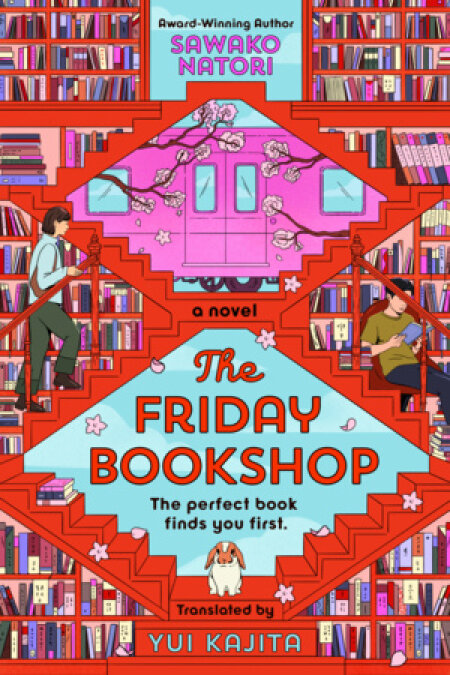
Welcome to the Friday Bookshop, a cozy little bookstore tucked inside a rustic train station north of Tokyo. Rumor has it, you’ll find the perfect book there—one that you need at that particular moment, even if you don’t know it yourself....
When college student Fumiya visits the Friday Bookshop as a last-ditch effort to find a book for his ill father, he is disappointed in its ordinary appearance despite whispers of its peculiar charm. But he soon discovers that it not only includes a café where the food menu changes daily on the chef’s whim but also a vast underground vault lined with bookshelves, lovingly converted from an old abandoned subway platform. The bookshop, run by a quirky trio who have been close friends since high school, quickly becomes Fumiya’s favorite place—so much so that he begins to work there part-time.
Fumiya, who was never really a reader, learns to embrace the joy of reading, and that books can be a means to connect with other people and navigate the twists and turns of life.
Through colorful interactions with the zany shop owners and their visitors, as well as mouthwatering dishes inspired by the books the owners recommend, it’s impossible not to fall in love with the seemingly ordinary yet enchanting little bookstore in the subway station in Kanto.
Release date:
November 3, 2026
Publisher:
Berkley
Print pages:
256
* BingeBooks earns revenue from qualifying purchases as an Amazon Associate as well as from other retail partners.
Rumor has it that there's a bookshop in a small train station in northern Kanto where you can find the book you want to read.
"The book you want to read" can mean a lot of things, but here the gist of it was, if you go to this bookshop, whatever book you need most right now will find you. When I stumbled across this rumor online, I pushed my glasses up the bridge of my nose and looked skyward, as if to beg for a miracle.
I could've doubted it ("This can't be true"), laughed it off ("As if"), or hurled it aside ("Get real!"), but I didn't do any of that. I couldn't. I just kept spiraling down the rabbit hole, and once I dug up the names of the train station and the bookshop, I looked up how to get there from home straightaway.
Twelve hours later, I was sitting on the train to the station in question, scrolling through my social media feed.
I'd left Tokyo nearly two hours ago. I'd already read the posts by my friends or friends of friends, by people I knew, and by people I didn't actually know at all but was apparently "friends" with, skimming the articles they linked and leaving a socially acceptable number of likes and comments. Time would usually fly by like that, but two and a half hours was a lot to kill. The steps going down to Hiroo Station, where I'd started, had been dyed orange in the sunset, but now the sky was completely dark. The unusually vivid moon told me that the night air was chilly outside. I wished I'd brought my puffer jacket with me, though I'd figured I wouldn't need it now that it was March.
"Three more stations," I murmured, trying to cheer myself up, and adjusted my glasses. The train was so empty that I didn't even mind talking to myself out loud. It was eight p.m. on Friday-the kind of time when you might expect to see the train packed with office workers freed from their jobs after a week of hard work and heading home-but the seven-seater bench across from me was totally empty. I had the bench on my side of the train all to myself, too.
When I'd caught up on social media, having left a trail of reactions, I switched to the browser and popped "Chorin Main Line empty why" in the search bar. A bunch of results came up in a second, and I tapped through them. Apparently, this line was mostly used by students, which meant that the trains were "startlingly empty" during those times of the day when they weren't commuting to and from school. There was even a blog post that declared, "If the birth rate keeps declining, this line will most certainly be discontinued."
"Makes sense," I muttered with a nod, fiddling with my glasses. The train stopped at a station called Kamado, which rang a bell. "Oh, so that's where our campus is . . ."
At my college, students in my department were supposed to go to the Kamado campus for their third year instead of the one in Tokyo, but I never knew it was in the middle of nowhere. The commute time from Tokyo that I'd seen on the college pamphlet must have been an estimate assuming there were good connections, but now I was learning the hard way that changing trains in places like this hardly ever went smoothly.
But then I remembered. Well, it's got nothing to do with me anyway. I'll be taking time off from college before I get to third year.
I twisted around in my seat to lean closer to the window and gazed out at the dark scenery streaming by. There were no tall buildings in sight-just rice fields stretching out as far as I could see, dotted with billboards and houses. White blossoms flecked a tree growing in the garden of a large house. When I saw the soft glow of the petals in the gloom, it struck me that spring was here. Spring had come for everybody. Though where they stood in their lives and how they felt as they greeted the season were different for each person.
I felt tears pricking my eyes, so I hastily shook my head, then rested my forehead against the window. I felt the train slowing down through the vibrations against my forehead, and my glasses slipped.
Nohara Station.
The announcement in the train and the sign outside told me that I'd arrived at my destination. I shouldered my small backpack and stepped out onto a deserted platform.
There were two platforms in Nohara Station. The one I got off at had tracks 1 and 2 running on either side so trains facing both directions could come and go at the same time. The other platform had just one track and a vacant lot on the other side. That one, Platform 3, was unlit and pitch-dark. Have all the trains gone for the day? I looked all around for the bookshop I'd come for, but it was nowhere to be seen. Okay then . . . With the dim fluorescent lights as my guide, I headed toward the stairs at one end of the platform.
The stairs led up to the footbridge connecting the two platforms and the ticket gates. There were no escalators, only a small elevator on the side. Commuting to college from home was the most I got up to in the way of exercise-I didn't belong to any club sports nor did I have a part-time job-so I beelined for the elevator.
Though it wasn't as big as a terminal station in the middle of Tokyo, the bridge at Nohara Station was more impressive than I'd expected from its exterior and the look of the platforms. The walls were thick, the lighting was bright, and it even had air-conditioning. And there it was: On the other side of the stairs, a bookshop stood along the wall. A classic train-station bookshop.
I hurried closer. Conveniently for me, the shop's automatic door and walls were made of glass, so I could easily look inside. I peered in as I walked across the bridge. It was a perfectly ordinary bookshop; nothing stood out to me. There were bookshelves with displays of books stacked around them, arranged in a way that didn't make the limited floor space feel too cramped. Judging by the size of the shop and the number of shelves, the best lineup I could hope for in a store like this was a selection of recent books by a handful of bestselling authors, along with popular manga titles and buzzy books that got turned into movies or won awards.
"I'm not so sure about this . . ." I murmured, pushing up my glasses. Is this really the bookshop where "you can find the book you want to read"? Maybe it was just another urban myth doing the rounds online. Figures.
When I walked to the end of the glass wall of the bookshop, I felt a bit weary from my quest of sorts and staggered back against the cream-colored wall next to it. I was curious what the shop behind this wall could be, but I felt too exhausted to move. I'd come all this way for nothing. With a heavy sigh, I slid down the wall until I was squatting. Just then, the automatic door a few paces away whirred open and somebody stepped out. Their springy footsteps came closer and stopped right in front of my downcast eyes.
"Hello!"
A bright, perky voice came from above me. When I looked up, I locked eyes with a woman who seemed as bubbly as a kid who'd just gone to Disneyland for the first time ever, her eyes positively sparkling with excitement. She had really big doe eyes, with clear double eyelids and thick eyelashes that curled upward. I couldn't tell whether it was the lighting, or she was wearing contacts, or she was just born that way, but her dark irises seemed unusually large. With her other features-like her nose and mouth-being small, her bold eyes stood out even more.
"Oof." A weird half yelp slipped out of me when the woman crouched down, brushed back her loose, wavy hair, which fell to her chest, and beamed at me. I was distracted by a citrusy scent that gently tickled the tip of my nose.
"Do you have experience?" she asked.
"What?"
"Um, have you done it before?"
Is she actually hitting on me? I'd heard of women picking up guys on the street, but I'd always assumed that was just an urban myth. To be honest, I was taken aback by how she got straight to the point, but she had such a sunny smile on her face that I felt like I had to step up as a man and answer her.
"Uh . . . well, yeah, I'd say so."
"Amazing," she said, clapping her hands together. "Okay then, could you start now?"
"What, here?" I blurted out in shock.
"Yes, here. Of course." She nodded, still smiling. Then she knocked on the wall above my head. "We're desperate to have another pair of hands."
I sprang to my feet and twisted around to find a flyer calling for part-time workers.
"Our part-timer had to quit because her husband got transferred to another office, so we're in a tight spot," she explained. "You said you have experience working at a bookshop?"
"Ahh, right. Yes, of course. A part-time job . . ." I readjusted my glasses, hoping she wouldn't catch on to my cringey mix-up, and added, "But I'm not here to apply for a job today. I'm sorry."
"Oh . . . that's all right . . ." She was visibly crestfallen, but she pulled herself together in no time. "So, you must be here as a customer," she said, snapping her fingers.
"Uh, yes, kind of."
She didn't seem to mind my noncommittal response. When our eyes met, she gave me another radiant smile. Flustered, I looked down, finally realizing that she was wearing a typical bookseller's moss-green apron with a name tag pinned on her chest: Makino Minami. She noticed my gaze and pulled up her badge.
"I'm sorry, I should've introduced myself. I'm Makino Minami, the manager here. Welcome to Kinyo-do: the Friday Bookshop!"
At her perky greeting-which would have put a maid café to shame, with its cosplaying waitresses welcoming home customers as their masters-I almost felt like turning on my heel and heading back home, but the next thing I knew, I was being shepherded into her bookshop.
Makino went back to her position behind the checkout counter in the corner of the store. I looked around the shop awkwardly, conscious of her eyes on me. Copies of a novel that had recently won the Naoki Prize were stacked on a display shelf. It was the number-one bestseller right now, and every bookshop put them up in the most prominent spot. There was nothing original about the selection here. I moved over to the paperbacks section, scanning the shelves with dead eyes.
I looked through the authors with names starting with S. Slowing down a little when I got to Renzaburo Shibata, I carefully checked the names on each book. There was Soji Shimada, Rio Shimamoto, and Minato Shukawa. I slowed down even more, tracing the spines with my finger as I read each name. Yukiya Shoji, Kazufumi Shiraishi, Saburo Shiroyama, Kazuma Shinjo . . . The books covered a wide range of genres even just in the S section-historical fiction, mystery, romance, horror, business novels, light novels, and so on.
But I sighed. I knew it. It's not here either.
I bowed a little to Makino behind the counter, then headed for the door. From the corner of my eye, I saw her open her mouth as if to say something, but I didn't stop.
Before I reached the door, it slid open with a slight tremble. I glanced at the newcomer with mild curiosity. A ridiculously flashy guy with a blond flattop crew cut and a purple suit glared back at me. My height was average, at just under five foot eight, and this guy was shorter than me by about four inches, but he didn't strike me as small. He had a stocky build, and more than anything else, his face was intimidating. Even if I gave him the benefit of the doubt, he definitely looked like the underground type.
"Nuh!" I squeaked in alarm as I jumped back. The second I thought Crap! it was too late to stop: I knocked into a stack of hardcovers and sent them tumbling to the floor.
"Hey, whaddaya think you're doin', kid?! Watch where you're goin'!" The Crew Cut barked without missing a beat.
"I'm sorry. I'm so sorry." I bowed down to him desperately, throwing my honor and pride out the window.
"Yasu, can you stop browbeating our dear customer?" Makino said brightly over my head.
As though in response to her voice, the door opened again. This time, a rather tall man stepped in, ducking his head under the threshold. He was wearing a moss-green apron like Makino, and his name tag read Kou Sugawa. I guessed he worked here, too.
I wanted to slip away, but with this mismatched pair blocking the way to the not-so-wide entrance, I was stuck.
"Oh, you're back, Sugawa," Makino said. "Were you with Yasu?"
The tall man looked up. I couldn't help but freeze with my hand holding the frames of my glasses, mesmerized by his good looks and the color of his eyes. Coupled with his black hair, pale face, and classic Japanese features, his blue eyes were striking.
While Sugawa slowly raised a reusable shopping bag-with vegetables and a milk carton poking out the top-the man called Yasu piped up. "We bumped into each other right outside the station. Right, Sugawa? You coulda told me you're gonna restock. I woulda helped you out."
Why would a bookshop need groceries? My confusion cleared up when I saw where Sugawa was headed.
On the side of the store opposite the checkout counter, there was a bar with a row of high stools and a small table with seating around it. Lights with orange retro lampshades hung over the bar, and the wall behind the counter was lined with shelves for tableware and liquor, as well as a small fridge underneath. The whole vibe of this corner was so different from the rest of the space, with its interior decor and tinted lights, I'd assumed it was a separate shop, but apparently, it was part of the bookstore.
We hope you are enjoying the book so far. To continue reading...

 Please log in to recommend or discuss...
