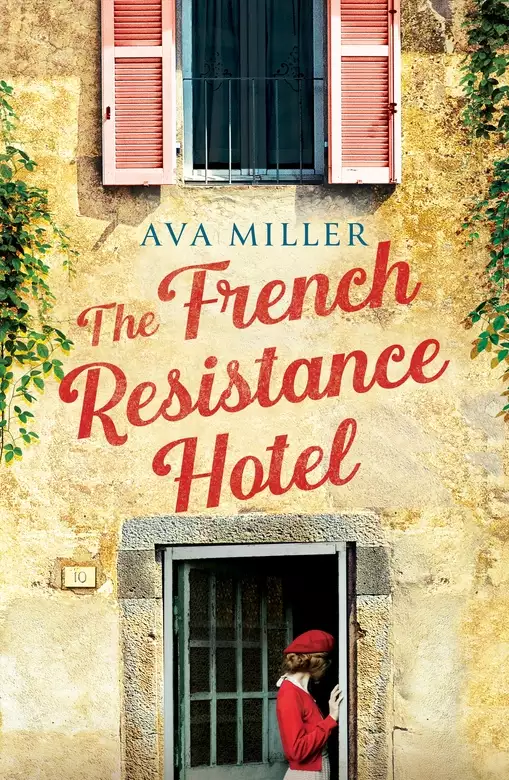
France, 1940. A hotel on the border. One woman will risk everything in the name of freedom.
'The characters were compelling, the romantic aspect wonderful, and the tension never let up as I raced through the pages' Jill Mansell, Sunday Times bestselling author
'A thrilling page-turner charting astonishing female bravery and resilience in an intriguing wartime setting. Gripping and heartfelt. A must-read for historical fiction fans' Annie Lyons, USA Today bestselling author
'An edge-of-your-seat story of wartime heroism and heartache . . . brilliant storytelling - I couldn't put it down' Gill Paul, bestselling author of The Second Marriage
'A beautifully written tale of wartime courage and sacrifice, wrapped around an unforgettable love affair' Daisy Wood, bestselling author of The Forgotten Bookshop in Paris
After escaping an abusive relationship in Nice, Eloise thought she'd never find a home again. Until she arrives at the Hotel Cordier in the eastern town of Sainte-Béline, straddling the frontier between Switzerland and France.
But when the Nazis invade, everything changes.
Trapped under occupation, Eloise finds herself drawn to the resistance - and to André, its charismatic local leader. André is determined to use the hotel's unique position to save as many refugees fleeing persecution as he can.
It doesn't take long before the Germans start closing in. Facing the threat of discovery and the shadows of her past, Eloise must decide how much she is willing to risk for the cause, for freedom, for love . . .
A devastating, sweeping and romantic historical epic of the Second World War from a thrilling new voice in historical fiction, perfect for readers of Kristin Harmel, Fiona Valpy and Heather Morris.
Release date:
August 13, 2026
Publisher:
Hodder & Stoughton
Print pages:
400
* BingeBooks earns revenue from qualifying purchases as an Amazon Associate as well as from other retail partners.
The city of Nice, Alpes-Maritime, south-east corner of France
June 1938
It was golden hour. The sun was low, the sea and sand bathed in an unearthly glow. The sky above the beach was a patchwork of cloud and cornflower blue. Towards the east, the weather was changing the sky to swathes of gunmetal grey. Eloise watched it. Though it seemed far away, it wouldn’t be long before they were pelted with rain. She ought to go. Sylvestre would be there soon.
She ran her fingers through the sand beside her, warm and dry on the surface, damp and grainy beneath. She thought of the English beaches she’d visited with her mother, the south coast of England, its ice creams and fairgrounds. Would she ever go again, now that her mother was gone?
She wasn’t going to let her grief sweep over her again, not now. She didn’t want to think about the past. But then, she didn’t much want to think about the present either, about what was happening, right now, inside her body.
She stood up quickly. Time to move. She pulled on her cotton skirt and blouse over her damp bathing suit, then, carrying her sandals loosely in one hand, letting them swing and tap her thigh as she walked, she paced across the sands to the seafront path. Slipping on her sandals, she went home quickly, through the streets to her mother’s small apartment, now hers alone. She nodded and smiled at the caretaker at the entrance, then took the steps two at a time to the door on the second floor. A cosy flat, just right for two.
Her father had died before they moved there, so he’d never seen it. Her mother had been gone for nine months now and still Eloise hadn’t done anything with her belongings. She couldn’t bear to. Her mother’s clothes still hung in her closet. While they were there, it was as if her mother was still there too, just having stepped out for a moment, to pop to the bakery for chocolatines. Even her father’s books were on the shelf, though they hadn’t been read for years, lined up beside her mother’s. Hugo and Verne for him, Dickens and Austen for her.
They met in the Great War, he an injured French serviceman, and medical student before the war, she the English nurse that tended to him. Eloise would follow in her footsteps, when she finished her medical training in just over a year. Eloise had been brought up bilingual, speaking English with her mother and French with her father. She was raised to feel she was a special mixture of the best of both cultures. Her parents’ meeting was the stuff of romance books. Eloise wondered if she’d ever have a romance that pure, that perfect.
Maybe she did. Maybe it was with Sylvestre. She certainly loved him, adored him with an intensity she’d never known before in her life. He was the only thing that had kept her going after she lost her mother. Whenever he could get away and spend hours with her, he filled their time with activity, so that she couldn’t stop for a moment to remember her grief. And he was certainly romantic, buying her flowers, sweet treats, that silk scarf . . . she shuddered suddenly, remembering his anger when she had left it in his car. His panic at the prospect of his wife finding out about them.
No time to dwell on that now. She had to wash her hair, prepare herself. He was due that evening and he liked her to be ready. As she ran a bath, she heard the storm come, the rain pelting against the windowpanes. But it had passed before the bath was filled. The sun shone after it, throwing bright squares on the bathroom floor. She climbed into the warm water, took the soap and scrubbed herself thoroughly. Sylvestre didn’t like sand. He wouldn’t want to find a grain of it on her.
Getting out, she gently towelled her light brown hair. It wouldn’t take long to dry completely, as it was cut in a bob, just below her ears. He liked it curled, but she wouldn’t have time for that. She hoped he wouldn’t mind. She wanted everything to be just right, for him to be pleased with her, for she was worried about how he was going to take the news. She felt a flutter of fear. He had a temper. And what she had to tell him . . . well, it wasn’t exactly part of the plan: a baby. She was carrying his child. But he’d always said he’d leave his wife. Maybe this will be the push he needs, she thought. Or maybe it’ll push him over the edge. What if he lashes out, like he did over the scarf? She hadn’t meant to leave it in his car. He’d accused her of doing it deliberately, but she hadn’t. She’d put a cold compress on her black eye and bruised cheek after. She’d been able to cover it with foundation at work. Matron had spotted it though and asked her what clumsiness she’d got herself into now, and she’d agreed, she was such an oaf sometimes, opening a cupboard door too quickly like that and bashing herself in the face.
But surely a baby was good news. He’d be happy, wouldn’t he? He always told her they’d make beautiful babies. She put on her yellow polka-dot dress. He loved that one. It had lots of little buttons all the way down the front. He liked to slow things down, open them one at a time and watch her face as he did so. She brushed her hair again in the mirror. It was still a little damp. Maybe she should go for a brisk walk outside to let the wind dry it, or stick her head out of the kitchen window, which looked out over Nice, the sea just visible between the buildings, a strip of sparkling blue on the horizon. Was there time?
Then came his knock on the door. Never mind. She glanced at herself in her mother’s full-length mirror, strips of mother-of-pearl gleaming in the wooden frame. She’d have to do. She trotted to the door and opened it. There he was, Sylvestre, ten years older than her, thirty to her twenty. His hands were in his pockets as he grinned at her. A crisp white shirt rolled up to the elbows, braces, grey slacks, his jacket slung over his shoulder, fedora shading his eyes. Effortlessly stylish and timelessly handsome.
‘I like that dress,’ he said, coming inside, sliding an arm around her waist and pulling her in close. He kissed her briefly, then stepped back, gave her a look, the once over. He approved. ‘I like the little buttons.’
‘I know you do. I put it on for you.’
‘Good girl.’
That was a promising start. He was in an affable mood. That would help. He draped his jacket over a chair and took off his hat. His black hair was slicked back with pomade, not a strand out of place.
‘I’d like to take a snap of you in that dress. And out of it.’
She didn’t want him to take photographs of her again. She was still ashamed of the time he’d persuaded her to take her top off with only some of her mother’s silk scarves draped across her to preserve her dignity. He’d said the film was exposed and none of the pictures had come out. She’d been so grateful for that.
‘I’d rather it was just you and me and nothing between us,’ she said, and smiled.
He smiled too and took her hand, then led her over to the table where she and her mother used to eat their meals. He put both hands on her waist, easing her down, his knee between hers, his eyes hooded with desire. She knew what was coming next.
‘I’ve something to tell you, darling,’ she said.
‘Not now,’ he whispered, kissing her neck.
‘No, really, I need to tell you. Or I’ll lose my nerve.’
He stopped. He looked down at her and his face had changed. ‘What is it then? Hurry up.’
He stood up straight, leaving her half on, half off the table. She stood up too, watching him pull a carton of cigarettes from his pocket. He lit up a smoke, testily, taking a long drag and blowing it out with a huff.
‘Well? I haven’t got all damn night.’
‘It’s good news,’ she said. ‘Really, it is.’ She smiled and reached out to touch him.
He narrowed his eyes and edged back, just out of her reach, his cigarette pinched between thumb and forefinger, its white smoke swirling in spirals, obscuring the air between them.
‘What the hell have you done now?’
CHAPTER 1
The small town of Sainte-Béline, Jura, eastern France
May 1940
‘But sir!’ called out a keen little boy called Samuel on the front row. ‘My papa says that the Boche got through Luxembourg and into Belgium like a walk in the park. They’ll be in France tomorrow!’
‘Tomorrow?!’ went the cry around the room, repeated by many a child. One girl started to cry. This was getting out of hand.
‘Now then, my children, let us have some hush. And some decorum,’ said their schoolmaster, and they immediately piped down. Mr Babineaux commanded the utmost respect from his charges and also from his classroom assistant, Eloise Dauphin, who, out of school, called him Julien.
He came out from behind his desk and began to pace slowly along the small avenues between the children’s desks. All eyes and heads turned to watch him as he passed. His halting gait, evidence of a weak knee injured during a rugby career in his youth, served to keep him here at school, instead of conscripted to fight.
‘Firstly, Samuel, let me remind you that we do not use crass slang such as the Boche to denote our German neighbours. Secondly, let us consider the facts of the situation, as it stands. It is true that the German army have invaded Luxembourg and now Belgium. However, let me remind you that our French army has around five million men, guarding our borders and ready to fight. That’s more men than we had in the Great War, which your parents will remember, though it was before you were born. And which, let me remind you, we won. We have powerful fleets of ships and aircraft, as well as the impenetrable Maginot Line, upon which, as we speak, our brave soldiers are prepared to fight for our survival. I know many of your fathers and perhaps elder brothers are away with our French forces. And you miss them. But be assured, we have as good a chance as any nation to come out of this with our heads held high, whatever the outcome.’
There was a ripple of approval, yet some incomprehension bubbled amongst the children. Eloise could tell that Julien was attempting not to lie, at the same time as trying to reassure them.
‘And now, it is time for play. Stand up . . . stand tall, shoulders back, eyes front. You may file out, girls first, boys bringing up the rear.’
The children did as they were told and Eloise was about to join them to supervise when she caught Julien’s eye. He grimaced at her, and she nodded in agreement.
‘It’s a tightrope walk,’ he said, looking down at her. He was inordinately tall and slim, with a slight stoop and thick swept-back hair the colour of conkers. His large blue eyes spoke of clarity and kindness. In his thirties and having taught at the school for nearly ten years now, everybody respected him, and liked him too. Eloise felt lucky to have found such a nice mentor in her new career. She’d always loved treating the younger patients at the hospital in Nice during her training, and now she was fortunate to have found a job in this small town, her father’s birthplace, where she could spend all day with little ones, doubling up as the school nurse as and when needed.
‘You did very well,’ she said.
‘I’m lying though, really. Not about our army. It’s the strongest it’s been in years. But nobody expected the Germans to invade in the north. And the speed! It’s like they have wheels of fire, scorching everything beneath. They took Denmark in a day. One day! God knows what’ll happen when they reach French soil.’
‘We have to be optimistic, I suppose. Or we give in to . . . to fear.’
Fear was a word that hung over Eloise’s life, a constant shadow against the sunshine. It dogged her, like a dark thing crouching nearby. Fear of loss, fear of attack, fear of the word itself. And now, beyond the confines of her little life, a shadow of massive proportions was racing across Europe, hurtling towards them.
‘You’re right, and the last thing these children need is to stoke their worries. We mustn’t lie to them though, but try to keep them realistic. But not ignorant. My God, it’s impossible!’
‘I know, I know,’ she said. ‘Must get to the playground, before war breaks out there too.’
He nodded, then shook his head as he started to gather up the exercise books from the desk. She left him and walked swiftly towards the playground, yet her progress was prevented temporarily as the headteacher, Georges Tournier, came out of his office and saw her in the corridor.
‘You are late for play duty, Miss Dauphin,’ he pronounced, stopping her in her tracks. He was a squat, pompous little man with a short temper who did not seem to like children at all, which made her wonder how on earth he ever came to be in charge of a building full of them. She wanted to say that if he hadn’t stopped to inform her that she was late for play duty she would not, in fact, be late for play duty. But she didn’t say that, of course.
‘Sorry, Mr Tournier. On my way.’
She fervently disliked him, and so did Julien. But fortunately, she had little to do with him as he tended to stay in his office for much of the day, most likely hiding from his pupils.
She reached the playground and stood at the side, watching the children rush about, boys aping planes with stretched-out arms and dive-bombing noises, while girls skipped in pairs, or gathered in huddles around patches of daisies sprouting through the cracks in the playground, picking them and making chains. One little girl, a lively one called Sylviane, joined in with the boys, running about like a mad thing and laughing. She has no idea what she’s imitating, none of them do, not really, thought Eloise. They’ve no idea what’s coming.
A child’s scream pierced her thoughts. It was Sylviane. She’d fallen from the aircraft-riddled skies onto the stone and scraped her knee. Eloise could see it blooming with blood. She marched over, took Sylviane’s hand and led her to the medical cupboard, a small closet in a small office, where Eloise kept her things. It had a door, two chairs, a washbasin and a little bed, raised high above the floor, where Eloise could fix minor injuries, or poorly children might stretch out and await the end of school. Eloise lifted Sylviane onto the bed and, as the girl grizzled and sobbed, Eloise took out cotton wool and antiseptic, as well as a little bandage to tie around the knee. She set to cleaning the wound, embedded with playground gravel, a mess of grey, red and the peachy-white of Sylviane’s skin. She also popped a lemon pastille into Sylviane’s hand, a sweet and sour little treat of which Eloise had a stash in her cupboard. They worked wonders at keeping injured parties quiet as they sucked on them while Eloise patched them up.
‘Miss Dauphin,’ said Sylviane, thoughtfully, subdued by the taste of sugar.
‘Yes, Sylviane.’
‘Will the Germans win?’
It was such a direct question, it took Eloise by surprise for a moment.
‘Nobody knows. We can’t see into the future, whatever crystal ball gazers might say.’
‘My papa is away. Mama says he’s at the front, but I don’t know what he’s at the front of. And really, if I was away with the army, I’d wait around at the back. See what’s coming first, in case I want to run away.’
‘Very sensible,’ said Eloise. She could’ve given her a lecture about how soldiers should never run away. But what good would it do? Neither of them would ever be in that situation, and quite frankly, running away from certain death seemed a perfectly practical thing to do.
‘My brother says that’s what cowards do. If I told him I’d do that, he’d wallop me.’
‘That’s wrong of him,’ replied Eloise, looking up from her wound cleaning. ‘Does he do that often?’
‘All the time. Leaves a bruise. Look, there’s one here.’ She wrenched up her sleeve to reveal a nasty black and yellow bruise in the fleshy part of her upper arm.
‘That’s a bad one,’ said Eloise, trying to react calmly. Inwardly, she was furious. That little bully! How dare he strike his younger sister. But there was no point in riling up Sylviane. The thing to do was talk to the mother. ‘Does your mama know he does that?’
‘She’s so busy, she doesn’t notice,’ said Sylviane, airily. It was clearly normal, that Sylviane got beaten at home regularly. ‘There’s five of us girls, and then my big brother is fifteen and rules the roost now Papa is away.’
‘I’ll have a word with your mama,’ said Eloise, bandaging the knee.
‘Don’t do that!’ cried Sylviane. ‘She’ll wallop me for telling!’
‘We’ll see,’ said Eloise, the universal phrase for evasion. She packed off Sylviane to the playground again. Enjoy it, while it lasts, she thought, gloomily, of Sylviane’s innocent playtime.
Eloise had come north to escape shadows of her own. As she cleared up the medical things and went back out to the playground, she couldn’t stop thinking about Sylviane’s black and yellow bruise. It filled her thoughts, and she knew precisely why. She’d had a bruise like that, but about ten times as big, all across her stomach, where Sylvestre had kicked her. That was when she was on the floor of her mother’s apartment, her head beneath the table, her arms and legs flailing, trying to stop him from inflicting more damage. He’d punched her in the head several times already, all down the left side of her face, over and over.
He’d shouted at her, screamed it really, utterly out of control. When she’d told him she was expecting a baby, she’d smiled like a fool, waiting for his response. He’d calmly switched his lit cigarette over to his left hand, then threw the first punch. Whore! he’d yelled. Try to trap me, would you? Try to wreck my life? You had to ruin everything, didn’t you! You stupid – punch – damned – punch – whore! After that, he’d stopped shouting, just grunted with effort, as each successive blow had rained down upon her body.
It took weeks for her to recover. She left her nursing course two-thirds finished, packing up her parents’ belongings and selling most of them, keeping a couple of books she’d probably never read and items of jewellery she’d probably never wear. She didn’t like jewellery much, as it irritated her, rubbing her skin, dangling everywhere. She’d never pierced her ears. Always felt barbaric, putting a hole in human flesh for decorative purposes. But she’d wanted to keep some things of her parents to prove they’d lived once, they’d had a life before they left their daughter too soon. She had no aunts or uncles in Nice, or nearby, so couldn’t leave stuff with family. She sold most of it to the people taking her mother’s flat, and packed the rest in a couple of suitcases, before boarding a train to Jura, the mountainous region on the border with Switzerland, where her father had been born.
By the time her father had died of a heart attack, he’d not returned in many years. He’d gone to Nice as a medical student after the Great War, to finish his studies, stayed and never went back. He had no relatives there, so Eloise knew she’d know nobody and it was likely that nobody would know her either. And that suited her fine. She’d wanted to escape . . . from the grief that haunted every street corner of Nice, where she kept thinking she’d spotted her mother’s back striding away from her, just out of reach; from the hospital, where Eloise had worked so industriously, completing her training so well, Matron said she’d make an exemplary nurse one day. But that was where she was taken, when the bleeding between her legs wouldn’t stop, when the blows she’d taken to her head wouldn’t let her think straight, where the blood trickled down into her eyes. Matron saw her there, her fellow nurses too. Everybody saw her damage, laid bare. Everybody knew her married boyfriend had beaten her half to death. Everybody knew about the miscarriage.
She couldn’t bear to stay. She’d left Nice in a hurry, despite her colleagues’ insistence that she should stay and finish her studies, stay and press charges. But she wouldn’t. She was too ashamed. She wanted to crawl under a table and curl up into a ball and die. The shame came like a flood, waves of it, drowning her career, her aspirations, her confidence, her sense of self. All she had left were two hands to pack and two feet to run far away.
The apartment only reminded her then of her mother’s short battle against the cancer that took her in a matter of weeks, and the attack that had left Eloise herself half dead. She simply could not stay there a day longer. She’d had no idea where to go, until she remembered her father’s birthplace, a little town called Sainte-Béline on the Swiss border. It sounded quiet. And safe. And with the connection to her father, though she’d never visited, it somehow retained a vestige of home.
It had felt that way living there, this last eighteen months. She’d had a little money left from her mother, and rented a flat above a bakery, the scents of pastries flavoured with orange blossom and freshly baked bread wafting up the stairs. She’d got a job at the school. She’d lived quietly. She’d made a friend or two. Things were getting better, lighter, brighter. And then the shadow had found her again, this time from the east, approaching in tanks, and trucks, with guns, and bombs, and murder on its mind. Was nowhere safe?
CHAPTER 2
The bell rang for the end of playtime and Eloise ushered in the children for the last session of the day. She was trying to focus on the mathematics lesson that Julien was dragging the unwilling pupils through but could think of little else than the war and what might happen in the coming weeks, or days, or even tomorrow, so swift was the German advance.
At the end of school, she and Julien tidied the classroom and closed it up for the weekend. They were off for two days, and set off lifted by a gust of freedom, walking down the street together, away from the school and through the town. The streets were crowded with houses that had balconies to hang washing on or lean over and spy on the street dwellers below. Cafés and bars had striped awnings and wooden chairs and tables outside for an afternoon sip of wine, and there were shops with bright window displays, the smells of food and drink for sale emanating from within: Morteau sausages and salted pork, morels and shallots, Morbier and Mont d’Or cheese. The hills circling the town were smothered in pine trees, glimpsed as distant green patches from the end of many streets, and beyond were the mountains where skiers would congregate each winter. It was a large enough place to be lively, small enough to know and be known, and feel cosy.
As Julien and Eloise walked, they talked only of war, and so did the passers-by, some stopping to see what Julien thought. Antonin, the town’s postman – an excessively neat and tidy figure about town who always wore a perfectly waxed moustache – crossed the street to speak with the schoolmaster.
‘Your thoughts on the advance?’ he asked Julien. ‘And forgive me, good afternoon to you, Miss Dauphin.’
‘And to you,’ she replied.
The town inhabitants were polite to Eloise, but even after eighteen months she didn’t quite pass muster as a local.
Julien answered briefly. Eloise could see he was glancing up the road, keen to get on with their journey.
‘I’d say we’re in for a rough ride, Antonin. Our lads could do with some help. I just wish I could be out there beside them.’
‘You’re a braver man than I, schoolmaster. I’m glad I’m too old for all that and my sons are too young. Anyway, I won’t hold you up. I imagine you’re keen to see your lady, in these uncertain times.’
Antonin took his leave, nodding at Julien, before striding off purposefully down the street, his brass buttons shining in the sunshine.
Julien Babineaux was born in Sainte-Béline and had lived there all his life, and as schoolmaster, they turned to him for his considered opinions on all topics, so much so that his nickname around town was “The Oracle.” Before they reached their destination, Julien and Eloise had been stopped by no less than five other townsfolk asking his views. Consequently, they reached the Hotel Cordier a little late. It was a pretty two-storey building at the eastern side of a small square. Its façade seemed reasonably small and yet it extended behind further than one might expect, with land owned by the Cordiers beyond that. The hotel’s exterior walls were painted white, contrasting with the red wooden shutters and terracotta roof tiles.
They went up the stairs to the entrance of the hotel, Julien holding the door open for Eloise as they went inside. The interior of the hotel was largely pine wood, stairs and doors and wood-panelled walls, giving it a light, alpine feel. There were flowers in rustic jugs on each table in the bar area, as well as a large vase of daffodils on the reception desk.
‘Detentions delayed you, was it?’ said a voice from behind the daffodils.
‘Yes, except it was me in detention, my love,’ said Julien, striding across and embracing the woman who had appeared from behind the desk. He kissed her lightly on the lips, then lifted her easily off her feet into his arms.
Marie Cordier was dark-eyed, with soft, dark curls, and though she was petite, everyone in town knew not to let her diminutive size fool them: she was feisty and took no nonsense from anyone. She had started managing the hotel five years before, at the age of only twenty-seven, after the death of her parents, something she and Eloise had bonded over when they first met.
‘What’s he done now?’ said Marie, side-eyeing Eloise, who laughed.
‘You know how it is with “The Oracle”,’ Eloise replied. ‘Everyone wanted to pick his brains on our walk over.’
‘Well, he doesn’t know everything,’ said Marie and went back behind the desk, which adjoined a curved bar. She strolled along it, pulling down a bottle of vin jaune from the shelf and pouring out three glasses. ‘He doesn’t know a thing about running a business. I’ve had eight Swiss hikers here last night, and persuaded them this lunchtime – with a perfect Morbiflette – sizzling with salty meats, sautéed onions and cheese, to stay another night. My cooking is so good, I can even stop Europe from scuttling home as the Germans rampage across it.’
‘You’re a culinary genius,’ said Julien, leaning across the bar and kissing her again, then took the two glasses of wine, passing one to Eloise, who sat down on a stool at the bar.
Marie lifted her own. ‘Santé!’ she said, with mock enthusiasm, as after one small sip, she reached up to brush away tears.
‘Now then,’ said Julien softly and took her hand across the bar. ‘We don’t know anything yet, nothing is certain.’
‘That’s the problem!’ she snapped, pulling her hand away. ‘I’m sorry, darling. But I’m beside myself about André. Where is he? What is happening to him? He could be dead within days!’
When Eloise had moved to the town in the late autumn of ’38, Marie’s little brother had been living in Dijon working as a wine merchant’s apprentice, learning the trade. He was twelve years Marie’s junior. When their mother and, soon after, their father too had died of tuberculosis, Marie had had to become a parent figure to young André and had mothered him ever since. He was conscripted last September, apparently having spent much of the past few months dug in along the border. Eloise still hadn’t met him.
Julien replied calmly, ‘Or he could be home in days. Nobody knows what will happen next.’
‘He won’t come home!’ Marie sobbed, wiping her eyes furiously. Eloise could see she was determined to stand firm and not to break down. ‘He’ll be running at every damn German he sees. He’s too impetuous, that boy.’
‘He’s not a boy!’ Julien said, trying to bring her round. ‘He’s a grown man of twenty, married two years now and perfectly able to take care of himself.’
Marie’s fac. . .
We hope you are enjoying the book so far. To continue reading...

 Please log in to recommend or discuss...
