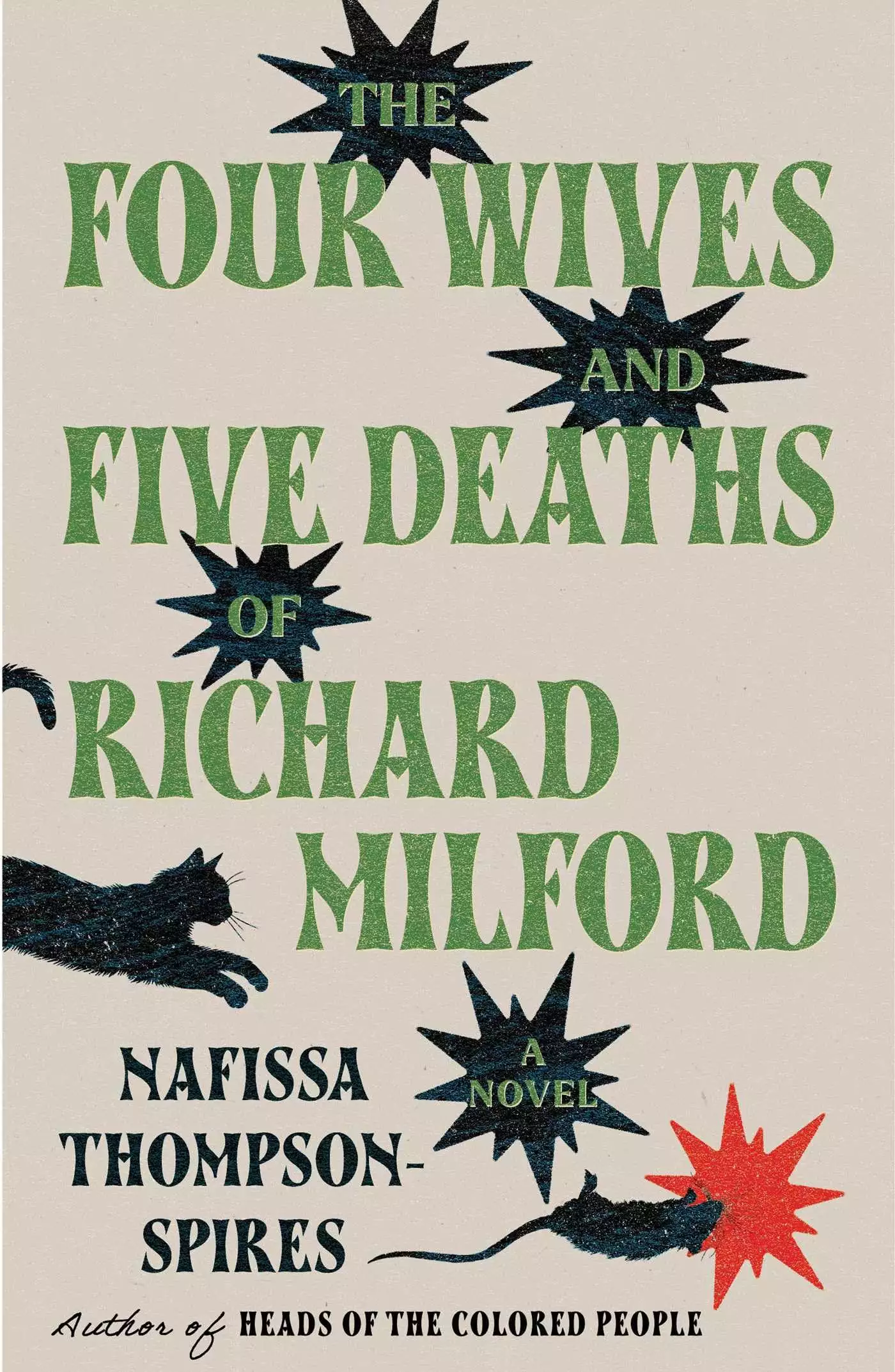
From the author of the multi-award-winning, National Book Award–longlisted, “vivid, fast, funny, way-smart, and verbally inventive” (George Saunders) story collection Heads of the Colored People, comes a sly, spry, tall tale of a debut novel about the murder of an infamous moonshiner and the cacophony of true stories a small town can tell about itself.
Rich Milford is dead. At last.
We find ourselves in Oklahoma, just far enough out of Tulsa, just long enough after the Massacre of 1921. For as long as anyone can remember, the Milfords have led plentiful lives on the backs of the townspeople of Newville. Now, on the ominous brink of the Great Depression and at the height of Prohibition, Richard Milford is an infamous moonshiner and womanizer and, it seems, finally crossed the wrong person at the wrong time. He’s dead and buried with no one but his women to mourn him but a question remains: who killed him, and why?
Top suspects are his four “wives,” Lally, Sophronia, Georgette, and Vivianne. But as their stories burst to light in a volley of competing narratives, the very idea of a true story comes apart before our eyes.
In an electric follow-up to her beloved and critically acclaimed debut collection, Nafissa Thompson-Spires once again serves up a brilliant distillation of front-of-mind happenings—think, cults of personality, capitalism run amok in politics, and rampant societal distrust—this time magicked into taut historical fiction structured as a stupefying line dance. In her uniquely powerful, humorous manner, Thompson-Spires takes on the interdependent clash of the traditional and the new-fangled in this genre-bending, gob-smackingly excellent debut.
Release date:
October 13, 2026
Publisher:
Scribner
Print pages:
176
* BingeBooks earns revenue from qualifying purchases as an Amazon Associate as well as from other retail partners.
Chapter One Chapter One It was at the funeral, at the funeral, where we first saw all the wives, and the curtains of the house drew open. We had caught glimpses around Newville for years, but now that we could examine them up close, we wanted blood and wailing, the dramas of fighting, grieving, concupiscent women flinging themselves over Rich’s exanimate body. They met us instead with upturned faces and dignity, pressed clothing and palms. The devil beat his wife that day, as we heard Rich had beaten his. The rain pelted us, the sun pelted us, and sweat, water, mud, and dust dotted our clothes and soaked our ankles, so it was like the Lord punished us for coming to ogle.
There were six pallbearers, the oldest sons, paper-doll cutouts of Rich in descending sizes. We showed up with stuffed Cornish hens, greens, macaroni and cheese, crisp fried chicken, potato salad, pecan pie, ribs, biscuits, cobbler, shortcakes, raspberry cordial, cordiality, and affected pity as our self-charged admission fee for the spectacle. We didn’t like the way our children looked at theirs, not so much with natural curiosity, but with hunger in their eyes. We were hungry, too.
Yet those women, Lally, Sophronia, Georgette, and Vivianne, and their brood of children were civil, respectable, striking, lined up in their plain white cotton dresses and pants, for it was a Friday—and their getups apparently part of Rich’s eccentric practices—along with Rich’s three-legged hound, who barked only once when the first handful of dirt landed on the plain ash casket.
And that was that. No one spoke. Rich belonged to the church of himself and had no reverend. The women and children sang a song we did not recognize and cannot remember, led a cappella by the light-skinned wife with freckles, Vivianne. He was buried in the ground almost unceremoniously, until she tried to jump in after him. The other three women snatched her back with one big hand, then started crying in more harmony than in their singing moments before. Rich came into the world with a bang, lived in it with lightning flashes and flared nostrils, and left it as we all do, alone, with little blues, except what the women made over him, and a slight buzzing in the air. We followed the procession, gaping at the scene, glancing occasionally at the sun, gulping up the raindrops in the field.
And here, now, lies Rich, dead as a doornail, like the ones used by the day laborers to expand the Chantilly house where he kept all those concubines. When his body turned up swollen and stinking of gangrene, poisoned and bootmarked, and missing a foot, everyone proposed a suspect, and he brought scrutiny upon all of us, too.
Piddling pissant. Since time for us in Newville moves in the shape of a full moon, we could simultaneously Juba and teach one how to Dougie—and detest Rich Milford beyond the infinite in every parallel reality. Excuse us, then, while we alternately stomp, spit, blow our noses, Cakewalk, C-walk, Charleston, Nae-Nae, Macarena, Wobble, Electric Slide, Cha-Cha Slide, and do the Hustle on Rich’s grave. Fool. Disrespecting the practices of our ancestors and others’, casting his sperm about like so much flotsam, jettisoning his electric hands, all for what? Slide to the left.
Now, a ghost town tour through our Newville, the place to which Rich brought the spectacle. Here was once the old jailhouse, where the women spent three nights, binding the marshal to solve the great mystery of Rich’s death and his missing foot. Here stood the gables and runs the river, where on the night of a full lunar eclipse, and for one night after, if you looked carefully, some of our most gullible wide-eyed women said a goddess shimmied over the surface of the blood moon with crystals in her hair and, depending on her mood, conferred blessings or curses, as women are wont to do. The same murky water where Rich used to showboat his muscles, a body that beat nearly everything walking and sexed everything talking before it met its timely end.
Here, in 1890, near the middle of the Verdigris River, is where Richard Aloysius Milford was born, with a misshapen head that broke his mother and required forceps, marking him from the outset. The midwife, sure she’d seen everything under the sun, reshaped the outside of his head but didn’t fix the inside, and when baby Rich smiled up at her with teeth already in his mouth, one crooked eye hazel and one eye brown, she took off screaming and left his mother, Tess, without tending properly to either of them.
Over there once stood the house, where local lore holds that Rich went mad after the police found him, age nine, and his sister, Mae, eight, stunned by the remains of their father and mother, brain matter all over the walls and floor, blood on both children’s hands and feet, smeared across their faces like Rorschach blots. “She Tried to Leave and Lost Her Life,” “Horrible Mess of an Apparent Murder-Suicide,” the Negro papers across the region, including the Newville Tribune, reported. The papers omitted the rumor that the night of the shootings, a blood moon in the sky, Rich’s father communed with the crystal-haired goddess Rosemary and left cursed, his mind gone before he reached his front door.
Still others insist that Richie, as he was known by his uncle Mil Milford, the founding mayor of Newville, who took him in—and Richie Rich or Dick, and “some pig” once by a spider he killed in cold blood—didn’t show any signs of insanity or violence until he was struck by lightning later that year while playing with the horses behind the house. Others say it was not until his final rodeo at fourteen, for he was a prodigy, when Whitey the Warrior bucked him off, throwing him twenty feet in the air, that Rich went mad. Thereafter, when the wind blew in the wrong direction, or when there was a tear in his skin, or whenever it rained, or when “too much electricity” welled up in his fingers and he “needed to let some of it out,” he punched at the air and the people around him and started many fights about town. Whichever oddity precipitated his troublesome personality, however, nearly all of us agreed, in the aftermath of his death at thirty-seven and its circumstances, that he never had a chance, and the women never had much choice.
Our dazzling 1.5-square-mile town of Newville, Oklahoma, once sat along the blackhand side of the Verdigris River tributary, a ten-hour buggy ride northeast of Boley, roughly the length of eleven scuffle hoes multiplied by the time it takes a giant to piss east of Muskogee County, and about forty-five stone throws (which is to say, fifteen miles) northeast of Red Bird—before statehood, and before the Depression disappeared most of us into history.
Here stood our old schoolhouse, where Rich used to kiss up on Berta and fondle Miss Martha with her prim giggle and no protestations. Now, all that remains is the highway they built over it—slate gray, like Rich in death. The mile of forsythia fields behind the school across from the cemetery never leaned right after the fires Rich set two years in a row, though no one could ever prove to the sheriff at the time that it was him, despite our very own witnesses.
Up against this riverbank, Rich Milford’s—and before him Mil Milford’s—farm sprawled, with a cotton gin and a thousand-barrel oil well, ninety heads of Angus cattle, an apple orchard, and a small cider mill on its two hundred acres. Over here were once the barns, where they stored the fruit gin, Sheriff Brown all the while looking the other way and tippling in it and taking a cut from it, too.
And here we are, at last, at the Chantilly Milford “estate,” about fifty yards from the river, where the women laid up with Rich. The Milfords isolated their home as much as themselves behind a dense thicket, but in the fall and winter, when all but the evergreens stripped down to their trunks, when passing by rowboat or while fishing, or when observing the currents of the water with binoculars from the top of the Overlook—Newville’s tallest structure—we could easily see clear across to the Milford home.
We built modest one- and two-story houses with white wood siding and picture windows. But not the Milfords. After a fire toppled the original house, Mil Milford built an assuming replacement, neither Victorian nor colonial but almost baroque, the only one in Newville of its kind, painted in layers like a cake, with a redbrick level at the base, a pink layer on the second, a powder-blue one on the third, two great big whipped green turrets at the top, and a white-beamed balcony going around all three levels, giving it the look of a Chantilly trifle. There, the mothers, as we called them when we were in a good mood, the heathen hussies when we were salty—the wives when we were charitable—had occupied the local mythos in Newville for nearly two decades before we ever saw them all come out of the house. The stiff little gingerbread haints, in their white-dress shrouds, with their baker’s dozen of children drew quite the crowd, singing over Rich at his funeral.
With this recounting of their passage through our town, may we erase the damage of their days and print a new story. May their scurrilous history unravel itself, finally, from ours.
We hope you are enjoying the book so far. To continue reading...

 Please log in to recommend or discuss...
