
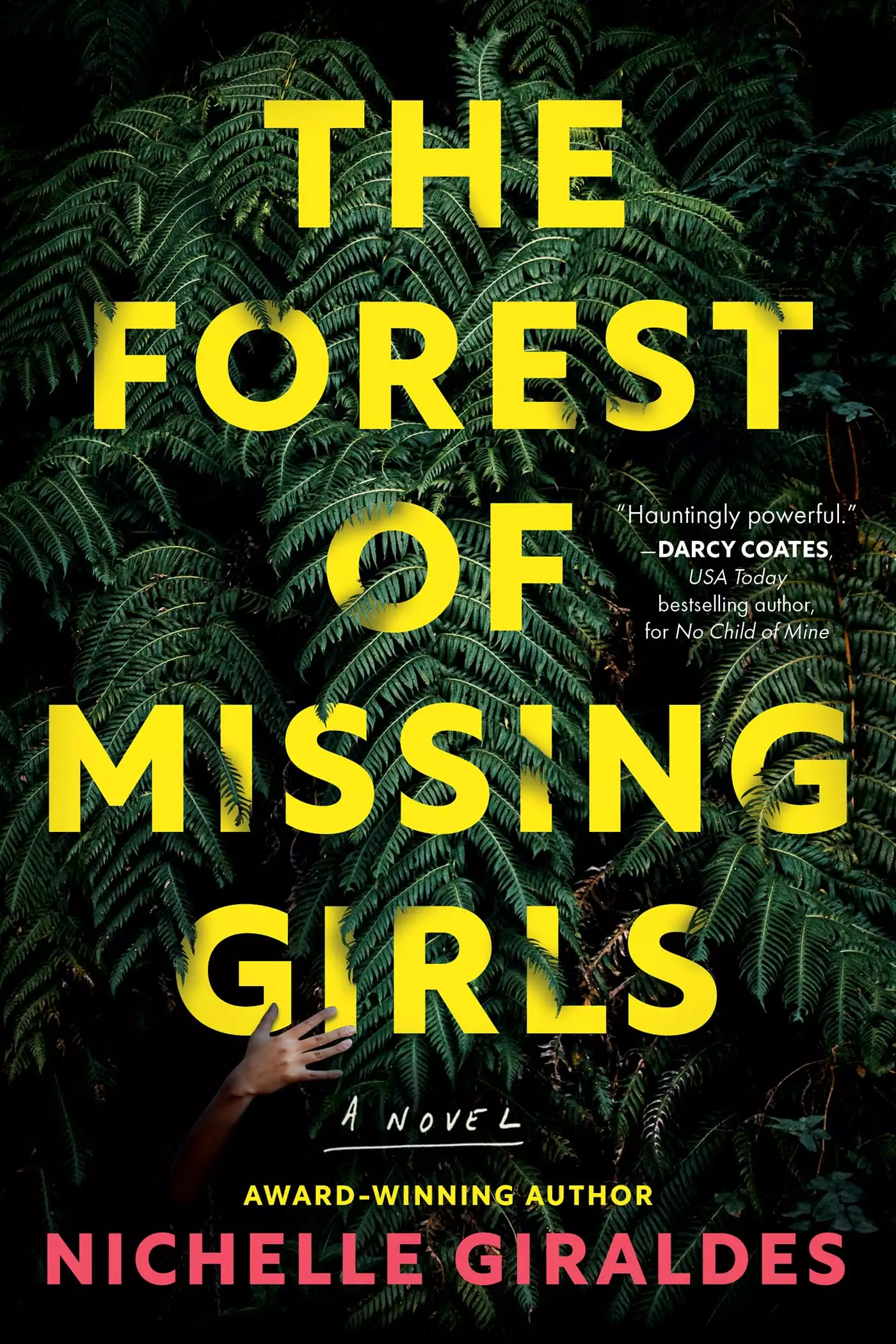
The Forest of Missing Girls: A Novel
- eBook
- Paperback
- Audiobook
- Book info
- Sample
- Media
- Author updates
- Lists
Synopsis
The forest is hungry, and her family's secrets are tangled in the trees...
Lia Gregg always hoped to outgrow her fear of the woods surrounding her childhood home. The dark, menacing trees have long been the site of whispered legends and disappearances of girls like her. But after a breakup sends her back to live with her family, the woods feel more sinister than ever.
When a teenage girl disappears from their backyard, Lia's childhood fear becomes terrifyingly real. The missing girls are no longer just faces on the news. Now, the danger is closer than she imagined, and her younger sister could be next.
As Lia digs into the disappearances, she begins to suspect her mother knows more about the forest—and the horrors within—than she's letting on. To save her sister and uncover the truth, Lia must confront the secrets lurking in the trees and the darkness they conceal...before it's too late.
"Hauntingly powerful." —Darcy Coates, USA Today bestselling author, for No Child of Mine
"Haunting and eerie...will chill your spine. I highly recommend it." —Amy Lukavics, author of Daughters Unto Devils, for No Child of Mine
Release date: November 11, 2025
Publisher: Poisoned Pen Press
Print pages: 382
* BingeBooks earns revenue from qualifying purchases as an Amazon Associate as well as from other retail partners.
Reader buzz
 Please log in to recommend or discuss...
Author updates
The Forest of Missing Girls: A Novel
Nichelle Giraldes
No one ever warned me how much of my life would feel like playing pretend. Pretending I knew what I was doing, where I was going, what I wanted. Pretending I was happy.
When I was a child, make-believe was fun, the sort of game I could lose myself in for hours in the forest behind my house. That forest seemed to possess a magic of its own, plucked straight from a fairy tale. Not the sanitized kind we were fed in children’s movies where princes fell in love with young maidens without voices or shoes but rather the darker, bloodier kind. Where toes were chopped off, eyes carved out of their sockets, and children were eaten. Those stories, where danger and magic danced, were as familiar to me as my own pillow.
I suspect I felt the way most children feel about their own imagined worlds, the line between reality and the impossible so blurry that it was difficult to tell the difference. But even now, when I no longer believed in fairies or witches, something about those trees still made me shiver. The forest was the kind of place Hansel and Gretel got lost in, filled with trees plucked straight from Snow White’s race through the haunted woods. Trees that whispered through the night. Branches that reached down low to brush their leaves across my cheeks. The trees that surrounded my childhood home for miles on each side felt alive. It was a place that I played in during the day and refused to turn my back on once it got dark.
As I got older, it became easy to forget the dark magic of the trees, to tuck the memories in a back corner of my mind where they’d collect dust. Especially when I moved away. Especially when I moved to a place where hot cement and incessant sunshine blotted out any secret shadows where magic might hide.
Even as I forgot the trees, part of me still believed that life contained its own sort of magic, that things would work out like in a storybook, the next chapters unfurling without much effort. A beginning of a life that led seamlessly toward a middle, then continued in a clean, straight line to an ending—if I was lucky, a happy one. That eventually, all my pretending would become something real. But so far, my life hadn’t worked out that way.
I unhooked my key from my key ring and set it on the kitchen counter, a wide swath of black quartz that I had learned how to perfectly wipe so there wouldn’t be any streaks. This place, Tom’s place, was the kind of home I had always imagined for myself—a beautiful modern apartment with big picture windows and pale hardwood floors. I walked through the kitchen again, pretending to do one last check despite the fact that all my belongings were already packed into my car. It’s funny how little you accumulate when you live your life tucked into the corner of someone else’s.
I opened the fridge one last time and took in the rows of perfectly arranged bottles and cans on the top shelf, giving way to the mismatched take-out containers below. A familiar desire sprang up in my stomach. I wished I felt at
home here. I never had, even when this had technically been my address. In the months I lived here, I never felt like more than a houseguest who had slightly overstayed their welcome.
I had lived in a studio apartment when I first moved to LA, fresh out of college. It was tiny and never felt clean, even after a full day scrubbing at the grout in the bathroom with a toothbrush. I hated it. When my lease was up, Tom, who at that point was my boyfriend of nine months, asked me to move in with him. I assume he felt bad for me, or maybe he was tired of driving twenty minutes out of the way to pick me up when we went to dinner. I had already taken to spending most nights at his place anyway, much preferring the double marble sinks in his bathroom to my tiny sink with an impossible-to-clean orange ring around the drain.
When he’d broken up with me less than two weeks ago over a candlelit dinner, I wasn’t completely surprised. I had felt it coming. He had grown bored with me. But I hadn’t expected it so soon. I hoped for another few months with him. While our relationship wasn’t exhilarating, it wasn’t bad. I was happy to endure conversations that never went past small talk and evenings out that felt like obligations to keep my beautiful apartment and enviable boyfriend. But the illusion of my perfectly composed life was fragile. Everything collapsed the moment he didn’t want me anymore.
He explained that he wasn’t ready to settle down. It didn’t matter that I wasn’t ready either. My novelty had worn off. He had already memorized the exact weight of my breasts. The birthmark inside the slight dip in my left hip bone was familiar. The way my skin broke out in goose bumps when he whispered my name in my ear no longer reminded him of his power over my body. These things, the parts of me that only he possessed, had become mundane and unexciting. The
They had lost their magic.
“You’re incredible, Lia,” he said. “But I’m not ready to take the next step right now. I wish we’d met a few years from now when I’d be prepared for all that.”
I nodded through his explanation while I picked at dinner. When he wanted to settle down in a decade or so, I would no longer be a candidate because he would want the twenty-three-year-old version of me with my tits high and forehead unwrinkled. He wanted to put this version of me on ice until a wife and a baby seemed more palatable.
I knew that I shouldn’t blame myself for his waning interest. I shouldn’t be required to reinvent myself into something new every full moon to keep him from growing bored. But I still felt like I’d failed because I couldn’t keep him entertained, as if I were a movie he had walked out on because there weren’t enough car chases.
He would have kept you if you were prettier…if you were just a little better, a small voice whispered in my ear. I tried to shoo it away like a fly at a summer picnic, but it was persistent. I should have pretended that I didn’t hear it or, at the very least, didn’t believe it. But it felt true. I had worked so hard to shape myself into the sort of girl who belonged in this city with Tom. It was an expensive regime. The workout classes. The salads. The bimonthly highlights. And skin-care routines. I had carved out new ways of dressing, talking, and moving through the world. But it hadn’t been enough. The glass slipper didn’t fit, even when I cut off my toes.
The morning after the breakup, I called my mom. I couldn’t justify living in LA on my current salary. I didn’t want to find another crusty studio in a part of town so far from the ocean that it might as well have been Nebraska. “Come home,” she told me, when I explained that Tom had ended things. Maybe she asked me, but regardless of whether it was a demand or a request, I agreed without hesitation.
lingered in the background most days, a quiet melancholy that I could have lived with for a while. There had been something undeniably tempting about leaving the seasonless city for the comfort of my childhood bedroom. The endless sun had started to grate on me. I dreamed of rainy days and trees under whose branches it was easy to forget the color of the sky.
Twelve days later, my car was packed, and I was headed back to my home in the trees.
I had forgotten just how frightening these woods were at night. My memories of them had become tinged with the candy-coated layers of nostalgia that painted my childhood in Technicolor. Even during the day, the forest was dangerous. It was deep, stretching for miles and miles on all sides, trees clustered so tightly together the house disappeared after just a few steps past the first branches. It was the kind of place it was too easy to get lost in.
But at night, it was worse. The tree trunks looked white in the glare of car headlights, cutting through the darkness like sharp teeth, the forest an endless mouth. As I made the familiar turn into the winding driveway, I felt like a thousand eyes were watching me from the darkness, their stares raising the hair on the back of my neck. The forest felt alive, like a wild animal—unpredictable, uncontrollable, something that could kill me without a second thought but for the moment was curled up at my feet.
Yet, even given all that, it still was the place that I felt most at home. We had moved into this house just before my third birthday, a few years before my sister was born. Most of my childhood memories had taken place under these branches. Perhaps it was just the familiarity that felt comforting, even when it was tinged with fear. But there was something more, something that kept pulling me back. This place felt written into my bones.
Every time the driveway turned, my headlights illuminated a new section of trees, the bright light making the deep shadows more pronounced. It was only a two-minute drive. Less than a half mile separated the house from the main road, but it felt like it took longer, the minutes stretching lifetimes as I recalled every time I had driven down the winding path between tree trunks. My tires crunched against the gravel road, a siren song beckoning me home.
The noise always brought me back to my childhood, to the moments during long car rides when I knew that the trip was almost over. I would slow my breath and relax all the muscles in my body so my father would carry me to bed. My mom would carry my sister, who never failed to wake up when the car stopped, her tiny whines and babbles filling the space that the sound of the gravel had left behind.
The house wasn’t visible until you rounded that last bend in the road. There was nothing but trees and darkness until you made the final turn, and then it appeared all at once. Golden light poured out from the windows, a lighthouse on a stormy night.
I pulled my car up against the house, the silence thick as I turned the key. My car was stuffed with everything I had acquired over the past year. White dresses and cutoff shorts, bikinis and oversize hats, blazers and barely scuffed heels, unlit candles, and books I’d never read.
I had gone to college a few states away on a campus with brick buildings and grassy quads. But I still spent my holiday breaks and
summers here, each semester just a long trip away from home. The move to LA was different, though. It was supposed to be a clean break, the first chapter in a new part of my life. I hadn’t planned on ever coming back.
But here I was again, staring at my childhood home and wondering if I’d made a mistake. I told myself I wouldn’t stay forever—just a few months, until I figured out what came next. Yet, as I sat with the warm light from the front porch pushing back the darkness of the surrounding forest, I wasn’t sure leaving would be so easy.
I could see the front room from my car, the lamp on the side table still on, a wedge of light cutting across the floor from the kitchen. At night, the house became a stage, every corner visible from one window or another. I slipped out of my car, grabbing only the tote bag I had tossed on the passenger seat. The rest of my belongings could wait until the morning. The air outside was cold. Winter was already here. Its icy breath cut right through my sweatshirt. I ran up the porch steps, eager to be locked inside, safe from the cavernous dark.
I kept my eyes fixed on that front window, waiting for someone to appear and notice me. It wasn’t very late, but maybe everyone had already
gone to bed, forgetting that I was arriving tonight. Perhaps I could slip inside without waking anyone, although that seemed unlikely.
I had tried to sneak out of my house only once, when I was in high school. Driving my own car was out of the question. There was no way I would make it down the long gravel driveway without the whole house hearing. You could hear cars on that driveway from every room. So, one night, after I had confirmed both of my parents were asleep, I snuck out the back door and made for the trees. My friends were supposed to meet me around the corner, their car idling on the street at the end of our driveway. But I never made it that far. The moment I was deep enough in the woods that the trees hid the light from the windows, I turned back and ran inside the house, feeling like something was chasing me. I was certain that, at any second, a hand would reach out and grab my ankle and pull me into the dark.
I was out of breath by the time I made it back to the house and slipped in the back door. I couldn’t have been gone for more than a few minutes, but I found my mom leaning against the counter.
I waited for the reprimand. I didn’t bother making excuses. Even in the dim light of the kitchen, she couldn’t have missed my outfit: ripped jeans, a too-small tank top, and gray eyeshadow smudged halfway to my temples. Even then, I was practiced at pretending, trying on different versions of myself to find which girl would be the most appealing to the people around me.
My mother’s eyes traced over me while I stood frozen, my hand still on the knob. She barely seemed to register that I was there, and then the slightest smile had lifted the corners of her mouth. “You shouldn’t use that shade on your lips. It really washes you out.” To this day, I would think about that comment every time I tried on a new lipstick color. My mother’s voice was never far away when I looked in a mirror to assess if my cheeks looked too pink or my skin too pale, always seeking her approval, even when she was hundreds of miles away.
The comment had been routine, just one of thousands of unspoken expectations. My mother had rules about everything from skin care to hair color. There were rules about what I needed to look like. Rules about what were acceptable methods to achieve that. Rules about what I wore. Rules about what I ate. Rules about how loud I laughed or talked. Rules about what I was allowed to talk about. Rules about what I should enjoy. The rules, her rules, were carved into the insides
of my eyelids, little reminders every time I blinked. It wasn’t like there was a handbook somewhere. Most of the time, the rules went unspoken, governed by disapproving glances and sighs. But still, they were always present, like walls moving in closer and closer until it was impossible to breathe, narrowing the acceptable circumstances I needed to exist within.
She pushed away from the counter, sparing me one more glance. “Lock the door,” she said over her shoulder, then floated up the stairs. I had braced for my punishment to be doled out the following day at the breakfast table, but she’d never mentioned it again.
She was waiting for me in the kitchen tonight too. Her long blond hair was swept back in a twist, her posture perfect as she sat at the table. My mother, Elizabeth, was the kind of woman who would draw attention the moment she walked into a room. It wasn’t just that she was beautiful, although that was certainly true with her perfect blond waves, pearly white smile, and bright blue eyes. It was something more than that. You didn’t want to merely admire her; you wanted to be her. To peel off her skin and slip into it for a while. She exuded an effortlessness that felt possible only on the glossy pages of a magazine. If I had to choose a single word to describe my mom, it would be that one: effortless.
I looked nothing like her.
At a glance, you might not notice the differences between us—two women of roughly the same height, both with long blond hair. We looked the same in the way that a pet might begin to resemble its owner. Not a matter of genetics but of habit and preference. My eyes were smaller than hers, my nose wider, my chin softer, my dark roots clearly peeking out from my scalp, my face greasy after a few too many days spent in the car. It wasn’t that I looked ugly, like some strange alien creature, but no one would ever call me effortless.
disordered stack of paper was on her right. The glasses were a new addition from a few years back, a little reminder that she was getting older too. Her face had softened some over the years, a few new faint lines appearing each time she added a candle to her birthday cake. But she had never so much as considered plastic surgery or any sort of injection. She said there was something unnatural about those sorts of procedures, and she wanted to age gracefully. It was easy to say that when you looked the way she did. She was already an after picture.
She looked up at the sound of my footsteps, the light from the laptop screen reflected in her lenses. “How was the drive?” she asked.
“Not too bad, but I’m grateful to be home,” I said, as if the last two years in LA had been nothing but a bad vacation where my luggage had been lost and they had double-booked my hotel room.
The dogs heard my voice, and their claws clicked against the hardwood as they headed toward us. Poppy and Daisy, a pair of goldendoodles my parents had gotten while I was away at college. As soon as they spotted me, they pressed their noses into my palms. I scratched their heads, and their collars jingled in the quiet house.
“Are you hungry? I can heat something up for you,” my mom offered. The gesture was almost obligatory, but it was comforting all the same. I couldn’t remember the last time I’d had a home-cooked meal that I hadn’t made myself.
The dogs had already grown bored of me, walking away in tandem to their matching beds in the living room. I shook my head. “I’m okay. I think I’ll probably just head up to bed. I’m exhausted.” It wasn’t a lie, but more than that, I was eager to be alone in this space. To recalibrate myself into the version of Lia who would be expected here.
“You look tired.” The words were innocent enough, but coming from her, they felt like judgment. She would have arrived looking perfect: clothes unwrinkled, hair freshly blown out, probably with fresh flowers and a handwritten thank-you note. I had been home for five minutes and was already falling short of her expectations. Her vague disappointment was familiar as it lingered in the air between us. “Get some sleep,” she said, her eyes returning to her screen.
I watched her face for a second, illuminated by the kitchen light and the blue glow of her laptop. Even as a child, I had known my mom was not like other mothers. There was something almost otherworldly about her.
When I was in kindergarten, I told my classmates that my mom was a lost princess who had left her kingdom and could never find her way back home. It was the only explanation that felt feasible. It was the only way I could rationalize how she felt different, better somehow than the other parents. She would have been the heart of any fairy tale, either as the lost princess I imagined as a child or the evil queen. Someone as beautiful as her wouldn’t be relegated to a side character.
Sometimes I wished she looked more like everyone else, with crooked teeth or a lopsided smile. The slight imperfections in ordinary faces were comforting. They gave you something to hold on to, to sink your nails into, a part of them to memorize and fall in love with. My mom was too perfect; her face was made of marble and silk, far too easy to slip through your fingers.
I turned and headed for the stairs as she tapped against the keys. I was almost out of sight before I heard her say, “Welcome home, Ophelia.”
The sound of my name made me hesitate on the first step. Another signal that I was back home. My mother was the only person who called me that. No one in my life in California had ever called me by my full name. I had become Lia, a lighter version of myself, uncomplicated by the weight of a Shakespeare play. What kind of parent would give their daughter the name of a drowned girl, a name sure to lead to tragedy? But here I was, Ophelia again. ...
We hope you are enjoying the book so far. To continue reading...
