- Book info
- Sample
- Media
- Author updates
- Lists
Synopsis
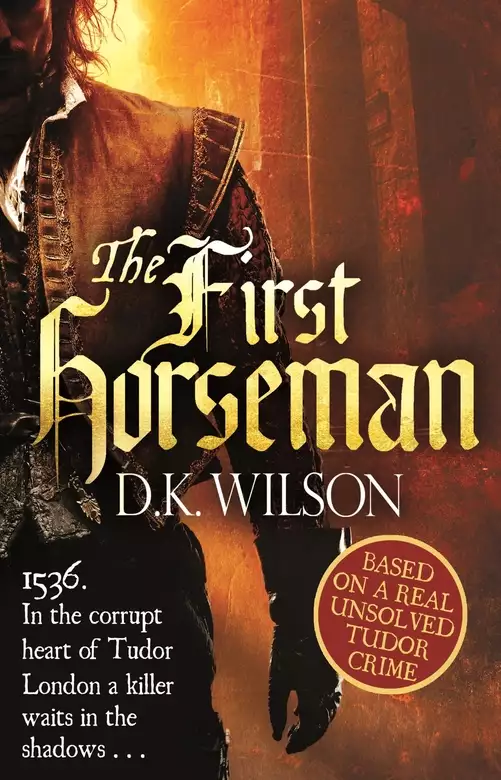
1536. In the corrupt heart of Tudor London a killer waits in the shadows...
The Real Crime
Before dawn on a misty November morning in 1536, prominent mercer Robert Packington was gunned down as he crossed Cheapside on his way to early morning mass. It was the first assassination by handgun in the history of the capital and subsequently shook the city to its core.
The identity of his assassin has remained a mystery.
Our Story
Thomas Treviot is a young London goldsmith and a close family friend of Robert Packington. Through his own upstanding social connections - and some less upstanding acquaintances he has made along the way - Thomas launches a dramatic investigation into Packington's death.
As Thomas searches for revenge, he must travel from the golden heart of merchant London, to the straw-covered backstreets of London's poorest districts before reaching the country's seat of power: the court of King Henry VIII. Before long he is drawn into a dark conspiracy beyond his wildest imaginings and claiming justice for his friend starts to look impossible. Especially when Thomas realises that Robert wasn't the man he thought he knew...
In the first of a new series investigating real unsolved Tudor crimes, D.K. Wilson brings the streets of Tudor London to spectacular life as Thomas Treviot faces a fight to bring the truth to light in the corrupt world of Anne Boleyn, Thomas Cromwell and Henry VIII.
Release date: August 8, 2013
Publisher: Little, Brown Book Group
Print pages: 400
* BingeBooks earns revenue from qualifying purchases as an Amazon Associate as well as from other retail partners.
Reader buzz
 Please log in to recommend or discuss...
Author updates
The First Horseman
D.K. Wilson
‘Master Thomas, Master Thomas, rouse yourself!’
Master Thomas had not the slightest intention of rousing himself.
‘Sod off, Will!’ I thrust my throbbing head deeper into the pillow.
I only half heard another voice. ‘Stand aside, Will. Give me that bowl.’
The wave of icy water that crashed over my head brought me, gasping and coughing, into the garish daylight. The shutters had been thrown open and Robert Packington’s thin, grave, disapproving countenance seemed etched on parchment. He bent over me.
‘Jesu, but you stink! Have you brought the Stews home with you? At least you were too drunk to undress. That will save us time.’
‘Leave me alone.’ I rolled over to face the undrawn curtain on the far side of the bed.
Robert grabbed me by the collar and yanked me into a sitting position. ‘You’ve an appointment at the Tower and I’m going to make sure you keep it – though the Lord knows why I bother.’
I struggled but there was little strength in my arms and legs. Aided by my servant, Robert had little difficulty getting me on my feet. As I swayed, half-conscious, he tackled my unfastened doublet, doing up the points. ‘Will, fetch his best livery gown,’ he ordered. ‘We have to cover up these disgusting stains.’
‘Why all the fuss?’ My tongue seemed swollen to twice its size in my dry mouth.
‘You know why – we’ve been nominated to be among those representing the City companies. Fortunately it’s been postponed to a later hour. That’s more luck than you deserve. Don’t press it any further.’
Slowly, grindingly, my memory’s clockwork whirred into action as the two of them wrapped my blue goldsmith’s gown around me. I recalled what ‘it’ was.
I scrabbled for an excuse. ‘The king won’t —’
‘The king certainly won’t be there. But his eyes and ears will be. Your absence would be noted. There will be many who’d happily put their own interpretation on it in order to make trouble for you with your superiors. You’re already in bad odour in the Goldsmiths’ Company because of your recent behaviour. Any suggestion that Thomas Treviot was sympathetic to her —’
‘That’s absurd,’ I protested.
‘We live in times when many absurd things happen,’ Robert muttered bitterly. He stepped back as Will fastened the clasp of my gown and set a cap on my head. ‘Jesu, what a sight. It’s a mercy your father isn’t here to see you thus. Come on.’
He half-steered, half-propelled me through the doorway and down the broad stairs to the shop, then out into Goldsmith’s Row. Our horses were waiting and with a shove from Will I scrambled aboard Dickon, my grey gelding. West Cheap was alive with its usual hubbub, the stalls already set out and people and horses moving along the paved thoroughfare. Despite the crowds, Robert insisted on leading the way at a bustling trot that jarred all my bones and rattled my still aching head. We must have completed the journey in a fast time, though it seemed to me as long as purgatory.
I was certainly unwilling to arrive at our destination. Anyone hungover, melancholy or otherwise out of sorts should keep away from the Tower of London. I suppose my nurse must have planted the seed of fear in me. The threat ‘I’ll take you to the Tower’ was her standard way of dealing with naughtiness and it was usually effective. It was all too easy to believe that anything could and did happen within the walls of this monstrous soaring pile that crouched like a malevolent stone beast, keeping watch on the capital.
My stomach churned as we emerged from Tower Street and jogged along the well-worn track across the green. We joined a file of other travellers on foot and horseback, most of whom attached themselves to a small crowd that surrounded the Bulwark Gate. I looked about as we pressed our way through. My bleary gaze passed over the mixed throng – a quiet, expectant blob of humanity. A hag thrust a grubby kerchief at me. ‘Fetch me some of the blood, Master,’ she screeched.
We paused at the gate to have our credentials checked and were waved on to cross the causeway. We were stopped again by guards at the Middle Tower and the Byward Gate and I swear that if my hands had not been trembling on the reins I would have turned Dickon’s head and fled from the ordeal. Never before had I come this far within the concentric cordons of the fortress. Occasionally business took me to the Royal Mint but that was situated within the outer wall. As we dismounted I inadvertently cringed away from the uprearing stonework. It seemed to sway, as if about to crumble on top of us. Robert grasped my arm and urged me briskly forward. We entered the inner ward through yet another gateway and followed a path beside the White Tower – its pallid complexion pockmarked where the paint was flaking. And so to the green, the theatre where the tragedy was to be performed.
An arena had been created in front of St Peter’s Chapel, Tiered staging arranged on three sides of the black-draped platform. The seats were already almost full. Prime positions were occupied by courtiers and government men. The upper levels were for prominent citizens, like ourselves. We clambered up and found two spaces at one end of the topmost bench. An elderly alderman grunted and grumbled as he made room for us. Clamped between him and Robert, my stomach still churning, I wanted it all to be over. Wanted to be back in the warm anonymity of my own bed.
‘Have you ever seen the new man, Cromwell?’ Robert asked, pointing to a thickset councillor seated next to the familiar figure of Lord Chancellor Audley.
‘No.’
‘Well, take a good look and remember what you see. Cromwell’s the future. He has more brains than all the rest of the king’s council put together. He’s climbing fast to the top. You’d do well to cultivate him.’
I was scarcely listening. ‘How long is it going to be? Much longer and I’ll throw up.’
But the waiting was over. The buzz of conversation stopped and all eyes turned towards a gateway beside the White Tower. It was a small procession: two pikemen, four female attendants, then the Constable, Sir William Kingston, and beside him a woman, small but walking very erect, in an ermine mantle over a grey gown, her face framed by a gable hood. Queen Anne of England, going to her death.
She was helped on to the platform and spent some minutes talking with her ladies, two of whom seemed on the point of collapse with grief. One was on her knees clutching the queen’s gown and had to be pulled aside by a guard. Anne turned away and came to the edge of the dais. Not a flicker of movement from her audience as she lifted her head to speak. I leaned forward, focused on the slight figure. My head seemed suddenly clear.
‘No priest, Tom,’ Robert muttered in my ear. ‘No priest. Mark that.’
It was a brief speech but I don’t recall all the details. I know what she did not say – the silence all London was abuzz with for days after. She did not confess her adulteries. She bade us pray for the king and for herself. Then the women helped her remove her cape and her headdress. Her long hair gleamed in the sunlight before she tucked it into a little cap. As she was composing herself, a tall figure stepped on to the stage behind her.
I turned to Robert. ‘Who —’
‘The executioner. Brought specially from France. They say he’s very good. Pray God it may be so.’
One of the ladies came forward with a blindfold. Before it was fastened, the queen looked around the ranks of men happy or content or indifferent to witness her destruction. As her gaze reached the end of the line, it rested on me for a long moment – or so it seemed. I could not tear my eyes away from the slight figure, who now knelt, her head bent slightly forward, her lips moving in silent prayer. Up to that moment the performance had proceeded at a slow, almost stately pace, like a sinister pavane. But now the Frog took a stride forward, swinging his large sword as he did so. It flashed down in a wide arc. The capped head fell to the floor, bounced and rolled a few feet. The body, fountaining blood, remained upright for several seconds before tumbling sideways.
That was when I threw up all over the smart black gown of the man sitting in front of me.
The nauseating scene I was obliged to witness that May morning was the first in a series of violent acts that would change England for ever and involve a very reluctant twenty-two-year-old merchant in that revolution. The sequence of events would rob me of my truest friend, turn my life inside out and, in very fact, almost bring it to a precipitate end – and that more than once. Of course, I could not know that at the time. The queen’s death had no relevance to me, Thomas Treviot, freeman goldsmith of the City of London. I had no interest in the affairs of the royal court. For all I cared, Lecher Harry could have been a Musselman with a dozen wives and decapitated every one of them. I had problems enough of my own. Grief enough and to spare.
A mere eight months before Queen Anne’s execution I had been one of the most fortunate young men in London. And I knew it. I was the only son (in fact, the only surviving child) of Thomas Treviot Senior and his wife, Isabel. My father was one of the leading City goldsmiths and, at the age of ten, I was apprenticed to him. Nine years later, having served two years as a journeyman, I was admitted a freeman of the Worshipful Company of Goldsmiths of the City of London. I worked beside my father to build upon an already flourishing business. My life lay before me like the map of a familiar land. There were no spaces marked ‘Terra Incognita’ or peopled with speculative monsters, such as one sees on new charts of Africa or America. One day I would take over the business operating from the sign of the Swan in Goldsmith’s Row, continue running it on the lines laid down by my father, assume my place among the mercantile nobility of the City, grow into an old and respected member of the Worshipful Company and eventually be laid to rest with others of my peers in the Church of St John Zachary, next to our company hall. Life became even more agreeable a year later when, in May 1534, I married Jane Coutray, a daughter of one of the London aldermen. It was in every way a suitable match. Suitable, not only because it greatly pleased our families, but also because we were very much in love. Jane, with her flowing fair hair and heart-melting smile, was everything a successful young businessman could want in a wife. She kept house immaculately and presided with charm and wit over our table when we entertained. There was only one thing we lacked – children. But we were young and time was on our side. Or so, in the careless arrogance of youth, we thought.
It was in December 1534 that Jane became pregnant. Any parent will know the joy and excitement that filled us over the following months. Yet no one was happier than my father. The prospect of a new generation to carry on the business delighted him. He dismissed as nonsense our protests that the baby might be a girl. He was right, but would never know it. The following summer he fell victim, like hundreds of others, to an outbreak of quotidian fever. Suddenly I was left alone, shouldering all the responsibilities of running the business, supporting my grieving mother and ensuring that Jane had everything necessary to bring her to term successfully. Her time came in early September of 1535. She was delivered of a healthy boy. Three days after the birth my lovely Jane was dead of the fever that kills many new mothers.
Everyone was very kind. John Fink – my journeyman apprentice, who had been with the firm as long as I could remember and knew the business as well as I, if not better – eagerly took on fresh responsibilities – I knew I could leave much of the day-to-day running in his hands. I could also rely on the Goldsmiths’ Company’s excellent record of looking after distressed members. For several months brother craftsmen kept an eye on the workshop and supervised my accounts. Neighbours were sympathetic. But sympathy is a flower that soon fades and grief is a much hardier plant. Perhaps I might have come to terms with it more rapidly had I not had so much support. If I had thrown myself into supervising the workshop, the heat and din of precious metals being melted, hammered and fashioned into jewellery and table plate might have driven other thoughts from my mind for much of the working day. Discussing their needs with clergy commissioning chalices, patens and altar furniture, with courtiers wanting to impress the king with the New Year gift of an embossed cup and cover, with newly rich merchants wishing to adorn their tables and court cupboards with silver plates and dishes or young gentlemen seeking expensive love pledges would have kept me in the world that goes on despite all our personal tragedies. But I was left much to my own memories and they were unbearable.
I fled from them. I had to escape from the everyday, the familiar. All that I saw, heard, smelled and felt reminded me of what I had lost. They spoke of happy days now gone beyond recall. My home at the sign of the Swan had become a mausoleum. The shop and the atelier were filled with my father’s shrewd, energetic presence. The parlour and especially the bedchamber enshrined the very essence of Jane. She had been my light, my warmth. Without her all was like a cold, blackened hearth on which no fire would ever burn again. Escape seemed to offer the only way to keep a semblance of sanity.
So I took myself out. Out of the shop. Out of the house. Out of the City. Away from anywhere that conjured up images of lost happiness. I rode about aimlessly, steering Dickon along the solitary heights of Hampstead or the marshy banks of the Lea near Hackney village. I had no care for where I was; no interest in the things I saw and heard. Sometimes I shouted my rage into the empty autumn air. Rage against a cruel God, who had given me everything and then taken a perverse delight in snatching it all away. I even complained to the yellowing woods and new-ploughed fields about well-meaning friends who tried to comfort me with platitudes, sympathy and advice.
Everyone warned me about riding unaccompanied along roads around the City infested with highway robbers. My response was that anyone killing me for my purse would be doing me a service. Colleagues urged me to put the past behind me, to abandon self-pity and look to my responsibilities. My son needed me, they said. But I could not bring myself even to look at him. To my distraught mind he was his mother’s murderer. Or, if he was not, then I must be, for I was responsible for the condition that had killed her. My mother and her ladies had decided that the boy was to be baptised with the name Raphael. Our parish priest had advised that the name of the archangel meant, in the original tongue, ‘God heals’. It was, he said, a good omen. I raised no objection. I was too much out of my wits to listen to any counsel. The counsellors themselves were abhorrent to me. I shunned them and wanted only to be alone. That was why I failed to notice the change in my mother. She, who had always been so calm and strong, was being destroyed from within by the canker of a grief even more virulent than my own. She became vague and absent-minded. Sometimes she spoke as though her husband were still alive. I should have seen the signs if I had not been blinded by my own feelings.
My random wanderings seldom took me across the river but on a crisp January day in 1536 I stuffed half a manchet loaf and a flask of Canary wine into my saddle bag and set out across London Bridge. Islands of ice were drifting slowly downstream to grind against the bridge and break themselves on its piers. On the other side, I turned westward, deliberately avoiding the crowded Southwark streets clinging to the towering bulk of St Mary Ovey’s priory church and the Bishop of Winchester’s even more impressive palace, and jogged along Bankside. Steadily I put behind me the monastic hostelries and the fashionable houses built for nobles and bishops which gazed across at London and Westminster. A gaggle of onlookers were down by the royal barge house taking the opportunity to have a close look at the king’s magnificent river craft, which had been brought out and moored at the wharf for its annual redecoration. Three men were applying fresh crimson paint and gilding while others worked inside the windowed cabins. Apart from them, there were few people abroad on this raw winter’s day. That suited my solitary mood. I followed the river round the wide bend to Lambeth and rode on past Archbishop Cranmer’s palace. A bleary sun was wrapping itself in folds of translucent cloud as I rode out on to Kennington Common. I gave Dickon a canter to the top of the hill, unpeopled save for two bodies dangling from a frost-rimed gibbet in the breezeless air, and in their company I stopped to eat my simple meal.
But not for long. The sky was darkening ahead, threatening snow. It was time for Dickon and me to retrace our steps. We had reached the semi-cultivated area known as Paris Garden and were just passing the bear pit when a sudden roar from one of the creatures caged there startled my horse. He skittered sideways, caught a hoof in a frozen rut, stumbled, recovered and broke into a frightened canter. I was almost unseated. It took me several moments to regain my balance, rein Dickon in and pat his neck to calm him. Then after a few more paces I realised that something was wrong. The poor animal was walking awkwardly. I dismounted and lifted his left foreleg. It was as I had feared: Dickon had cast a shoe.
Unless I could find a farrier, I faced a long walk home. Either way I needed to make haste. Dusk would be early and I wanted to cross the bridge before the bascule was closed for the night. Southwark, a haunt of whores, cutpurses and criminal gangs, was no place for honest citizens after dark. Only months before, the king had tried to close the bawdy houses. He could as well have ordered the river to stop flowing for all the good his edict did. This side of the Thames fell under the sway of Bishop Gardiner of Winchester, one of Henry’s own councillors, and that good man of God earned too much from the rents paid by harlots and their panders to have the area cleared of the ‘Winchester Geese’, as these women were known. I took hold of the reins and set off, leading my horse, towards Southwark.
I had not been walking many minutes when two riders coming in the opposite direction halted and greeted me. I eyed them carefully. The elder of the two seemed to be a man of some substance. Though his heavy cloak was well wrapped round him, I glimpsed beneath it short trunk hose of a style fashionable at court some dozen years or so earlier and the hilt of a short sword. His boots were shiny and of good hide. The other man, in a leather jerkin and worsted cloak, I assumed to be his servant. They looked respectable enough but many of the thieves and ruffians who infested our roads were masters of deception. I was automatically on my guard.
‘Good day to you. Do you have a problem with your horse?’ the senior enquired with a polite doffing of his cap.
I was aware that Dickon and I were being scrutinised as carefully by these strangers as I was evaluating them. Well, I had taken no care of my dress. If they were contemplating villainy, they would have seen a dishevelled young man with three days’ stubble on his chin, who was unlikely to be carrying much money. There was, however, no disguising Dickon’s pedigree. He was bred out of sturdy, dark-haired Friesian stock but had taken his Irish mother’s colouring and easy temperament. It did not need a wily coper’s eye to recognise a beast that was strong, fleet and willing. He would be a considerable prize for any murderous villain. ‘Lost a shoe,’ I said, preparing to continue along the road. ‘Just my luck. It seems we’re in for snow.’
‘Do you have far to go?’ the older man asked.
‘Not too far,’ I replied non-committally. ‘But I must keep moving. God speed you.’
The strangers exchanged glances and the servant nudged his mount sideways, blocking the path. ‘Take care, young sir,’ he said. ‘This ain’t the best place for a gen’leman travelling alone.’ By the man’s rough speech I marked him for a countryman, probably from Kent. ‘Why, if you knew the number of poor travellers what’s bin waylaid on this bit o’ road… Ain’t I right, Ned?’
‘You are, indeed, Jed. Now, sir, might I suggest you give my companion and me the pleasure and privilege of accompanying you as far as your lodging?’
I glanced along the road. There was no one else in sight. ‘That’s remarkably kind, but I couldn’t allow you to delay your own journey for me.’ I tried to sound more relaxed and casual than I felt.
‘’Tis no more than our Christian duty, sir.’ ‘Ned’, or whoever he was, turned his horse. ‘Jed, let the gentleman have your mount. We cannot allow him to trudge the road like a wretched vagabond. You can lead his poor, afflicted beast.’
I had to think quickly. I waited while Jed dismounted. Then, as he handed the reins to his companion, I leaped back into Dickon’s saddle, pulled his head round and legged him hard. There was no point in riding back along the road. The discomfort of the missing shoe would slow my horse down and I would have been swiftly overtaken. So I plunged in among the trees of Paris Garden. Despite its name, part of the area was still tangled and wooded and had the reputation of being a hideout for criminals and a place of assignation for those whose affairs called for secrecy. Desperately, I hoped that its deep shade would provide me with a hiding place from my assailants.
The trees were very close together and the undergrowth beneath them a jumble of ferns and briars. We made what pace we could, dodging around trunks, slithering into gullies and leaping over fallen, rotting boughs. I had no idea how close we were being followed. All my attention was given to peering ahead through the gloom for obstacles and low branches. It was such a branch that I did not see which proved my undoing. It caught me full on the temple and knocked me clean from the saddle. I felt myself thrown to the ground and sudden pain as my shoulder struck something hard. Then nothing.
My first sensation when I came to myself was the smell – a mingled odour of latrines, stale sweat and something sickly sweet. When I opened my eyes I could only make out a blur of timber beams and mottled paintwork. I turned my head in an effort to identify my surroundings and was rewarded with a flash of pain across my temple. Then I sank back into welcome unconsciousness.
When I awoke again the pattern of ceiling beams was clearer. They were wide, suggesting another floor above. They had been painted, as had the plaster between, but long since, for the surface was flaked. This was not my room, nor any room I recognised. I turned my head slowly and carefully to the right. A good-sized chamber with plain wooden walls and over a simple chimneypiece a single candle burned. Night, then. Painfully I shifted my position and the truckle bed creaked its protest. Immediately there was movement in the room. A young woman’s face and shoulders entered my vision. She wore her long, dark hair unbound but I could see little of her face which was in shadow.
‘So, Master Treviot, you have decided to rejoin us.’ The voice was soft but somewhat deep for a woman.
I groaned. ‘Who is “us”?’
She laughed – something between a trill and a chuckle. ‘Us? We are the Sisters of the Unholy Order of St Swithun.’
‘My head is bursting, woman. Don’t tease it with riddles. Be so good as to tell me where I am and how I came here.’
‘That is soon said. You are at the Sign of St Swithun in Southwark, close by the Clink prison. You had an accident not far from here and were unhorsed. Luckily for you, a couple of Samaritans discovered you and, not knowing what else to do with you, they brought you to us to tend till you regained your wits. Do you remember anything yet?’
‘Near the Clink, you say? Then I am in the Stews and you are…’
‘An honest woman serving the needs of travellers and fine citizens, like yourself, Master Treviot. Don’t pretend you’ve never been here looking for some comforting company away from home.’
‘Never. And how is it you know my name?’
‘Why, all London and half the country around knows your name. There have been bills posted everywhere and search parties out looking for you. It’s not every day a rich City goldsmith disappears without trace.’
‘Then I assume you have sent word to my home. My mother will be anxious…’
‘One matter at a time, Master Treviot. When you are fully yourself we can make arrangements for your return – and discuss suitable terms.’
‘Ah, I see. I am kidnapped and to be held to ransom by you and your accomplices.’
The whore stepped back from the bed and for the first time I could see her features. The candlelight revealed pale, somewhat flat cheeks, and glinted from dark eyes. She had the slim figure of a woman not yet in her prime. Though faint lines had already appeared around her mouth, I judged that she could be no more than eighteen. She stood, hands on hips, glowering down at me. ‘Kidnapped, is it? If it weren’t for my “accomplices”, you’d be lying out there rotting under a foot of snow, waiting for the foxes and crows to make a meal of you!’
‘Well, then,’ I replied, ‘if I’m free to leave I’ll be on my way and put you to no more inconvenience!’ At that I tried to sit up. Pain juddered through my back and neck and I collapsed with a gasp.
She laughed. ‘Going to stumble all the way back to Cheapside, are you, with a bruised head and a broken shoulder bone? The bridge is closed and no boatmen working the river as long as it’s littered with floating ice, so I suppose you’ll swim the Thames.’
Gingerly I felt my left shoulder. It was tightly bound with linen strips. ‘Whose handiwork is this?’ I asked.
‘Our apothecary. We do have such things here, you know. We’re not quite the dregs of society you think us. Now you just go back to sleep. I’ve still work to do and a living to earn.’ She ran her fingers through her hair and patted her cheeks to bring colour to them. She left and I heard the rasp of a door bolt as I drifted once more into unconsciousness.
Light filled the room from a wide, unshuttered window when next I woke. Inner illumination also seemed to be clarifying my thoughts. For the first time I remembered clearly the encounter on the road up to the moment of my flight into the Paris woods. I tried to imagine what must have happened thereafter. I envisaged the two supposedly solicitous strangers following me and coming upon my unconscious body. They would, undoubtedly, have stripped me of anything valuable and taken possession of Dickon. Why had they not, then, left me to perish of cold or despatched me themselves? There could be only one reason: I was worth more to them living than dead. So they had brought me here to this bawdy house to be patched up by their female partners in crime.
Slowly, carefully, I urged myself off the narrow bed. With my dangling left arm thrust inside my doublet for support, I limped across to the window.
What I looked out on was a courtyard enclosed on all sides by an old timbered structure three storeys high, the upper floors overhanging the one at ground level. Several windows had open shutters and, while some were glazed, many were filled with panels of grimy hempen cloth as protection against the cold. The weather had obviously improved a little since I had been brought here for the ground was covered in slush, churned into muddy mounds where wheels, hooves and boots had trampled it. Three urchins were playing a desultory game of snowballs, scooping up handfuls of the dirty, frozen mess to hurl at each other. Washed clothes hung on lines stretched between upper windows. Beyond this enclosed yard I could not see, for opposite my window the large doors that gave on to the street beyond were closed. This was clearly an inn lodging that had seen better days. Once the town house of a prosperous lord or, perhaps, a monastic hostelry for travellers to the City, it had, like many buildings in overcrowded London and its environs, been divided into tenements taken up by the poor and ‘undesirables’.
The door behind me opened and, turning, I saw one of the villains who had waylaid me on the road. The one who had called himself ‘Ned’. I was able to get a better look at him and beheld a stout man of about fifty years, with thick white hair and a ruddy complexion. His doublet and hose were faded but clean and his beard was well trimmed. He wore an apron tied round his waist which bore streaks of what might have been blood and he carried a satchel. His confident and genial air suggested that in the community of this wretched dwelling he probably passed as a gentleman.
‘Master Treviot, how good it is to see you on your feet.’ He set down his bag on the bed.
‘No thanks to you,’ I growled. If there had been any strength in my body I would have lunged at him with my fists.
He shook his head. ‘Now there, I fear you do me a disservice. Had my assistant and I not searched long and hard, found you and tended to your needs… well, you would not be standing where you are now with every prospect of a full recovery from your accident.’
‘Accident!’
Before I could find words to vent my anger, my visitor held up his hand. ‘I must confess, sir, that the original fault was mine. I should have introduced myself properly when we met. Of course, I could not know that you would take such alarm at our a. . .
We hope you are enjoying the book so far. To continue reading...