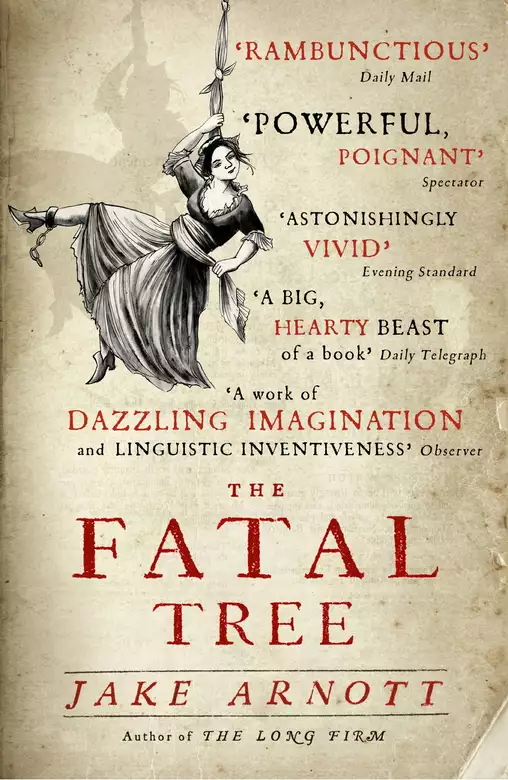
London, the 1720s. Welcome to 'Romeville', the underworld of that great city. The financial crash caused by the South Sea Bubble sees the rise of Jonathan Wild, self-styled 'Thief-taker General' who purports to keep the peace while brutally controlling organised crime. Only two people truly defy him: Jack Sheppard, apprentice turned house-breaker, and his lover, the notorious whore and pickpocket Edgworth Bess.
From the condemned cell at Newgate, Bess gives her account of how she and Jack formed the most famous criminal partnership of their age: a tale of lost innocence and harsh survival, passion and danger, bold exploits and spectacular gaol-breaks - and of the price they paid for rousing the mob of Romeville against its corrupt master.
Bess dictates her narrative to Billy Archer, a Grub Street hack and aspiring poet who has rubbed shoulders with Defoe and Swift. But he also inhabits that other underworld of 'molly-houses' and 'unnameable sin', and has his own story of subterfuge, treachery and doomed romance to deliver. As the gallows casts its grim shadow, who will live to escape the Fatal Tree?
By the acclaimed author of THE LONG FIRM, this is a tour de force; inventive, atmospheric and rich in the street slang of the era. Drawing on real figures and a true history of crime, punishment and rough justice, it tells a heartbreaking story of love and betrayal.
(P)2017 Hodder & Stoughton
Release date:
February 23, 2017
Publisher:
Hodder & Stoughton
Print pages:
352
* BingeBooks earns revenue from qualifying purchases as an Amazon Associate as well as from other retail partners.
‘All of you that in the condemned hold do lie, prepare you, for tomorrow you will die.’ This is the cheerful song they recite to those who await the journey from the doleful prison of Newgate to the fatal tree of Tyburn. At midnight comes the peal of St Sepulchre-without-Newgate, the execution bell, whose sound is carried through an underground passage to the very cell of the doomed wretch. Twelve double tolls are rung and each woeful chime makes its demand. It is the bell of Old Bailey that calls When will you pay me? But we all know the account will be settled soon enough.
I write to you in the hope that you might provide some credit in the meantime. For as you are aware if the condemned confess to the chaplain here, that holy man will likely sell the contents of an unburdened soul on Grub Street. He might earn twenty pounds if the story is a good one. All those sins remembered in The Last Dying Speech of _____ or The Ordinary Account of the Behaviour, Confession & Dying Words of the Condemned Criminals Executed at Tyburn. A pretty pamphlet sold for sixpence at the criminal’s own hanging.
Prisoners have learned that it is far wiser to deal directly with a publisher and earn a little money to pay the fees, the garnish, the gaolers charge for any comfort in this purgatory. That is why they send for you, John Applebee, known to all in this particular branch of the trade as its finest exponent, and that is why I trust you are found by this letter. For I can offer you a work that I am certain will interest you as the man who made his fortune with The History of the Remarkable Life of John Sheppard as well as The True & Genuine Account of the Life & Actions of the Late Jonathan Wild. This new account might capitalise on the success of these previous narratives, for we will meet both of these infamous gentlemen within: the house-breaker Sheppard; the thief-taker Wild. And what follows will eventually form a history that links them both: the tale of the woman who tempted the young Sheppard away from his apprenticeship to a wicked life and betrayed him to the corrupt Wild. I present to you the story of Elizabeth Lyon, never fully told before, that lewd soul known as Edgworth Bess, now awaiting judgment here in Newgate, who has agreed to confide to me the details of her adventures and misfortunes. As justice draws near it is surely time for her to give her own testimony.
In the biography you printed of Sheppard he said of his lover Bess: ‘A more wicked, deceitful and lascivious wretch there is not living in England.’ So now hear her evidence attentively that you might be certain of your own and the reader’s verdict. Accordingly, I enclose with this letter the first chapter of her story. If it meets with your satisfaction and we can agree terms, I will send you the rest in instalments.
It is, of course, hoped that the moral of this confession might keep the public sensible and cautioned of temptation, even where its sensational details might incline them to be otherwise. All should be warned of the salacious nature of some of the elements described in the recounting of this wretched life. But sincere penitence insists that every sin should be depicted in all its wickedness and true justice requires a full report of its own shadow.
And to that shadow-land are we now headed, with its queer customs and foreign tongue. I have retained Elizabeth Lyon’s use of the thieves’ vernacular so the readers might acquaint themselves with the strange dialect of this wicked world, whose canting-crew contains filchers, bung-nippers, spruce-prigs, punks and mollies: the St Giles’ Greek better known as flash. For example, in flash talk the evil trade of Edgworth Bess is spoken of as buttock-and-file, that is, whore and pickpocket. If possible a full glossary of terms should be provided in the end pages. A guide for the reader, like the link-boy who leads with a lantern through the alleys at night.
For you will know to beware of that other whore and pickpocket: the writer. That hackney-scribbler always ready to filch someone’s life and fence it cheap. Dissipated talents who trade in feigned sentiment and dulled wit, those poor wretches who reside in Grub Street. It is said that this thoroughfare was once called Grape Street and before that Gropecunt Lane where, as the name suggests, the very lowest forms of harlotry could be found. You may think, as many do, that its present inhabitants merely follow this tradition. I have some reputation in this dubious profession but can be trusted to write a faithful account and to deliver it in a timely fashion. For the moment, however, and for reasons I will explain in due course, I wish to remain anonymous. So I would beg your indulgence and request you direct your reply to my subject here at Newgate.
You might consider this just another petty story to be sold and one of doubtful value but I am certain that in the publishing of this account a handsome profit could be realised. As you know, now is the fashion for criminal narratives, ever more extreme and each loudly boasting its authenticity. Most are badly told lies. But if the public really craves the truth, to hear the lamentable voice calling out of the condemned hold, I can assure them that each word that follows comes from the very mouth of that hell.
So here begins the tale of Edgworth Bess, related by me in her own words and a darker narrative for those that would look a little closer. A hidden history that must be told in secret: of lives too scandalous even for the Newgate Calendar. And of love lost, which is the saddest story of them all.
I am, sir, your most obedient servant,
the author of the below
I was born in the small town of Edgworth, some ten miles north of London, the year Queen Anne came to the throne. If any seek significance as to why the place of my birth was later to provide my notorious alias, they might note that the old Roman road from there makes one straight line to London, without a single turn or bend in it, and ends directly at where Tyburn now stands. So this was my swift journey from innocence and, in truth, I was headed for the gallows of that wicked city too soon and far too young.
For I was not always so harsh in my manners or so coarse in language. I grew up in a noble household and as a child I learned some etiquette, some reading even. I used the proper words for things then, not the canting tongue I would later be schooled in. When I tell the flash citizens of Romeville that I grew up in a gentry-ken, they laugh, but it is true. A fine country house in a small park with an ornamental garden, a fish pond, and a summer-house – that was my world when I was a child. Our master, Sir Wickham Steevens, had it built in the classical style with the great fortune he had made in the Americas.
I lived downstairs, of course, in a small room I shared with my mother. She was servant to Lady Steevens and, though the rules of the house were strict, I was allowed some liberty when young and was raised partly with the family. I was always expected to fetch and run errands, but there were times when I took the opportunity to gain some education in the little while I spent with our master’s children. Learning by imitation and enquiry rather than direct instruction, I acquired a fickle wit but a keen and curious spirit.
The staff were ruled by Fenton, master of the household, a stern cove who had served as a sergeant in the Foot Guards. He ordered all the servants, the footmen, the cook, the kitchen maids and the gardener. He chided me sometimes for being too familiar and warned me that I would soon have to learn more of duty.
My happiest memories were of playing, and my dearest playmate was Richard, the eldest child and only son, who was but a year older than myself. I was as fond of the boys’ games as those the girls played but I had a warmer affection for Richard than for his sisters, who in their turn could be quite offhand with me. As I grew to be their servant they soon forgot that we had once all been mere children together. Because of the closeness of our ages, Richard had a gentler recollection of when we were almost like brother and sister.
My mother died when I was thirteen and I took her position. Within the next two years I grew tall and strong and my figure ripened at hips and bosom. The master’s son now looked at me differently. He would still act towards me in a playful manner but there was a new game to be learned.
It happened one day that he came running up the stairs calling up to his sisters. I came from where I was alone in a room and met him in the doorway. I said to him, ‘Sir, the ladies are not here. They are walking in the garden.’
His breath was quick, his manner bright and full of haste. He clasped both my arms. ‘Bess,’ he hissed. ‘That is all the better. Are you here alone?’
I nodded and his eyes sparked with mischief as he pushed me back into the room.
‘What is it?’ I asked, as he turned from me to close the door on us both.
He took hold of me once more, pulling me to him tightly and kissing me on the mouth. Even as I pushed him away I felt my blood fire up. He reached out to trace my cheek gently with his fingertips. ‘Bess,’ he whispered.
His face came close to mine, eyes hooded, the mouth a trembling pout. His lips brushed mine and he seized me once more. I was possessed by a strange fear as I yielded to him. Not of him, though. He was but a stripling and I might have wrestled him off. No, my fright was at something inside myself.
Presently he stopped and we stood just looking at each other, both scant of breath and in wonder at a strange new joy discovered. I remember noting at that instant how Richard looked all the prettier in a disordered state, his curls falling loose over a dampened brow, his cheeks flushed in a rosy glow.
‘Bess, I am in love with you,’ he told me.
And that spell worked its glamour on me. A foolish girl tranced, never doubting the truth of what he said. I believed these words as if I had uttered them myself and there lay the folly: Bess was in earnest but Richard was not.
He went to the window and looked out. ‘My sisters are coming back,’ he said, and turned to leave the room. As he passed me he took my hand and kissed it, holding my gaze all the time. ‘Will you be mine, Bess?’ He let the question hang in the air as he rushed out, calling to the daughters of the house as he thundered down the stairs.
The next few days passed with hardly a word shared between us but we rarely missed the chance to trade a glance, smile or gesture. Those silent expressions made me as heady as his spoken words. More so, perhaps, as they told of some great secret that could not by reason be deciphered, only by the senses.
Then the day came when all his family were out on a visit and the house was empty but for the maids below stairs. He found me in his sister’s chamber, rudely caught me up in his arms and carried me to her bed. Once more he spoke of his love for me as he unlaced my stays. He set to work on loosening every part of my rigging, then unpinned the handkerchief at my bosom. I gasped as his eager hands sought out my naked flesh. I did not quite know all his intent, as I was innocent then, so I offered little resistance to his attention. Indeed, I was too pleased with this new game to think of where it might lead. Then Richard thought he heard somebody coming up the stairs so he got up and urged me to reorder my dress.
It was then that he took my hand and put a guinea into it. Well, I was as charmed by the money as I had been by his words. I imagined that the coin was a token of love, not a bargain for it. He asked again, ‘Will you be mine, Bess?’
And I nodded, thinking that this was a promise of the heart. I kept the gold piece he gave me on the table by my bedside.
By arrangement he came to my room in the middle of the night. I lit a candle and he crept into my bed. I stayed his hand as he pulled at my shift but he entreated me with such persuasion, saying all would be reckoned well when he came into his estate. Once more I did not doubt the honour of his words, being of such childish inexperience that I thought of love as but a simple story ending in marriage. And so I soon lay exposed before him.
With a sigh he ran his hands across my form, examining it by the yellow flicker of the candle and remarking at its beauty in a way that appealed to a vanity I’d never known. My excitation quickly matched his. And the very urgency and danger of my predicament spurred me on, especially as the debt of my virtue seemed secured by some destined guarantee. All these things blew the coals of my desire and I readily gave myself to him.
A fierce pain soon gave way to tantalising pleasure. Richard seemed possessed by some demon as he bucked away at me. I felt the yearning of joy, just out of reach, lost somewhere in the frenzy of sensation. Then he shuddered violently, his whole body clenched in some furious ecstasy. For a moment I thought that this spasm might be a fit of the falling sickness. Then he groaned and with an addled-headed grin rolled over and fell into slumber.
Sleep did not come so readily for me, though. I snuffed the flame and lay in the gloom, brooding on my circumstance, wondering idly on imagined prospects, bewildered but utterly ignorant of how forsaken I really was. And it was this vain attempt at comprehension that contributed to my ruin, for I slept late and woke to find Richard still in my bed. I tried to rouse him but it was too late. One of the other maids had seen him and told the mistress of the house what she had witnessed.
So we were discovered and the shame of it laid bare to the whole household.
Richard’s mother was in a fury. ‘You have let this whore snare you, is that it?’ she demanded of him.
And he meekly agreed to this hateful lie. ‘Yes, Mother,’ he muttered, becoming her little boy once more. ‘She took a guinea for it.’
‘Is this true?’ she asked me.
‘He entreated me,’ I tried to explain. ‘He asked me, “Will you be mine?”’
‘And so you were his?’
‘Yes, madam.’
It was then that Lady Steevens spied the coin on the table by the bed. She picked it up and held it in front of my face. ‘For a guinea?’ she sneered. ‘You took this from my son?’
‘No!’ I protested. ‘He gave it to me.’
‘Forgive me, Mother,’ Richard told her, ‘but she led me astray.’
It is said that with repentance of sin comes a hatred of its object, and that the greater the affection felt in the act so the detestation will be more in proportion afterwards. If that is the case then Richard might well have been telling the truth when he told me that he loved me before as he treated me so cruelly afterward.
And so, in those flash terms I was soon to learn, love is a sharper that works the queerest of drops. I had my innocence filched from me and, thus peached, I was dismissed from the household.
‘Take your guinea,’ Lady Steevens told me curtly, ‘as the wages of your sin.’
But for that accursed coin, all I had was a meagre bundle of my possessions. Fenton escorted me to the gate with a sorrowful look on his face. ‘I warned you not to be so familiar, Bess.’ He shook his head and sighed. ‘But this is cruel. Far too cruel.’
‘What am I to do, Fenton?’
‘Make for London, child. You’ll find work in one of the grand houses there. But be careful, my dear.’
He bade me goodbye. I was fearful at being turned out of doors into the wide world but I knew that all I could do was follow his advice, to journey to the great city and find some employment there.
So I left meekly but vowed that one day I would come back and take vengeance. I would make them pay somehow for my ruin. With the gold coin I bought a place on the next stage-coach for town and was soon on that straight road to Tyburn.
Arriving in London I felt a fierce assault on all my senses: the bewildering parade of people and carriages in the streets, the mad bustle of business, the shriek and clatter of its traffic. And the stench! Scattered heaps of filth, dead fish and offal, dung everywhere. Ragged beggars clamoured at every corner. I held my little bundle close and made to walk in a manner that might show I knew my way. But I was hopelessly lost.
The world there was so close and stifling. Even the grand houses Fenton had spoken of were often crowded in terraces. They stood proud above the squalor below but elsewhere lay darker streets and alleys cluttered with wretched dwellings and menacing inhabitants. All was discord and tumult to a forsaken country girl.
I was as shocked by the harshness in manner of London’s citizens as I was bewildered by the sharpness of their tongue. I would, of course, soon learn a new way of speaking. Indeed, the reader will be tutored in it also as they follow my tale.
But for the moment all I sought was a friendly face and counted myself lucky when a kind-looking lady of middle age approached me. She wore silks and a bonnet and had a large beauty spot on one cheek. ‘You look new to town, my dear,’ she told me.
I nodded.
One hand held a fan, the other stroked my face. ‘Then you must be careful,’ she went on. ‘London is a wicked place. Full of danger for a young maid like you.’
‘What am I to do?’ I beseeched her.
‘Come with me, my dear. There’s a position for a serving girl in a good house, if you’ll take it.’
‘Who are you?’
‘Call me Mother Needham.’
But as she went to link her arm with mine a younger woman came between us and pushed her away. ‘Leave her be, you old trull,’ said the interloper.
‘Touted her first!’ answered the elder.
‘Touted her last, too.’
And so an argument arose that proved a lesson in the peculiar discourse of the streets. Tout meant to see or to look: I could follow that at least.
‘She’s no game pullet for you,’ the new arrival went on, grabbing me at the elbow. ‘Offer you work, did she? Say Romeville was a wicked place and she could look after you? Well, this abbess will want you for her nunnery, sure enough. She’s a buttock-broker.’
‘Blow the widd, would you?’ Mother Needham called out, her voice now coarse and shrill. ‘Then blow all of it and tell her you want her for your own academy!’
‘Least I won’t sell her to the colonel. Like you did me.’
Mother Needham stopped still and squinted at the young woman. ‘Punk Alice,’ she declared. ‘You’ve grown. I’d hardly recognise you.’
‘I was but a child then. Like this dell.’ Punk Alice turned to me. ‘Come, let’s wet the neck. Will you take a cup of prattle-broth with me?’
By this I learned that we were to take tea together as she led me to a nearby tea-house. There Punk Alice explained that Mother Needham was the most notorious procuress in the whole of London and would approach girls who had arrived fresh from the country and offer them work as servants. She would first sell them to the colonel, an evil rake with a taste for young virgins known as the ‘Rapemaster General of All England’, then set them up at her brothel in St James’s. There she would work them day and night for little pay, making them hire the very clothes on their backs and throwing out any that fell sick or into disfavour. I was truly shocked by this, but with the relief in avoiding this fate came fear and, indeed, confusion at what plans this Alice might have for me.
She related everything to me with many of the strange words and phrases I had heard her use with Mother Needham. This was the first time I had come across the thieves’ cant known as flash and I learned slowly how to patter it, as they say. A canting-crew can hide the meaning of what they communicate to outsiders but it seems to have another purpose all of its own. I swear that as I became versed in its strange terms it changed how I saw the world, how I heard it and how I comprehended its meaning. And once you master this way of speaking you become its slave. You become a flash one yourself and can never truly be anything else.
We walked to Covent Garden and reached the piazza by sunset. That great Square of Venus was ending its daily trade and preparing for its nightly commerce. Alice pointed out the beaus and the bloods, the gentlemen of fashion, the toasts of the town, all dressed up fine. She insisted that, it being my first day in London, we go ‘for a dish at Moll’s’, meaning Moll King’s coffee-house, not much more than a shed in front of the church that I came to know as a most popular meeting place where parties might consult on their nocturnal intrigues. There, they might make assignations (though to effect consummation they might need to find other premises). At Moll’s all society, high and low, went to see and be seen.
Quite a throng had gathered outside on the steps and portico of the church. There was a buzz of conversation and some lively comments made in our direction. Punk Alice hustled me within and we found a bench in an inner saloon she told me was called the Long Room. I noticed above the fireplace a framed print of a fellow in mask and motley crouching behind a woman on all fours baring her ample buttocks as he kissed them. It was entitled The Curious Doctor.
We were waited on by a black serving-girl, whom Alice hailed as Tawny Betty. The coffee at Moll’s is laced with strong spirit: brandy, rum or arrack. I had not tried coffee before, let alone hard liquor. The effect of them together both quickens and dulls the senses at once. In a calm reverie I watched a mizzy-eyed man try to rouse a sleeping strumpet, who lolled asleep, her ragged handkerchief fallen and her bosom exposed. A soldier broke into a bawdy ballad and some of the company joined in. I smiled, quite unperturbed by my disordered surroundings. Half of me knew that I had fallen into a low and debauched place while the other half reasoned that if this was Hell it was a merry place indeed.
All at once the hubbub hushed as a thick-set man entered. He wore a fine brocade coat and a long powdered wig beneath a tricorn hat but as he turned his head I noted a brutal countenance contrary to his noble bearing. His appearance was undeniably striking: a once handsome face etched with livid scars and coldly vigilant eyes of the palest hue. He walked with a loping gait, one leg dragging a little, pounding out a mournful rhythm as a silver-hilted sword swung at his side. All the assembly marked his entrance, though none dared look directly at him. Except me, of course. I sat staring with all the foolish curiosity of innocence. He caught my gaze and held it fast: in an instant I was trapped by his pallid stare. Then he reached into his coat and, seeing the butt of a pistol poking out, I gasped, thinking he was about to draw it. He grinned at me as he pulled out a pamphlet and held it up for all those in the Long Room to see.
‘An Answer to a Late Insolent Libel,’ he declared. ‘Sixpence a copy, and here’s a free issue for Moll King’s reading room. Where is she?’
He dropped the bound tract onto a table as Tawny Betty led him through to find the proprietor.
‘Who is he?’ I whispered to Alice.
‘Jonathan Wild,’ she replied. ‘The new thief-taker.’
I thought I knew something of that breed of men. We country folk imagined them as bold fellows who recovered stolen goods and apprehended villains in the wicked city.
A rake had picked up the pamphlet and begun to read aloud from its detailed frontispiece. There was some general discussion and the gist I caught was that there was a dispute between Wild and another, in a similar station, called Charles Hitchen. The rake holding the paper was ragged and wild-eyed but his deportment bore some trace of the stage, as did his voice when he intoned: ‘Wherein is prov’d in many particular instances who is originally the Grand Thief-taker; that a certain author is guilty of more flagrant crimes, than any thief-taker mention’d in his nonsensical treatise; and he has highly reflected on the magistracy of the City, in the said scandalous pamphlet …’
‘This is his reply to Hitchen’s accusations,’ Alice explained.
‘What accusations?’
‘Of villainy. Each blames the other, then boasts of his own reputation as a whore might protest her virtue.’
I thought to question this as they surely both sought to uphold the law but Alice had turned to hear more.
‘… set forth in several entertaining stories, comical intrigues, merry adventures. With a diverting scene of a sodomitish academy!’
At this the room broke into an uproar.
‘Wild has really blown the widd now!’ cried Alice.
‘Why, all Romeville knows that Hitchen’s a molly!’ called another.
I had yet no notion of what they spoke.
Wild came back into the room, baring a blackened tooth as he grinned. He snatched back the pamphlet and held it up in a gesture of triumph. ‘Gentlemen,’ he said, with a slight bow of the head. ‘Ladies. You see before you the new thief-taker general. Never mind Hitchen. He’s nothing more than a madge-cull.’
He toss. . .
We hope you are enjoying the book so far. To continue reading...

 Please log in to recommend or discuss...
