
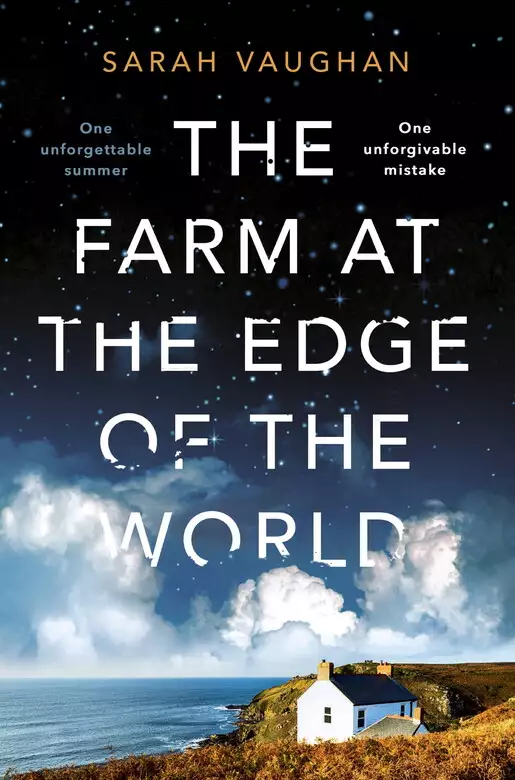
The Farm at the Edge of the World
- eBook
- Paperback
- Audiobook
- Hardcover
- Book info
- Sample
- Media
- Author updates
- Lists
Synopsis
The farm sits with its back towards the Atlantic—a long stretch of granite hunkering down. For over 300 years it has stood here, steeped in the history and secrets of one family. A farm at the very edge of the world.
It's 1939, and Will and Alice are evacuated to a granite farm in North Cornwall, perched on a windswept cliff. There they meet the farmer's daughter, Maggie, and, against fields of shimmering barley and a sky that stretches forever, enjoy a childhood largely protected from the ravages of war. But in the sweltering summer of 1943, something happens that will have tragic consequences. A small lie escalates. Over 70 years on, Alice is determined to atone for her behavior—but has she left it too late?
It's 2014, and Maggie's granddaughter, Lucy, flees to the childhood home she couldn't wait to leave 13 years earlier—marriage over, career apparently ended thanks to one terrible mistake. Can she rebuild herself and the family farm? And can she help her grandmother, plagued by a secret, to find some lasting peace?
This is a novel about identity and belonging; guilt, regret and atonement; the unrealistic expectations placed on children; and the pain of coming of age. It's about small lies and dark secrets. But above all it's about a beautiful, desolate, complex place.
Release date: June 30, 2016
Publisher: Hodder & Stoughton
Print pages: 320
* BingeBooks earns revenue from qualifying purchases as an Amazon Associate as well as from other retail partners.
Reader buzz
 Please log in to recommend or discuss...
Author updates
The Farm at the Edge of the World
Sarah Vaughan
It watches, this farmhouse, as permanent as the rocks, more so than the shifting sand dunes; sees the hedgerow that spills out to ensnare a rare driver – for few make their way to this spot, high above the sea. The details change with the seasons – the hawthorn burnishing then falling bare; the sky bruising then lightening after rain; the crops placed in shocks then gathered in – but the view remains the same: a ribbon of lane leading up and away from this lonely patch of coast, through a tapestry of fields, towards the heart of Cornwall and the rest of Britain. And, above it, always, hulking in the distance, the moor – brooding ochre and peat and grey.
In the sunshine, all looks idyllic. This is a farm a child might draw: slate roof, whitewashed porch, near-symmetrical windows; one either side of the door with an extra one tacked on in the eighteenth century when the house was stretched. The proportions are good. A house assured of itself and built to withstand a wind that whips the trees into right angles, that blasts the panes with fat plashes of rain, that endures winter after winter. Two chimneys stand, and, from October to May, the tang of woodsmoke mingles with the ripe stench of the farmyard and the gentler smells of the coastline: the fruity reek of silage, of honeyed gorse and sea salt, wet grass and cowpats, camomile and vetch.
On sunny days, the granite walls of the house, barns and workers’ cottages glow, warm and gentle, the stone glinting against the blue of the sea. Walkers, rooting out cream teas, drink in the view from the back garden – the fat-eared crops, the full-bellied cows, the surfers riding white horses across the bay. And then they hear the birdsong. A glorious melody so irrepressible, so unrelenting that it gives the place its nickname. No longer Polblazey, but Skylark Farm.
Yet, when the skylarks stop singing, and the sky turns grey, the granite dulls to a dark charcoal. The farm becomes less inviting: bleak if not austere. Then, it is clear that the casements are in need of a paint, and that the garden – with its close-cropped grass fringed with clumps of woody lavender and thrift – is untended. A wizened crab apple bends over a rotting bench, and a tamarisk stripped of its leaves by a vicious wind, points inland. Skylark Farm – run by the same family for six generations, steeped in its history and secrets – shrugs on its traditional Cornish name. Becomes Polblazey once again.
On such days, when the earth has been ploughed into great clods of soil, when the cobbles are slick with manure, when a murder of crows follows the tractor, the farm is at its most remote and unforgiving. For nothing lies beyond its cliffs and headland but the petrol-blue Atlantic – and then America, unknown and unseen. Then, it is a farm at the edge of the world. The sort of place where the usual rules can be bent, just a little, and any secrets stay hidden. For who there would tell? And who would hear?
Lucy sits in a dip in the sand dunes, watching the tide roll towards her; lulled by the rhythm of the thud then slither of the waves on the shore.
An early evening in mid-summer: the sand is still warm from the heat of the day; the beach is clear – for the schools haven’t broken up yet, and the dog walkers have all gone home. She lies back, listening to the constant hum of the grasshoppers, the caw of the seagulls. High above, two brown specks hover, throwing a melody that spirals and shimmers: a seamless strand that sears through a mackerel sky and out across the deep blue of the bay.
It is a year since it happened. Since she made the mistake that would see her come hurtling down here. A year ago today, she found out about Matt and Suzi. Tomorrow it will be a year since she last worked as a nurse.
Jacob is doing well. She went back to the hospital in November to say goodbye to her old colleagues, and there was a card from his parents pinned to the noticeboard, thanking them for saving his life. A photograph of a baby boy was attached: still tiny, but unrecognisable from the jumble of bones and tubes she had left, dwarfed by a premature-baby nappy. He had beamed from the photograph, and she had given Emma a short, tight smile of thanks. For how could she not do? Without her checking, little Jacob would not be alive.
She was relieved to leave the cloying warmth of the neonatal ward, and the busy-ness of London. Happy to step off the train at Bodmin and breathe in the damp, lush smell of woodland; salt-lashed hedgerows; gorse-covered moor. Even when the weather was harsh – the puddles frozen to ice, the farm drenched by storms – she has never regretted coming back. There have been setbacks – Uncle Richard changing jobs and having to withdraw some of his investment; Tredinnick cutting their order in the winter – but Skylark ice cream is starting to grow in such a way that she can see their overdraft shrinking. They worked flat-out to fill Kernow’s freezers from Easter, and she and Flo have been selling it at festivals and at the more popular beaches on bank holidays. Their fledgling business is burgeoning at last.
With the threat of financial ruin starting to lift, the farm has begun to feel more cared for. She and Judith ripped the peeling wallpaper from the hall in October and are waging a battle against rogue patches of mould. Her mother seems revitalised: buoyed by Lucy returning home, released from keeping the secret of her husband’s suicide, from having to dissemble. But it is her grandmother who has changed the most.
Watching her getting to know Sam has been like seeing a couple falling in love. At first it was heady: Maggie infatuated, as if she couldn’t get enough of her long-lost son. It might have been hard for Richard, had he been around, but Judith, with two children at home and her granddaughter an increasingly talkative presence, has been mildly amused by such blatant favouritism, while aware that it couldn’t last.
With time, Maggie has become less giddy. She still sees him three or four times a week – for they have years to catch up on – but she views him a little more objectively. ‘I’m not quite sure about the beard,’ she had confided, when he had flirted with a goatee. ‘Do you think he’s a bit alternative, after all?’
Lucy had looked at Sam, with the surf beads he wears now he has retired from delivering the post, and the fortified roll-ups he smokes in his back garden, the sickly-sweet smell of weed overpowering the tamarisk. ‘I’m not sure it matters if he is,’ she had posited, for she is more willing to challenge her grandmother’s prejudices now that Maggie is back to being her opinionated self. ‘No.’ Maggie had thought about it. ‘I don’t suppose for a minute that it does.’
She had got to know Sam better when they took a long train journey up to London, on a chill Tuesday in early December, to attend Alice’s funeral. The church was fuller than she’d expected: her sons, Rob and Ian, and her six grown-up grandchildren, visibly distressed rather than merely subdued. They hadn’t introduced themselves beyond saying they had met her in Cornwall the previous summer, and if anyone noticed a faint resemblance between the dead woman and this nut-brown, wiry-legged man, it wasn’t mentioned. But he later wrote, sparking a tentative email exchange with Rob, the elder son, and a card on his birthday with a black-and-white photograph of a young Will.
Being with Sam – listening to the story of his early years on the moor and of his marriage to Anne and adoption of their two children (Funny: we couldn’t have them; so I did what my parents did. Repaid the favour.) – meant any half-considered plan to meet Matt for a drink was abandoned. And that was for the best. Suzi was replaced by a Cate, and though the news had initially rankled – he had waited how long before moving her in? – Lucy’s sense of inadequacy disappeared far more quickly than she thought. You don’t want to think, later in life: Oh, if only, her grandmother had said; and she doesn’t, she really doesn’t. Regret – wondering what might have been, never having the chance to discover – would have kicked in more clearly if she had returned to her old London life and left the farm.
And what of her? Does she dare risk falling in love again? She is wary, for she knows that love alone is not enough to secure her happiness. Her father’s suicide has shown her that: he could not have been more loved, but he killed himself, still. And yet her grandmother has taught her that if she has a chance she should grasp it with both hands, trusting it will work in a way it couldn’t for a young Maggie. Wondering what might have been. Never having the chance to discover, well, I think that’s the most painful thing.
She has been thinking about this today, on the anniversary of Will’s death. Running along the cliffs, she had stood on the headland: arms outstretched, with a stiff cross-onshore wind blowing, trusting entirely to its strength. Land’s End was to her left, Devon to her right, the Atlantic stretched in front of her: aquamarine then teal, then a deep dark blue as it hit the horizon and the sky rose up and away. The edge of the cliff. The edge of her world. Dare she risk it? Believe in this exhilaration that could buoy her up and buffet away sadness? Below her, the spume swirled around the rocks, drenching a pair of mating seals; above, a pair of guillemots soared on the breeze.
Well, here he is now. A figure making his way through the sand dunes, holding packets of fish and chips, sharp with vinegar, soft and warm as a newborn baby.
‘I thought tea would spill so I’ve brought beer.’ He hands her a bottle. A tear of condensation runs down its neck.
He sits next to her, with the ease that comes from knowing someone for several years; and yet there is a tension in the inches between their thighs, in the small distance between them.
‘To my great-grandfather.’ Ben holds his bottle aloft.
‘To Will,’ Lucy says.
Dive straight into Sarah Vaughan's gorgeous novel THE ART OF BAKING BLIND - 'A great read about guilt, atonement and identity' (Hello!)
The idea for The Farm at the Edge of the World emerged from my love a specific area: the cliffs of north Cornwall to the west of Padstow, where I holidayed as a child. When I began to write about a Cornish farm that would be a physical refuge during the war, and an emotional one in the present day, it was inevitable I drew on my knowledge of this place, not least because the north Cornish coast was peppered with WWII airfields, allowing for the possibility of bombing, and I wanted it to be sufficiently close to Bodmin and Bodmin moor.
I have taken a few liberties with the geography, however, and introduced a couple of caves that don’t exist as well as giving it a flavour of the land further to the west – more the Cornwall of West Penrith, the area from which my mother’s farming ancestors originate. The Cornwall that feels as if it is at the edge of the world. I have also introduced dairy cows, though I know that the Camel Estuary is fringed with fields of barley and cauliflowers, and it is sheep that graze on the coast.
If I tweaked the geography and topography, I was deeply conscious of the need not to create historical inaccuracies. At one point, I detailed each of the bombs that fell on Cornwall during World War II and tried to bend my narrative around one. And then I read Kate Atkinson’s Life After Life and her author’s note in which she states that she finds it hard “to create an authentic atmosphere or narrative credibility if continually constrained. Fiction is fiction, after all,” she continues. “That doesn’t mean that I don’t check things afterwards … but sometimes to find the truth at the heart of a book a certain amount of reality falls by the wayside.”
She refers to being unaware of whether any bombs fell in the real Argyll Road in real life and I found that incredibly freeing: as long as I respected history, I could risk a little flexibility.
So a Heinkel did drop bombs in the deer park of Prideaux Place but I am unaware of whether the windows shattered in the main house; and a doodlebug struck the Aldwych on June 30, 1944, but among the many fatalities there was, of course, no Will Cooke.
I hope that this approach is acceptable. As a former news reporter, I have tried to get every detail right where it matters: obsessing about the types of plane that would have flown from Davidstow airfield, and the date on which the Duke of Cornwall’s light infantry would have left for north Africa, (March 23 1943); or the pesticide applied to drenched wheat reed; or the exact amount of milk produced by a cow. I am hugely indebted to the many farmers I have interviewed, some of whom have proofread my copy in a bid to prevent any mistakes creeping in. Should any errors have occurred, they are, of course, all mine.
I am hugely indebted to my publishers, Hodder & Stoughton, and in particular to my editors, Kate Parkin and Sara Kinsella, and their assistants Francine Toon and Sharan Matharu, who helped hone this novel into shape. Special thanks, as ever, are due to Lizzy Kremer, my unfailingly supportive agent, and to Harriet Moore, her clever assistant, who urged me to capture the Cornwall I love.
The Farm at the Edge of the World evolved from my love for an area of north Cornwall I have visited since childhood and from my mother’s stories of summers spent running wild on Trewiddle, her grandfather’s farm. I am hugely grateful to my mother, Bobby Hall, and to her cousin, Graham Howard, who whet my appetite with their tales of a world in which children built dens among the stacks at harvest, put chicks in the warming drawer of the Aga, and hid among the rhododendrons. My mother and my father, Chris Hall, fuelled this love affair by taking me on repeated childhood holidays to the area west of Padstow that is detailed in this novel.
Graham’s intricate discussion of the risks of growing wheat reed helped inform my present day story, while my stepfather’s brother, Mark Evans, taught me about running an organic dairy farm. I am particularly grateful to Graham for his patience as I grappled to understand the mid-20th century process of threshing and binding, and to Mark and Will Pratt for allowing me to watch an afternoon milking. If I have come anywhere close to capturing the pressures of present day farming it is thanks to them.
A trio of octogenarian Cornish farmers, all teenage boys in 1943-4, provided invaluable descriptions of how to hand milk a cow or plough a field; and of the sound of a bomb whistling down a chimney or blowing off gateposts. I am hugely grateful to Clifford Butter, Robin Moore and Humphrey Eddy who welcomed me into their homes with grace and humour and allowed me to interview them for hours.
Major Hugo White of Cornwall’s Regimental Museum was a courteous, knowledgeable and efficient guide to the movements of the Duke of Cornwall’s 2nd Battalion, and vividly described being a Winchester schoolboy watching the Battle of Britain dogfights. Steve Perry and Rod Knight, at the Cornwall at War museum, situated at Davidstow airfield, gave me an invaluable sense of place and time.
Thanks are also due to three one-time evacuees I interviewed: Pauline Cocking, who was evacuated with her three siblings in 1939, and whose memories informed much of my early thinking; Norma Thomas, and John Beale. I am also grateful to Sarah McDonnell, Ian Johnson of the NFU in Exeter, and Alison Spence of the Cornwall Record Office, for providing links to contacts including these.
For my medical aspects of the present-day story, I am indebted to Gillian Bowker and Harriet Sperling, and to Jean Slocomb of Cancer Research UK.
Writing my second novel has been a steep learning curve and I am proud to be part of the Prime Writers, a group of authors who have all been traditionally published over the age of 40, and who have provided consistent support.
I am also grateful for the continued support of my extended family, not least in helping with childcare. Special thanks go to my mother, to my in-laws, Sue and Bryn Vaughan and to my lovely sister, Laura Tennant.
But my most heartfelt thanks, as ever, go to my husband, Phil, and to my children, Ella and Jack. Not only have they had to put up with my going to Cornwall without them but they have grown to love it almost as much as me.
She takes the opened letter and smooths it out on the kitchen table. It was never going to be good news. She knew that, as soon as she saw the official frank across the top of the envelope. This was it: the confirmation of Monday’s appointment in black and white with the trust’s name emblazoned in that institutional cobalt blue that conjures up the smell of disinfectant and tepid, overcooked food, and plump young nurses who call her ‘dear’ – as if her age and diagnosis gives them the right to bestow not just sympathy but affection. She does not want either. Just the thought of their eyes, brimming with understanding, makes her want to rage.
Still. Just for a moment she had allowed herself to hope. To imagine a reprieve. That there had been a mix-up – and some other poor woman was receiving the news she had dreaded to hear.
But no, here it is, in a letter to her GP, copied in to her. ‘Further to yesterday’s consultation with Mrs Coates …’ the oncologist, Dr Freedman, begins, and for a moment the use of the third person throws her: as if he is referring to somebody else. And then comes the crucial bit: ‘Following the liver ultrasound, it appears the malignant melanoma on her upper back that we removed has metastasised. A few spots were found on her liver. Surgery, at her age, is not advised.’
She blinks. Inoperable. Not that she wants further surgery. The wound, which had required a general anaesthetic, itches, and was deep.
‘I have discussed biological therapies with Mrs Coates, but she declined them after raising concerns about the side effects. She understood that they would extend her life by a year at best. During our discussion, she was most insistent that I give a prognosis. I advised her that, without treatment, the average outlook would be less than a year.’
Actually, Dr Freedman, she thinks, you gave the impression that a lot less was far more probable. ‘How long before it begins to affect me?’ she had pressed, and her voice – so dry throughout the consultation – had quavered, just the once, at that point.
She did not want to envisage the pain, the extreme fatigue, the sickness, but she would rather know what she was up against. ‘Six months – even less?’
‘We can only give you the average outlook,’ Dr Freedman had said, and then he had nodded slightly: just the gentlest of nods, almost inadmissible. ‘No one can tell, but that’s not an unlikely scenario.’
‘Thank you,’ she had said.
Death – something she had been so aware of since Pam, the last of her siblings, had died – had jumped a little closer. Six months. After eighty-three years, it would feel like such a short time. She tries to force a laugh at the thought that she has always been someone who puts things off; who needs a deadline. But though she can do a stiff upper lip, she doesn’t do black humour. It comes out as a mirthless cough.
The only good she can find in all this – and she is trying so hard to do so – is that at least she knows. And while dying in her sleep, like Ron, her husband, might be the ideal way for it to happen, perhaps it is better to prepare. Maybe this is what she needs: this prompt to tie up loose ends. And to think this should come today of all days. June thirtieth. She has been dreading this anniversary. Seventy years. Most of her lifetime. The coincidence chills her. As if a shard of ice has pierced her core and remains, still frozen there.
A drill whines. The builders next door are hard at work. Another loft conversion and kitchen extension to push a Victorian terrace upwards and outwards, though her neighbours – a young couple who work in the City – have only one child. Her parents brought up five of them in a terrace this size before the war. Then they were all evacuated – even Robert, ever the baby. And life irrevocably changed.
She pours a mug of tea from a glazed brown teapot and warms her fingers around it. How has it come to this: that it is only now, with death so imminent, that she is considering trying to put right something she should have done years before? Everything – each recollection; every throwaway thought – leads back to that summer, that time she has tried so hard to forget.
Her eyes flit to the PC sitting on her small mahogany table in the corner. Who is she trying to protect? Someone she once loved, or herself: ever fearful of recrimination, as cowardly as she was at thirteen? A lump forms in the back of her throat and she swallows. No time like the present. And she has so very little time.
The computer takes a while to start up. Her hand grasps the mouse and she concentrates, the tip of her tongue out like a stalking cat’s, as she navigates to where she has saved the link. She smiles, a little sardonic. They are still using its nickname, though its more forbidding Cornish name seems more in keeping with the nightmares that have started to wake her: heart palpitating, nightdress soaked through with sweat. ‘Skylark Farm, Trecothan, north Cornwall. Run by the Petherick family for six generations. Offering self-catering and cream teas.’ For a moment, she is back in the sand dunes, listening to peals of birdsong – rapid, repeated, joyous. Fresh from London, she had been mesmerised by the speck that hovered, and anxious. ‘That swallow’s a bit high,’ she had said.
She had been eight then: wide-eyed and entirely innocent. By the time she left, all that would have changed. And yet the farm remained the same. She looks at it now: solid, seventeenth-century. She glances at Maggie’s bedroom window – the room of the daughter of the house; decorated with rose wallpaper and that cast-iron bed – and then at her own, at the very end of the house, closest to the sea.
It’s largely a dairy farm, now, according to the website. So no lambs bounding across the lush spring grass, no chill March nights spent lambing. A sudden memory and she is back in the lambing shed: the air ripe with crushed straw and mucus, the metallic stench of blood and brine. She has a flash of Aunt Evelyn: all thin-lipped dissatisfaction and disapproval as she watched her baby an orphaned lamb. She shuts away the image – and the others, the ones that surface in the early hours of the morning when the nightmares press upon her. She would never romanticise Skylark, or the family that lived there.
And yet, for all that, it had been a place of refuge for an evacuee escaping the horrors of the Blitz. Quite literally, as the WRVS woman had told her mother, ‘a safer place to be’. It certainly felt cut off from the rest of Britain, towards the very end of a peninsula: the farm’s fields running to the edge of England, right down into the crystalline, tempestuous, unpredictable sea.
She opens the timetable of weeks when the two cottages are available, and their surprisingly reasonable prices. Not completely booked up yet, which is curious given that it’s late June. The last two weeks in August are free. She hesitates. Should she really do this? She has terminal cancer: enough to contend with. She pauses for a moment, willing away the tears that prick and burn her eyes so that the image wobbles and blurs.
If she does nothing she will die never knowing if she might have made things better, if she could have exorcised the demons that harangue her, not just at night, now, but during the day. She craves peace at the end of her life. And reconciliation. If there is a possibility she could achieve that, well, then it is worth the risk.
With a sudden click, she highlights the box and is directed to the next page. Judith Petherick – Maggie’s daughter? – will email her back to confirm her booking if she will leave her details. She does, before her nerve fails.
There. It is done. A couple of tears seep from her eyes before she wipes them brusquely away. She cannot quite believe it.
After seventy years, she is going back to the farm.
It is terrifying, Lucy thinks later, when she tries to be rational, how life can change at a single moment: as if a coin is spun to decide if it should continue merrily – or teeter and fall.
As a nurse she knows this. Has seen the impact of a split-second’s loss of concentration: the mangled limbs and paralysis when a driver ploughs into another on the motorway; the drunken arguments that start with a shove and end with a knife; the prank – free-running along a rooftop, diving into a shallow lake – that seems such a good idea at the time, then ends as anything but.
She knows it as a daughter, too. An accident – tragic, needless and preventable – took her father from her. Fred Petherick: killed when he slipped while running on the north Cornish cliffs.
But she has never felt it as clearly as she has today: that sense of the mercurial nature of life. How one simple mistake – a ‘near miss’ in clinical terms – could shatter her entire world and expose its painful, terrible fragility; could lead to her wailing on her bathroom floor so that she barely recognises the woman staring back at her from the mirror, crimson-eyed, swollen-faced.
One shift you can get over, she thinks, as she pulls her knees to her chest and hugs them tightly. But two: a mistake on top of a life-changing discovery? Two is too much, it seems. For it’s this combination that has made her world shatter – and exposed her seemingly happy life, here in London, as groundless. As insubstantial as a dandelion clock puffed by the breeze.
She rocks her knees tighter as a fresh volley of sobs racks her body. She needs to get a grip. Her mind whirs; her heart skips, jumps, flutters. Wired on caffeine, sugar and misery or a cocktail of all three. She hasn’t slept in forty-eight hours. And in that time, her life has been wrenched apart like a suitcase of inappropriate clothes: the contents turned upside down, sneered at, discarded.
It had started yesterday morning. She had come in off her Sunday night shift, in the neonatal unit of the hospital where she works, bones weary, eyes aching, and had gone to take a shower upstairs. The disposable contact lens case on the edge of the sink had niggled; it wasn’t hers and Matt’s eyesight was perfect. A sliver of cold crept inside her; wormed its way in tight.
Perhaps one of their friends had been around and had changed a lens? She ran through who it could be as she dried and dressed herself, but could think of no one. Better not to fret but to grab a couple of hours’ sleep. She stretched out, and tried to relax. Imagine you are back home, she told herself. Back at Skylark. Think of the headland – and imagine standing there: at the edge of the world, the very edge of the cliff. Drink in the view: Land’s End to your left, Devon to your right, the Atlantic stretching in front of you: aquamarine, then teal, then a deep, dark blue as it hits the horizon. Feel the stiff onshore breeze temper the heat of the sun, then blast you backwards. See the seagulls drift upwards; and a pair of seals, sleek and slippery, bask on the rocks beneath.
It was no good. Though her body was weary, her mind whirred: feverish, over-analytic. Even the state of her bed bugged her: the sheets needed changing; Matt’s pillow was tinged with sweat. . . .
We hope you are enjoying the book so far. To continue reading...
