READERS LOVE BAUMER'S DARK WORLD . . . 🗡♰ 'Angels, demons, serial killers in a fantasy Vatican, so much beautifully written longing!' 🗡♰ 🗡♰ 'Would recommend for lovers of Ava Reid, Leigh Bardugo and Katherine Arden' 🗡♰ 🗡♰ 'I adored this book... It's such a great blend of fantasy and mystery, with a slow-burn romance that I am DEEPLY obsessed with. Couldn't stop thinking about it for weeks!' 🗡♰
'A twisty and beguiling gothic fantasy, lyrically written and tightly plotted . . . with one of my favourite villain-slash-anti-heroes of all time. You will be entranced by Baumer's darkly magical tale' AVA REID, #1 NYT bestselling author of A Study in Drowning
🗡♰ This is the city of miracles, but not everything miraculous is good 🗡♰
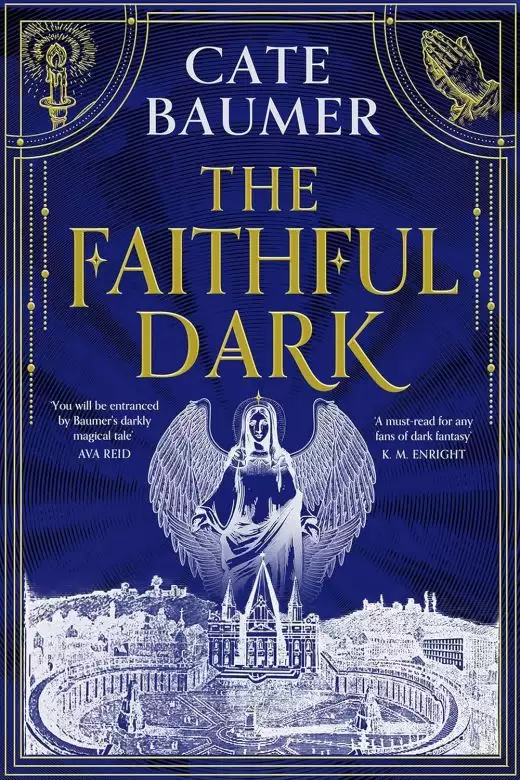
In a holy walled city where sin and sanctity are revealed through touch, Csilla - a girl born without a soul - is worth little to the Church that raised her. But when a series of murders corrodes the faithful magic that keep the city safe, the Church elders see a use for her flaw: she can assassinate their prime suspect, a heretic with divine heritage, without risking the stain of sin.
The heretic, however, makes Csilla a counteroffer: clear his name by helping him catch the real killer, and he'll use his angelic gifts to grant her very own soul. Meanwhile, ruthless Ilan, desperate to earn back his position as Church Inquisitor, sees the case as his chance at redemption: he'll bring in the murderer - or, failing that, Csilla and the heretic - and regain his title.
But as the death toll rises, and their hunt pits them against the all-powerful and callous Faith, Csilla finds herself torn. Will her salvation come at the cost of everything she believes in?
Release date:
February 19, 2026
Publisher:
Hodder & Stoughton
Print pages:
400
* BingeBooks earns revenue from qualifying purchases as an Amazon Associate as well as from other retail partners.
I began The Faithful Dark in 2018. From there, it had a long journey, through Pitch Wars, indie publishing and finally to the version you have today. None of this would have been possible without many, many talented and generous people lending their hands and eyes.
First thanks to my agent, Julie Gourinchas, who loved the book so much she queried me and has been an absolute champion. May this book be the first of many!
To the team who kept the book on track and made my dreams come true, I couldn’t ask for a better publisher. Huge thanks to my editor, Kate Norman, who was always down for making things even more disturbing, as well as to Victoria Denne, Saxon Bullock, Claudette Morris, Dewi Hargreaves, Robyn Bowler and George Biggs.
I owe massive gratitude and everything I know about revision to my Pitch Wars mentors Hayley Stone and Erin Tidwell, as well as my AMM mentor Liz Parker. And to my mentee sibling Maiga Doocy, I’m so excited our books will be on the same shelf!
Tara Christofes-Bell, you poetic and noble land mermaid, you always have the correct opinions. Leanne Schwartz and Heidi Christopher, I love being in the trash with you.
To the slack: Amanda Helander, Angel Di Zhang, Anita Kelly, Anna Sortino, Avione Lee, A.Y. Chao, Briana Johnson, Briana Miano, Brighton Rose, Chandra Fisher, Gabe, Elora Ditton, Emily Varga, Gigi Griffis, Hugh Blackthorne, Kaitlyn Hill, Kat Hillis, Kate Dylan, Katie Bohn, Lani Frank, LC Milburn, Maiga Doocy (again), Mercy Blackburn, Molly Steen, Piper Vossy, Sami Ellis, Sarah Mughal Rana, Siana LaForest, Sophia Mortensen, Tanvi Berwah, Vaishnavi Patel and Victor Manibo. I would literally be unable to survive publishing without you, please never leave me.
I don’t think I could list all the wonderful people who looked at various drafts over the years, just know that if you read, commented, liked on socials or just said the book sounded cool, that’s what kept me going over the eight years it took to get this book to its final form.
I have to express my deep appreciation for Ava Reid, K.M. Enright and Lyndall Clipstone, who supported The Faithful Dark from its earliest publication as an indie book, and Therese Andreasen, the trad edition’s fairy godmother.
Of course I owe my mom who, in addition to giving me life, also gave me space to write my weird books without judgement.
And finally, to my beautiful cat Halle, who deleted this whole document halfway through. You really were no help at all.
1
Csilla
There was an art to mercy. It was science, measured in the drops of poppy milk to ease pain, the days a child needed in the womb. It was faith, too. Everything was.
Csilla was as competent at tending the ill as anyone raised as a kindly hand of the Church, but faith was where she excelled. Faith that her service made a difference, despite its ceaseless demands.
Despite the fact that, no matter what she did, the Church would never care. Every time she touched a consecrated chalice or the iron mark of virtues worn by the Faithful and left it dull, she revealed the truth of herself: soulless, and darkly singular for it.
‘How are you feeling?’ Csilla asked, waving Elmere to the unsteady firelight of his hearth, hoping as always that her treatments had finally taken root and there would be no more work here, save a prayer of thanks. But dark-edged lesions still bloomed on his face and neck, and the wool over his elbows and knees had rubbed thin against his swollen joints. Bitter winter was hard on everyone in Silgard, but the old, sick and poor always suffered most.
Every day, new smoke carried the ashes of the dead through the air of the Brilliant City, from those delivered to their maker by illness, or hunger, or battlefront injuries that refused to heal as soldiers died cursing an absent god. It had been over three hundred years since They’d answered any prayers, and Their last response to humanity’s transgressions and pain had been to remove Themselves entirely.
Then there were the other bodies dragged out of the city gates before dawn, bloodless corpses swaddled and bound with ink-smeared strips of knotted scripture.
It’s not for you to worry about, dearest, Elder Ágnes had said when Csilla asked why they weren’t being blessed, and washed and burned.
But worry was the only thing that came as easily to her as care.
The lines on Elmere’s face deepened with a grimace. His teeth were loose against his thin lips.
‘Better than I was.’
Csilla poured blessed water onto fresh linen and dabbed at the open wounds. They did look cleaner, free of pus or crusting edges.
‘Surprised you’re working alone,’ Elmere continued, tilting his chin so she could continue her ministrations. ‘They’ve finally accepted your vows? Do I owe you more deference now?’
But they could both see her overdress was a grim stained colour that could charitably be called off-white, not the deep grey worn for mercy work. Even a Curate, the lowest rank of clergy, would wear the colours of their order of virtue.
Csilla held up her palm, pale and unscarred by the Prelate’s holy knife, and offered a smile she hoped looked less pained than it felt.
‘Not yet. The fevers have everyone busy. Ágnes is just next door.’
‘A treat for me, then,’ Elmere laughed, and Csilla’s smile turned more genuine, her cheeks flushing with the simple pleasure of being seen.
Her patients never minded who their care came from as long as it came with gentleness. Or if they did, they were polite enough not to mention it in her presence.
She pulled a bottle of distilled herbs mixed with just enough of their strongest syrup to blunt any pains from her leather sack, the final piece of today’s mercy. The glass picked up the fire’s glow, becoming almost a lantern as it bent light into the corners of the dim and dusty room.
‘Don’t drink it all at once,’ she cautioned as he eyed the bottle and its liquid hope.
The poppy syrup was almost gone. There were too many suffering, too little in the stores, and no way to get more of the precious pods to milk until the warmer months. She’d exhausted every text they had, cut recipes down to the bone and shaved off further shards in hope of extending them, studied miracles and history and come up with nothing better than that people would die.
But fewer of them than otherwise if she kept to her work.
‘I won’t,’ he promised, hands not stirring from his lap. Odd. Usually he poured a cup and they chatted while she boiled water for hot compresses and fixed up what she could to spare him trouble, sweeping rushes or mending oil-paper windows, and wishing she could give him better. It wasn’t like the Church was lacking.
‘You’re feeling that well?’ She grabbed the rough handle of his iron pot with both hands and heaved it up to the hook over the fire, breath short with the exertion. Being used to the work didn’t make the pots any less heavy.
When she glanced back, Elmere’s face was alight with a strange sincerity, rheumy eyes solemn and lips curved up.
‘What?’ Csilla asked, unable to keep the fondness from her voice. Elmere had been her patient since she was twelve, tolerant of gaping bandages and clumsy adolescent fingers as she learned the art of care. Eight years on, and he still sometimes slipped her pieces of rosewater candy on her way out, when he could afford them. ‘You look like you have a secret.’
He touched his lips in acknowledgement, and her skin prickled.
‘I went to see the Izir.’ Elmere’s voice slipped into reverence.
Csilla turned so quickly she bumped the pot, spilled water sizzling to faint mist in the flame. ‘Oh?’
Izir were rare, descendants of the angels who walked the world of salt and blood before the Severing and those humans they had loved. There had been one in town for weeks – not that her endless work gave her leave to gawk. He certainly didn’t come by the cathedral; blooded divinity had no need of intercession.
Elmere nodded, gesturing to his pocked skin. ‘He heals, child.’
The lesions weren’t healed, but if Elmere was feeling better, that was a true blessing.
‘How?’
A hundred litanies crawled through her throat. Where there were blessings, there should be praise, and this was the closest that remained to miracles in the world.
The old man’s laugh was a bark. ‘Through Asten eternal. Virtues and vices, didn’t the Church teach you anything?’ She bit the inside of her cheek at his teasing as he continued. ‘He heals with a touch, and he has the most marvellous voice. Makes one think of how Silgard must have been in its glory.’
There had been a time when the streets glowed with the divinity of those who walked on them, every footstep a benediction. Saints and angels had made this city the locus of the Faith, nestled safely in the centre of the territories of the Immaculate Union, its walls of stone inlaid with prayers to last until the material world fell to dust.
But that was when their god, Asten, still found the world worthy of notice. Now, when the walls cracked, they were repaired with nothing more than earthly mortar, and the only things that watched from on high were vigilant pigeons.
‘One day we’ll be gloried again,’ she said, words tripping off her tongue as easily as song. ‘Once every soul is Brilliant.’
It was the Church’s most important charge. Asten may have left, but perfect obedience would lure Them back and wash the world clean, would allow the angels to return and bring a second golden age. It was only the fact that humans were a corrupted creation in the first place that made obedience so hard.
‘He might get you a miracle too, you know.’
Elmere’s voice was soft, but the words chafed as she bowed her head for a prayer to blessed Arany, an angel whose sacrifice had kept humanity’s hope alive long centuries ago.
It was kind of him to say, but there was no miracle for something like her. Not even in a city built on one.
10
Csilla
Csilla’s feet stilled as they approached the city gate and she touched her mark of virtues, measuring the distance between her faith and Mihály’s ideas.
‘Why so pale?’ Mihály said, an amused glint in his eyes. ‘The gates of Silgard don’t open directly into oblivion, regardless of what the self-righteous here think.’
She wasn’t naive enough to think so. The land outside the city was still under the banner of the Immaculate Union, bound to the same practices and laws. But people were only there because they weren’t good enough to be here. And surely Mihály would realise what he was asking of her.
‘If I go, they won’t let me back in.’ That was what she’d been told and what the finality in Elder Abe’s eyes had promised. She was no demon, but anyone let into the city had to be proven pure. She was nothing, pure or otherwise.
‘Then it’s very lucky you’ll be travelling with me.’
He gave a smile that would be impossible to argue with, and it lit a flicker of confidence in her, even as the iron gate swung closed behind them with a crash. She should have taken some holy water or dirt from the cathedral grounds, a small physical token of where she belonged.
Csilla turned her head one way and then the other, drinking in the frightening expanse of land unshadowed by walls. There was almost nowhere inside the gates you could run full out and not risk hitting brick or body or both. Even the indulgent gardens kept by those wealthy enough to devote space to nothing more productive than beauty weren’t so large.
‘How far is it?’ she asked, eyeing the dark woods in front of them, breathing deep of the unpolluted scents of dirt and dry grass.
The area directly around the city was cleared to make it easy for farmers and loggers to move in their goods, but the bare trees ahead had stripped silver branches with peeling bark that clawed what light there was out of the sky. It wasn’t all grim, however. On the branches that stretched towards the clouds there were buds that promised spring, same as there were on the weeds that forced their way through cracks in city stone.
It didn’t feel any different, standing on ground that wasn’t blessed.
But the knowledge of it made all the difference in the world.
‘Not far. Maybe an hour?’
An hour? An hour with his long legs was far more with hers. Her feet pre-emptively ached.
She hummed, sang, and answered Mihály’s questions about growing up in the Church to pass the time. She kept her own questions to herself lest he take offence and leave her in the woods. There was no sign of travellers or any bandits, but every twig snap and rustle made her start until she relaxed to the beauty in the winter-ravaged wood. The vast, cool peace was how she had always imagined the eternal to be, and a part of her wanted to step off the road and sink into the quiet tangle of the briars.
If it weren’t for the wheel-rutted road that spoke of pilgrims and trade, it would have been as if they were the only two people to exist. She’d always been surrounded by voices and steps; the whispers of the other children in mercy care, the comings and goings of clergy doing both the sacred and mundane work of life, the never-empty streets of Silgard. But here the woods swallowed everything. Even the birds’ calls came and fell away as quickly as a breeze.
She paused to sweep her eyes up a tangle of dried vines, some thicker than her wrist, so entwined around the trunk and branches of a tree it looked to be choking it. Similar vines tried to climb the belltower, only to be pulled down year after year before they could spread past the reach of the gardeners. These had been allowed to embrace their cycle of dormancy and rebirth, and she hadn’t known they could grow so large.
‘You’ll catch flies in your mouth if you keep staring like that,’ Mihály teased, and she scowled, which did at least close her mouth. ‘You really haven’t been outside before? You’ve never seen a tree?’
‘You know we have trees in Silgard.’ But not many, and not tall.
Csilla had always been told how lucky she was to have been born – and given a graced childhood – in the holy city. The words had been a comfort when she was sharing a bed with two other girls and their sharp elbows or when she was last in line for what was left of breakfast. But the forest had its charms, and the unplanned lines and curves of leaves and trunks were softer on the eyes than angled stone. Even the birds seemed happier than the fat crows and ever-moulting pigeons who had thrown their lots in with civilisation, and their rosy breasts and warm brown wings in the bare trees were as pretty as any festival decor. The world hadn’t been made in brick and mortar but wood and earth and flesh. This was as close to paradise as one could visit – nature before the creation of humanity soured it.
She was so busy with her gaping that she nearly walked into the dark slash on the road. A black scorch marked the dirt, angry like bubbling tar.
‘What’s that?’
Mihály walked over it like it wasn’t even there. She blinked for a half-second, wondering if she was hallucinating.
He turned, eyebrow raised. ‘A tarry prison. You haven’t seen a sealed demon before? Of course not, blessed thing that you are. Take a look. That was Asten’s will, after all, when They left us.’
Csilla flinched at the mention of the Severing. The world had gone dark for three days, and then no more angels or demons walked among them.
‘There’s a demon in there?’
The damaged surface of the road was glassy, but as she peered over, she couldn’t see her reflection. The black sucked in every hint of light and colour that touched it. It wasn’t so much looking into darkness as it was looking into a hollow nothing, and a deep, animal terror crawled up in her.
It was said that the birth of humanity was a crisis that became the world. That when the angels urged Asten to make just a little more, to make companions so they could be to this new creation as Asten was to them, that the selfish seed in that urge brought forth creatures of hungry Shadow along with humanity, equal parts dark and divine. That somewhere in the north was a burning garden that was never extinguished, that was the childbed of evil. Here was proof. Not burning, but dark enough to take her breath away.
‘It’s perfectly safe. The Servants of the Road take care of them, and if one popped out right now, I’d banish it for you.’ He tapped it with his foot, and she cringed, imagining Shadow-born flesh reaching through, inhuman hands grasping his ankle.
There were hundreds of years between her and the creature trapped in there, and it suddenly didn’t seem enough.
‘You could do that? Banish a demon?’ The notes she carried and what she’d seen Ilan researching burned hot in her mind.
He tilted his head and looked thoughtful, scratching at his beard.
‘Maybe? I’ve never tried, but I suppose I’m holy enough.’
That was an endorsement she had no desire to test. Csilla stepped carefully around the edge of the tainted ground, but as they made their way further down the road, she kept glancing back over her shoulder. No matter how far they walked, the black spot lingered on the horizon.
‘Here we are,’ he said as they approached an old logger’s stead, the trees around it stunted and young compared to the greater forest.
There was a solid-looking, if small, house with broken windows covered in faded and drooping cloth, a wide and sagging porch and a thick-planked barn much larger than the living space. The well was covered, but freshly split logs in the woodshed showed the lot hadn’t been abandoned. Everything else was dire. The roof had a recent patch that was just a board laid across at an awkward angle. A gust would send it careening.
‘Who lived here before?’
The porch boards looked so worn Csilla was sure her foot would plunge through. Winter damp had left them spongy in places, and it was a wonder Mihály hadn’t broken the whole thing with his weight.
‘The family here had plague, I think,’ Mihály said without the slightest hint of concern. ‘I found it on my way to the city last year, thought it might be useful. Space is quite the commodity in Silgard.’
Csilla shuddered, remembering the last outbreak. Mothers with aprons dotted with bloody phlegm begging sanctuary for fevered children, delirious victims claiming to see angels with hundreds of eyes or demons with the foaming-mouthed heads of rabid animals. The cracks left in the Faith made the city ripe for a preacher like Mihály who could offer hope. With the Incarnate away for longer and longer stretches, people were starved for a connection to the divine.
‘Don’t be afraid,’ he continued. ‘I’m here all the time, and I’ve never gotten sick.’
Mihály’s nonchalant tone made her skin tighten. He hadn’t been through the worst of it. The miasma of illness could be stirred with the dust at their feet, or soaked into the wood like mould spores, or carried in her clothes to people who might not be blessed with her health. He should know that.
He led her to the barn. Inside was dim, even with the doors open. A few lamps hung from rafters – clearly salvaged, no two matching – carefully positioned away from anything that could catch fire. Mihály lit the oil with a long starter stick.
As the fire flicked, doves flew from their roost, and Csilla startled at the grey storm of wings and the dust they cast down.
The light revealed a long table covered in tarp cloth that looked like it had once served as part of the barn floor. Brown could have been the original colour of the cloth or just as easily manure residue. He paused, hand light and hesitant on the wood.
‘I’m sorry, this isn’t the kind of thing a delicate girl should see.’
Csilla gave a little huff. He didn’t know the work the mercy crews did if he thought her delicate. And she was still the girl who’d at least considered killing him.
But when he pulled back the cloth, her hands flew to her mouth to prevent a scream.
The table was covered in animal corpses.
There were squirrels, their bushy tails frozen in unmoving question marks, a few with open stomachs revealing lines of dried intestines, looking like draped paper cutouts. Little chipmunks lined up in a row, black eyes shrivelled in their balding heads and sinking into the sockets. Tufts of brown fur were scattered around their paws, some of it with skin still attached.
A fox with one mangled leg stood with the limb drawn up as if his black-tipped paw still caused him pain, and the white bone and tendon poked through black congealed clots around the wound of whatever trap had felled him. At least a dozen doves with wrung necks were laid out like game in a butcher shop. No wonder the roosting birds had panicked.
His grotesque collection wasn’t limited to warm-blooded creatures. There was a blacksnake, a dried-out toad, and even a handful of small river fish with brown and flaking scales. Perhaps the flies lying around were part of the design and not eager opportunists drawn by the gore.
‘You . . .’ She had to pause for a breath. ‘You killed all these?’
A small voice in the back of her mind began to murmur. What would his followers say if they knew the man offering them so much hope of life spent his time like this?
Her feet tensed in her boots, ready to run.
Mihály stared at the bleak menagerie, his expression unreadable. ‘I find those that are already sick or hurt. I don’t go around killing things for death’s own sake. In most cases, it’s a mercy.’
Csilla grimaced. ‘What do you do with them?’ She forced herself to walk over. The creatures were beyond help, but they deserved the respect of being seen.
Oh, there were kittens. Tiny, with brown and white patches, looking so much like her Erzsébet it cracked the centre of her heart and sent the pieces to her lurching stomach. She longed to be back in bed with her cat snuggled close, timing her breath to the rhythmic purrs. Enjoying what life she had, not staring at this panoply of death. She missed the cathedral with a seizing homesickness, and she grabbed her mark of virtues. When she’d had a question, she only had to ask Ágnes and be given the correct answer. She didn’t have to confront so much awfulness on her own.
‘I study them,’ Mihály said. ‘I study the bodies. And I study their souls.’
‘Study their . . . How?’ She reached out and stroked the head of one of the kittens with a fingertip, the fur now dry and patchy. They couldn’t have lived long. She had to believe they hadn’t lived long, that they hadn’t suffered.
Mihály’s cheek twitched, and for a moment it looked like he wanted to stop the words.
‘I can see souls when they leave the body. Hear them, if they stay around. Call them, direct them, if they want to come back.’
Direct them? Did his heresy have some truth to it? She tried to quiet her thoughts with recitations of Faith. People were born with split souls, theirs to do with what they liked. If they obeyed the tenets of the Church and remembered the Brilliance within them, they would rejoin Asten’s peace after their mortal trial ended. And if they followed the corruption of the Shadow, their soul would never join Asten eternal. They would spend eternity knowing nothing but loneliness and all the sorrow that came with regret.
There were ghosts, but they were said to be born of trauma, souls that refused to let themselves be escorted beyond the ether. They weren’t anything to speak of gently, and some didn’t even believe they were real. They couldn’t, shouldn’t, be created on purpose.
‘That’s the province of Asten.’ She could hear Ágnes’s own instructional sharpness in her tone, and she straightened from muscle memory. Though, if Ágnes had been here, she would have no doubt been dragging Csilla away.
‘And They gave me this gift.’ Mihály raised his hand in oath. ‘The purest way to worship is to fully understand creation, to never stop trying to see what They have truly given us. That’s why Knowledge is counted among the virtues. And our souls are Their most perfect creation, as eternal as They are.’
‘Yet They corrupted Themselves in the making of them.’ Shadow had only come about in the creation of humankind. Even an Izir shouldn’t forget that.
A sad, sick meow echoed from somewhere in a dusty corner, pulling her from the argument. A thin cat shook against the clapboard wall. She was so dark, knotted and thin, she nearly blended in with the shadows.
‘That’s the mother of those dead kittens,’ Mihály sighed. ‘Skittish thing.’
Csilla scowled and walked diagonally towards the wall, giving the cat a wide berth. Then she crouched, held out her hand, and waited. She tried not to think about the man staring at her, watching as if she were another experiment.
Gingerly, the cat stepped forward. She was a skeleton – not many mice around this time of year, and she was clearly too weak to hop on the table and fight the tarp for what Mihály had laid out. She might not even be able to chew bones.
The pink nose touched Csilla’s fingertips, and Csilla stroked the ridges of her spine, trying not to even breathe. When she got close, Csilla snatched her up in her cloak. The cat yowled but didn’t fight. She didn’t have the strength to.
‘I’m sorry, I’m sorry, sweet thing. I’m going to help you.’ Her own breath quickened with the cat’s panicked panting.
She turned back to Mihály, revulsion churning. She thought she could still help the Church by finding the killer, or at least help herself to Mihály’s knowledge. But this was more than she could stand. She wasn’t lying when she said she wasn’t delicate; she’d treated festering wounds and wrung chicken necks, walked hours in freezing sleet delivering medicines. The difference was, that was all in the service of life. There was no life here.
‘I’m going back now.’ Her shoulders shook with anger, but it was all directed at herself for daring to expect something better. ‘Forget I ever came to you.’
He arched an eyebrow. ‘You came looking for me. You believed I could help you.’
She cringed at the reminder as he continued.
‘And I can do more for you than you even know if you stay with me.’ The sweetness was back in his voice, softening her again despite her instincts. ‘The Church has turned its back on its own tenant – I have knowledge they wouldn’t ever admit to. That is why I preach. It’s a light, meant to uncover. Not darkness.’
‘What do you mean?’ Csilla looked back at the table, all the stiff and dried-out corpses, their frozen yawns uncomfortably close to screams. ‘You said your powers don’t create souls, and you hardly seem inclined to help me help the Church.’
‘Create? No. But with the right vessel, I can move one.’ He stepped in close and drew a finger across her cheek. ‘Do you know what that would mean for people? How much hope there is in the idea of rebirth?’
She jerked back, the sudden familiarity a jolt.
‘I wasn’t prepared before, and animals have a fragile essence. No Shadow, of course, but not quite Brilliance either. And moving a soul into a creature that already has one never ends well. But you, empty but not dead—’
‘Do it, then.’ Her heart hammered, and the cat squirmed. ‘If you can prove you’re right using me, you can leave them alone.’
He took a deep breath, closing his eyes for a moment. ‘First, we need the soul. And a lot of blood to carry it.’
Her throat seized, dry and closing. ‘Whose blood?’
‘And that is where our interests align. I agree the killer needs to be caught.’
Her heartbeat thudded in her throat as pieces slid together. ‘You want to give me the murderer’s soul?’
Mihály shook his head. ‘We could, if it comes to that, but what we need is his blood. Trust me, it’s better if we use someone else’s. It’s hard to work miracles with an open vein.’
‘You know something about it, then?’ Her voice was so quiet she wasn’t sure he could hear her. But his lips thinned, and he rolled up his sleeve. Along the river of his vein was the raised pale flesh of a scar at his wrist. By the thickness, the cut that had made it had been deep, and she instinctively reached for it even though it was long healed.
Magic that came from the body was powerful. There was a reason the Church used it in vows, and spilled blood was prayed over and cut hair was burned. That power made it easy to turn dark.
‘But you’re an Izir.’
‘Which is why I can’t work Shadow magic.’ His tone was even, and the Brilliance of his soul showed in his smile, melting her doubt. ‘Asten intended for us to have these physical forms, no matter what went wrong in the making of them. Let me help you. And you will help me.’
Her entire being curled with want at his promises, rich with power and more than she’d ever dared hope for. ‘But we still need a human soul.’ Her voice was nothing but a whisper.
‘I have one in mind. A kind one, don’t worry.’ His eyes were lit with a look she recognised. Hope, undercut with desperation.
He talks to ghosts. He said he calls them.
The idea of rebirth.
‘What—’
‘You’ll still be you,’ he promised, eyes earnest. ‘Just . . . just more. I know I can do it.’
She looked again at the scar visible from under his shirtsleeves, a stark warning on his skin. She believed him. That didn’t mean it was safe.
‘What if you can’t?’
Offence flashed over his face, and then he softened.
‘Then at
We hope you are enjoying the book so far. To continue reading...

 Please log in to recommend or discuss...
