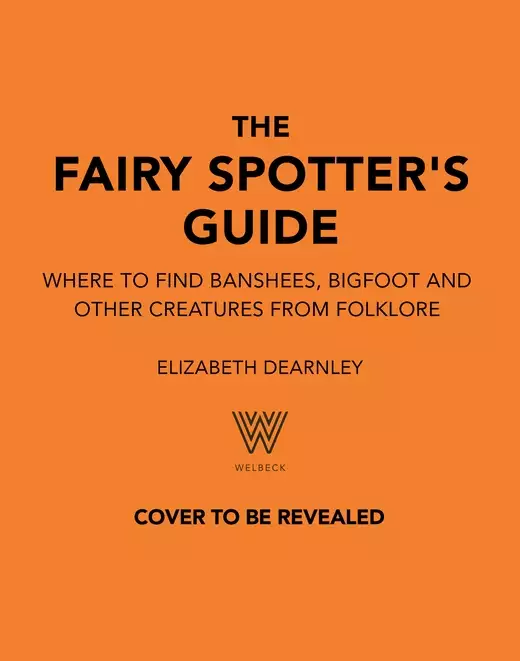
No matter where you are, you're never far from a door to the Otherworld ...
From the bloodthirsty baobhan sith of the Scottish Highlands to the mischievous trasgu creeping beneath your floorboards, the world is teeming with hidden, magical beings.
The Fairy Spotter's Guide is your essential companion for navigating the world of the uncanny. Journey across continents and cultures as you uncover the origins - both real and mythological - of 80 extraordinary folk creatures, from mermaids and bigfoot to shapeshifters and spectral hounds.
Packed with over 100 original, spellbinding illustrations and written by a leading expert in fairy tales and folklore, this is no ordinary field guide. Whether you're a seasoned cryptid hunter or a curious newcomer, this beautifully crafted book will enchant, unnerve and utterly captivate.
Watch your step. Not all fairies are friendly.
Release date:
September 10, 2026
Publisher:
Headline
Print pages:
192
* BingeBooks earns revenue from qualifying purchases as an Amazon Associate as well as from other retail partners.
Do you believe in fairies? This question is not as straightforward as it might first seem. Throughout history, scholars, scientists and anyone searching for answers have attempted to catalogue the spectrum of supernatural beings with whom we share the earth. These efforts stretch from medieval bestiary compilers and early folklorists, like 17th-century Scottish priest Robert Kirk (whose treatise The Secret Commonwealth of Elves, Fauns and Fairies suggested the fae may be ‘of a mi[d]le Nature betuixt Man and Angel’), to modern-day cryptozoologists on the trail of Bigfoot, the yeti and the yowie. All have concluded that defining the true nature of these creatures may be beyond human understanding, but this hasn’t stopped them wanting to create as complete a record as possible.
This book is a field guide to the multiplicity of fairies, marvellous beasts and murk-loving monsters found across the globe, providing practical tips for identifying and interacting with any creatures you encounter (although some should be approached with more caution than others). Whether they’re ethereal winged beings like the Persian parī, prowling shapeshifters like the African werehyena or snowbound terrors like the Inuit qallupilluit and the North American wendigo, the creatures in these pages testify to the broad and bewitching variety of beings hidden just out of sight in tree branches, inside rocks or even under your bed.
Students of fairy lore will notice several commonalities between fae from different parts of the world. Nearly every culture has its own version of mischievous goblins who steal your keys, child-snatching swamp monsters or dangerously seductive spirits who lure mortals into the woods. From the Arctic to the equator, fairies are liminal creatures, flickering on the edges of human existence and drifting like smoke out of the hands of anyone attempting to define them too rigidly by behaviour, gender (while some identify as male or female, others avoid fixed gender boundaries), appearance (shapeshifting is ubiquitous) or country (the fae pay no attention to geographical borders). Many creatures also strongly embody environmental and community-building messages, warning humans to respect the natural world and not to be greedy with resources.
While The Fairy Spotter’s Guide makes no claims to capturing every aspect of these beings – after all, folklore is fluid and there’s always another side to any story – it invites you to keep your eyes and ears open the next time you’re out in a forest, by the seashore at twilight or simply sitting at home reading this book. And if you hear a sudden rustle of leaves or high-pitched singing, it’s up to you whether you follow.
A monochromatic green watercolor illustration of an ethereal, humanoid figure with pointed ears, wearing a wreath of leaves. The figure is draped in a flowing tunic and holds a branch with small blossoms. The bottom of the figure fades into watercolor drips.
If you’re travelling through the Congo Basin rainforests and lose your way among the dense foliage, meeting an abada is a welcome sight. This shy unicorn-like animal has been spotted across Central Africa under various names, with the 19th-century German naturalist Eduard Rüppell recording nillekma and arase as alternatives. In the Kongo language, spoken across the Democratic Republic of the Congo, the Republic of the Congo, Gabon and Angola, it is known as abada.
The abada is smaller than many unicorns, with two crooked horns growing out of its head rather than the more usual singular horn, and is believed to have its origins in Kordofan, central Sudan. According to cryptozoologist Charles Gould’s 1886 book Mythical Monsters, the French geographer Antoine Thomson d’Abbadie collected an account of the creature – here referred to as an a’nasa – in 1848, noting that ‘[i]t is the size of a small donkey, has a thick body and thin bones, coarse hair, and tail like a boar.’
Abadas are said to appear during times of trouble, such as serious illness or when a traveller is lost, and seeing one is a sign that good fortune will come your way. Their horns are believed to contain healing powers and be an antidote to poison, although it goes without saying that you should never attempt to harvest a horn from a living abada.
A monochromatic purple watercolor illustration of an Abada. It resembles a small horse or donkey with a beard, a flowing mane, cloven hooves, a curly pig-like tail, and two long, spiraling, crooked horns on its head.
ABADAS ARE SAID TO APPEAR DURING TIMES OF TROUBLE, SUCH AS SERIOUS ILLNESS OR WHEN A TRAVELLER IS LOST, AND SEEING ONE IS A SIGN THAT GOOD FORTUNE WILL COME YOUR WAY.
An illustration of the Adze, depicted as a large, horrifying insectoid creature with greenish wings, a segmented body, sharp grasping forelimbs, and a face with jagged teeth dripping blood. Bright red blood splatters are painted below it.
When preparing for nightfall across the coastal regions of West Africa, make sure to close your windows and seal up any chinks in the walls, in order to prevent the adze from entering. This nocturnal entity can slip through keyholes and under doors, in the form of bloodsucking fireflies, eager to drink from sleeping victims.
Adze has a complex spectrum of meanings within the cultures of West African peoples such as the Ewe, Fon and Yoruba. It can be understood as malign sorcery, while The Watkins Book of African Folklore author Helen Nde notes that it can also mean ‘creative genius’ and ‘spiritual power’, especially that wielded by women. However, this force is believed to become harmful when summoned by malevolent human sorcerers known as adzetos or adzetowos. Entering the adzetos’ body, the adze emerges through their nose or mouth as floating balls of light or fire which become fireflies, beetles or owls, flying through the night to drain the life force from others.
Following the establishment of colonies by European missionaries in the 19th century, earlier recordings of adze stories told by the Ewe people – initially by missionary Jakob Spieth in 1906 – often framed these tales using Western supernatural tropes such as vampires. However, artist and folklorist Adwoa Botchey (part of West African diaspora storytelling team Adeche Atelier and co-host of the podcast Afro Mythos) cautions against these interpretations, noting how adze ‘intertwin[es] notions of spiritual power, sorcery and social dynamics within the Ewe community’.
If you manage to catch hold of an adze in its glowing insect form, it will transform into a hunchbacked taloned humanoid and can be killed while assuming this shape. Should you spare its life, however, it will cease to be a threat to you. Leaving offerings of palm oil, coconut water or coconut milk may also provide the adze with a tempting alternative to blood on which to snack.
By the seashore in Tangier, on the banks of the Tétouan or Sebou rivers, or beside the canals of Fes, a figure can sometimes be seen. While her upper body is that of a beautiful woman – she might look exactly like someone you know – her legs and hooves hidden beneath her clothing, are those of a camel. This is Aicha Qandisha, one of North Africa’s most enigmatic supernatural beings.
The origins of Aicha Qandisha (عائشة قنديشة, also romanized as Aicha Kandicha and Aisha Qandicha) are unclear. One theory suggests she may have developed as an Egyptian goddess, while the Encyclopaedia of Islam notes that ‘Qandisha’ derives from the Hebrew qedēshā (sacred prostitute). More recently, she has been hailed as a legendary figure in the anti-colonial resistance against Portuguese occupation in the 16th century: after her village was massacred and her husband murdered, Aicha allegedly took revenge by seducing and killing the colonizing soldiers.
Many tales told about Aicha have traditionally emphasized her more horrifying aspects. Some recount how she disguises herself as a man’s wife in order to lure and destroy him (see also the Melanesian Abere and the Russian rusalka). However, in the 21st century several Moroccan artists have reclaimed Aicha as a feminist icon – one example is Yasmine Benkirane’s 2022 film Malikates (Queens), which reimagines Aicha as the benevolent queen of the jinns. All the stories agree that she is a force to be reckoned with.
A monochromatic blue watercolor illustration of Aicha Qandisha. She is depicted with the upper body of a woman wearing a headscarf, tunic, and flowing cloak, but from the knees down she has the furry, cloven-hooved legs of a camel. A dark circular moon or aura is behind her head.
Of all Africa’s supernatural beings, the wisest and wiliest is Anansi the spider. This trickster hero of countless Akan stories has many guises – sometimes he appears as a spider with a human face, at other times a man with spidery limbs – but his ability to outsmart and outspin any opponents with his quicksilver storytelling is never in doubt.
Spider tales have been told across West Africa for generations but appear to have their ultimate origins in the Anansi stories of Ghana (Anansi’s name comes from the Akan word for spider). Anansi is both storyteller and protagonist in these tales, using his brains, wit and cunning to defeat stronger and more powerful foes, although he is also prone to making the occasional foolish mistake when his a. . .
We hope you are enjoying the book so far. To continue reading...

 Please log in to recommend or discuss...
