- Book info
- Sample
- Media
- Author updates
- Lists
Synopsis
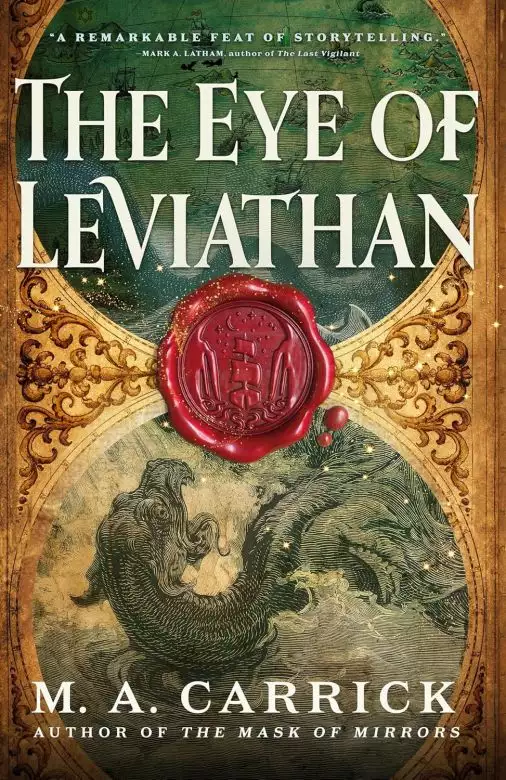
From the author of The Mask of Mirrors comes a sweeping adventure set in a world where fae secretly walk amongst those who seek to persecute them.
In an alternate Spanish Golden Age, the Council of the Sea Beyond has risen to unrivaled power, exploiting the Otherworld’s most precious resources for their own gain. Estevan seeks to uncover their secrets, but he risks the exposure of his own: that he is a faerie, masquerading as a mortal.
The Hungry Girl is the human whose place he took. Lost among the fae and desperate to find some purpose for her existence, she leaps at the chance to help a group of Spanish explorers in the Sea Beyond…only to be horrified at the atrocities they commit.
A faerie pact has separated them– but only together can they bring down Spain’s worlds-spanning empire and save the homes they have both come to love.
Release date: July 14, 2026
Publisher: Orbit
Print pages: 500
* BingeBooks earns revenue from qualifying purchases as an Amazon Associate as well as from other retail partners.
Reader buzz
 Please log in to recommend or discuss...
Author updates
The Eye of Leviathan
M.A. Carrick
This was not like the Inquisition’s other autos, where heretics and relapsed Jews were dressed in their tunics and caps of shame, made to confess their crimes and hear their sentences, before the few “relaxed” to the control of secular authorities—a euphemism that would have made even the most double-tongued faerie of the Sea Beyond blush—were led away to be burned. With or without a merciful garroting first, depending on whether they repented of their sins.
This event, the priests insisted, was not haunted by the specter of death, but blessed by the promise of life everlasting.
The prisoners, waiting in a chained and huddled mass on the stage before the royal dais, wore no tunics. The great theologian Fontesar had argued that, like Adán and Eva before the Fall, faeries had no true knowledge of good and evil, and so they should go without even a fig leaf to cover their nakedness, but propriety had won out: In order for women to decently attend, all prisoners must have loincloths, and breastbands for the ones with a female form. But the rest of their skin was on display, so that all might see the miracle occur.
The king’s confessor, a Priscillianist friar, thundered out lines from the Book of Enoch, while the king himself sat like a statue, Habsburg jaw floating proudly above black Habsburg velvet. Felipe II had once declared to the pope that he had rather lose all his states and his life a hundred times rather than rule over heretics: a sentiment heartily reciprocated by the Protestants of the Low Countries, those Lutheranism-raddled possessions inherited from his father. God had obligingly relieved the king of his Netherlands obligations, freeing him to focus his attention on matters Otherworldly.
With resounding success as a result. Scripture warned man about the dangers of gaining the whole world but losing his soul; Felipe had struck quite the bargain, surrendering only a small part of the world, and gaining many souls in exchange. A great fleet of Spanish ships, funded with silver bled from the New World and bearing a tercio of three thousand ferocious soldiers, had located and subdued the mighty Storm Isles of the Sea Beyond. More faithless children of the angelic Watchers, gathered at last into the flock.
Don Estevan Carrasco, hidalgo of Andalucía, cared very little for theology. Like many of his status, his pride stood in inverse proportion to his income; he had come to Madrid in pursuit of some lucrative appointment that might allow him to debauch himself in greater comfort. Knowing of this celebration, he brought with him his son—named after himself, naturally—in the hopes that seeing these devilish creatures baptized would instill some proper steel in the boy’s spine. He was too much his mother’s son, and the mother too much a creature of unsuitable fancies.
The boy now called Estevan had long ago concluded that anything his namesake approved of should be held in the greatest of doubt. Estevan Senior was an odd admixture of strict, unyielding Catholicism whenever that served his purposes, and careless blasphemy whenever Church dogma threatened to interfere with his gaming, whoring, or violence. Since none of this seemed to bring him much happiness, Estevan Junior questioned its merits as a way of life.
But never where the man he called father could hear. He’d learned that lesson early on.
The preceding few days had been enjoyable enough, if he ignored the cause for all this revelry. Although the auto formed the centerpiece of this splendor, it was surrounded by a nimbus of plays, parades, bullfights, brilliant equestrian feats in the game of reeds. Today, however, the mood was more solemn. Spectators had gathered in Madrid’s great Plaza del Arrabal at the crack of dawn, merchants and apprentices and pickpockets and the poor jostling for the best views of the king and the condemned. Estevan Senior had not hesitated to use his status and the pommel of his sheathed sword to ensure his son would have a clear sight of the proceedings. His reward was having to stand through the Priscillianist’s interminable sermon on the sins of the Watcher angels and their godless descendants.
At least the event itself, when it finally began, was quick. Each body huddled in chains was blessed with the same fate.
There were more than threescore of them, and Estevan watched them all, but it was the first who seared himself into memory. A tall male, whose ink-black hair faded to lightning white at the tips, who held himself with vicious pride despite the iron burning his wrists and ankles. A true denizen of the Storm Isles: He would have smashed the stage with the fury of the skies if he could.
He could not. And he never would again.
The faerie neither begged nor made a futile attempt to run. He only forced his captors to drag him forward unwilling, to where the Priscillianist waited with his cross and his holy water and his prayers.
There was no stench of seared flesh, whatever people claimed. Estevan would instead have believed that scent vanished, as the water of baptism effected its miraculous transformation. Certainly color drained from the faerie, fading his skin to ash and flattening the subtle shades of his hair. The scream that rose from him started as agony and ended as a hopeless, lifeless keen. Everything about him was lifeless now—yet still the newly mortalized faerie moved, stumbling along like an obedient puppet when the guards prodded him aside to make way for the next in line.
The Church claimed that baptism bestowed a soul on a faerie, drawing from a heavenly storehouse that priceless gift all humans were born with, so that this fallen, forsaken creature might at last know God.
Estevan, seeing it firsthand, knew the truth: Whatever else baptism might do, it tore something away. Something equally priceless, which that proud faerie would never get back.
His father beat him later for being sick on the cobblestones.
The memory remained in his mind like an iron scar, warning and spur alike. This was what he sought to stop—and the fate that awaited him, if anyone ever realized he was a changeling, a faerie switched out for a human child. He would wind up like those poor mortalizados baptized that day in Madrid.
But between eagerness and proper caution lay a gulf he spent years learning to bridge.
In the early nursery years, it was easy. His only companions were Teresa, who already knew his secret; little Leonor, barely a year older than he purported to be and incapable of understanding a secret, let alone exposing it; and Catalina.
Poor Catalina. At ten years of age, she was his oldest sister, and smart enough to be certain that someone was playing tricks on her.
In Estevan’s defense, the nursery was a very dull place for a bored changeling.
“He was talking to Leonor. He was!” Catalina swore to their father.
From the rush mat on the floor, Estevan grinned up at his sister and his father with all four hard-earned teeth. Estevan Senior was not a figure often seen in the nursery. He had intermittent employment with the Indies fleet, the annual flotilla of ships sailing to and from the New World, and when he was in Andalucía, he preferred to be in more interesting surroundings than his own home. He took no interest at all in the six daughters provided by his second wife, and only a little more in a son not yet old enough for masculine entertainments. But his laziness and pride were as broad as his shoulders and as deep as his gut: For proof of both, one need look no further than his eagerness to repurpose the name Estevan, after its previous inheritor—the son of his first wife—had inconsiderately died of pestilence, along with the woman who bore him. And naturally, any boy named for him would be exceptional.
“Of course he was talking,” Estevan Senior declared. “My son is brilliant!”
Leonor was across the room on awkward spindle legs, hanging like a monkey from the window casement. At her father’s booming voice, her fingers slipped and she toppled back, bum over brain. Her face screwed up with impending tears, and Estevan scooted over as fast as hands and knees could carry him, burbling nonsense and drooling on her to distract her from infantile tragedy.
“See? You see, Father?” Catalina gestured, as though this were proof of talking. “And before, he was teaching her to open the casement.”
“What I see is that his heart is already too soft from spending so much time with women,” his father said, sounding far less jovial. Hands closed around Estevan’s middle and jerked him away from Leonor, holding him up by the pits to face his father. “Grow up quicker, boy. Papá will teach you about men and women.”
Estevan, more precocious than Catalina insisted and more brilliant than his father believed, managed to respond with a dual stream of spit-up and poop.
The lack of full control over his body was the most galling part. He’d known that entering human society as a changeling would mean going through childhood, but the sheer duration and helplessness of it went far beyond anything he could have anticipated. He had the mind of an immortal being trapped inside a sack of suet, and the latter leaked from every possible orifice for a humiliatingly long time. Even once he learned to regulate those responses, coordination took agonizing years to develop, during which he dropped spoons, fumbled balls, and tripped over his own pudgy feet.
He could have endured it better had it just been him and Teresa, at the rural estate where their friendship had formed. With her he could talk—once his tongue learned to obey him. But even had she been able to bear living so close to her surrendered daughter without ever seeing the girl, Estevan Senior would not have permitted it. She’d only half recovered from the birth when he’d uprooted her and brought her back here, to the village of Tomares outside Sevilla, to resume the duties of running his household. And although their household was far from the wealthiest, Estevan still had six elder sisters and nearly as many servants to contend with; there was always someone around to hear.
“You must keep quiet,” Teresa implored in a desperate whisper as they sat in the house’s patio garden one day, shaded by orange trees. The heat had driven everyone with sense to the cooler shadows of the downstairs rooms. “Catalina already suspects. If she gets it into her head to report you to the Inquisition…”
“Would she do that to her own family?” Estevan asked, as quietly as his disobedient vocal cords would allow.
Teresa sighed and jiggled him as if he needed comforting. He hated that; it made him burp. When he complained, she told him that was the point. Now she said, “If Catalina thinks a faerie has taken the place of her brother, then you are not her family.”
He did try. Not just for his own safety or Teresa’s; he’d set himself a mission, and had no desire to fail so early. But once Leonor started talking, it was hard not to at least rise to her level. As the favored boy-child, he was given the best bread and mutton to eat whether he wanted it or not, so they were almost of a size. Even people who knew better often mistook them for twins, to his father’s everlasting fury.
So, to avoid getting caught speaking beyond his years, he started teaching her language beyond her world.
The language of trees, with its whispering hiss of wind in leaves, kept Catalina from noticing their conversations and raising a fuss, until one day when Estevan was two and Leonor three. The fig tree outside their nursery window had grown well in response to Estevan’s coaxing, trunk thick and branches strong enough to facilitate escape once he wasn’t at risk of falling. Leonor was complimenting the fig on its explosion of flowers when their oldest sister interrupted.
“You make many fruit,” Catalina stammered in the badly accented language of trees. Then she glared at Estevan. “Not like this fruit. Rotten fruit.”
He rabbit-froze in fear before laughing. Too loud. But he’d heard stories of changelings long before he dared become one; he knew the traps. “Silly,” he accused, then made nonsense leaf-rustling noises—the sort trees wouldn’t even stir their limbs for. “Sister is silly.”
“And ‘brother’ isn’t fooling me,” she said, abruptly splashing him with water from a cup. A moment later, she pressed a crucifix to his brow. An iron crucifix.
He giggled again, inanely, and tried to chew on Jesús, earning himself a slap.
Estevan couldn’t blame Catalina for testing him, even though she’d been there at his baptism. It had taken all his will not to hold his breath when the priest poured holy water over his head, and only Teresa surreptitiously pinching him had reminded him to cry instead of laughing in relief afterward. Not for him the fading and hollowing he would later see firsthand in Madrid; Teresa’s promise and the presence of her seventh daughter among his forest kin protected him against sacred rites.
So he learned his prayers like a good little boy, kneeling and piously clasping his hands in supplication of a virgin who had somehow given birth, and he exercised noble restraint in not asking Teresa if faerie assistance had been involved in that miracle. If it had been, the faerie in question had a great deal to answer for, given what Christians did to his people now.
Much of what he knew about that, he learned from his second-eldest sister, María. She was headed for a nunnery, everyone agreed; whereas Catalina could do no more than sign her name, María had begged and pleaded to be taught to read so she could immerse herself in holy psalms and the lives of saints. She had no Latin with which to read the Bible, of course—Estevan Senior would never go to such lengths to educate a mere daughter—but there were cheap texts in Castilian that told the stories: the Watcher angels who had sinned with the daughters of men, siring the nephilim from whom came faeries; the great Flood that had swept most faeries from the mortal world into the Sea Beyond; the might of Sansón that had slain the great bull-beast Behemoth, afterward dragging together his horns—the Pillars named by the pagans for Hercules—to mark the way between the worlds.
Tales seen through a warped and unreliable mirror. The fae told their own stories about how the world came to be as it was, as many stories as there were islands in the Sea Beyond. But on a few points, everyone agreed, faerie and mortal alike: Leviathan and Behemoth, the sea and the land, the children of salt and the children of soil.
Those tales were also nearly his downfall. They offered his first opportunity to learn something of how the Church saw his people, and perhaps therefore the magic that let them baptize faeries and conquer the Sea Beyond. So he listened avidly to María’s stories, and he asked Fray Lorenzo about them when the Franciscan visited their house to catechize him for his confirmation. The chance to learn was as intoxicating as a barrel of his father’s favorite wine: He drank greedily and too much.
“But if Sansón closed the passage between the worlds with the strength given to him by the Lord, why isn’t it heresy for mankind to reopen it?” he asked, dogging Fray Lorenzo’s steps as the stout little man waited for his donkey to be fetched from the pasture. “How can we reopen it, without the Lord’s strength?”
It was a mild spring day, a mix of rain and poor drainage bogging the ground around the pasture fence into mud and slippery grass. Estevan swung his arms in the exuberance of freedom. Fray Lorenzo bore his antics with as much placidity as his old donkey.
“We have reopened nothing, Estevan,” the friar said, tucking the skirts of his robe into his rope belt in preparation for riding. “Some passage through was always possible, as we knew from the voyages of San Brandán and the Portuguese ship that reached Antillia. But the Lord made the means of that passage known to us because the time has come to bring His Word to the poor, soulless creatures there.”
The donkey arrived, and Fray Lorenzo heaved himself into the saddle. Estevan said, “But why now? If He wants the Sea Beyond evangelized, why didn’t He send people to do that a long time ago?”
The friar’s groan was as much for the questions as for the difficulty of mounting. “Perhaps He provided this as a way to unify good Christians against Lutheran heresy. I don’t know, Estevan. If you were not your father’s only son, I would say you should become a monk and devote your life to answering such mysteries.”
Estevan suppressed a shudder. He ached to learn, yes… but not at the cost of living out his existence trapped inside a monastery. The entire point of doing this was to escape God’s holy yoke.
Fray Lorenzo continued to entertain his questions with good humor and misguided wisdom until the time for the sacrament came. Although the Carrasco household usually attended services at Our Lady of Belén in Tomares, for his surviving son’s first Communion, Estevan Senior packed up the entire family for the short trek across the Bridge of Boats over the Guadalquivir and through the city gates into Sevilla.
The city’s fortunes had transformed dramatically during the short span of Estevan’s mortal life thus far. An untimely battlefield death next door not long before Teresa made her deal had put the Portuguese throne under the rump of an elderly cardinal sworn to celibacy. When he died shortly thereafter without leaving behind so much as a helpful bastard, no quantity of claims that his predecessor, the late Sebastião, had survived the Battle of Alcácer Quibir by fleeing to the Sea Beyond could fill the vacancy. Only Spain’s Felipe II could do that—a fact he ensured by efficiently quashing his assortment of rivals.
In a single stroke, the Treaty of Setúbal was rendered meaningless. With the whole Iberian Peninsula joined atop a single crowned head, that agreement—in which the Spains had ceded to Portugal claim to all but a few outposts in the New World, in exchange for dominion over the entirety of the Otherworld—became fit only for wiping the royal arse. Sevilla had always enjoyed a monopoly over trade with the colonies of New Spain, but with the gates to New Portugal thrown wide as well, the wealth poured in like a flood: American silver, hardwood, hides, and more.
And Sevilla grew like a boil in response. From the slight rise on which Tomares sat, Estevan was able to look over the Guadalquivir to the Arenal, the sandy strip outside the city wall where ships loaded and disgorged their cargo, aided by one inadequate crane and the slaves who worked its treadwheel. On that shifting and unreliable ground, dusty in summer, muddy in winter, had sprung up a veritable town of mariners and merchants, fruit-sellers and fish-sellers and sellers of fleshly favors, petty thieves, tax collectors, drunkards fighting duels, their chaos spilling over into the streets of the city itself. Estevan Senior regularly crossed the river to Sevilla, often not returning until days later, but such excursions were forbidden to his wife and daughters and son—until now.
Catalina grimaced when they entered the lodgings their father had secured for the night. She had become a young lady, seventeen and looking ahead to marriage, and from the groaning planks of the floor to the rafters studded with beetles, this inn did not meet her standards. “I don’t see why we all need to come,” she muttered, lifting her skirts away from the threat of splinters. “Or why Estevan couldn’t have taken Communion at home like the rest of us.”
“I think it’s thrilling,” Beatriz said, hurrying to the wooden grating of the window as if she would see much through that barrier.
“It’s only for one night,” Teresa said, peering at the narrow beds and not quite hiding her grimace. “Besides, Catalina, this is a chance for your father to begin seeking a husband for you.”
The invocation of that possibility brightened her daughter’s countenance like the sun had risen in the little room. Catalina to a husband and María to the Church; talk of that was enough to occupy the three eldest women, leaving the younger siblings to amuse themselves. Beatriz shoved as much of her face against the window as would fit, earning the annoyance of Isabel and Juana Inés, who were playing some inexplicable game with marked pebbles and sticks. Leonor wasn’t speaking to Estevan, still annoyed that he received so much attention and a new set of clothes for the occasion when she, older than he, had to make do with their village church and a dress attending its sixth first Communion. She pretended interest in the game as her petty revenge.
Picking at the starched collar poking red welts into his chin, Estevan lingered by the door to their room, listening to boots on the landing and voices raised from the stairwell. A few whispers and nudges, and the weathered oak obligingly tightened in some places, loosened in others, until he could hear the conversations as more than just noise.
The inn took in a wide variety of clientele, caring more for their coin than their breeding. Just a few doors down from Estevan was a room of sailors fresh from the Indies route, looking to spend what pay they hadn’t preemptively gambled away. One had more in his purse than expected: The tropical fevers of the New World had done for the ship’s master, earning the pilot a mid-oceanic promotion. His new rank having been confirmed upon return, and with the prospect of lucrative contraband and spurious fees lining his pocket in voyages to come, he’d offered to buy drinks for all his companions that night. And as they clattered away down the creaking stairs, Estevan remained at his post, cradling a hope as fragile as a baby bird.
Pilot. One of those men who, by some arcane art, guided ships across the waves to their destination.
The waves of the Ocean Sea, not the Sea Beyond—but surely, Estevan reasoned, it must bear some resemblance. He’d tried several times already to question his father about it: The fortune Estevan Senior was busy squandering had been made at sea, via the father of his first wife, a well-connected hidalgo deeply enmeshed in the trade with New Spain. Unfortunately, Estevan Senior had little patience for the prattling of his childish son, and even less for the rough men who did the actual work of sailing the ships. However arcane the art of navigation, it still carried the stink of manual labor, and no hidalgo would sully himself even by socializing with a pilot, much less learning anything from him.
But the man who would be busy celebrating tonight in a tavern was himself a pilot. And among his things, Estevan might find some clue to the magic of the sea.
He had to wait until Teresa and his sisters slept before he could seize his opportunity. At his request, the warped floorboards held themselves as tense and quiet as wild hares while he crept barefoot across them and into the hallway. He was a shadow among shadows as he questioned door after door before finding the room taken by the pilot and his companions. It was empty, the men still out carousing. Their sea chests stood at the feet of the two beds, and a few wooden whispers found him the one that belonged to the pilot.
But that was the end of his success. The chest might be wood, but the lock was cold brass and had no more words for him than a grandee would for a goatherd.
Nor were the chest’s answers much more helpful. What was inside? Cloth, metal things, paper. It could not tell him what was on the paper, nor much about the uses of the metal. Frustrated, Estevan sat back on his heels, wondering if he dared ask the chest to flex open far enough for his hand to fit through the gap. There were limits in what the wood could do without cracking, and if he left behind evidence of his snooping…
“What’s this now—a thief?”
In his haste to go drinking with his friends, the pilot had forgotten the gift he intended to bring to a certain lady of his commercial acquaintance. Returning to find a hip-height intruder in the room, he reacted with predictable force. And while life with six sisters had made Estevan good at dodging, he wasn’t good enough to evade an adult’s grasp; the man got him by the arm, hand wrapping fully around his slender limb, hard enough to bruise. Estevan forced down the panic, the urge to sprout thorns, shred flesh, rip himself free and flee to the safety of high boughs and deep roots. Human, he was meant to be human now.
“I’m no thief, señor,” he whispered, soft as leaves shifting underfoot. Recalling the man’s proud boasting, he added, “I heard there was a pilot staying here, and I wanted to see…”
What? Secret things? He could kick himself for shifting the man’s suspicion. He should have just confessed to thieving.
The man dragged him over toward the thin light slipping through the window’s fixed shutters. “Christ, you are just a kid, aren’t you? No starveling, though.” His fingers plucked at the fine linen of Estevan’s nightshirt. “Where’d you come from?”
“I’m staying in the inn with my family, señor,” Estevan said promptly. His manners earned him a huff of laughter; this was not the sort of man who was often addressed with such courtesy. “My father is Don Estevan Carrasco. I’m here for my first Communion at the cathedral tomorrow.”
“Your father know his son’s in the habit of breaking into strangers’ rooms?”
He couldn’t lie and say he’d mistook the room; he’d already admitted his curiosity. Instead, he ducked his head and mumbled, “We’re meant to have sins to confess before our first Communion. This seemed more interesting than putting frogs in my sister’s shoes.”
The man barked a deeper laugh, his hold loosening. Estevan could have taken his chances at escape… but hadn’t he come here to learn things?
There were many ways of learning. He didn’t try to conceal his hunger as he looked up. “Are you the pilot that’s now the ship’s master, señor? Have you really sailed to the New World and back?”
His respectful words puffed the man up with pride. “I am. I have.”
“How do you do it?” Estevan asked eagerly. “How do you know where to go in the Ocean Sea? And how are the maps made? What magic do you use? Where did you learn it? Where can I learn it?”
“I—” This barrage left the man temporarily speechless. “You want to be a pilot?”
He wanted nothing of the sort. But he couldn’t say, I want to destroy the magic being used against the Sea Beyond so my people will be safe, and so it was his turn to be without words.
The pilot rubbed a hand over his face. “Kid, boys like you don’t become pilots. Your father’s too high for that.”
How could the people necessary to carry out such a voyage be less important than stupid brutes like his father, who only came along with their guns and swords? But this was similar to all the questions Teresa and Fray Lorenzo warned him against asking, like the difference between a cassock and a dress. The mortal world was full of incomprehensible rules, and those in power did not like them being questioned.
“There must be some way,” he said, more to himself than to the bemused pilot.
The man hesitated, then crouched down. “What is it you actually want? To sail to New Spain?”
This time Estevan had a lie ready. “To the Sea Beyond. I want to help the king map the islands of the Otherworld and bring them under his control.”
“Hoo!” The pilot’s exclamation was loud enough to make Estevan flinch, but what followed more than made up for the danger. “That’s not the work of a pilot, boy. They guide the ships, but you’re talking about cosmographers—”
“How do I become one of them, then?”
“Go to school,” the pilot said dryly. “Then go to university. Make friends with the sorts of men who run this kingdom. You’re talking about work handled by the Council of the Sea Beyond, and it takes more than a please and thank-you to make them give you a position.”
He was slated for private schooling with Fray Lorenzo; surely that would count. As for the rest… “What’s the Council of the Sea Beyond? My father’s not too high for that, is he? How long does university take?” He’d already been in the mortal realm for so long. Ages could pass in the faerie realm as light as thistledown on the wind, but every day here dragged with the weight of mortality and the burden of the quest he’d set himself.
“Lord have mercy. Boy, I don’t have time to answer all your questions; I’ve got a very accommodating lady waiting for me, but she won’t stay accommodating all night. The Council serves the king, your father might not be high enough for the likes of them, and you’re talking about more schooling than I ever had. Ten, twenty years—I don’t even know.” The pilot turned to his sea chest and unlocked it with a key from his neck, rooting around in the depths.
No amount of craning could net Estevan a useful glimpse of the chest’s contents, nor ease the shock of that news. The route to his goal was longer than the Way of Santiago. And in eight years as a human boy, he’d barely taken the first step.
Trinket in hand, the pilot herded Estevan out of the room like a despondent lamb. The door to his own family’s room swung open as they ne
We hope you are enjoying the book so far. To continue reading...