A dark, propulsive literary gothic novel that puts a modern twist on Stevenson and Poe, from a thrilling new voice in Latin American horror.
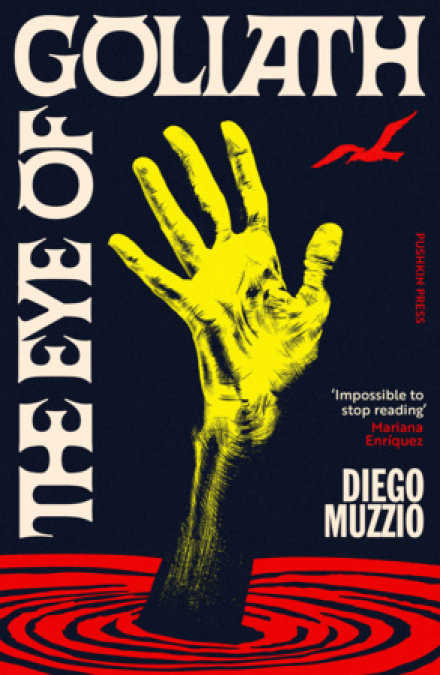
“Impossible to stop reading. It has all the fascinating tension of great literature.” — Mariana Enríquez, author of Our Share of Night
In this deliriously inventive twist on The Strange Case of Dr. Jekyll and Mr. Hyde, Argentine powerhouse Diego Muzzio conjures a haunting story of shattering war trauma and the disturbing proximity of sanity and madness in his English-language debut.
In 1920s Edinburgh, war veteran Dr. Edward Pierce develops experimental therapies to treat mentally ill patients whose cases have been rejected by conventional psychiatry. One night, he receives a visitor who asks him to take on an unusual new patient: David Bradley, an engineer who was sent to inspect the conditions of a lighthouse on a remote island in southern Argentina. The sojourn was a disaster, and he returned completely mute, his body overwhelmed by a single compulsion: to swim and swim, in any environment, to the point of total exhaustion.
Bradley’s fragmentary diary reveals how this rational, disciplined man became the deranged individual brought to the sanatorium. Full of bizarre details and echoes of macabre events, it guides Pierce in his studies of his patients, propelling him into scientific terrain that grows increasingly grotesque.
With an ingenious structure that creates doubling and uncertainty at every turn, The Eye of Goliath is a masterfully tense novel that unites classic gothic atmospheres with disturbingly modern psychological horror.
Release date:
September 1, 2026
Publisher:
Pushkin Press
Print pages:
192
* BingeBooks earns revenue from qualifying purchases as an Amazon Associate as well as from other retail partners.
That evening, while hypnotizing the ‘cannibal’, Doctor Edward Pierce felt his neuralgia coming on again. It always began the same way: with a flash of heat in his right temple. Then, with the deceptive speed of a blazing fire, the pain would spread, laying waste to any possibility of reflec-tion and leaving the psychiatrist defenceless in the face of his own suffering. In the worst moments, the hunk of metal that brought on the headaches seemed to turn into a living being: an iron rat chewing through his skull from the inside. There were only two antidotes for the torture: morphine and sleep. At four in the afternoon, Pierce cancelled the remaining work he had planned for that day, went up to his room on the third floor of the sanatorium and collapsed onto the bed.
This complaint had its origin in the wound Pierce received in 1916, at the Battle of the Somme. For six days, the German front trembled under a deluge of fire. On the first of July, twenty-six British divisions, supported by fourteen French ones, attacked the enemy between Gommecourt to the north and Fouquescourt to the south. The fighting went on for 141 days. Edward Pierce was there as part of the contingent of psychiatrists that the British high command had dispersed across the front on a mission to study a cer-tain disorder that had been causing a significant number of casualties among the troops: shell shock, they called it, or war neurosis.
Posted to the area surrounding Ovillers-la-Boisselle, Doctor Pierce spent a few months studying the symptoms on the ground—fits of hysteria, mutism, paralysis, apathy, sleep disturbances, muscle spasms, hallucinations—while at the same time receiving rapid instruction on how a flurry of shrapnel or the bullets from a Maschingewehr 08 can modify human anatomy in an instant. One dreary and driz-zly afternoon, as he was analysing a case on the second line of the trenches, a shell exploded a few metres away from him. He felt a stabbing pain in his temple and touched his face: a trickle of blood was running down his cheek. The verdict of the surgeon who examined him was conclusive: it was more dangerous to undergo surgery to remove the piece of shrapnel than it was just to leave it there. In any case, he had to stay under observation for a few days. The hospitals in the rearguard were falling to pieces and they put him in the only available bed, in a room crowded with dying men. After a reasonable amount of time had elapsed, Pierce left the hospital. He was not in any particular discomfort. He forgot about the iron filing lodged in his right parietal and returned to his scientific work beneath the din of the explosions. It was one evening some time after returning from the front, while he was watching a performance of The Flying Dutchman at Edinburgh’s Royal Lyceum Theatre, that he felt the pain erupt for the first time. From that moment on, he lived with that recurring torture, which would appear out of nowhere with no obvious cause, incapacitating him for hours and confining him to darkness. In the gloom of his bedroom, Pierce would close his eyes; the pain came accompanied by the noise of bombardments, geysers of mud, blood, chaos, macabre images of butchery. One image persistently upset his dreams: the heads of a horse and a soldier emerging from the earth. Facing each other, their mouths open and crawling with worms, man and animal both emitted silent howls. The screams of the past would then blend in with those of the present, for the sanatorium he ran was far from silent.
The old stone building was located to the west of Edinburgh, a few miles from Broxburn. A wall and a garden populated with oaks, cedars and firs protected the sana-torium from prying eyes. Until Doctor Pierce had taken over the institution, the place had simply been a dumping ground for the insane, known by the generic name Lunatic Asylum. His first act as director had been to replace the bronze plaque at the entrance. This symbolic change was followed by others of a material and clinical nature. Since then, the St Bartholomew Sanatorium—the name by which it was thenceforth known—had been transformed into an exclusive, almost secretive mental institution. It harboured a select group of the many mentally ill people who had come back from the war; cases deemed lost causes by conventional psychiatry, the offspring of the nobility, or of the merchants and industrialists who, together with the monarchy and poli-ticians of all types and extractions, ruled over the Empire, wielding the highly persuasive cudgel that kept the colonies in check.
The trust that members of these circles placed in Doctor Pierce was due as much to his proverbial discretion as to the new treatments he employed to diminish the suffering of his twelve patients. At his sanatorium, the patients were not confined in cells. Each had their own room, simply fur-nished, which they could enter and leave as they pleased—the doors weren’t even locked at night, except in cases of force majeure—as if they were staying in an exclusive resort hotel. This meant it was not abnormal for Pierce, his assistant Doctor Paul Hastings or even one of the nurses to come across a patient who, unable to sleep, had left their room for a nighttime stroll, sometimes in the gardens, other times in the kitchen or along the corridors. They did not torture them with hydrotherapy, electricity, straitjackets, chains, cages or beatings. Pierce favoured a new method based on a series of treatments: hypnosis, narcosis and psychoanalysis, with atten-tion paid also to the patients’ hygiene, diet and recreation. In the asylum, they had the chance to occupy themselves with modest manual labour such as carpentry, gardening and mechanical work, as well as taking painting and piano classes and even enjoying discreet visits from certain ladies who plied their trade at an Edinburgh brothel and who came out to the rural asylum once a month to offer their services to the patients. The encounters took place in a special room located next to the old stables, known in the asylum as ‘the rose room’, not because of the sexual activities that went on there but for another, more prosaic reason: the pattern printed on the wallpaper. The sanatorium also had an ample library, seldom visited by the patients despite being well-stocked with works of philosophy, history, psychology, biographies and travel writing (Pierce advised against fiction; he felt reading should be an intellectually enriching activity and not a mere pastime), as well as a room for concerts and conferences.
Between doctors, nurses and domestic staff—who worked in the kitchen, in the gardens and as cleaners—ten people worked in the asylum. For parents resistant to the idea of tossing what was left of their sons into some overcrowded military madhouse, St Bartholomew was an almost inevitable choice. The burdensome annual fee they paid to the institution placated their consciences. However, when the time came to decide, there was another unspoken but equally important motive: the asylum’s highly convenient and unusual location. ‘Edinburgh is not London’, Doctor Pierce would repeat in private, with a knowing smile.
A few hours later, the neuralgia had become a distant throb. His head, at once heavy and ethereal, felt like it was wrapped in a cotton ball. Before he opened his eyes, Pierce imagined his own body as a chrysalis about to open. The clock read ten minutes to eleven p.m. He looked at the chair heaped with diaries, clinical histories and the books he had been immersed in the previous night: Stevenson, one of the few authors exempt from the suspicion that fiction gener-ally inspired in him, as well as a curious volume written by one William H. Hudson, still open at the page he had been on when he put it down. It was a sort of travel narrative or memoir—including, scattered across its pages, the beginnings of an ornithological treaty on South American birds—in which the author recounted his adventures during a long stay in Patagonia. His eyes fell, as if by accident, on a passage he had highlighted in the margin with two parallel lines: ‘The change in me was just as great and wonderful as if I had changed my identity for that of another man or animal’.
He was about to go back to sleep with these words ring-ing in his mind when some knocks at the door stopped him. Hastings announced that a visitor had arrived. Pierce was aware that the select few with the privilege of being able to walk through the doors of the institution did not need to worry about trivial matters like arranging meetings in advance or appearing at a respectable hour. Even so, this was unusual.
After freshening up and getting dressed, Pierce went down to the entrance hall. The visitor was an old man of medium build, rosy-cheeked with a head of abundant white hair and well-trimmed sideburns. He carried a shabby folder under one arm and did not notice the doctor arriving because he was lost in contemplation of the single oil painting that decorated the hall: Dante and Virgil in Hell. It was a copy of a work by the French artist William-Adolphe Bouguereau, which Pierce had commissioned from a painter friend with a talent for imita-tion. The picture was inspired by an episode in the eighth circle, in which Dante and Virgil observe a fight between two condemned souls: Schicchi biting Capocchio’s neck.
Pierce proceeded to shake the visitor’s hand. The old man’s fingers were soft and cold, like fish. He waited for the stranger to introduce himself but instead was simply handed a letter. The House of Commons logo could clearly be seen at one corner of the envelope.
The note, which Pierce read right there, was concise and would have opened doors far more important than those of an out-of-the-way psychiatric institution. It was handwrit-ten by a political figure who demanded discretion above all and requested that Pierce offer the bearer of the letter—the engineer David Alan Stevenson—the help and support nec-essary for his protégé to overcome the health difficulties that were afflicting him.
The doctor folded the letter and returned it to the visitor. He couldn’t resist commenting on the coincidence that the man shared a surname with the writer.
‘It’s no coincidence, doctor.’ The engineer’s voice was deep and powerful and its possessor had adopted the habit of speaking almost in a whisper to mitigate its unintended force. ‘Robert was my cousin. I hardly knew him: he was always very ill. He died in the South Pacific, among savages. I am inclined to think that death can sometimes be a form of liberation.’
Pierce mentioned that The Strange Case of Dr Jekyll and Mr Hyde was one of the books on his bedside table. He then commented that, although he didn’t usually waste his time on novels, he had a certain weakness for this particular one because its theme—personality disorder or doubling—was psychiatric in nature. Stevenson said nothing. Based on his previous observation and that unequivocal silence, Pierce inferred that, for some reason, the old man’s family connec-tion to the writer represented a cause for displeasure rather than satisfaction. Or was his silence perhaps a result of the brief critical exegesis he had just put forward? Whatever it was, he decided not to address the topic again.
We hope you are enjoying the book so far. To continue reading...

 Please log in to recommend or discuss...
