As spiritualism reaches its fevered pitch at the dawn of the 20th century, a Scottish girl crosses the veil to unlock a powerful connection within an infamous asylum in this thrillingly atmospheric, exquisitely evocative exploration of feminine rage and agency for readers of Sarah Penner, Alice Hoffman, and Hester Fox.
Leaving behind a quiet life of simple comforts, Nairna Liath traverses the Scottish countryside with her charlatan father, Tavish. From remote cottages to rural fairs, the duo scrapes by on paltry coins as Tavish orchestrates “encounters” with the departed, while Nairna interprets tarot cards for those willing to pay for what they wish to hear.
But beyond her father’s trickery, Nairna possesses a genuine gift for communicating with the spirit world, one that could get an impoverished country girl branded a witch. A talent inherited from her grandmother, Lottie Liath, widow of a Welsh coalminer, whose story of imprisonment and exploitation in a notorious asylum is calling out to Nairna from four decades past—a warning to break free from the manipulations, greed, and betrayals of others.
What do the cards hold for Nairna’s future?
Rescued from homelessness by a well-connected stranger, Nairna is whisked into a new life among Edinburgh’s elite Spiritualist circle, including visiting American star Dorothy Kellings. Researchers, doctors, psychics, and thrill-seekers clamor for the rising young medium. But after a séance with blood-chilling results, a shocking scandal ensues, and Nairna flees to a secluded community near Boston, where she assumes a new identity: Nora Grey.
But Nora can’t stay hidden when Dorothy Kellings offers her the chance to face all comers and silence skeptics at a spectacular séance at Boston’s Old South Meeting Hall, where Nora will come face to face at last with her spiritual guide: the courageous Lottie Liath, whose heart-wrenching story and profound messages are indelibly tied to Nora’s destiny.
Release date:
July 29, 2025
Publisher:
Kensington Books
Print pages:
448
* BingeBooks earns revenue from qualifying purchases as an Amazon Associate as well as from other retail partners.
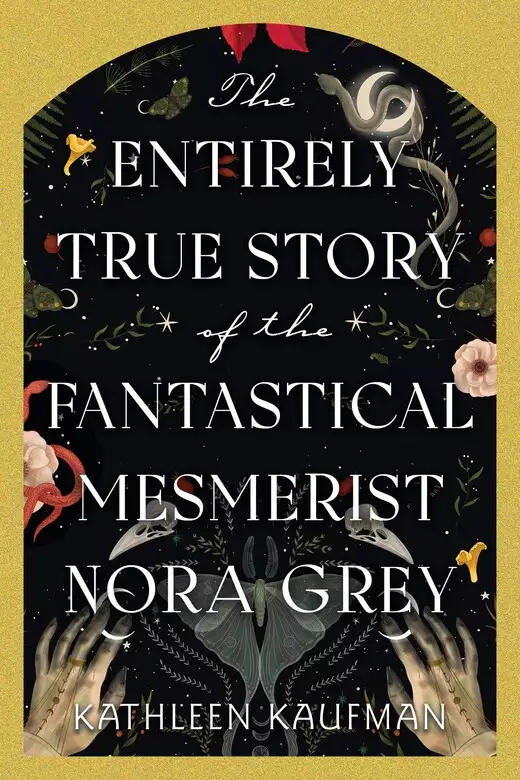
The Entirely True Story of the Fantastical Mesmerist Nora Grey
Kathleen Kaufman
“Come, beloveds. Come and join us, come and join us.” Tavish Liath’s voice echoed off the corners of the cottage as the fire in the hearth crackled in defiance. “The spirits are waiting to be invited in, they watch through the glass windowpane, they scratch at the door. They are waiting for your word.”
Silence filled the room. Lord Lennox sat closest to the hearth, his wife to his side, a stricken look on her face. The children huddled in the corner; in the dim light their wide eyes reflected the firelight in such a way they looked like a parliament of owls.
“Grady Lennox, do you invite the spirits into your house?” Tavish asked in a low voice, his eyes closed and arms skyward.
Lennox nodded stiffly. This hadn’t been his idea. His wife, Elspeth, had taken ill last season and never quite recovered. And then little Maggie had died of the consumption in the spring, leaving one fewer set of owl eyes to watch the séance from the corner of the great room. Lennox had relented out of grief and fear, but it was clear to Nairna that he would rather not have eyes at the windowpane and scratching at the door. Her father had been paid five shillings already with a promise of five more plus the handful of coppers Lady Lennox had slipped into the pocket of Nairna’s skirt when they entered the cottage. The Lennoxes weren’t wealthy by Edinburgh standards, but here in the outlying villages they lived well enough. Lord Lennox had inherited his title from his father, along with a pile of debts and land that wouldn’t grow a thistle in June. But still they kept up the appearance of prosperity, the cottage was well maintained, and it looked to be a real silver platter that sat over the hearth.
Tavish cast his daughter a look only she would discern and then began to chant in a low voice.
“Teacht chun solais shìn.”
Nairna knew that her father’s grasp of the old language was limited; she only hoped it exceeded the Lennoxes’. She flinched to hear her father’s rough words. She had studied the old ways with her Nan before they left for the road, but her father had always called it hogwash; English was the new way, he’d always said. That was until he realized a sprinkling of Gaelic added just the right authenticity and, for those who didn’t know better, an air of mystery.
Lady Lennox looked as though she might pass clean out on the smooth dark wood table. Lord Lennox shifted uncomfortably and glanced at his children, who huddled in the corner, silent as mice. Nairna took a deep breath and shifted her leg in preparation.
“Come inside, shìn! Come in from the cold!” Her father began to shake from his feet to the top of his head, his midnight hair vibrating with his efforts. Nairna let out a deep sigh designed to draw the Lennoxes’ attention away from her father. Then Nairna allowed her eyes to roll back so only the whites showed. It was a cheap parlor trick she’d learned in Aberdeen from the carnie folk but effective, nonetheless. Lady Lennox gasped as Tavish shook his leg with enough force to ring the tiny bells he had sewed into the inside pocket. The table jostled and shook as Lord Lennox began to rise either in fear or protest; Nairna took the cue and popped her knee joint out and in. The sound was faint but persistent, and it drove Lord Lennox back into his seat.
Tavish stopped his shaking and motioned to the door.
“She has arrived; your child is here. Oh shìn! What do you wish to say to your loving parents?”
Nairna stopped the knocking, her hands reaching in front of her and her eyes rolling back to their normal position. It hurt something terrible to do, and she feared one day she’d be stuck with her eyes clear in the back of her head. But it was easily the most effective bit of fright she had to employ.
“What is it, child? What do you wish to say to your loving parents?” Tavish whispered, forcing Lady Elspeth to lean forward, straining to hear. “The slate and chalk! Hurry before the message flies away!”
Tavish pushed a child’s slate and a rough piece of chalk into her hand. Nairna kept her eyes straight ahead as she scrawled the words the grieving mother was paying to hear.
“Oh we have been blessed. Your child has spoken.” Tavish’s voice was filled with a practiced wonder. Nairna readied herself for the finale. As Lady and Lord Lennox stared wide-eyed at the chalk words on the slate, Nairna curled her toes under her feet and ignoring the pain pushed herself upward. It was a particularly athletic move that had taken a full year to perfect, but the end result was the illusion that she levitated from her seat for a moment. Lady Elspeth fell backward out of her chair in a full faint, and the mad scramble to aid her gave Nairna a chance to grimace in pain as she fell to the side. She stood and surveyed the room as though she had never seen the space before.
“What happened, Father? Did the spirits answer your call?” she asked innocently, pitching her voice to sound as childlike as possible. Though she was only sixteen, she was so slightly built that she often passed for younger. Her father said this was to her advantage, as a child wonder was far more fantastical than a young woman.
Lady Elspeth was coming to with the aid of her husband. The owls in the corner had all fled. Lord Lennox thrust a coin purse into her father’s hand.
“Tavish Liath, your daughter’s talents have been proven to be true. I saw the spirit of my Maggie standing behind her, I did.” The man’s face was pale, but his eyes were filled with fervor. Lady Elspeth reached into the pantry and pulled out a cloth sack, handing it to Nairna.
“I wish we could offer more,” she said apologetically.
Nairna curtsied, her strained leg muscles screaming in protest, and offered a small smile.
“My gift is a blessing from the fae folk,” she said in her best little girl voice.
“Come, my girl.” Tavish ushered her to the door. “Let’s leave these good people. Slán.”
“Slán.” Lord Lennox replied as he shut the door behind them.
The pair walked in silence until they were a safe distance from the Lennoxes’ cottage. The night was cold, and there was frost in the air. Nairna shivered under her wool cloak. Her father indicated for her to stop while he stomped around the area, looking for any indication that they were not alone.
“Here will do.” They set out to start a small fire, and Nairna pulled a rough wool blanket from her rucksack. It was only then that her father poured the coins from the purse into his hand and counted.
“Four shillings, the cheap bastard. He promised five before and five after. Should’ve told ’em a demon was setting a curse upon their house. That’d keep ’em up at night; serve ’em right, I say. Let’s have those coppers the good lady slipped you as well.”
Nairna swallowed a complaint as she pulled the ha’pennies from her pocket and placed them in her father’s waiting hand.
“Cheap bastards,” he muttered.
“They gave us food, Da,” Nairna said softly. Her stomach contracted in its emptiness. They’d last eaten the night before, when the butcher had thrown out a tray of burnt meat pies. She hadn’t liked the idea of fighting off the rats in the bin for the last of them, but it had been better than nothing.
“Let’s have at it then,” Tavish said with resignation.
The sack did not disappoint. It held a loaf of freshly baked bread, salt crystals embedded in the golden crust. It also housed a hunk of goat’s cheese wrapped in cloth and two apples, hard and bitter but still quite edible. Her father tore a wedge of bread from the loaf, smeared the goat cheese on it with his small knife and handed it to Nairna. She fought the urge to devour it whole and instead nibbled at the corner, savoring the flavors.
“You need to watch it with that fae talk,” her father said between bites. “The closer we get to Edinburgh, the more that will only bring you trouble. It’s only the country people who believe such rubbish. The city folk will run you out for paganism with that mouth.”
Nairna nodded. She knew better than to argue with Tavish, especially when he was in a foul temper, as he was tonight.
“There’s a harvest fair north of here, outside of Kirkcaldy. I could read cards. It would be good for a few shillings, and there’s always plenty to eat; the food stalls throw out the leavings every night.” Nairna spoke softly, hoping he’d agree. It would give them a rest, and she could fill her belly without breaking her toes in half or battling a starved rat in a rubbish bin.
Tavish nodded, thinking. “That’d be a fine idea, daughter. Lots of farms up in Kirkcaldy.”
Nairna felt a pinprick of dread even though she was relieved they would be allowed to rest. Tavish sold himself as a water diviner to the country farmers, a scheme that had found themselves run out of Peterhead with an angry lot at their tails. Word spread fast. Nairna knew the farmers in Peterhead had likely spread their grievances about the charlatan who had taken their pence and not found a drop of fresh well water through the taverns from Peterhead to Edinburgh by now. She’d told Tavish then that he needed to abandon the trick. Stick to the cards and the occasional ghostly writing, and while she was sure she’d go straight to hell for it, she knew how to make a mother believe her beloved was nearby.
Nairna curled as close to the fire as she dared and tried to sleep. Deep in the woods surrounding her, she could hear the stir of creatures watching them from the periphery of the trees. She had sprinkled a bit of black salt in a circle around them when her father had gone off into the trees to relieve himself. He would have cursed her for superstition, but Nairna knew that neither the badgers and martens nor the fae folk would dare cross it while they slept. Nan had shown her the way to seal a circle back in their cottage in Inverness when she was just a child. Every night they had gone out to sprinkle the black salt that kept the voles and black rats from burrowing their way through the thatch roof. Da had been gone during those years, off to the factories in Glasgow for a spell, and then the harbor at Aberdeen. She sometimes wished he’d stayed gone and she’d been left to the peace of the little cottage and stone hearth where the great coire hung over the fire. Nairna drifted into a restless sleep while the forest fae kept watch.
A farmer hauling beets and potatoes to the harvest fair let Tavish and Nairna ride in the back of his cart among the baskets and burlap sacks. The road was washed out in places by the late summer rains, and Tavish had to get out and help the farmer steady the horses and dig the wooden wheels out of the mud. Nairna had kept a still face but secretly enjoyed her father’s discomfort. Nan used to curse him and say he was not meant for manual labor. He considered himself above getting calluses on his hands and dirt on his pretty face, she would sneer as she stoked the hearth. Nan hadn’t been wrong. Tavish had been let go from the factories in Glasgow for sloth, and the ports had soon learned he was more use as an anchor than a shipyard man. So the grimace of disgust on his face as he stepped in a pile of fresh horse dung made it hard for Nairna not to laugh aloud. Tavish didn’t dare complain, though. The farmer was doing them a good turn by offering a ride; it would have taken three days or more on foot.
Back on the road, Tavish muttered low enough the farmer couldn’t hear. “Damned peasants. I tell you, daughter, our line comes from Robert the Bruce himself. We weren’t meant for digging in the mud like a commoner.”
Nairna closed her eyes and curled against a burlap sack of neeps. Their “line” changed with her father’s fancy. Now they were descended from Robert the Bruce. If you’d asked him a month ago, he’d have sung the praises of Colin Campbell and claimed that they were in line to receive the riches of the East India Trading Company. Nairna suspected that they were more Sawney Bean than Robert the Bruce or Henry Bell, or any of the other noblemen who her father claimed lineage to. Tavish had a speckled history, and none of it was entangled with Robert the Bruce or Colin Campbell. The only records that existed stated that his father, Elis Liath, had been killed in a tunnel in Cwmaman Colliery in the same year that Tavish was born. The only mention of his mother, Lottie Liath, was a court record from 1866, when she’d been seen by a judge regarding a disturbance listed as a fit of “grief-induced mania.” But there was nothing that followed it, no mention of what had become of her. There were no records of Tavish’s birth or Lottie’s death. Nothing at all to indicate why the infant Tavish had arrived at Smyllum Park Orphanage in Lanarkshire, Scotland, with only a small parcel of his mother’s surviving possessions.
Tavish had survived the orphanage, but on an autumn night in his eleventh year he’d climbed out a dormitory window and burrowed like a jackrabbit under the imposing stone wall to the woods beyond. He’d made it all the way to Linthouse by the River Clyde, where he forged a labour card and found work in a brick factory. This history was courtesy of Nan, who had been against her daughter marrying Tavish Liath, a Welshman with a Scottish name who’d been born to a madwoman with a court record and had spent his youth running the streets like a common criminal.
Tavish didn’t speak of his past much—his real past, that was. He would talk of Bonnie Prince Charlie and Rob Roy and all the great men he wished he was descended from until your ears were weary from the hearing. That was Tavish’s way, lost in a pretend world peopled by those he admired most. The reality of daily life, the constant hunger that followed him and Nairna, the impermanence they had known since Nan passed and they headed to the road—all these things were an illusion to him. To Nairna, however, they gnawed at her, and she longed for the simple life she had known with Nan. Their hearth and the thick stews Nan would make from barley and mutton. The stillness of the woods at night, the sound of rain on the thatch. She’d take it back in a heartbeat. Now, when she dreamt at night, she allowed herself to fantasize about the little comforts she saw in others, especially the city folk as they traveled from there to here. Clean linens to sleep on, real soap to wash the dirt from her face and hands, meats roasted in rich gravies and green vegetables.
By the time a young Tavish Liath had found his way to Inverness and Anne Bhasa’s door, he’d long given up factory work. He was selling his skills as a land prospector, skilled in finding just the right spot to dig the well. He told Anne he was twenty-five and a success, with a big manor back in Glasgow on Cathedral Hill. She’d only been seventeen and by Nan’s description utterly besotted. It was a matter of weeks before a farmer outside of Inverness dug straight into a wall of rock instead of water, then traded his story with others. They pulled Tavish out of his rented bed at the local inn and threatened to tar and feather him if he didn’t return their pence and leave town. It was only after he’d been gone for several months and Nairna was growing fast in her mother’s belly that Anne found out the grand manor, Cathedral Hill, and even his age were a lie. He was a nineteen-year-old nomad who scraped a living from cheating farmers and slept in barns and rafters when he wasn’t on the street.
Tavish promised to turn it around when he heard of the baby, though, and a local pastor ignored Anne’s swollen belly and quietly married the pair in a ceremony that only Nan attended. Nan had been forced to admit that, liar as he was, Tavish was a sight with his dark eyes and coal black hair falling just so over his forehead. Anne matched his beauty, her skin pale and smooth, and her eyes containing the night sky in summer. Or so it had been told to Nairna all her childhood. She had only seen her father sporadically, as he returned from there and here with a little money from this job and that. He had tried his hand at honest labour for a spell, but finding that the Scottish wind added lines to his pretty face and calluses to his hands, he had gone back to his scams.
The seer cards had been brought to the family by Tavish. His story went that they’d belonged to his mother and hers before that, but there was no evidence to support the claim. Nan taught her to read the cards, but Nairna learned to see past the seeker’s pride and confidence, their anger and sugary kindness. She was granted a glimpse of that which few dared to show the world. It made it hard to offer readings that successfully walked the line between truth and the desired result. She rarely gave an entirely honest reading at fairs and carnivals. She’d learned people hardly sought the truth, and when it was told to them, they reacted with anger or fear.
Two years she had traveled with Tavish. Two years since Nan had passed in her sleep, her breathing slowing and quieting until it left this world altogether. Nairna hadn’t written her father; she had hoped he wouldn’t hear the news and she could continue to live in the cottage in Inverness, reading the cards for coins and selling cheese from the goat in the small shed that served as a barn. But he had turned up, nonetheless. Someone from town had written him, or perhaps he’d seen the small notice in the local paper. Tavish Liath had arrived on a summer evening, walking through the door of the cottage without bothering to knock, something he never would have done when Nan was alive. They’d stayed for a month or so before Tavish had seen her read the cards for a local woman whose daughter was expecting. He’d been quiet as the tomb during the reading, watching Nairna work, watching the coins that exchanged hands.
They had left the next week, all of Nairna’s belongings in a rucksack, the cottage and the goat sold to a neighbor. We’ll make a bloody fortune we will, Tavish had said. We’ll buy that manor house on Cathedral Hill or maybe even Edinburgh. For all his grand talk, they were still living off scraps two years later, scamming wealthy families with lies and trickery. The séances paid more than a simple card reading, but the dead did not speak to Nairna; the only voice she heard was the pain of the one who asked for contact with the other side. Tavish continued his claims as a water diviner and mesmerist even though it typically got them run out of town after a matter of weeks.
The cart hit another ditch, and Tavish grunted as he climbed down to dig the rear wheel from the muck. The farmer smiled at Nairna as he walked back to help.
“Good thing you and yer Da needed a lift. I wouldn’t have made it past Berry Hill on me own.”
The cart unlocked from the mud and the horses refreshed, they set off again to Kirkcaldy. Nairna tilted her head back and watched the clouds in the sky. She whispered a silent prayer for the lies to stop, for her truth to be enough, a prayer for an end to their inconstant existence.
Kirkcaldy proper was a winding collection of stone and brick shop fronts and cobblestone streets. A cable car ran down High Street along the Causeway, and the market sold fresh strawberries from the fields in Fife. The harvest festival was along the southern wall, overlooking the waters of the North Sea. Nairna and Tavish thanked the farmer, who refused their ha’pennies, saying they had dug him out of enough ditches to more than pay their way.
Nairna breathed in the salt-tinged air as she and Tavish approached the festival grounds. As Tavish went to pay the fees and see about renting a cloth tent, Nairna wandered the grassy patch watching the farmers and shopkeepers set up their stalls. A woman with deep amber hair and freckles across her nose gave Nairna a fresh spun honey stick. The woman smiled at her and folded the sweet in her hand before Nairna could object. She realized that it had been a long stretch, since before the Lennox house, that she had found the chance to wash, and she could feel the sharp outline of her bones against her skin. The farmer had given them boiled potatoes, and Nairna had found some sweet pea root, but it was a meager ration, and her hunger had given up its screaming pains and retreated to a dull ache some time ago. She looked a sight, and as the kind-eyed woman pressed the treat into her hands, Nairna knew she looked like a lost and starving child.
“We’re set!” Tavish walked up behind her, his face red from sun and exertion. “They had a vendor cancel, but the fees had already been paid, so we can have his tent, and they’ll even throw in a table and a couple of chairs. Only cost me a pence, and we’ll make that back in an hour.” He paused, looking down at Nairna. “What’s wrong, girl? I thought you’d be pleased. We have a bit of shelter, and as you yourself said, the food stalls throw out the leavings nightly. I bet I could even find us a pint here somewhere . . .”
Nairna shook her head. “I am glad, Da’, I am. But promise me you’ll not start in with the divining again. We could stay here a spell, even after the festival, maybe work High Street, rent a room?”
Tavish considered her words. His dark eyes scanned her face, and she saw a twitch in his normally unreadable expression. “P’r’aps that’s not such a terrible idea. Winter comin’ on and whatnot. You’re lookin’ a bit ragged; suppose I am, too. Come, girl, let’s go get ourselves settled. We can go down to the water and wash up a bit, find a bite to eat, how’s that sound?” His eyes held concern, and Nairna felt her guard go down. He was looking out for her in his own way. Soon she’d be old enough to do as she pleased, and she might even miss his company at that.
Later, after they had washed their faces and hands in the cold North Sea water and wrung out their clothes as best could be, the pair settled into the battered cloth tent where Nairna would read cards and palms for the crowds. Tavish would work the crowd, direct the passersby her way. Nairna was determined to prove to Tavish that they could make enough here to stay for a spell. Her bones were weary to the very core of her being, and she feared her father’s actions if they ventured into the countryside. His stubbornness refused to let him give up on the con; every time he assured her he knew a new trick, a new method. Sometimes Nairna thought he actually believed he could divine water, even though it had been proven so many times that he had no talent for that or anything except for his uncanny ability to make nearly every man and woman he met trust his words.
As her father’s snores rose up, Nairna snuck out the front of the tent. A few figures moved here and there. Most lived locally and would arrive in the early morning before the crowds.
“Girl! Come over here. Join us for a bite.”
Nairna turned her head to see the amber-headed woman sitting by a circle of crackling logs with a man and two little boys who shared their mother’s hair and freckles. The man smiled, and the woman waved her over, indicating a flat stone set over the fire where a bit of bread was heating.
“We’ve enough to share,” the man said reassuringly.
Nairna cast a doubtful look at the tent behind her. Tavish would have her hide if he woke and discovered her gone. But the odor of the warm bread was more compelling than her fear.
“That’s it, love,” the woman said as Nairna crossed to them and sat by the fire, offering a smile. “I’m Wynfreyda. Call me Wyn. This is my husband, Ian, and these two little ones are Gavin and Kyle. Say hi, boys.” The two small faces nodded, their eyes wide and staring.
“I’m Nairna. I came with my father. He’s asleep now.” Nairna’s voice was barely more than a whisper, and her hands shook as the smell of the bread filled her sen. . .
We hope you are enjoying the book so far. To continue reading...
The Entirely True Story of the Fantastical Mesmerist Nora Grey

 Please log in to recommend or discuss...
