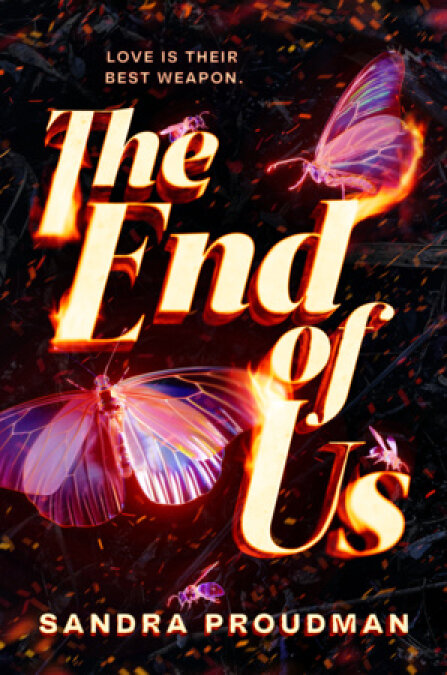
A couple fights their way back to each other in a post-apocalyptic world after one gives their spot in California’s last known haven to the other, in this captivating dystopian romance about sacrifice, survival, and unshakeable love.
For year, Jules and Rico have only had each other—through the burning heat, hunger, and sleepless nights together in the Wasteland. Their only hope of escape? Winning the lottery into the Oasis, the last safe haven in California.
Though the odds are against them, Rico’s number is selected. Selflessly, he gives his spot to Jules. He’d be locked up for his role in a failed rebellion if he went, anyway. But even in a fancy city built for the elite, Jules can’t stop thinking about Rico—or how to save everyone she left behind.
Then Rico learns that the lottery was rigged. The rebels have a new plan—with Rico at its center. If he refuses to help, Jules won’t survive paradise.
Now their relationship is being tested in more ways than one. The harder they fight for the life they’ve always dreamed of, the more they wonder: Is there a future for the two of them . . . or is this the end of everything?
Release date:
October 13, 2026
Publisher:
Joy Revolution
Print pages:
368
* BingeBooks earns revenue from qualifying purchases as an Amazon Associate as well as from other retail partners.
I hate lottery days in the fall, when cooler times remain out of reach and random heat waves make even the night miserable.
It’s nearing sunrise in the burnt and ravaged part of San Francisco that was once downtown. The temperature in the Scar—this canyon of scorched buildings—is already rising, and it’ll be hot as hellfire in a few hours when daylight breaks. Rico sings to himself like we have no problems whatsoever. My lungs, meanwhile, squeeze with every breath, the thin air painful despite our mostly full oxygen tanks and protective suits. The air is the least of our concerns today, though. Even after hours, we haven’t scavenged anything worthwhile. The area’s been picked clean, but Rico wants to salvage the night, so here we are still at work.
I turn back to the car in front of me. I use a pipe to break the last of the glass in the window. The noise ricochets in the emptiness of the Scar. I clean the jagged shards away from the edges, then reach inside and unlock the door. It’s a miracle we found a vehicle that hasn’t been searched.
Then again, there’re skeletons in the front seats, arms wrapped around each other, that weren’t visible through the tinted windows. I’ve seen dead bodies before, especially in this area where the annual fires trapped so many, but my heartbeat quickens as a too-familiar emotion roars within. This type of mental ache transcends death and is ruefully shared by those who witness it. Even scavengers like me.
Will Rico and I end up like this one day? In love, but ultimately unable to protect each other from the world around us. I should search their pockets and the car, but I can’t bring myself to tear them apart. I understand why no one has moved them. It’s a sign we haven’t all fully lost our humanity yet. I close the door. Squeeze my eyes and tell myself not to cry. Doing so in my protective suit always fogs the visor of my helmet.
I turn to Rico and try not to think about how much I need him. In a time of hurt, he’s my comfort.
Static bursts to life in the ear of my helmet from the small radios that Rico linked in our suits. It’s how we communicate while we scavenge. “¡Jules, ven aqui! Come and look at this. Finally found something good,” Rico calls from where he digs underneath a half-charred car a block away.
I approach him and pretend I’m not out of breath from the short walk over.
He stands. Between his forefinger and thumb, he holds up a diamond ring. It shimmers against the light of my headlamp.
I smile and press the button on the side of my visor to turn on my own radio. “That can’t be real.”
He lowers to one knee. His protective suit stretches and rubs against debris on the ground. I make a mental note that I’ll need to replace the fabric soon. He grins through his helmet, the way only he can because life sucks. I recognize the gesture. I’ve seen it before in fifty-year-old magazines right before I traded them.
“Juliana, will you marry me?” he asks.
I smack his arm and tell him, “Knock it off.” His expression softens into a thoughtful gaze. He’s serious. He wants me to marry him. We’re literally in a hellhole and that’s where his head’s at?
I should say yes. What is there to lose? What is there to wait for? Instead, I shake my head and laugh it off. “Don’t you think we have more important things to worry about?”
“I know. I’m joking, anyway.” It’s not true. His smile fades as he stands, and I regret letting the moment pass as soon as it’s gone. But we still have time. If we’re lucky, and if we do good work for the Sheriff, we’ll have a whole lifetime together ahead of us.
I ask, “What do you think the Sheriff’s Station will give us for the ring?”
He winks, and the twinkle returns to his eyes. “Let’s go find out.”
We pocket what little we have, eager to beat the sunrise to the Wharf, where the Sheriff’s Station is located in an underground bunker. We’ve been scavengers for the Sheriff for a few months now. Working the Scar for the man who oversees San Francisco is the best way to get a survivable amount of food and correctly processed desalinated water rations—without having to steal or murder for them. That’s not to say the job is without its dangers. It may kill you if your protective suit rips and you suffer ash inhalation, or you can get attacked by someone trying to rob you. Out here, even the natural world is dangerous. We’re mindful of the ravens that’ll eat you while you’re still alive. And the killer bees that’ve evolved to not die after they’ve stung you with venom that’ll leave you numb for days. Many scavengers come back empty-handed or simply disappear. It’s worth the risk. To us, anyway. Because it’s allowed us to believe that we can make it.
Working the Scar is also the best way to earn extra tickets for the lottery to get into the Oasis, a lavish mountainous haven protected by an impenetrable dome that people would kill to live in if they could. As the leader of our isolation city, appointed by the last President Burberry, the Sheriff helps run the lottery in San Francisco, while two other sheriffs run those in San Jose and Sacramento. Between our three cities, we make up 90 percent of survivors in California. But only those who win a spot in the Oasis truly live. Maybe Rico and I will both be chosen one day. I try my best to buy into it, but every time we don’t get picked, it’s like a match has been lit to our paper dreams.
Still, Rico gets lost in the reverie.
We jog, which I hate almost as much as lottery days. It’s the only way to get anywhere quickly without a vehicle, though. As we go, others emerge from the several thousand connected underground bunkers below the high-rises that once dominated the sky. We’re like ants coming out of a colony, using the cool earth to hide from the scorching heat of the day and any possible fires topside. The bunkers are discolored, unkempt, and dirty, overcrowded with families and also kids who’ll grow up without families, like we did—but livable unless the air-conditioning stops. Fortunately, ours is close to the Sheriff’s Station.
To our knowledge, the Oasis is the only place in what was the United States where people still live aboveground. Not that anyone truly knows what exists beyond the Oasis. Radios are localized. There are no supplies left to create ships or planes. And even when there were, people left and never returned.
People theorize that outside California’s four isolation cities—the Oasis, San Francisco, San Jose, and Sacramento—Sibervirus never stopped spreading. By the time widespread communications were disrupted, 40 percent of the population had already succumbed to the severe flu-like illness that came from deep drilling in the Arctic. But there have to be others like us. I’m sure of it. And one day, we’ll find them. Or they’ll find us. And maybe life will be better.
For now, the surface is unrecognizable from what it used to be when my mami was my age. After over a decade without maintenance, the buildings around us show their signs of wear—sun-spotted walls that are falling apart, shattered windows, and graffiti galore. What were malls, bookstores, and schools have long ago been foraged and repurposed—turned into underground homes.
The crowd at the Wharf seems to be winding down when we arrive, as most people are headed to Union Square, where there will be free fresh food and water at today’s lottery. Mami told me the area used to be called Fisherman’s Wharf back in the Old Epoch. A fun area families went to shop and to enjoy the ocean, where people made lasting memories. Now the territory is all part of the Sheriff’s Station. In it, his deputies govern the fifteen thousand people who live in San Francisco. Whatever we find in the Scar, we bring to the station. And in return, we get food, shelter, and extra lottery tickets. With all the competition, we have to watch our backs.
Not that I’m a fighter. I have Rico for that, who is strong and has a reputation for being as fast as a cat. No one’s ever been able to hit him. In our darkest days, we used to count on it during the street fights Rico competed in to feed us. He’s as vigilant as ever. As we weave our way to the Sheriff’s Station, Rico shoves a few suspicious people out of the way.
We pass other scavengers as we head underground. Out in the Scar, we see them but can hardly ever recognize anyone with our suits on. With our helmets off, everyone we walk by has this same worn expression. Their eyes twitch or are bloodshot, noses gnarled, giving the impression of as if in a perpetual rage. Others have scratches or burn scars. We live among those already gone.
We enter the overcrowded man-made grotto, where people have congregated into the two-hundred-foot rectangle. The bunker walls were created with a gray cement that makes everything extra dark. The lights in the Sheriff’s Station bunker are interspersed along the ceiling. The dusky smell gets worse the farther we go into the crowd.
We head right, to the three ticket booths meant to process small items, which the Sheriff’s deputies run. They’ve been set up against the far wall, shielded by impenetrable plexiglass.
We choose the shortest line and wait our turn as other people who work for the Sheriff try to make a stop for extra lottery tickets. I don’t recognize the deputy at our ticket window. He’s too tall and big, made more intimidating by his sharp and serious glower. Even his top-grade navy-blue protective suit can’t hide how his nostrils flare at every interaction. He’s a killer; all of the Sheriff’s deputies are. My hands sweat from the nervousness. If the station worker is having a bad day, we have one, too. And bad days are unpredictable.
When our turn comes, Rico and I walk up to the booth together. At the window, we get our retinas scanned by a machine. When it’s confirmed that we’re in good standing with the Sheriff and our IDs have been verified, the deputy signals to the slot where we can pass through any pocket-sized items. Rico glances both ways before he puts the ring and the few other items we found through the small slot in the ticket counter. Sometimes people will step in and rob you before you can set your items down, and whoever sets them down owns the payment, so you have to act fast. The deputy scrapes everything else aside and picks up the ring. He examines it closely in a machine by his side, which gives a positive beep, and without a single word to us sends through one lottery ticket.
We hope you are enjoying the book so far. To continue reading...

 Please log in to recommend or discuss...
