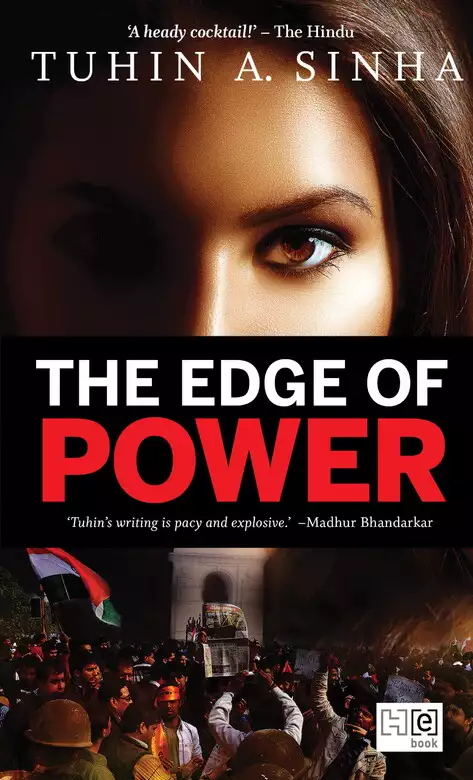
The heinous gang-rape of Nirbhaya has jolted the Indian nation out of its apathy but rape and violence against women are only symptomatic of a deeper malaise that ails the nation: the total collapse of governance under the weak and vacillating PM, Devender Singh. Ironically, aiding the PM and his Indian Democratic Party(IDP)s cling to power is a casual and largely indifferent Opposition led by the venal Ravi Nehra. A ray of hope finally emerges when ex-journalist and RTI activist Daivik Verma and the gorgeous Catherine Khan, a leading Bollywood film-star with a mysterious lineage, decide to challenge the existing system by floating a new political party but lack of funds and cadre-support thwarts their efforts: their only recourse being Shruti Ranjan, who had sworn off politics three years ago. Will Nirbhayas gruesome rape and her subsequent death bring a disillusioned Shruti Ranjan back into the political fray, dominated by crime lords and bankrolled by industrial barons? Will the trio manage to stage a coup and dethrone Indias worst regime? Will the land of great leaders like Chandragupta Maurya, Ashoka and Akbar, finally get a dynamic Prime Minister she so badly needs? A racy political thriller, The Edge of Power is a powerful enquiry into the underbelly of Indian politics. It raises important questions over the funding of Indian political parties, while presenting Shruti Ranjan, the immensely popular protagonist of The Edge of Desire, in a refreshingly new, resurgent avatar. Key Features: Another book from the bestselling author of The Edge of Desire Written in his usual pacy style, it looks at current issues including the Nirbhaya rape case Places an inquiry into the issue of womens safety in India Also looks scathingly at the current political scenario fictionalizing many of the current players in Indian politics
Release date:
December 15, 2013
Publisher:
Hachette India
Print pages:
312
* BingeBooks earns revenue from qualifying purchases as an Amazon Associate as well as from other retail partners.
First published in 2013 by Hachette India (Registered name: Hachette Book Publishing India Pvt. Ltd) An Hachette UK company www.hachetteindia.com
This ebook published in 2013
Copyright 2013 Tuhin Sinha
Tuhin Sinha asserts the moral right to be identified as the author of this work
All rights reserved. No part of the publication may be copied, reproduced, downloaded, stored in a retrieval system, or transmitted in any form or by any
means without the prior written permission of the publisher, nor be otherwise circulated in any form of binding or cover or digital format other than that
in which it is published and without a similar condition being imposed on the subsequent purchaser.
This is a work of fiction. Any resemblance to real persons, living or dead, or actual events or locales, is purely co-incidental
Print edition ISBN 978-93-5009-704-5
Ebook edition ISBN 978-93-5009-708-3
Hachette Book Publishing India Pvt. Ltd 4th & 5th Floors, Corporate Centre Plot No. 94, Sector 44, Gurgaon 122003, India
Originally typeset in Adobe Garamond 11/13.5 by Saanavi Graphics, Noida
This book is dedicated to an imagined future Prime Minister of India, who might be able to pull the country out of the mess she finds herself in right now
Prologue
On an unsuspecting winter night in December 2012, India was shamed yet again
A t 9:30 p.m., after watching a movie in a popular mall in New Delhi, a
feisty twenty-three-year-old girl and her male companion boarded a bus bound for Dwarka in west Delhi. The bus had only five other people in it, so they
climbed in without a thought, happy to get seats, and began an animated discussion on the movie they had just watched.
All was well until the friend
suddenly noticed that the bus had swerved off its regular route, into a narrow by lane. One of the men inside a boy of seventeen or eighteen
deliberately bolted the door. When the friend objected, the men abused him. He was subsequently gagged and beaten to within an inch of his life with an iron
rod.
The men then dragged the girl, kicking and screaming, to the rear of the bus. They beat her with the rod, and gang raped her repeatedly while the bus
driver continued to drive. The rod was shoved into the girls insides at one point. The most savage of the men was also the youngest among them. When each
of the men had finished with her, the girl and her friend were tossed out onto the road, with the driver even trying to run them over by reversing his bus
into them. Her friend managed to pull her away in the nick of time.
When the details of this horrific incident began to emerge over the next few days, the
country was reminded of another ghastly gang rape that had taken place nearly fifteen years ago, a few hundred kilometres east of Delhi in a remote village
in the Kishanganj district of Bihar. The victim back then had been Shruti Ranjan, wife of the Deputy Commissioner of Kishanganj, who had been brutally gang
raped and left for dead by politically-sheltered local goons. This incident had altered the course of Shrutis life in unimaginable ways. Along with her
mentor, the late nationalist leader Sharad Malviya, she had gone on to rewrite the politics of the land.
The rape assault on Nirbhaya, however, was a stark
and shameful reminder for the country that nothing absolutely nothing had changed in India insofar as crimes against women were concerned.
As Nirbhaya
battled for life in the Intensive Care Unit of Delhis Safdarjung Hospital, the worthies in Lutyens Delhi were as unconcerned as always. Indias aging
prime minister, Devender Singh; the forty-eight-year-old president of the ruling Indian Democratic Party(IDP) Mukta Prajapati; and the thirty-eight-year-old
president of Indias leading Opposition party, the Jan-Hit party, Ravi Nehra, all issued press statements professing their concern and dismay, but remained
largely indifferent. They were all engrossed in maintaining the status-quo that ensured them their seats, filled their pockets and fueled their avarice and
greed.
Chapter 1
It was 10:30 a.m. on Friday five days after the gang rape in the capital city of India that had outraged the nation and shocked the world. Ravi Nehra,
leader of the Opposition Jan-Hit party sat in the conference hall of his party office on Humanyun Road with fifteen party-members who constituted the
Oppositions Parliamentary Committee. Since it was the last day of the winter session of Parliament he had assembled his party to take stock of their floor
strategy for the day. The events of the hour were not particularly pressing to him.
Seated to Ravis right were his two most trusted aides: the bearded, forty-five-year-old MP from Hajipur, Ankur Yadav who had started his career as a
building contractor until his skills at fixing deals had won him Nehras trust; and the fifty-seven-year-old sugar baron Raghunandan Gupta, once accused of
illegally stashing a large sum of undisclosed earnings in the Bahamas.
Even as the group mulled their options, they were distracted by a scene that was unfolding a couple of kilometres away at India Gate, and playing out on the
large-screen LED TV of the conference room.
The majestic lawns around India Gate were overrun by a protest march of huge proportions as thousands of angry people, women of all ages among them, rallied
against the Governments inability to curb crimes against women. The rape victim, Nirbhaya, was struggling for her life in hospital. The only words she had
whispered to her mother, as she swam in and out of consciousness had been, Ma, I dont want to die.
As hordes of incensed college girls protested Indian
chauvinism and political apathy, a scuffle broke out at one end of the venue and the cameramen quickly trained their cameras on this bit of breaking news.
The police instantly retaliated by resorting to a lathi-charge and tear-gas, bearing down on the young girls with characteristic insensitivity. The angry
young girls, sick of the patriarchal boorishness of the Indian system, were in no mood to be cowed down; they actively clashed with the men in uniform.
Leading a large group of these protestors was a tall, thin man who was just a few days away from launching his own political organization: the Azad Bharat
Party. A journalist turned activist who represented the common man, Daivik had greatly stirred up the political scenario in the country with his fiery,
proactive stance on issues that the two leading political parties were perceived as being characteristically compromising on.
Daivik appealed for peace but his pleas were lost in the pouring of outrage. Finally, he took the mike and began to speak. As Daivik began his passionate
speech a hush fell on the crowd. Incensed with the policemens insensitivity in attacking the protestors he lamented: Despite all of the Indian Democratic
Party (IDP) Governments failures, if there was one thing that had not yet taken place, it was a Jallianwala Bagh kind of massacreToday, seeing the way the
police are gearing up for a massive clash, I fear that even that unsavoury chapter from history might repeat itself here
Hearing Daiviks voice, Ravi
Nehra looked at the TV screen in distaste. This stupid bugger was becoming a thorn in his side: Bastard! He has a penchant for exaggeration, laughed Ravi
Nehra mockingly, as he muted the TV and turned away from the giant-sized plasma set to face his party colleagues.
Ratna Pandey said: I think we should forget the issue of Foreign Direct Investment for the time being. Anyway, the common man wont connect with the issue
until it has been implemented and he suffers.
Nehra stared impassively at her face, refusing to comment.
Ratna continued: In fact, watching these protests, I feel womens safety can become a crucial election issue we must raise it to such a level that the
protesting public sides with us. It is such an emotive issue that if leveraged well, it will earn us rich dividends.
Nehra responded to this highly respected female MP with a supercilious sneer: Come on, Ratnaji, you know that these protests die out as quickly as they
begin. Our public is fickle-minded. One day they protest with the same intensity against corruption, the next day its against terrorism and now its about
womens safety. Have all these protests made any difference to politics?
But dont we have a moral responsibility as the countrys leading Opposition party? she countered, ignoring Ankur Yadavs frown, which was meant to
dissuade her from questioning the supreme command.
What are you talking, Ratnaji? We have two MPs and at least seven MLAs and MLCs facing charges of sexual misconduct. The ruling party has even more.
Besides, when you go lower down the order, at the district and shakha levels, you will find many party activists facing charges of sexual offences too. Rape
and sexual offences are all about power, Madam. It is common knowledge that many a times women consensually give in to powerful men to obtain favoursand
when they arent returned the favours they expect, they cry rape.
Ravi Nehras crass assertion left everybody in the room in queasy silence. His chauvinism was quite unbearable.
A silenced Ratna couldnt help but recall the radical speech that Nehra had given at the national executive of the womens cell of the party just two months
ago. The irony of it was appalling. Women ought to think and believe that they are not just equal but a step ahead of men. Our party is starting a
toll-free national helpline number which any woman who is facing sexual harassment at work or elsewhere can call at any time of the day. Apart from
counselling, this helpdesk will even help in initiating legal action against the guilty,
he had announced.
Nehras speech had drawn thunderous applause even as he had concealed the lascivious glint in his eye as he had looked at Aparna Kamath the voluptuous,
thirty-something president of the womens cell. Aparna, a social-worker in Pune, had been a peripheral member of the party until Nehra had appointed her to
the top-post. Of course, all sorts of steamy stories and speculation had blotted the unexpected appointment, with the commonest one suggesting that it was a
one-night stand at a party workshop for farmers in Wai that had paved the way for her meteoric rise. There were many stories of Nehras womanizing floating
around. At one point, early on in his career, a woman had even accused him of rape. But Nehra had used his guile to have the case dismissed. It was the same
guile that he had used to worm his way to the top and usurp the leadership of the party, outsmarting more deserving seniors. Ratna Pandey rued her isolation
within the party as did many others like the old warhorse, Ratnesh Prasad.
Ratneshji, what is your opinion? What should our key focus be today? Nehra turned his attention to the man in Ratnas thoughts.
Nehraji, what about the coal scam? We havent raised that issue since the last session, when we had completely cornered the Government on it Though
Ratnesh answered, he knew his opinion held little importance.
Nehra barely heard Ratnesh out his focus shifting back to the TV set. And his handsome Jat features turned dark with anger and disbelief as he watched a
familiar figure join the protest at India Gate.
Rheas entry had made all the media attention shift to her. Her presence would make it all the more difficult for the police to get away with its
high-handedness. Because, after all, Rhea was still Ravi Nehras wife.
After five years of a stormy marriage and a tumultuous relationship, it was common knowledge that Ravi and Rhea were a mismatched couple. They remained
together mainly for the sake of their three-year-old son whom Nehra doted on or so he made it appear. They even went on a yearly foreign holiday together.
But beyond that, only a deafening silence marked their relationship. Rhea lived at their Gurgaon home, while Ravi stayed at his official residence in
Lutyens Delhi.
Nehra switched off the TV abruptly, disturbed by his wifes show of rebellion, which he had not got used to over the years. He was embarrassed to have seen
her like this with his party-members watching him. The deft strategist in him was still struggling to arrive at the right way in which to deal with his wife
now that her advantages had been fully extracted and she was more of a liability.
Rhea was the daughter of the late Sharad Malviya, who was still referred to in the media as the best PM India never had. A firm, decisive and dynamic
nationalist leader, Malviya had died in 2002, in a mysterious plane crash, just on the eve of a General Election that his party had been predicted to win.
Until a few years ago, Rhea, as Malviyas political heir, had commanded a following that had made her both alluring and invincible. And then she had thrown
it all away by falling in love. Or perhaps, as Shruti Ranjan had warned her, she had been trapped by Nehra in what had been the mother of all conspiracies.
Glancing at his watch, Nehra ended the meeting rather hastily: Its time for the session to beginlets take stock of things again tomorrow. The
abruptness with which he ended the meeting echoed the impulsiveness with which Nehra took most of his decisions. Very few people actually understood what
was going on in his mind but, yes, Nehra never did anything not even shake hands without calculating its potential advantages first. Under Nehra, his
Parliamentary Committee had got used to the futility of such supposedly important meetings.
But, Nehraji, what will our key focus in Parliament be today? a young MP tried seeking some clarity.
Nehra was casual. Fuel price hikeprotest against it
But that was done two weeks ago
Nehra paused, even as he tried not to lose his cool.
Sensing his leaders annoyance, Ankur jumped in with his suggestion: Arre bhai
, is there ever any shortage of issues? Achcha
do one thing, protest
against the peace process being initiated between India and Pakistan. Isnt that a powerful issue?
Yes! We must raise the issue of this meaningless peace process, Nehra ratified his stooges suggestion instantly, not allowing any room for a
counter-opinion. Ratneshji, you will initiate the discussion on the matter, okay? he added.
Ratnesh nodded weakly.
Nehra got up and left. He was six feet tall, with sharp features and a handsome handlebar moustache. His personality had quite an impact on the voters. As
they watched him leave, a quiet exchange of helpless expressions was the only means of protest that the party-members had. Ruing the grim state of affairs
that existed in the Jan-Hit party today, Ratna Pandey wondered if this was indeed the party that had once been led by Sharad Malviya. She actually missed
the very person whom she had distrusted the most when she had been around Shruti Ranjan.
It was expected that the Delhi gang rape and issues concerning womens safety would dominate the days proceedings in Parliament that day. Instead, the
issue was raised only briefly in passing by a Jan-Hit party MP, who was among the worst speakers in the house. All he said was, The Opposition demands to
know the steps that the Government is taking to ensure that such an incident doesnt get repeated in future.
Indeed, so ineffectual was the statement that
the Home Minister was only too happy to spell out a series of safety measures that everybody knew had been cooked up on the spur of the moment. Yet the
Opposition chose not to pursue the matter and digressed to another issue.
PM Devender Singh, IDP Chairperson Mukta Prajapati, and Ravi Nehra were present in Parliament when this query was put forth. While the PM sat mum as he
usually did making it difficult to guess for a first-time viewer whether he existed for real or was a wax statue Mukta Prajapati pretended to be
occupied studying a file, while Nehra was seen passing a note to Ankur Yadav, like a bored college student.
No wonder the people of the country had begun to feel increasingly despondent about its political leadership, particularly as a perception of some sort of
match-fixing between the Ruling and Opposition party had begun to gain ground.
How they all wished Shruti Ranjan had been around.
Chapter 2
At 9:30 p.m. that night Ravi Nehra was ready for his last appointment of the day. The visitor was ushered in through a discreet back entry, away from the
prying eyes of the media, his own staff and other visitors. In fact, whenever he entertained one of his special guests, all his personal staff except for
his most trusted Officer on Special Duty (OSD) Pathak remained unaware of the secret guests identity. With time and experience, they had learnt that the
visitor had to be one of the four: a top industrialist, a senior ruling party MP, a hawala dealer, or a whore. When rumour was that the guest was the
last-mentioned, his staff indulged in a guessing game about the guests age and ethnicity. Ravi was quite versatile in his tastes.
This time though, the guest in question was B.C. DSouza, Special Advisor to the IDP Chairperson, Mukta Prajapati. DSouza a stocky, bald man in his early
fifties was among the shrewdest power-brokers in Delhi. He arrived in Nehras sanctum-sanctorum carrying an expensive bottle of French wine. Madam has
sent it for you. From her husbands collection.
Rajveer Thakur, the spouse of the President of the ruling party, had his own spectacular rags-to-riches story. Nobody quite knew the exact nature of his
business but in the sixteen years that Mukta and he had been married, his assets had multiplied no less than 500 times. He was supposedly in real estate
development. Some speculated that he also owned a lottery company in the North-East. It was rumoured that without officially being a part of the IDP, his
money virtually ran the entire show. Despite ample evidence of gross financial impropriety on Rajveer Thakurs part, nobody even from the Opposition
went after his case for fear that the vengeful Mukta would have the crusader implicated under false charges by the unreliable and wholly Government-owned
National Bureau of Investigation (NBI).
Ravi uncorked the bottle with the ease of a connoisseur and asked Pathak to serve the wine. Judging from their mutual warmth, it was evident that this
wasnt the first such late-night rendezvous between the two.
Madam is very thankful to you, Ravijiwith your support, this Parliament session passed off pretty smoothly.
Holding his glass of wine in one hand, Ravi rummaged in his pocket for his bidis with the other. Then putting his feet up on his desk Ravi lit a bidi with
the panache of a pipe-smoker. The raw smoke emitted by it made DSouza cough.
Desi jatdesi bidi
hahaha, Ravi guffawed at his discomfort, then suddenly changed his tone: DSouza Saab, we had struck a deal to let this session be
peaceful, remember? I have fulfilled my part of the promise. Now you need to fulfil yours.
The deal was this: the Jan-Hit Government in Haryana had been reduced to a minority after four of its MLAs had been disqualified for electoral malpractices.
If the regional Haryana Janata Morcha (HJM), which had five MLAs and was part of the IDP-led coalition at the Centre, could be pressured into supporting the
Jan-Hit Government in the state, then the State Government would easily survive. DSouza was supposed to play backroom mediator and get the HJM to support
the Jan-Hit party.
DSouza knew Ravi drove a hard bargain. We know, but you also know, Nehraji, that the HJM can be a tough nut to crack
I dont careJust one more year in power in Haryana will help us finance our next Lok Sabha campaignIts no longer safe to rely so heavily upon hawala
money. Already three of our MPs are under the scanner thanks to that honest swine whom youve made the Finance Minister.
Oh, Nehraji, you know all our other ministries are corrupthaving one honest Finance Ministry covers up for those, DSouza confessed brazenly. He also
knew that if the IDP did not fulfil its share of the promise then the next session of Parliament would be a wash-out. He thus left promising that the IDP
would do all it could to help a Jan-Hit-led government be formed in Haryana.
This deal was one of the many quid-pro-quo deals that Ravi had got into with the ruling party. He was convinced that in politics there was no victory, no
loss. Politics is pure business and barter is the best form of business, Nehra often told his cronies.
For all his failings, Nehra had some noble intentions as well; he was uncompromising when it came to protecting Indias territorial interests. He wanted
Government to increase the defence budget to 2% of the nations GDP. He wanted India to open up its economy further. For all the opposition that his party
had put up to the proposal for FDI in retail; in private conversations he held a different view.
Complex and multi-layered, Nehra typified the market-driven politician who had as many vices as he had virtues. In this age, when every perception tended to
be subjective, it had become difficult to dismiss him as outright corrupt. After all, Nehra had a comprehensive plan for the electrification of all Indian
villages. The Jan-Hit party State Government had sanctioned some very aggressive irrigation schemes. However, it was also a fact that most of the companies
to whom the irrigation projects were being outsourced were owned by people close to the party. These projects were outsourced at lavish, unrealistic budgets
and the beneficiaries in turn were supposed to be funding the party. So it was brazen quid pro quo at its very best.
But yes, in the end, villagers and villages were benefited, even if the cost incurred upon the economy was exorbitant.
Ravi Nehra had always been candid when he spoke of his politics to his close aides:
Barter is the essence of living. And our politics simply cant wish it away. Come to think of it, with the cluster of regional parties that we have today,
you think either of the two national parties can ever come to power on their own? Doesnt it make sense, then, to evolve a system of happy co-existence? In
fact, I am open to the idea of ruling by rotation. Let one alliance rule for the first five years, while the next one rules for the next five. Trust me, the
country will be the gainer in this.
Nehra had so many facets and layers to him that, despite all his negatives, the positives in him often managed to camouflage the evil. And he continued not
just to stay afloat but also to rule Indias principal Opposition alliance. Even as Ravi Nehra got back to flipping news channels for one last time that
night,...
We hope you are enjoying the book so far. To continue reading...

 Please log in to recommend or discuss...
